A prominent U.S. economist has criticized the Trump administration for misapplying academic research to defend its controversial "reciprocal tariff" policy, revealing significant flaws in the government's trade calculations.
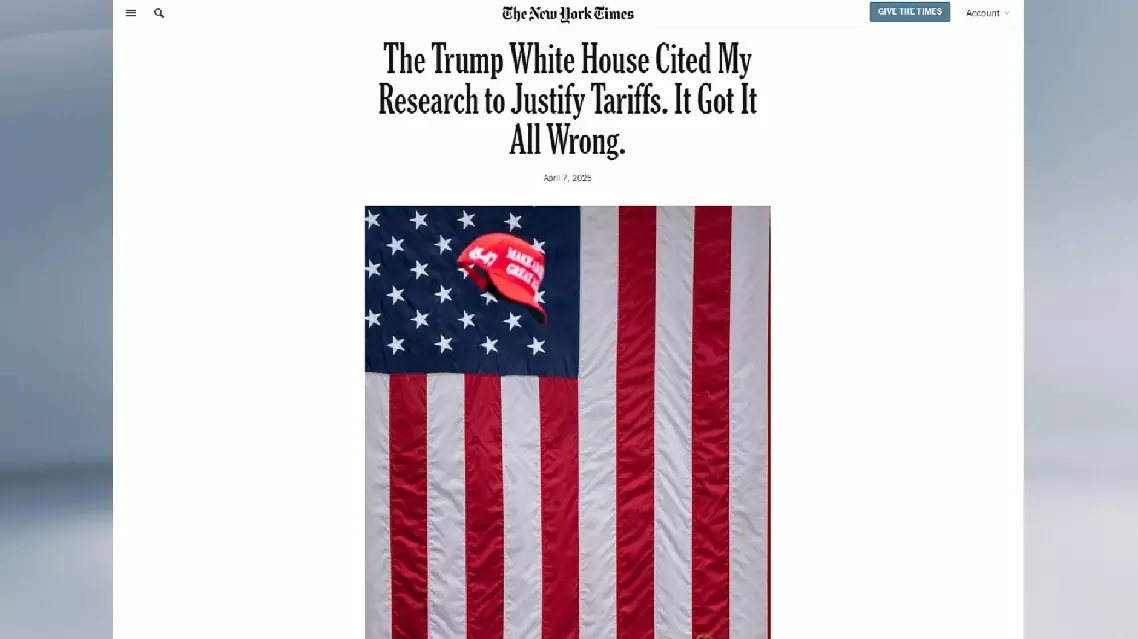
Brent Neiman, an economics professor at the University of Chicago's Booth School of Business and former U.S. Treasury official, disclosed in a New York Times opinion piece that the Office of the U.S. Trade Representative (USTR) had misused his research to justify its reciprocal tariff methodology.
The USTR published its methodology, referencing an academic paper co-authored by four economists, including Neiman, to back its figures. However, Neiman described the calculation as "very wrong" in his article.
Even when taken at face value, Neiman and his team's findings suggest that the tariffs should be dramatically smaller, perhaps only a quarter as large. He also voiced strong opposition to the government's trade policy and its overall strategy.
In the essay titled "Tariff Pass-Through at the Border and at the Store: Evidence from US Trade Policy", which is cited on the government’s webpage about reciprocal tariff calculations, the researchers originally concluded that around 95 percent of tariff costs are passed through to import prices. This means the cost of U.S. imports would increase nearly as much as the tariff rate itself.
The USTR, however, asserted that tariffs have a "low pass-through to retail prices", a different conclusion from the very paper they cited and one that Neiman called inexplicable and unsupported by his work.
As a co-author of the referenced essay, Neiman highlights that the Trump administration applied a 25 percent rate in its formula, diverging from the original findings.
"Where does 25 percent come from? Is it related to our work? I don’t know." said the economist in his New York Times article.
Neiman criticized the administration's impractical aim of eradicating all trade deficits through tariffs, emphasizing that bilateral imbalances are typically driven by macroeconomic factors rather than unfair trade practices.
He argued that Trump's ambition to eliminate all trade deficits, regardless of the potential harm, would ultimately fail to achieve its objective. The reason being that "the administration's tariff formula assumes that a tariff placed on one country won't affect imports from any others and ignores any implications for exports," Nieman wrote.
The economist cautioned that this fragile hypothesis overlooks real-world complexities, heightening the risk of inflation due to a stronger dollar and retaliatory actions from other countries, factors that would likely suppress U.S. exports.
Ultimately, Neiman concluded his article by stating that he "would strongly prefer that the policy and methodology be scrapped entirely."
U.S. economist slams Trump administration for misusing research in tariff policy