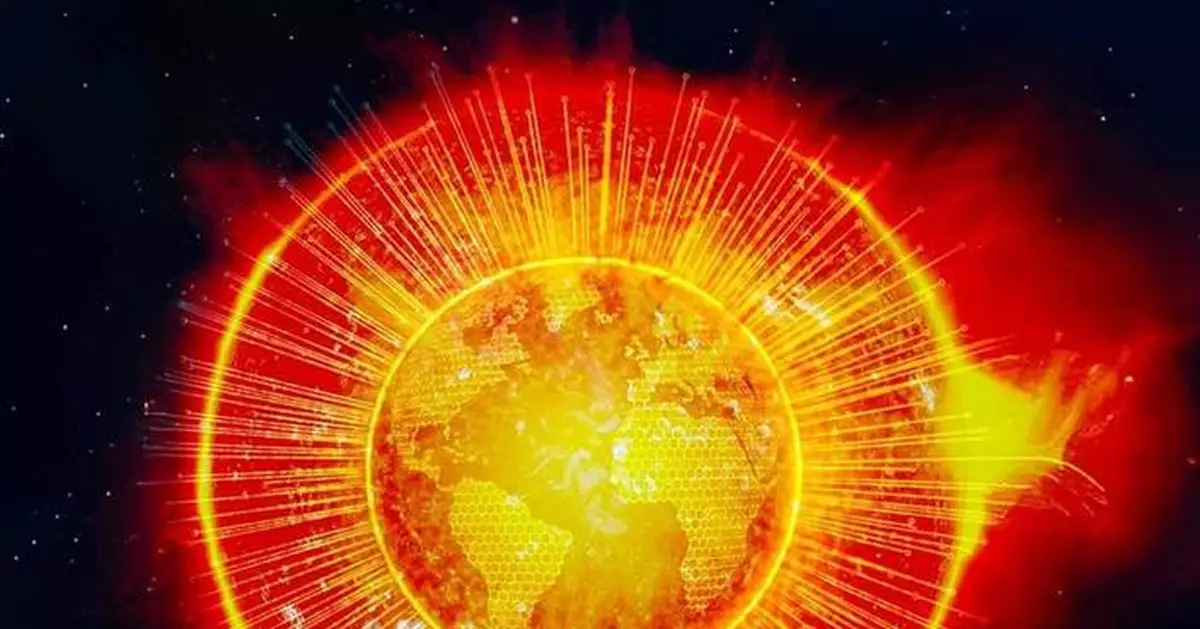
GRAND RAPIDS, Mich.--(BUSINESS WIRE)--Apr 9, 2025--
Todd Thomas, bestselling author and founder of climate-tech startup Woodchuck.ai, has once again captured national attention with the debut of his latest book, Unleashing an Abundant Energy Revolution, which launched at #1 on Amazon. Like his first bestseller, Unleashing Abundant Energy, this second installment continues to ignite critical conversations about how breakthrough technologies can address climate change while meeting our ever-growing global demand for energy. Unleashing an Abundant Energy Revolution and its predecessor, Unleashing Abundant Energy, currently hold the #1 and #2 spots on Amazon’s Best Seller list, a rare achievement for any author, particularly in the climate and energy innovation space.
This press release features multimedia. View the full release here: https://www.businesswire.com/news/home/20250409183699/en/
As the second volume in a visionary trilogy, Unleashing an Abundant Energy Revolution arrives at a pivotal moment. The world is experiencing an unprecedented surge in energy demand—fueled by electrification, AI, data centers, crypto, urbanization, and industrial growth—just as we face the urgent need to decarbonize. Thomas’s work meets this challenge head-on, offering a bold blueprint for accelerating innovation across clean power generation, energy efficiency, and sustainable infrastructure.
“This book isn’t just about energy—it’s about systems thinking, curiosity, and the power of human ingenuity to solve the biggest problems of our time,” says Thomas. “If we can consume energy more efficiently, then we can slow the growth in energy demand—and with it, reduce the impact of energy production on the earth’s current warming cycle.”
Spanning topics from fusion and geothermal to AI-powered waste recovery and high-efficiency building materials, Thomas draws connections between technology, scale, and implementation—demonstrating that the key to a livable planet lies not just in generating more energy, but in generating it smarter.
“Fusion won't replace the grid tomorrow, but it's no longer a fantasy. It’s a frontier—one we are rapidly approaching. Green ammonia, thorium molten salt reactors, and hybrid offshore energy converters are no longer fringe ideas—they’re the tools we need to redefine what's possible,” adds Thomas.
The trilogy, dubbed the Unleashing Abundant Energyseries, is designed to build in depth and urgency:
“The global energy system is at a tipping point,” Thomas said. “We don’t just need cleaner power—we need abundant, affordable, resilient systems that meet the growing needs of humanity while protecting the planet. That means embracing innovation like never before.”
Early praise for the book has poured in from leaders across finance, energy, and philanthropy:
“Todd Thomas presents a visionary yet grounded blueprint for the future of energy—one that investors, policymakers, and innovators can’t afford to ignore.” — Dr. Nishant Dass, Claremont McKenna College
“A compelling guide for investors and operators alike.” — Brian Hartmann, President, NorthStar Clean Energy
“Not just a book—it’s a call to action.” — Tammy McLeod, President & CEO, Flinn Foundation
Unleashing an Abundant Energy Revolution underscores the urgency—and the opportunity—of transforming our energy systems now. It's not only a call to dream bigger but to act faster.
About the Author
Todd Thomas is a recognized thought leader in innovation, AI, and sustainability. He is the CEO of Woodchuck.ai, a Grand Rapids–based startup turning industrial wood waste into clean biomass fuel. With an academic background in economics, business, and strategic innovation, Thomas has made it his mission to turn waste into value and unleash a new era of energy abundance.
For interviews, speaking engagements, or review copies, please contact:
angela@redroofindustries.com
Published by TC Bradley, New Life Publishing
© 2025 Unleashing Abundant Energy™
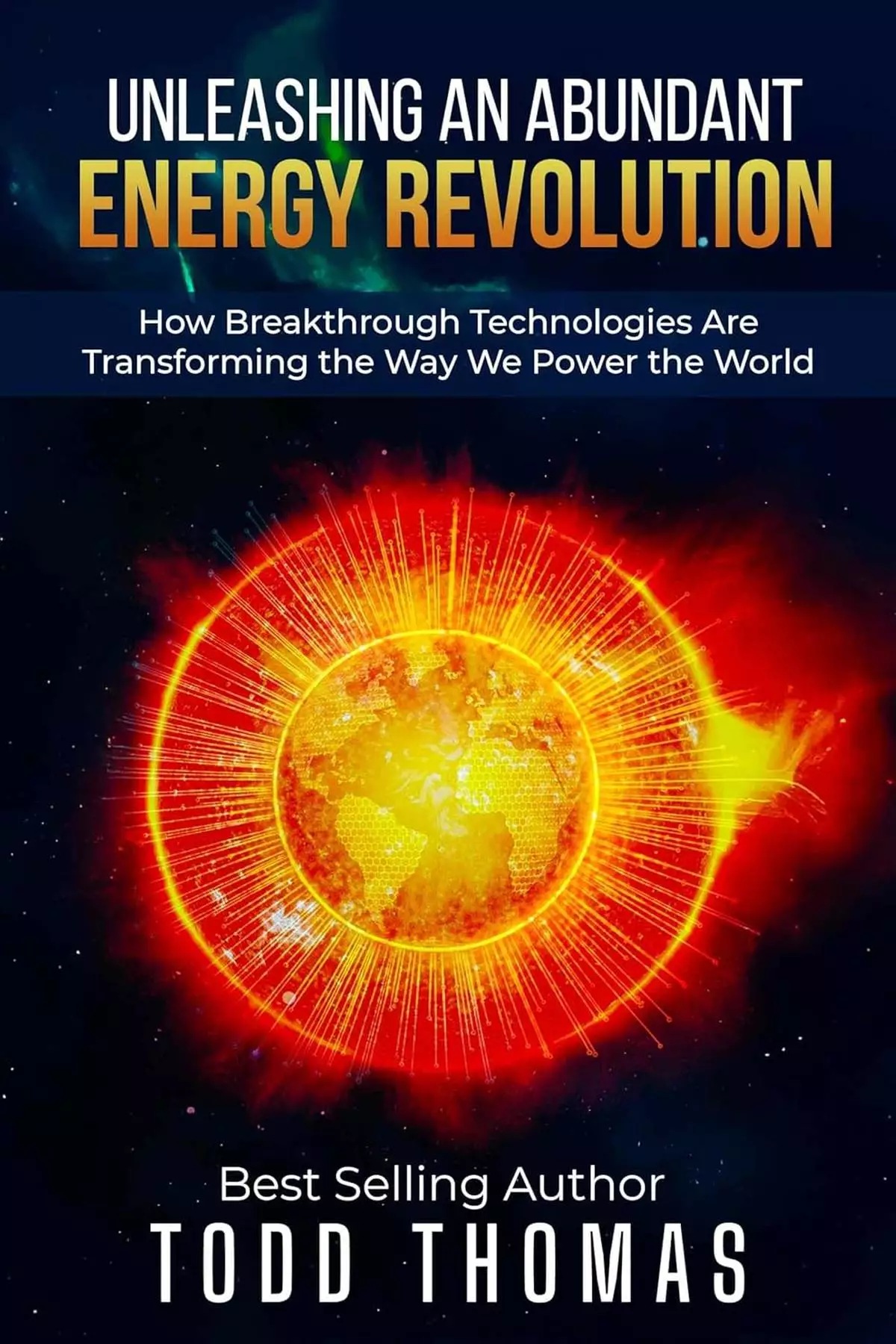
Todd Thomas, bestselling author and founder of climate-tech startup Woodchuck.ai, has once again captured national attention with the debut of his latest book, Unleashing an Abundant Energy Revolution, which launched at #1 on Amazon. Like his first bestseller, Unleashing Abundant Energy, this second installment continues to ignite critical conversations about how breakthrough technologies can address climate change while meeting our ever-growing global demand for energy. Unleashing an Abundant Energy Revolution and its predecessor, Unleashing Abundant Energy, currently hold the #1 and #2 spots on Amazon’s Best Seller list, a rare achievement for any author, particularly in the climate and energy innovation space.
OKLAHOMA CITY (AP) — Shai Gilgeous-Alexander isn't scoring the way he usually does, but the Oklahoma City Thunder are still winning the way they normally do.
Gilgeous-Alexander, the reigning NBA MVP, averaged 31.1 points during the regular season. In the Western Conference semifinals against the Los Angeles Lakers, he is averaging 20 points and taking only 14 shots per game.
Oklahoma City has still won the first two games by an average of 18 points. Gilgeous-Alexander and Chet Holmgren each scored 22 points, and the defending champion Thunder beat the Lakers 125-107 on Thursday night.
Ajay Mitchell, starting in place of injured Jalen Williams, is averaging 19 points on 50% shooting in the series for Oklahoma City.
“I think the coaching staff does a good job at just getting all of us ready,” said Mitchell, a second-year guard. "And we have a lot of competitors. Like, everyone’s a competitor on our team. So every time the lights are bright, everyone’s ready to go.”
Holmgren is the leading scorer for the Thunder in the best-of-seven series with 23 points per game. The 2026 All-Star also is averaging 10.5 rebounds and 2.5 blocks.
Jared McCain, a midseason acquisition from the Philadelphia 76ers, barely played in the first round against Phoenix but has averaged 15 points and made 8 of 10 3-pointers in the series.
“He goes in there, stays in character, stays aggressive," Thunder coach Mark Daigneault said. "He’s going to shoot the next shot. He makes the right plays, plays inside the team. He competes defensively, has had good defensive possessions for us. And he was huge tonight. You need that in a playoff series.”
The Lakers again were without scoring champion Luka Doncic, who is out indefinitely with a strained left hamstring. They also were missing forward Jarred Vanderbilt, the reserve forward who dislocated the pinkie on his right hand during the second quarter of Game 1. The Lakers had three players finish with five fouls, limiting their aggressiveness late in the game.
Los Angeles guard Austin Reaves, who struggled with his shot in Game 1, scored 31 points on 10-for-16 shooting in Game 2. LeBron James, coming off a 27-point effort in Game 1, followed that up with 23.
With the Lakers up 63-61 early in the third quarter, Gilgeous-Alexander got tied up with Reaves and was called for his fourth foul. Upon review, it was upgraded to a flagrant 1 for Gilgeous-Alexander's follow through. Oklahoma City's Alex Caruso was called for a technical foul as the situation was being sorted out.
Gilgeous-Alexander left the game with the Lakers up 65-61, but the Thunder rallied and took control without him. On a fast break, Holmgren found a trailing Jaylin Williams, who hit a 3-pointer and was fouled. His free throw put the Thunder up 85-74.
The Thunder outscored the Lakers 32-15 while Gilgeous-Alexander was out in the third quarter to take a 93-80 lead into the fourth.
“It was amazing," Gilgeous-Alexander said. “They strung together stops, they’re playing the right way offensively and things are going their way. Full confidence in those guys. They know how to win basketball games. And we've proven that. They’ve proven that no matter who’s on the floor, they know how to get the job done. And they just did it again tonight."
The Lakers cut Oklahoma City's lead to five in the fourth quarter before the Thunder pulled away again.
Los Angeles will host Game 3 on Saturday.
“We just stuck with it,” Holmgren said. “It’s the game of basketball. It’s not always going to go your way. It’s about how you respond. And this team has proven many times that we know how to respond. And we did so tonight.”
This story has been corrected to show that Shai Gilgeous-Alexander is averaging 20, not 19, points per game against the Lakers.
AP NBA: https://apnews.com/hub/NBA

Oklahoma City Thunder's Chet Holmgren (7) shoots over Los Angeles Lakers' Austin Reaves (15) in the second half of Game 2 in a second-round NBA basketball playoffs series Thursday, May 7, 2026, in Oklahoma City. (AP Photo/Nate Billings)

Oklahoma City Thunder guard Ajay Mitchell, front, works for a shot as Los Angeles Lakers' Austin Reaves, rear, defends in the second half of Game 2 in a second-round NBA basketball playoffs series Thursday, May 7, 2026, in Oklahoma City. (AP Photo/Nate Billings)
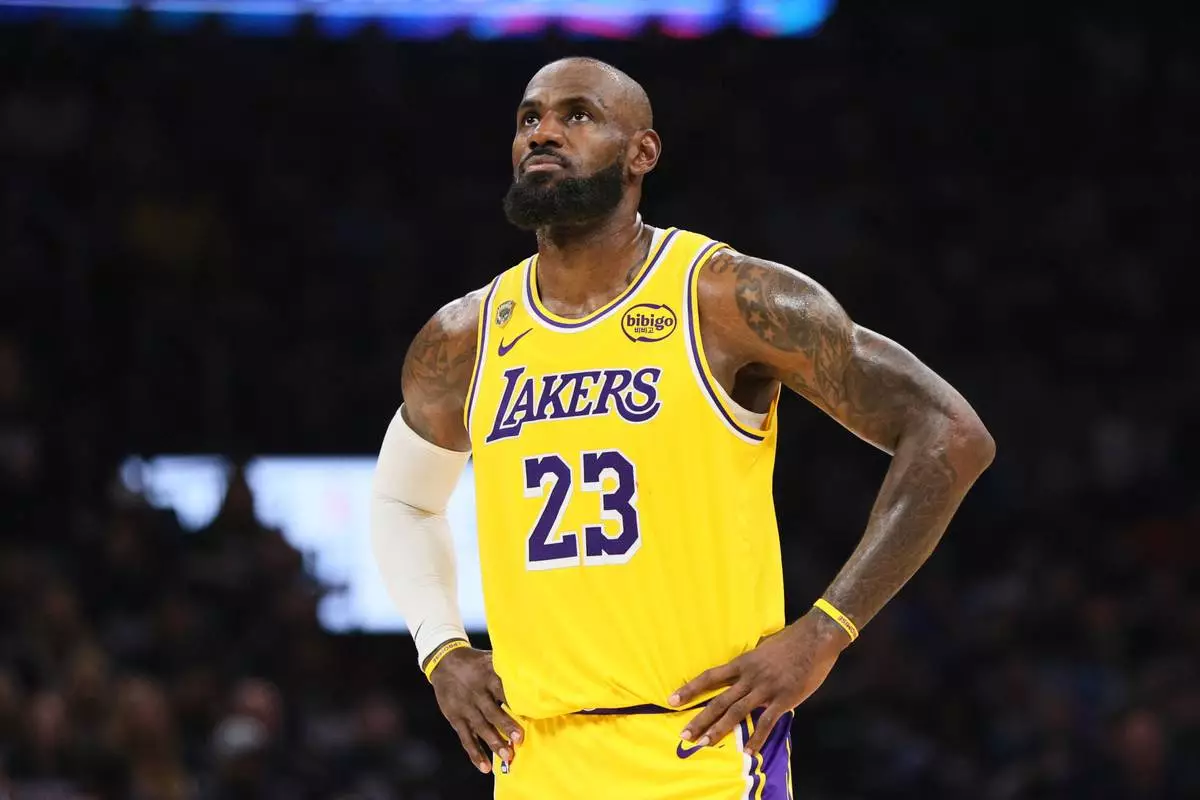
Los Angeles Lakers' LeBron James stands on the court in the second half of Game 2 in a second-round NBA basketball playoffs series against the Oklahoma City Thunder Thursday, May 7, 2026, in Oklahoma City. (AP Photo/Nate Billings)
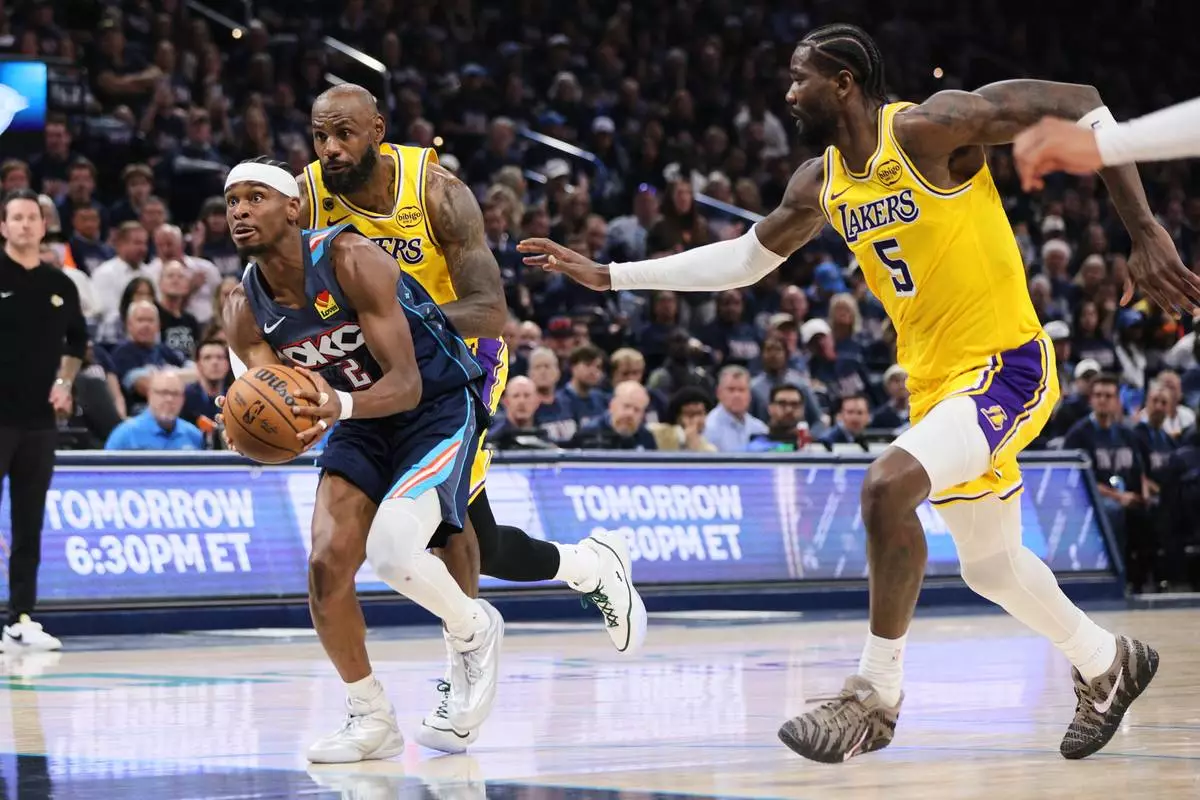
Oklahoma City Thunder guard Shai Gilgeous-Alexander (2) drives to the basket past Los Angeles Lakers' Deandre Ayton (5) and LeBron James, rear, in the second half of Game 2 in a second-round NBA basketball playoffs series Thursday, May 7, 2026, in Oklahoma City. (AP Photo/Nate Billings)

Oklahoma City Thunder center Chet Holmgren (7) works to the basket against Los Angeles Lakers forward Rui Hachimura (28) in the second half of Game 2 in a second-round NBA basketball playoffs series Thursday, May 7, 2026, in Oklahoma City. (AP Photo/Nate Billings)