Skip to Content Facebook Feature Image

Jon Hamm steals expensive stuff and likely viewers' hearts in Apple TV+'s 'Your Friends & Neighbors'

ENT

Jon Hamm steals expensive stuff and likely viewers' hearts in Apple TV+'s 'Your Friends & Neighbors'
ENT

ENT

Jon Hamm steals expensive stuff and likely viewers' hearts in Apple TV+'s 'Your Friends & Neighbors'

2025-04-09 21:32 Last Updated At:22:01

NEW YORK (AP) — “Your Friends & Neighbors” begins with a once high-flying hedge fund manager waking up in someone else’s luxurious house, next to a dead body and in a pool of blood.

How he ended up there consumes the first season of this compelling Apple TV+ series, which stars Jon Hamm and takes a peek at the lives of the ultrarich in a leafy New York suburb.

“I was interested in writing about the status symbols, about the way wealth informs community,” says creator, showrunner and producer Jonathan Tropper. “And then at the same time, what I really wanted to do is subvert it a little bit and talk about how impermanent it all is.”

Like “White Lotus” and “Big Little Lies” before it, “Your Friends & Neighbors” revolves around the woes of the wealthy and questions why we chase social status.

“Why is more always better?” asks Hamm. “Is the only metric really the accumulation of these larger and larger piles of stuff, whether it’s money or goods or houses or wives or what have you? We’re kind of arrived at this time where this story is particularly resonant.”

Hamm plays Princeton-educated hedge fund star Andrew Cooper, who finds himself divorced and unemployable. Drowning in debt, he turns to petty crime: Breaking into neighbors' homes to steal $350,000 watches, Hermès handbags and $32,000 bottles of chardonnay.

He rationalizes the thefts are just a quick fix until he figures out a way to get his money faucet back on. Plus, he'd never be a suspect. “I figured, ‘What’s the worst that can happen?’” he thinks.

“It’s the old story about what happens when you go bankrupt. It happens very slowly and then all of a sudden,” says Hamm. “Coop’s at the all-of-a-sudden part.”

Tropper says his show is exploring the notion of entitlement and how self-worth can be wrapped up in what people own. He's also showing how close to disaster we all really are.

“We’re all handed a script: Do well in school, go to these colleges, get these jobs, and you’ll be set. And you can do all that and excel and get it all right and the system may still spit you out. That’s really what this show is about. It’s about this man who is in a simmering rage that the system he bought into spit him out.”

There's a perverse delight in watching Hamm's Cooper saunter into mansions when he knows the owners are away and make off with luxury goods, becoming a sort of down-on-his-luck burglar sticking it to the rich.

Cooper becomes acutely aware that life in this well-to-do suburb is fueled by conspicuous consumerism and country club boasting. “It’s not like I’d never noticed," he says as the narrator. "But I guess now I was seeing it differently.”

Among the things he sees are the ways people have monetized the emptiness some men feel when they reach the top of the mountain — career, marriage, kids and prestige — and yet feel unfulfilled.

“Scotch, cigars, smoked meats, custom golf clubs, high-end escorts — entire industries built to cash in on the quiet desperation of rich, middle-aged men,” Cooper notes.

Cooper soon grapples with the underworld to fence his stolen merchandise while also hooking up with a divorcee (Olivia Munn) and scheming to get his old job back. His kids resent him and his unstable sister needs him.

Munn says its great to see Hamm tap into one of his most loved roles — Don Draper in “Mad Men,” a complex character with a flawed personal life.

“In this case, he’s this like finance bro, for whom everything has come so easily. And he’s sort of despicable, but you kind of feel sorry for him at the same time, somehow,” she says. “It’s really fun to go on the spiral with him.”

Tropper came up with the premise after living for many years in New York's Westchester County, in which communities like Scarsdale and Larchmont are among the nation's wealthiest.

Tropper was in a community adjacent to the kind of super wealthy one depicted in the series and watched the financial upswings where “people started to make stupid amounts of money.”

“I was a novelist. I was just feeling that it can’t possibly be sustainable,” he says. “As a non-finance person living amongst financial people, I had an insider’s access, but an outsider’s point of view.”

He'd drive down the pristine blocks and wonder what troubles were going on behind the closed doors of the mega-mansions: “What you realize is a lot of these are built on foundations of rot.”

Tropper pitched the series to Hamm and didn't write the show until the actor was on board. In his head, Cooper was always played by Jon Hamm.

“He’s an actor who really walks the line perfectly between comedy and drama. And, as a result, he can behave badly and you will still sympathize with him,” says Tropper.

“Hamm is a classically handsome man who people still find relatable. And maybe that’s because everyone’s delusional, or maybe it’s because he has a certain quality that he exudes that still makes him an Everyman, even though he’s an Everyman who looks like Jon Hamm."

Hamm, who was a fan of Tropper's novels and TV shows that include “Banshee,” “Warrior” and the science fiction drama "See," calls the writer a gifted storyteller and jumped aboard.

“He pitched this idea to me, which I thought had a lot of potential, not just to be an entertaining vehicle but to think about where are we as a culture and society,” says Hamm.

Season two of “Your Friends & Neighbors” was greenlit even before the first episode premiered. Tropper doesn't know how far the series will go but it can't stand still.

“I don’t believe we do five seasons of a man robbing houses,” he says. “Once we’ve got the viewer buying into this neighborhood, in this world, Coop’s survival tactics will change.

“I think the important thing with his journey is that he will never trust the system again. So we watch him struggle between wanting to keep up this lifestyle but rejecting the traditional ways of achieving it,” he adds.

“I think we’ll continue to be able to explore this community in this neighborhood and the wealth divide in our country.”

Jon Hamm, left, and his wife Anna Osceola attend the Apple TV+ premiere of "Your Friends & Neighbors" at the DGA New York Theater on Tuesday, April 8, 2025, in New York. (Photo by Evan Agostini/Invision/AP)

Jon Hamm, left, and his wife Anna Osceola attend the Apple TV+ premiere of "Your Friends & Neighbors" at the DGA New York Theater on Tuesday, April 8, 2025, in New York. (Photo by Evan Agostini/Invision/AP)
RHO, Italy (AP) — No ice is colder and harder than speedskating ice. The precision it takes has meant that Olympic speedskaters have never competed for gold on a temporary indoor rink – until the 2026 Milan Cortina Winter Games.

In the pursuit of maximum glide and minimum friction, Olympic officials brought on ice master Mark Messer, a veteran of six previous Olympic speedskating tracks and the ice technician in charge of the Olympic Oval in Calgary, Canada — one of the fastest tracks in the world with over 300 records.

Messer has been putting that experience to work one thin layer of ice at a time since the end of October at the new Speed Skating Stadium, built inside adjacent trade fair halls in the city of Rho just north of Milan.

“It’s one of the biggest challenges I’ve had in icemaking,’’ Messer said during an interview less than two weeks into the process.

If Goldilocks were a speedskater, hockey ice would be medium hard, for fast puck movement and sharp turns. Figure skating ice would be softer, allowing push off for jumps and so the ice doesn’t shatter on landing. Curling ice is the softest and warmest of all, for controlled sliding.

For speedskating ice to be just right, it must be hard, cold and clean. And very, very smooth.

“The blades are so sharp, that if there is some dirt, the blade will lose the edge,’’ Messer said, and the skater will lose speed.

Speedskater Enrico Fabris, who won two Olympic golds in Turin in 2006, has traded in his skates to be deputy sports manager at the speedskating venue in Rho. For him, perfect ice means the conditions are the same for all skaters — and then if it's fast ice, so much the better.

"It's more of a pleasure to skate on this ice,'' he said.

Messer’s first Olympics were in Calgary in 1988 — the first time speedskating was held indoors. “That gave us some advantages because we didn’t have to worry about the weather, wind blowing or rain,’’ he said. Now he is upping the challenge by becoming the first ice master to build a temporary rink for the Olympics.

Before Messer arrived in Italy, workers spent weeks setting up insulation to level the floor and then a network of pipes and rubber tubes that carry glycol — an antifreeze — that is brought down to minus 7 or minus 8 degrees Celsius (17.6 to 19.4 degrees Fahrenheit) to make the ice.

Water is run through a purification system — but it can’t be too pure, or the ice that forms will be too brittle. Just the right amount of impurities “holds the ice together,’’ Messer said.

The first layers of water are applied slowly, with a spray nozzle; after the ice reaches a few centimeters it is painted white — a full day’s work — and the stripes are added to make lanes.

“The first one takes about 45 minutes. And then as soon as it freezes, we go back and do it again, and again and again. So we do it hundreds of times,’’ Messer said.

As the ice gets thicker, and is more stable, workers apply subsequent layers of water with hoses. Messer attaches his hose to hockey sticks for easier spreading.

What must absolutely be avoided is dirt, dust or frost — all of which can cause friction for the skaters, slowing them down. The goal is that when the skaters push “they can go as far as possible with the least amount of effort,’’ Messer said.

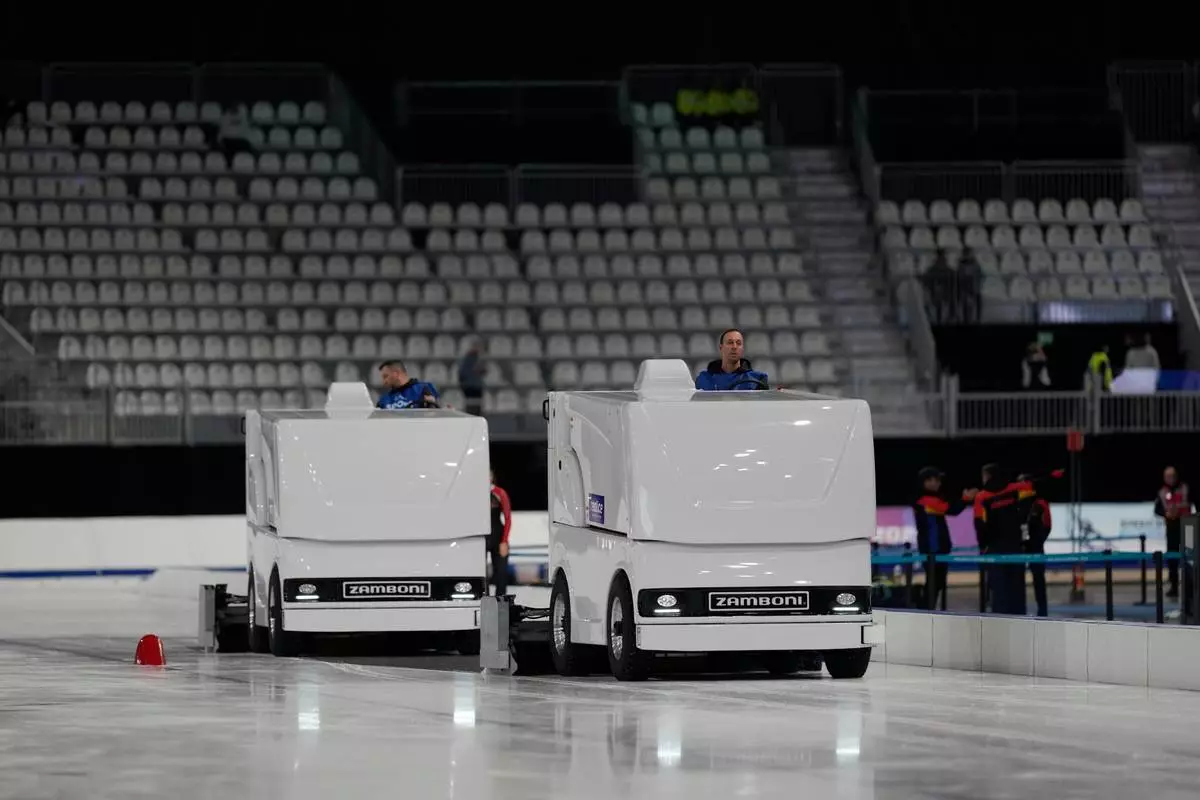
The Zamboni ice resurfacing machine plays a key role in keeping the track clean, cutting off a layer and spraying water to make a new surface.

One challenge is gauging how quickly the water from the resurfacing machine freezes in the temporary rink.

Another is getting the ice to the right thickness so that the Zamboni, weighing in at six tons, doesn’t shift the insulation, rubber tubing or ice itself.

“When you drive that out, if there’s anything moving it will move. We don’t want that,’’ Messer said.

The rink got its first big test on Nov. 29-30 during a Junior World Cup event. In a permanent rink, test events are usually held a year before the Olympics, leaving more time for adjustments. “We have a very small window to learn,’’ Messer acknowledged.

Dutch speedskater Kayo Vos, who won the men’s neo-senior 1,000 meters, said the ice was a little soft — but Messer didn’t seem too concerned.

“We went very modest to start, now we can start to change the temperatures and try to make it faster and still maintain it as a safe ice,’’ he said.

Fine-tuning the air temperature and humidity and ice temperature must be done methodically — taking into account that there will be 6,000 spectators in the venue for each event. The next real test will be on Jan. 31, when the Olympians take to the ice for their first training session.

“Eighty percent of the work is done but the hardest part is the last 20 percent, where we have to try to find the values and the way of running the equipment so all the skaters get the same conditions and all the skaters get the best conditions,’’ Messer said.

AP Winter Olympics: https://apnews.com/hub/milan-cortina-2026-winter-olympics

Serpentines are set on the ice of the stadium where speed skating discipline of the Milan Cortina 2026 Winter Olympics will take place, in Rho, outskirt of Milan, Tuesday, Nov. 11, 2025. (AP Photo/Luca Bruno)

Serpentines are set on the ice of the stadium where speed skating discipline of the Milan Cortina 2026 Winter Olympics will take place, in Rho, outskirt of Milan, Tuesday, Nov. 11, 2025. (AP Photo/Luca Bruno)

Ice Master Mark Messer poses in the stadium where speed skating discipline of the Milan Cortina 2026 Winter Olympics will take place, in Rho, outskirt of Milan, Tuesday, Nov. 11, 2025. (AP Photo/Luca Bruno)

Ice Master Mark Messer poses in the stadium where speed skating discipline of the Milan Cortina 2026 Winter Olympics will take place, in Rho, outskirt of Milan, Tuesday, Nov. 11, 2025. (AP Photo/Luca Bruno)

Workers clean the ice surface during a peed skating Junior World Cup and Olympic test event, in Rho, near Milan, Italy, Saturday, Nov. 29, 2025. (AP Photo/Luca Bruno)

Workers clean the ice surface during a peed skating Junior World Cup and Olympic test event, in Rho, near Milan, Italy, Saturday, Nov. 29, 2025. (AP Photo/Luca Bruno)

Ice Master Mark Messer poses in the stadium where speed skating discipline of the Milan Cortina 2026 Winter Olympics will take place, in Rho, outskirt of Milan, Tuesday, Nov. 11, 2025. (AP Photo/Luca Bruno)

Ice Master Mark Messer poses in the stadium where speed skating discipline of the Milan Cortina 2026 Winter Olympics will take place, in Rho, outskirt of Milan, Tuesday, Nov. 11, 2025. (AP Photo/Luca Bruno)

Ice Master Mark Messer poses in the stadium where speed skating discipline of the Milan Cortina 2026 Winter Olympics will take place, in Rho, outskirt of Milan, Tuesday, Nov. 11, 2025. (AP Photo/Luca Bruno)

Ice Master Mark Messer poses in the stadium where speed skating discipline of the Milan Cortina 2026 Winter Olympics will take place, in Rho, outskirt of Milan, Tuesday, Nov. 11, 2025. (AP Photo/Luca Bruno)

Recommended Articles