The universal "reciprocal tariffs" imposed by the United States signals a decline in the U.S. economic dominance and dollar hegemony, as the country is attempting to extract excessive financial benefits from its trading partners, according to economists, who warn the Trump administration is playing a "dangerous game".
U.S. President Donald Trump last week signed an executive order on the so-called "reciprocal tariffs," imposing a 10-percent "minimum baseline tariff" before unveiling higher rates on certain trading partners. The policy sent shockwaves throughout the global economy and triggered panic on financial markets, with analysts warning of significant risks and dire economic consequences.
In an interview with the China Global Television Network (CGTN), Hong Hao, chief economist of the GROW Investment Group, a Shanghai-based hedge fund, said the tariffs reflect Trump's strategy to extract economic benefits from trading partners, particularly viewing China as a significant competitor. "Trump really believes that the trade terms with the trading partners have been unfair to the U.S., and as a result, the U.S. manufacturing sector has been hollowed out. Therefore, the U.S. is paying an excessive price for globalization, and now, it's time to pay back. I think, from this angle, he is trying to extract economic rent from its trading partners, and also he is trying to see China as one of the major U.S. rivals at this juncture. So, I think, as a result, he is playing a very dangerous game. And, as you can see, it's political theater in the sense that he is trying to dramatize the extreme pressure, so that he can get excessive rent from the opponent," he said
Trump's unilateral imposition of tariffs has eroded global confidence in the U.S. and its dollar's status, leading many to state that the American hegemony may not persist, according to Josef Gregory Mahoney, a professor of politics and international relations at East China Normal University.
"The U.S. economy is at an inflection point. There is a moment where the previous strategies being used to sustain American hegemony were no longer working. And, it's only a matter of time before the U.S. position erodes, given the fact that it's been a house of cards built on the dollar supremacy. And a lot of people don't see that as having a brighter future. This has moved past the theater stage and has moved really directly into one in which no one really has confidence in the U.S. anymore. No one has confidence in the dollar. No one has confidence in the U.S. being committed to the multilateral system, to global trade and so forth and so on," he said.
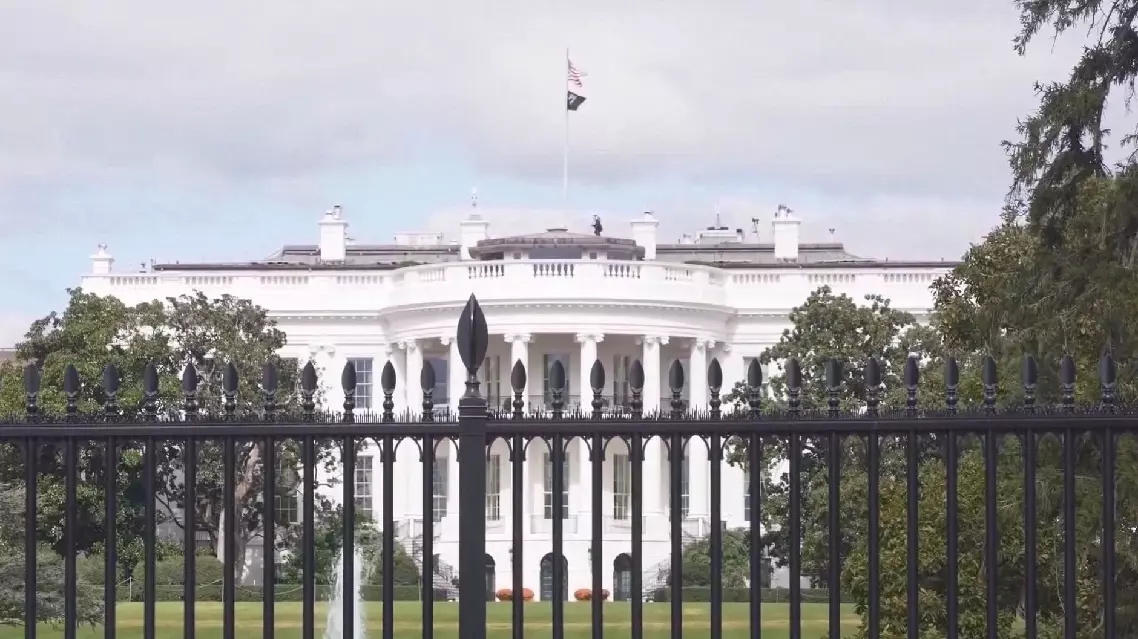
Trump playing "dangerous game" as tariff measures signal decline in U.S. dollar hegemony: economists
Visiting Chinese Foreign Minister Wang Yi said Saturday China is willing to work with Lesotho to strengthen exchanges on governance experience, enhance coordination in multilateral affairs, and advance the China-Lesotho strategic partnership.
Wang, also a member of the Political Bureau of the Communist Party of China Central Committee, made the remarks when meeting with Lesotho Prime Minister Sam Matekane in the capital of Lesotho.
During the meeting, Wang congratulated Lesotho on the 60th anniversary of its independence this year, and spoke highly of Lesotho government's efforts to prioritize economic development and steer the African country onto a path of sustainable growth. Since the Beijing Summit of the Forum on China-Africa Cooperation (FOCAC) in 2024, the two sides have advanced cooperation under the 10 partnership action plans unveiled at the summit, successfully implementing a number of key projects to effectively promote Lesotho's development and revitalization, Wang said.
China stands ready to work with Lesotho to strengthen exchanges on governance experience, enhance coordination in multilateral affairs, and push for greater development of the China-Lesotho strategic partnership, he added.
Calling on the two sides to firmly support each other, Wang said that China will accelerate the implementation of its zero-tariff policy for African countries, including Lesotho, expand bilateral trade, investment and industrial cooperation, facilitate broader access of Lesotho's specialty products to the Chinese market, and continue to support Lesotho's national development.
China will continue to stand firmly with African countries, uphold justice for the Global South, including Lesotho, oppose unilateralism and acts of bullying, and work together to build a community with a shared future for humanity, Wang said.
On his part, Matekane said during the meeting that Lesotho cherishes its friendship with China and the strategic partnership between the two countries, and expressed gratitude for China's valuable support for the development of African countries, including Lesotho.
Lesotho firmly adheres to the one-China principle and resolutely supports China in safeguarding its core interests, he said, noting that his country stands ready to strengthen strategic mutual trust with China, expand people-to-people exchanges, jointly implement the outcomes of the FOCAC Beijing Summit, and deepen cooperation in areas such as infrastructure, manufacturing and energy.
Matekane stressed that China's zero-tariff policy for African products will inject new impetus into Lesotho's development. He also expressed Lesotho's willingness to strengthen solidarity and cooperation with China on multilateral platforms such as BRICS to jointly address global challenges.
On the same day, Wang also held talks with Lejone Mpotjoana, minister of foreign affairs and international relations of Lesotho.
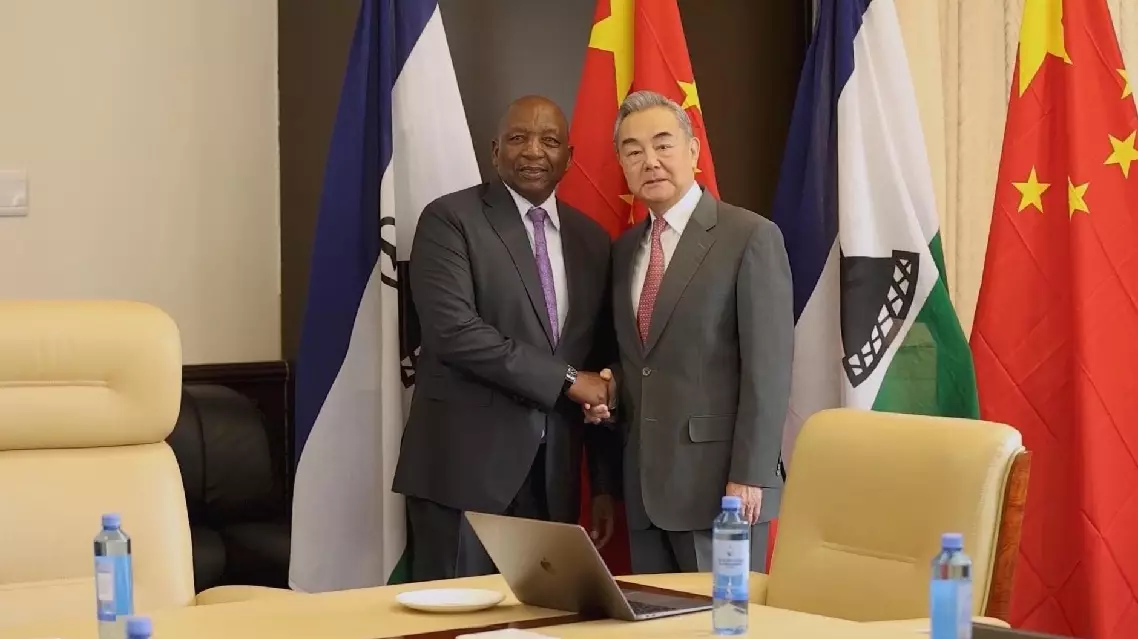
China, Lesotho to strengthen exchanges, advance cooperation
China, Lesotho to strengthen exchanges, advance cooperation