|
New research tracks evolving financial and economic crime risks, unveils the Secretariat Economic Crime Index (SECI), and highlights key trends shaping 2025 and beyond
ATLANTA and DUBAI, April 10, 2025 /PRNewswire/ -- Secretariat, the leading global legal, risk, and regulatory advisory firm, has released its inaugural Global Financial and Economic Crime Outlook 2025, providing a comprehensive analysis of financial and economic crime threats worldwide. The report maps jurisdictional risks, assesses emerging crime trends, and introduces the Secretariat Economic Crime Index (SECI)—a groundbreaking new country-by-country risk assessment measuring financial and economic crime factors impacting business viability.
Financial crime remains an alarming global concern, with illicit financial flows projected to surge between USD 4.5 trillion to USD 6 trillion by 2030, according to Secretariat estimates. Money laundering, fraud, bribery, and market abuse continue to evolve and become more sophisticated, fueled by shifting geopolitical and regulatory priorities, rapid advancements in virtual assets, decentralized finance (DeFi), artificial intelligence (AI), and machine learning.
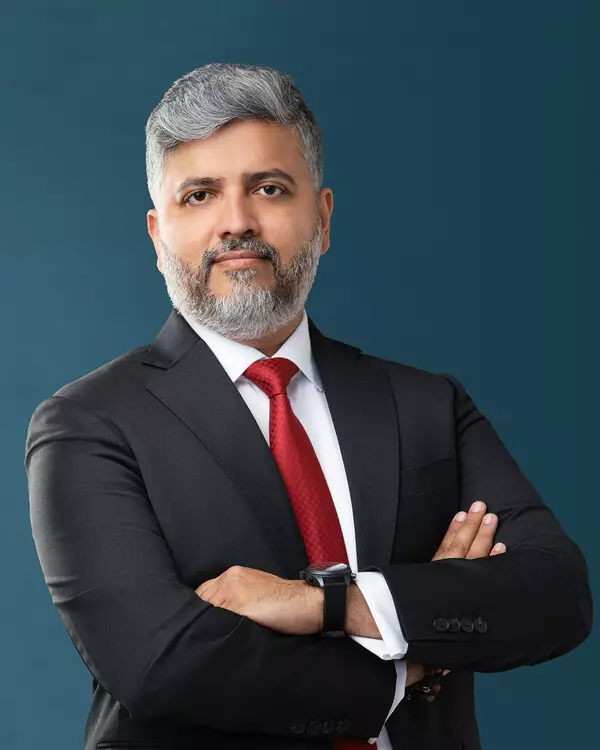
"The financial crime landscape is shifting at an unprecedented pace," says Secretariat Managing Director Bhavin Shah. "Our report equips organizations with the intelligence they need to navigate these complex risks, anticipate threats, and implement proactive safeguards."
Key Findings of the Report
- The Rise of AI-Driven Fraud: The use of AI in financial crime is accelerating, with deepfake fraud, automated money laundering, and AI-powered identity theft posing growing threats.
- Virtual Asset Risks: Cryptocurrencies and DeFi platforms continue to be exploited for illicit transactions, underscoring the urgent need for stronger global regulatory oversight.
- Convergence of Sanctions and AML/CFT Governance: Sanctions and AML regimes are increasingly integrated, with regulators leveraging shared compliance pillars and geopolitical intelligence to disrupt illicit networks and enhance global financial crime enforcement.
- Cross-Border Data Sharing is Critical: In an era of evolving compliance challenges, enhanced global cooperation and real-time monitoring are essential to combat financial crime effectively.
Mapping Global Risk with the SECI Index
At the core of the report is the Secretariat Economic Crime Index (SECI), a proprietary tool that analyzes financial and economic crime risks across 177 countries. The SECI score (ranging from 0 to 4) integrates Secretariat's expert analysis with data from three established global benchmarks: the Basel AML Index, the Corruption Perceptions Index, and the Organized Crime Index. Countries are categorized into four distinct risk tiers:
- Transparent Titans: 19 countries, with scores ranging from 0 to 1.53
These nations lead in financial crime prevention, with strong enforcement and transparency.
The top five countries include: Finland, Denmark, Iceland, Luxembourg, and Estonia. - Vigilant Players: 64 countries, with scores ranging from 1.54 to 2.18
Actively strengthening their regulatory frameworks, these countries continuously evolve to combat financial crime. The top five countries include: Netherlands, Austria, Seychelles, Israel, and Latvia - Reactive Reformers: 78 countries, with scores ranging from 2.19 to 2.83
Weak enforcement, regulatory gaps, and prevalent high-risk activities hinder these nations' ability to combat financial crime. The top five countries include: Ghana, Gambia, Malawi, Serbia, Bosnia and Herzegovina. - Regulatory Laggards: 16 countries, with scores ranging from 2.84 to 4.00
Characterized by entrenched corruption and systemic financial crime, these nations struggle with illicit financial flows that are deeply embedded in their economies, making enforcement efforts largely ineffective. The bottom five countries include: The Democratic Republic of Congo, Venezuela, Afghanistan, South Sudan, and Myanmar.
2025 and Beyond: The Future of Financial and Economic Crime Prevention
The report outlines ten major financial and economic crime trends shaping the next decade, including:
- Disruptive AI technology and deepfake frauds
- Virtual asset risks
- Real-time transaction monitoring
- Regulatory technology integration
- Behavioral biometrics for fraud prevention and detection
- Proliferation financing
- Convergence of sanctions and AML/CFT governance
- Rise of white-collar frauds and external threats
- Cross-border data sharing
- Rise of ESG compliance in financial crime risk management
As financial and economic crime becomes more sophisticated, regulators, financial institutions, and corporations must adopt data-driven, technology-enabled strategies to safeguard the global financial system.
"We're entering a new era where rules are being redefined in real time, not only due to technological disruption, but also because the global economy is fragmenting, legal systems are retrenching, and global norms are being rewritten," says Shah. "Alongside these shifts, rising tariffs are creating new vulnerabilities. This environment gives criminal networks new opportunities to adapt, exploit weaknesses, and outpace regulators, reinforcing the need for more agile enforcement strategies."
"In a rapidly shifting compliance landscape, organizations must move beyond traditional risk assessments," notes Secretariat Managing Director Ralph Stobwasser. "The SECI index and our in-depth country analysis brings clarity to jurisdictional vulnerabilities and emerging crime trends. Prevention is key, but readiness is vital. Institutions must react, respond, and remediate to minimize impact, restore trust, and ensure resilience. At the same time, we must recognize that protectionist tariffs, while aimed at safeguarding domestic industries, can unintentionally fuel the shadow economy. Distorted market prices create opportunities for smuggling and trade-based money laundering, particularly where enforcement is weak. These dynamics allow criminal networks not just to avoid tariffs, but to fund broader illicit operations under the radar."
The Secretariat Global Financial and Economic Crime Outlook will publish annually, establishing itself as a trusted resource and barometer for international business activity.
Download a full copy of the report.
About Secretariat
Secretariat experts are trusted in the highest-stakes legal, risk, and regulatory matters around the world. Renowned law firms, leading corporations, and respected governmental entities turn to our more than 600 disputes, investigations, economic, engineering, and data advisory experts when the stakes are high – supporting them with meticulous preparation, insightful analysis, and clearly persuasive communications. Our bright minds and passionate problem-solvers put their financial, analytical, and strategic insights to work in the fast-paced sectors we serve – from construction and energy to healthcare, technology, and natural resources. Quality, integrity, and independence are woven into every aspect of our work. But, most importantly, when success is on the line, our globally integrated teams thrive on working through the most daunting problems in ways that remove uncertainty and instill confidence. Learn more at www.secretariat-intl.com.
PDF - https://mma.prnewswire.com/media/2662069/Secretariat_Global_Financial_and_Economic_Crime_Outlook_2025_Map.pdf?p=original
New research tracks evolving financial and economic crime risks, unveils the Secretariat Economic Crime Index (SECI), and highlights key trends shaping 2025 and beyond
ATLANTA and DUBAI, April 10, 2025 /PRNewswire/ -- Secretariat, the leading global legal, risk, and regulatory advisory firm, has released its inaugural Global Financial and Economic Crime Outlook 2025, providing a comprehensive analysis of financial and economic crime threats worldwide. The report maps jurisdictional risks, assesses emerging crime trends, and introduces the Secretariat Economic Crime Index (SECI)—a groundbreaking new country-by-country risk assessment measuring financial and economic crime factors impacting business viability.
Financial crime remains an alarming global concern, with illicit financial flows projected to surge between USD 4.5 trillion to USD 6 trillion by 2030, according to Secretariat estimates. Money laundering, fraud, bribery, and market abuse continue to evolve and become more sophisticated, fueled by shifting geopolitical and regulatory priorities, rapid advancements in virtual assets, decentralized finance (DeFi), artificial intelligence (AI), and machine learning.
"The financial crime landscape is shifting at an unprecedented pace," says Secretariat Managing Director Bhavin Shah. "Our report equips organizations with the intelligence they need to navigate these complex risks, anticipate threats, and implement proactive safeguards."
Key Findings of the Report
- The Rise of AI-Driven Fraud: The use of AI in financial crime is accelerating, with deepfake fraud, automated money laundering, and AI-powered identity theft posing growing threats.
- Virtual Asset Risks: Cryptocurrencies and DeFi platforms continue to be exploited for illicit transactions, underscoring the urgent need for stronger global regulatory oversight.
- Convergence of Sanctions and AML/CFT Governance: Sanctions and AML regimes are increasingly integrated, with regulators leveraging shared compliance pillars and geopolitical intelligence to disrupt illicit networks and enhance global financial crime enforcement.
- Cross-Border Data Sharing is Critical: In an era of evolving compliance challenges, enhanced global cooperation and real-time monitoring are essential to combat financial crime effectively.
Mapping Global Risk with the SECI Index
At the core of the report is the Secretariat Economic Crime Index (SECI), a proprietary tool that analyzes financial and economic crime risks across 177 countries. The SECI score (ranging from 0 to 4) integrates Secretariat's expert analysis with data from three established global benchmarks: the Basel AML Index, the Corruption Perceptions Index, and the Organized Crime Index. Countries are categorized into four distinct risk tiers:
- Transparent Titans: 19 countries, with scores ranging from 0 to 1.53
These nations lead in financial crime prevention, with strong enforcement and transparency.
The top five countries include: Finland, Denmark, Iceland, Luxembourg, and Estonia. - Vigilant Players: 64 countries, with scores ranging from 1.54 to 2.18
Actively strengthening their regulatory frameworks, these countries continuously evolve to combat financial crime. The top five countries include: Netherlands, Austria, Seychelles, Israel, and Latvia - Reactive Reformers: 78 countries, with scores ranging from 2.19 to 2.83
Weak enforcement, regulatory gaps, and prevalent high-risk activities hinder these nations' ability to combat financial crime. The top five countries include: Ghana, Gambia, Malawi, Serbia, Bosnia and Herzegovina. - Regulatory Laggards: 16 countries, with scores ranging from 2.84 to 4.00
Characterized by entrenched corruption and systemic financial crime, these nations struggle with illicit financial flows that are deeply embedded in their economies, making enforcement efforts largely ineffective. The bottom five countries include: The Democratic Republic of Congo, Venezuela, Afghanistan, South Sudan, and Myanmar.
2025 and Beyond: The Future of Financial and Economic Crime Prevention
The report outlines ten major financial and economic crime trends shaping the next decade, including:
- Disruptive AI technology and deepfake frauds
- Virtual asset risks
- Real-time transaction monitoring
- Regulatory technology integration
- Behavioral biometrics for fraud prevention and detection
- Proliferation financing
- Convergence of sanctions and AML/CFT governance
- Rise of white-collar frauds and external threats
- Cross-border data sharing
- Rise of ESG compliance in financial crime risk management
As financial and economic crime becomes more sophisticated, regulators, financial institutions, and corporations must adopt data-driven, technology-enabled strategies to safeguard the global financial system.
"We're entering a new era where rules are being redefined in real time, not only due to technological disruption, but also because the global economy is fragmenting, legal systems are retrenching, and global norms are being rewritten," says Shah. "Alongside these shifts, rising tariffs are creating new vulnerabilities. This environment gives criminal networks new opportunities to adapt, exploit weaknesses, and outpace regulators, reinforcing the need for more agile enforcement strategies."
"In a rapidly shifting compliance landscape, organizations must move beyond traditional risk assessments," notes Secretariat Managing Director Ralph Stobwasser. "The SECI index and our in-depth country analysis brings clarity to jurisdictional vulnerabilities and emerging crime trends. Prevention is key, but readiness is vital. Institutions must react, respond, and remediate to minimize impact, restore trust, and ensure resilience. At the same time, we must recognize that protectionist tariffs, while aimed at safeguarding domestic industries, can unintentionally fuel the shadow economy. Distorted market prices create opportunities for smuggling and trade-based money laundering, particularly where enforcement is weak. These dynamics allow criminal networks not just to avoid tariffs, but to fund broader illicit operations under the radar."
The Secretariat Global Financial and Economic Crime Outlook will publish annually, establishing itself as a trusted resource and barometer for international business activity.
Download a full copy of the report.
About Secretariat
Secretariat experts are trusted in the highest-stakes legal, risk, and regulatory matters around the world. Renowned law firms, leading corporations, and respected governmental entities turn to our more than 600 disputes, investigations, economic, engineering, and data advisory experts when the stakes are high – supporting them with meticulous preparation, insightful analysis, and clearly persuasive communications. Our bright minds and passionate problem-solvers put their financial, analytical, and strategic insights to work in the fast-paced sectors we serve – from construction and energy to healthcare, technology, and natural resources. Quality, integrity, and independence are woven into every aspect of our work. But, most importantly, when success is on the line, our globally integrated teams thrive on working through the most daunting problems in ways that remove uncertainty and instill confidence. Learn more at www.secretariat-intl.com.
PDF - https://mma.prnewswire.com/media/2662069/Secretariat_Global_Financial_and_Economic_Crime_Outlook_2025_Map.pdf?p=original
** The press release content is from PR Newswire. Bastille Post is not involved in its creation. **

New Secretariat Report Maps Rising Financial and Economic Crime Risks in 177 Countries
New Secretariat Report Maps Rising Financial and Economic Crime Risks in 177 Countries
|
BEIJING, April 3, 2026 /PRNewswire/ -- HiTHIUM showcased its full-scenario energy storage solutions at ESIE 2026, held in Beijing from April 1-3. The company highlighted its ∞Cell 1175Ah long-duration energy storage (LDES) battery and BESS, along with its AIDC full-duration energy storage solution. At the event, HiTHIUM released the full results of a large-scale fire test for its ∞Power 6.25MWh 4h BESS and received certification from UL Solutions. This marks the world's first open-door fire test of the LDES system equipped with kAh-level battery cells, setting a new benchmark for system-level safety validation.
Advancing Industry-Wide Understanding of Energy Storage Safety
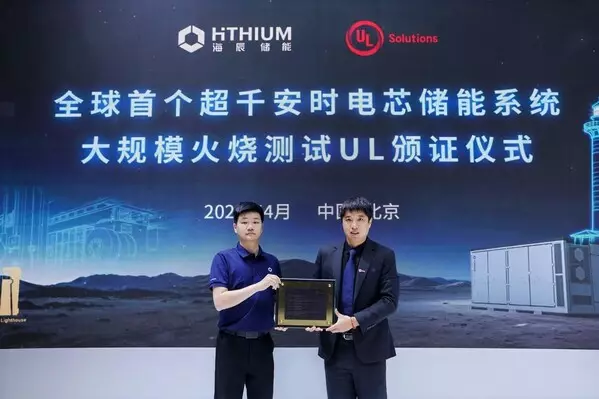
During the exhibition, HiTHIUM hosted a certification ceremony for the world's first large-scale fire test of a BESS equipped with kAh-level battery cells. Jiawu Chen, the Fire Test Project Lead and Senior Fire Protection Design Engineer at HiTHIUM, presented the test design and execution. A full-length video showcased the entire process, key technical milestones, and final results.
Through this technical sharing, HiTHIUM translated an extreme safety validation into practical and replicable industry insights, reinforcing the shift from "design-level safety" to verifiable system safety in long-duration energy storage.
UL Solutions Grants the Certification, Validating System Safety
During the certification ceremony, Chi Chen, APAC Senior Product Manager, Energy and Automation at UL Solutions, noted that UL 9540A 6th Edition (released March 2026) expands safety validation to full-container and system-level fire scenarios. HiTHIUM's 6.25MWh BESS was tested under open-door, large-scale fire conditions in compliance with this standard, validating the reliability of its passive safety design.
The certification indicates the system meets stringent market access requirements across major global markets and supports its international deployment.
Verifiable Safety Demonstrated in World's First Extreme Fire Test of a 6.25MWh 4h LDES System
Previously, under the full witness of UL Solutions and independent experts, the 6.25MWh BESS underwent an extreme fire test in accordance with the latest UL 9540A (2025) and NFPA 855 (2026) standards. The test applied multiple stringent conditions, including fully open container doors, minimal spacing of 15 cm in a back-to-back and side-by-side configuration, 100% state of charge, and deactivation of active fire protection systems.
Results showed the fire was contained within a single container, with no thermal propagation between units. The enclosure remained structurally intact after the burn, demonstrating reliable safety performance under real-world fire scenarios.
Ecosystem Collaboration Highlights Lighthouse Manufacturing
At the exhibition, HiTHIUM partnered with ecosystem collaborators to launch interactive check-in activities centered on the ∞Cell 1175Ah LDES battery, featuring a joint partner booth tour and a lighthouse factory-themed experience, attracting strong visitor engagement and in-depth interaction.
Notably, in January 2026, HiTHIUM's Chongqing manufacturing base was recognized as the world's first Lighthouse Factory for energy storage batteries and operates the first dedicated production line for LDES batteries. The site integrates over 40 digital solutions, incorporating technologies such as generative AI, machine learning, and AIoT to enable end-to-end intelligent management—from R&D and material selection to manufacturing and final testing—ensuring high consistency across production.
Looking ahead, HiTHIUM will continue to focus on long-duration energy storage, strengthening its capabilities in verifiable product safety, scalable delivery, and full-scenario solutions. Together with global partners, the company aims to support the high-quality development of the energy storage industry and advance the global energy transition.
BEIJING, April 3, 2026 /PRNewswire/ -- HiTHIUM showcased its full-scenario energy storage solutions at ESIE 2026, held in Beijing from April 1-3. The company highlighted its ∞Cell 1175Ah long-duration energy storage (LDES) battery and BESS, along with its AIDC full-duration energy storage solution. At the event, HiTHIUM released the full results of a large-scale fire test for its ∞Power 6.25MWh 4h BESS and received certification from UL Solutions. This marks the world's first open-door fire test of the LDES system equipped with kAh-level battery cells, setting a new benchmark for system-level safety validation.
Advancing Industry-Wide Understanding of Energy Storage Safety
During the exhibition, HiTHIUM hosted a certification ceremony for the world's first large-scale fire test of a BESS equipped with kAh-level battery cells. Jiawu Chen, the Fire Test Project Lead and Senior Fire Protection Design Engineer at HiTHIUM, presented the test design and execution. A full-length video showcased the entire process, key technical milestones, and final results.
Through this technical sharing, HiTHIUM translated an extreme safety validation into practical and replicable industry insights, reinforcing the shift from "design-level safety" to verifiable system safety in long-duration energy storage.
UL Solutions Grants the Certification, Validating System Safety
During the certification ceremony, Chi Chen, APAC Senior Product Manager, Energy and Automation at UL Solutions, noted that UL 9540A 6th Edition (released March 2026) expands safety validation to full-container and system-level fire scenarios. HiTHIUM's 6.25MWh BESS was tested under open-door, large-scale fire conditions in compliance with this standard, validating the reliability of its passive safety design.
The certification indicates the system meets stringent market access requirements across major global markets and supports its international deployment.
Verifiable Safety Demonstrated in World's First Extreme Fire Test of a 6.25MWh 4h LDES System
Previously, under the full witness of UL Solutions and independent experts, the 6.25MWh BESS underwent an extreme fire test in accordance with the latest UL 9540A (2025) and NFPA 855 (2026) standards. The test applied multiple stringent conditions, including fully open container doors, minimal spacing of 15 cm in a back-to-back and side-by-side configuration, 100% state of charge, and deactivation of active fire protection systems.
Results showed the fire was contained within a single container, with no thermal propagation between units. The enclosure remained structurally intact after the burn, demonstrating reliable safety performance under real-world fire scenarios.
Ecosystem Collaboration Highlights Lighthouse Manufacturing
At the exhibition, HiTHIUM partnered with ecosystem collaborators to launch interactive check-in activities centered on the ∞Cell 1175Ah LDES battery, featuring a joint partner booth tour and a lighthouse factory-themed experience, attracting strong visitor engagement and in-depth interaction.
Notably, in January 2026, HiTHIUM's Chongqing manufacturing base was recognized as the world's first Lighthouse Factory for energy storage batteries and operates the first dedicated production line for LDES batteries. The site integrates over 40 digital solutions, incorporating technologies such as generative AI, machine learning, and AIoT to enable end-to-end intelligent management—from R&D and material selection to manufacturing and final testing—ensuring high consistency across production.
Looking ahead, HiTHIUM will continue to focus on long-duration energy storage, strengthening its capabilities in verifiable product safety, scalable delivery, and full-scenario solutions. Together with global partners, the company aims to support the high-quality development of the energy storage industry and advance the global energy transition.
** This press release is distributed by PR Newswire through automated distribution system, for which the client assumes full responsibility. **
HiTHIUM's kAh-Level 6.25MWh BESS Receives International Certification Following Large-Scale Fire Test