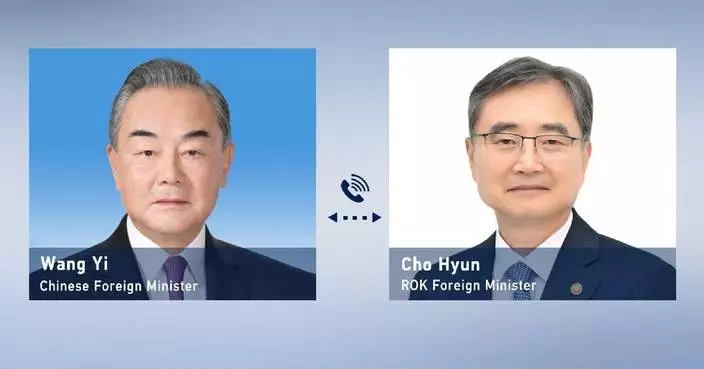
China has pledged deeper ties with its neighbors to foster common development and stability, following a central conference on work related to neighboring countries, which saw Chinese ambassadors from around the region gather in Beijing this week.
The diplomats and experts attending the conference said the country is working to promote regional collaboration amid growing global uncertainties, strengthening its ties with its neighbors in a way that takes account of both the regional and the global context.
"The trade volume between China and Malaysia reached 212 billion U.S. dollars [in 2024], marking an 11.4 percent year-on-year increase. A large number of infrastructure projects including highways, bridges, ports, terminals and hydropower stations are being implemented across Malaysia. China-Malaysia cooperation epitomizes the broader collaboration between China and ASEAN. We are confident that under the strategic guidance of both countries' leaders, bilateral relations will reach new heights," said Ouyang Yujing, Chinese Ambassador to Malaysia.
"ASEAN and China are geographically close and culturally connected, making ASEAN our important partner for development cooperation. Our combined population exceeds 2 billion, representing a massive market with sustained rapid economic growth in recent years and promising prospects," said Hou Yanqi, Chinese Ambassador to ASEAN.
Other Chinese diplomats said China was being guided by the principles of amity, security, prosperity and win-win cooperation, to promote a shared future with neighboring countries, using its own development to spur regional growth.
This vision has led to concrete achievements, with a consensus on a shared future agreed with 17 neighboring states, Belt and Road cooperation agreements in effect with 25, and 18 regional nations now counting China as their largest trade partner. These deepening political and economic ties have cleared a path toward warm neighborly relations and mutual prosperity, according to other ambassadors.
"China has established comprehensive strategic partnerships with all Central Asian countries and signed Belt and Road cooperation documents. We are jointly committed to building a community with a shared future," said Han Chunlin, China's Ambassador to Kazakhstan.
"The China-Pakistan Economic Corridor, as a pioneering project of the Belt and Road Initiative, has attracted over 25 billion U.S. dollars in direct investment and created 230,000 jobs. It has not only elevated China-Pakistan cooperation but also contributed to Pakistan's economic and social development," said Jiang Zaidong, the Chinese Ambassador in Pakistan.
As the global challenges brought by unilateralism and economic protectionism grow, China remains steadfast in advancing its vision of a shared future, strengthening partnerships with neighboring countries to anchor stability and renew hope, according to China's permanent representative to the United Nations, Fu Cong.
"We must steadfastly uphold fairness and justice, adhere to true multilateralism, safeguard the interests of developing countries, maintain the authority of international law, and firmly oppose 'might makes right'," he said.
"Our world has become highly interdependent. Attempts at 'decoupling' or forced division are not only impossible but also go against historical trends. We must promote shared development through global cooperation. This represents the true exemplar of major-country responsibility," said Wang Fan, president of China Foreign Affairs University.

China pledges deeper cooperation with neighbors to foster stability
The Israeli government is set to prohibit 37 international aid organizations from operating in the Gaza Strip and the West Bank effective Jan 1, 2026, after authorities stated the groups failed to comply with stricter registration requirements, according to an Israeli media report on Tuesday.
The report from The Times of Israel cited the statement from Israel's Ministry of Diaspora Affairs and Combating Antisemitism, saying that the new regulations are based on security concerns aimed at removing non-government organizations' staff allegedly linked to so-called "terrorist organizations."
The report came after the Israeli government announced the same day that it would suspend the activities of several international aid organizations, including Doctors Without Borders, in the Gaza Strip starting January 1, 2026, citing the organizations' failure to submit information on their Palestinian staff as required.
Last year, Israel rolled out new regulations on registration requiring international aid groups to provide detailed information of their staff's names, funding sources, and operation status.
On Wednesday, Israel's Coordinator of Government Activities in the Territories stated that the registration mandates were necessary to prevent humanitarian supplies from being exploited by Hamas.
In an online interview with China Global Television Network (CGTN) on Wednesday, Bushra Khalidi, policy lead at Oxfam, a global organization that fights inequality to end poverty and injustice, said the impact of the ban will be "devastating."
"It is devastating. We've seen the numbers from the IPC (Integrated Food Security Phase Classification) a few weeks ago. We saw them in the summer. There's been a slight improvement, but that's not good enough for the time of a ceasefire. And six months after the famine was declared, we should have seen much more improvement in Gaza," said Khalidi.
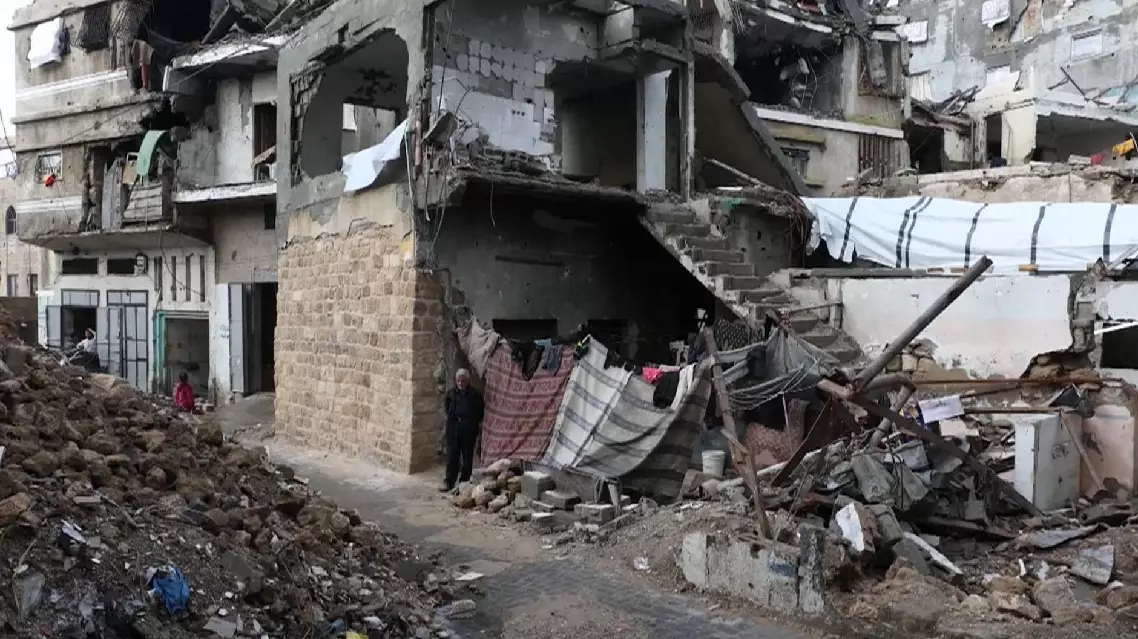
"It's winter here in Palestine. It was raining. It rained a record (amount) of rain per millimeter yesterday in Palestine since 1992. So, the impact is devastating. But the fact that shelter materials, for example, cannot enter. For families, this will mean slower repairs. It will mean fewer supplies. It will mean a longer wait for basic services. It will directly affect the access to clean water, to sanitation, to shelter materials, to public health interventions. Aid that should be moving predictably will remain delayed, it will remain restricted and it will remain stranded," she added.
She also emphasized that the operating environment became nearly impossible for organizations to navigate long before the new ban was announced.
"We have been obstructed and blocked from operating freely and unobstructedly for the last two years by Israel. Israel has killed a record number of humanitarian workers in the last two years. It has bombed our premises, it has bombed our convoys, it has blocked our items. It has driven famine like conditions in Gaza because of blocking humanitarian access. So, I think it's really important to set that scene, is that what is happening now is nothing new. It only continues within the kind of campaign that Israel has orchestrated to drive basically the population of Gazans' survival. So, we are, we have not been able to enter any materials in since March, in fact, us and many other organizations. And of course that has severely restricted our ability to scale up our operations," said Khalidi.
Hadja Lahbib, European Commissioner for Equality, Preparedness and Crisis Management, said on Wednesday that Israel's move is no different from cutting off lifesaving supplies for the local population, adding that the European Union has made clear that all obstacles to humanitarian access must be lifted.
Israel bans operations of 37 int'l aid groups in Gaza Strip, West Bank