DENVER (AP) — People in Colorado will soon have to pass a background check and complete a state-sanctioned safety course to buy most semiautomatic guns with detachable magazines under a bill signed into law by Democratic Gov. Jared Polis on Thursday.
Colorado, which has seen some of the country’s worst mass shootings — including the 2022 killings at the LGBTQ+ nightspot Club Q in Colorado Springs and the 1999 Columbine High School massacre — joins nearly a dozen other states in requiring some level of safety training or an exam to purchase a firearm.
One of the most restrictive gun control measures to be passed in the state as part of a long-running Democratic campaign to curtail gun violence, the law takes full effect in August 2026.
“We can’t afford not to do all we can to change the continuing impact of gun violence,” said bill sponsor and state Sen. Tom Sullivan, whose son, Alex, was killed in a 2013 shooting at a theater in Aurora. Speaking at the bill signing, he added that the measure is “just the next step we have undertaken on that effort.”
Republicans and other opponents contend that the measure violates the Second Amendment, and at last one organization, Rocky Mountain Gun owners, was considering a legal challenge.
The several layers of hurdles that the law requires to purchase these guns, and the accompanying costs and potential backlogs, make “it a more or less administrative ban,” said Ian Escalante, executive director of the gun rights group.
Previous attempts at securing an all-out ban on certain semiautomatic guns, as has been done in deeply Democratic states including New York and California, floundered in more purple Colorado where many including the governor have something of a libertarian streak.
“I really think this bill will make Colorado communities safer and prevent both accidents as well as reduce gun violence, and ultimately that means saving lives while protecting our Second Amendment rights,” Polis said.
The proposal was watered down from a flat ban on sale of most semiautomatics with detachable magazines, including rifles and some pistols. Proponents argued that allowing only permanently attached magazines would force a would-be shooter to reload bullet by bullet.
The final bill as signed is a concession to Polis and other Democrats wary of going too far.
Bedayn is a corps member for the Associated Press/Report for America Statehouse News Initiative. Report for America is a nonprofit national service program that places journalists in local newsrooms to report on undercovered issues.
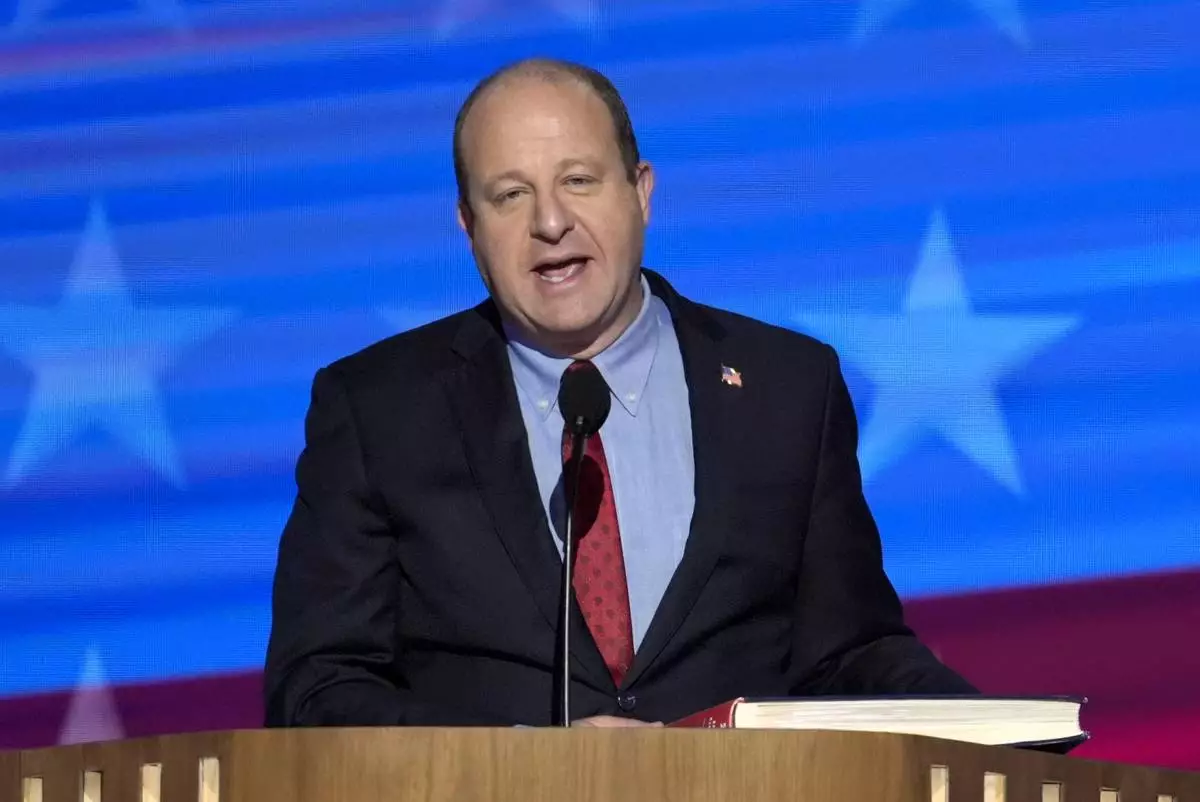
FILE - Colorado Gov. Jared Polis speaks during the Democratic National Convention, Aug. 21, 2024, in Chicago. (AP Photo/J. Scott Applewhite, File)
WASHINGTON (AP) — President Donald Trump’s military intervention in Venezuela will pose a fresh test of his ability to hold together a restive Republican coalition during a challenging election year that could be defined by domestic concerns like health care and affordability.
While most Republicans lined up behind the president in the immediate aftermath of the stunning U.S. mission to capture Venezuelan leader Nicolás Maduro and bring him to New York to face criminal charges, there were signs of unease across the spectrum within the party. In particular, Trump's comments about the U.S. positioning itself to “run” Venezuela have raised concerns that he is abandoning the “America First” philosophy that has long distinguished him from more traditional Republicans and helped fuel his political rise.
“This is the same Washington playbook that we are so sick and tired of that doesn't serve the American people, but actually serves the big corporations, the banks and the oil executives,” said Rep. Marjorie Taylor Greene of Georgia, a former Trump ally who is resigning on Monday, in an interview with NBC's “Meet the Press” on Sunday.
Those concerns were shared by some who are not associated with the party's far-right flank.
Rep. Brian Fitzpatrick of Pennsylvania, a moderate who is one of the most vulnerable Republicans in the November midterms, said in a statement that “the only country that the United States of America should be ‘running’ is the United States of America.”
Those comments reflect the sensitive dynamics between Trump and his fellow Republicans at the outset of an election year in which their party risks losing control of Congress. While the president's dominance remains undisputed, the ironclad grip that he has held over the party has faced unusual challenges in recent months. Blocs of Republicans have banded together to pressure Trump to release the Jeffrey Epstein files. Others have been vocal in encouraging Trump to take concerns about affordability more seriously.
Few issues are as central to Trump's political brand as ensuring that the U.S. does not get entangled in seemingly endless foreign conflicts at the expense of domestic goals. During a 2016 Republican presidential debate, for instance, he described the war in Iraq as a “big, fat mistake."
But on Saturday, Trump said he was “not afraid of boots on the ground” in Venezuela if that was deemed necessary, and he framed his actions as prioritizing the safety and security of Americans. He articulated an aggressive vision of U.S. dominance in the Western Hemisphere, and he told reporters it was important to “surround ourselves with good neighbors."
However, much like the Iraq War, a president's early confidence after a dramatic military action can sometimes meet more sobering realities that drain domestic political support.
In Venezuela, U.S. troops could be placed in harm's way again as Trump warns that more military operations may be in the works. An ongoing conflict could worsen the hemisphere's refugee crisis, something the White House has tried to tamp down with stricter border controls. In addition, there are questions about how much cooperation the U.S. will receive from officials still in Venezuela or how easily the country's oil reserves could be tapped to fulfill Trump's goal of extracting more energy with Maduro out of the picture.
Trump's comments this weekend about revitalizing the oil industry in Venezuela are in line with some of the earliest critiques he made of the handling of the Iraq War. During a 2013 speech before the Conservative Political Action Conference, Trump said the U.S. should “take” oil from Iraq and “pay ourselves back.”
Frustration with the handling of the Iraq War contributed to major gains for Democrats in the 2006 election and helped create the conditions for Barack Obama to be elected to the presidency two years later. Given the baggage surrounding those wars, Trump allies insist that the actions this weekend in Venezuela are different.
“Venezuela looks nothing like Libya,” Secretary of State Marco Rubio said on “Meet the Press. “It looks nothing like Iraq. It looks nothing like Afghanistan. It looks nothing like the Middle East other than the Iranian agents that are running through there plotting against America, okay?”
Senate Intelligence Committee Chairman Tom Cotton argued that the 1989 ouster of Manuel Noriega in Panama is a better comparison.
“That was a successful operation,” Cotton said on CNN's “State of the Union.” “I believe, in the long run, this will be too.”
Still, amid some of the pushback about the U.S. taking expansive responsibility for managing Venezuela, Rubio suggested a more limited role. He said that Washington would not handle day-to-day governance of the South American country other than enforcing an existing “oil quarantine” on Venezuela.
It is not clear that any forceful, organized opposition to Trump's Venezuela policy is emerging within the GOP. Instead, many lawmakers appear to be giving the Republican administration some room and, at most, offer some warnings.
Sen. Susan Collins of Maine, who faces a potentially challenging reelection campaign this year, called Maduro a “narco-terrorist and international drug trafficker” who should stand trial even, as she said “Congress should have been informed about the operation earlier and needs to be involved as this situation evolves.”
Even Sen. Rand Paul of Kentucky, who often criticizes military interventions, did not specifically oppose Trump's actions. He wrote on social media that “time will tell if regime change in Venezuela is successful without significant monetary or human cost.”
Many Democrats denounced Trump's actions in Venezuela and the Democratic National Committee quickly sought to raise money by blasting “another unconstitutional war from Trump.”
Rep. Alexandria Ocasio Cortez, D-N.Y., rejected the administration's argument that it was combating drug crimes, saying on X that the White House is instead focused on “oil and regime change” while seeking to “to distract from Epstein + skyrocketing healthcare costs.” Former Transportation Secretary Pete Buttigieg said the strike was part of an “old and obvious pattern” where an “unpopular president — failing on the economy and losing his grip on power at home — decides to launch a war for regime change abroad.”
AP Diplomatic Writer Matthew Lee contributed to this report.

President Donald Trump speaks at his Mar-a-Lago club, Saturday, Jan. 3, 2026, in Palm Beach, Fla., as Defense Secretary Pete Hegseth listens. (AP Photo/Alex Brandon)

President Donald Trump listens to a question during a news conference at Mar-a-Lago, Saturday, Jan. 3, 2026, in Palm Beach, Fla., as Secretary of State Marco Rubio watches. (AP Photo/Alex Brandon)