The United States stands as the largest source of China's deficit in service trade, with the deficit generally exhibiting an upward trend, said a white paper released by China's State Council Information Office on Wednesday.
The white paper noted that trade in services between China and the U.S. has maintained rapid growth, largely because the demand for services in China is expanding significantly, as its economy continues to develop and the standard of living rises, and the U.S. service industry is well developed with a complete range of sectors and strong international competitiveness.
Quoting data from the U.S. Department of Commerce (USDOC), the white paper said that between 2001 and 2023, two-way trade in services between China and the U.S. increased six times from 8.95 billion U.S. dollars to 66.86 billion U.S. dollars.
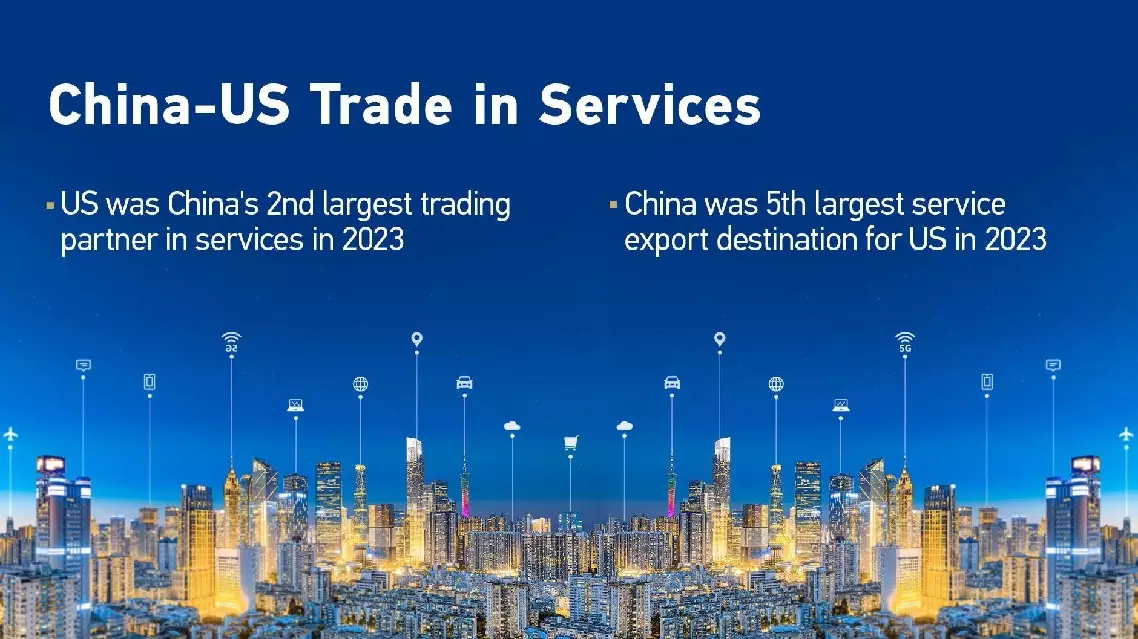
China's statistics show the U.S. as its second-largest trade partner in services in 2023, while U.S. data lists China as its fifth-largest services export market, the white paper said.
The white paper said according to the USDOC, from 2001 to 2023, U.S. service exports to China expanded 7.3 times from 5.63 billion U.S. dollars to 46.71 billion U.S. dollars.
The U.S. annual service trade surplus with China expanded 11.5 times to 26.57 billion U.S. dollars. In 2019, the figure even soared to 39.7 billion U.S. dollars.
In 2023, China continued to be the biggest contributor to the U.S. service trade surplus, representing roughly 9.5 percent of the total.
China's service trade deficit with the U.S. is primarily concentrated in three areas - travel (including education), intellectual property royalties, and transportation.
The white paper said China's trade deficit with the U.S. in travel services has expanded continuously.
Data from the USDOC shows that in 2023, Chinese tourists made approximately 1.1 million visits to the U.S., with their spending accounting for 14 percent of U.S. service exports to China. Tourism, medical treatment, and studying abroad remain the primary categories of service trade consumption for those traveling from China to the U.S.
According to the USDOC, U.S. exports of travel services (including education) to China grew 7.8 times from 2.31 billion U.S. dollars in 2001 to 20.23 billion U.S. dollars in 2023.
Noting that China's payments of intellectual property royalties to the U.S. have increased steadily, the white paper said that in 2023, intellectual property royalties remain a primary source of revenues for U.S. service trade, accounting for 13.1 percent of its service trade revenues.
The intellectual property royalties the U.S. receives from China represent one-fifth of the total royalties obtained from the Asia-Pacific region and account for 5 percent of U.S. global intellectual property royalty revenue.
US stands as largest source of China's deficit in service trade: data
The Ecological and Environmental Code solidifies China's successful reform experiences in the form of law, transforming ecological conservation into a long-term national goal for the sustainable development of the Chinese nation, said a member of the Standing Committee of the 14th National People's Congress (NPC) on Thursday.
Chinese lawmakers voted to adopt the Ecological and Environmental Code at the closing meeting of the fourth session of the 14th National People's Congress in Beijing earlier in the day.
Lyu Zhongmei, also vice chair of the NPC Environmental Protection and Resources Conservation Committee, who first proposed the drafting of the code, said in an interview with China Global Television Network (CGTN) that the adoption of the code represents a milestone in transforming the country's successful reform policies into a stable legal framework, with profound implications on both national ecological governance and people's daily lives.
"I think this actually sends a very strong signal to the world. Many of our past achievements in ecological civilization system reform were reflected through policies, with numerous reform measures introduced. This time, we are institutionalizing the successful experience of those reforms in the form of law, the most authoritative and stable way to solidify them. This shows that our efforts are not just a one-off campaign. Rather, ecological and environmental protection and the building of an ecological civilization are national goals that reflect the people’s aspiration for a better life and serve the ultimate purpose of ensuring the sustainable development of the Chinese nation," said Lyu.
Lyu highlighted that the code directly enshrines China's greenhouse gas pledge and dual-carbon goals into law, demonstrating the country's concrete actions to fulfill its international responsibilities and uphold its image as a responsible major country.
"We have directly written the commitment to fully meet greenhouse gas targets into the code, and incorporated pledges to use the 'dual carbon' goals as a driving force to advance a comprehensive green transformation of economic and social development. I think this reflects our concrete actions to honor our commitments and take responsibility to the international community, demonstrating China’s image as a responsible major country," she said.
On the topic of global trade, she explained how the code will help safeguard China's interests.
"On the one hand, we are raising standards for the green and low-carbon transition and adopting market-based measures. Some of the standards we have established based on China's actual situation and the methodologies we have created can contribute China's experience and expertise to the world. On the other hand, the Ecological and Environmental Code also includes provisions on extraterritorial application and establishes China’s own system of environmental protection standards," Lyu said.
Looking to the future, she discussed the code's role in the 15th Five-Year Plan period (2026-2030).
"During the 15th Five-Year Plan period, I believe our ecological and environmental protection will undergo fundamental changes. In the past, it relied more on strict administrative enforcement and control. But now, while not lowering strict control standards or reducing strict control measures, we must also introduce more incentive-based measures. Strict regulation will push enterprises to transform and encourage them to pursue environmental protection. The code will provide a clear, long-term and stable norm. In my view, the Ecological and Environmental Code is not only a 'tightening band' that constrains corporate behavior, but also an 'engine' that opens up new tracks for enterprises’ future development," she said.
China's ecological environmental code represents milestone in environmental rule of law