WASHINGTON (AP) — Anna Paulina Luna was at her Florida home in fall 2023, caring for her newborn son and turning over a question in her mind as a member of Congress:
“How do I change this?”
Luna, then a first-time mom and first-term lawmaker, could no longer fly to Washington to cast votes in the U.S. House, a crucial part of the job, due to complications from childbirth — which she blamed at least partially on her hectic schedule, having flown to and from the capital during most of her pregnancy.
Luna began reading House rules and found what seemed like a simple solution: allowing proxy voting for new moms.
What Luna considered a minor rule change, affecting just a few — only about a dozen women had given birth while serving in Congress — over time escalated into a standoff against her own Republican leadership and her allies in the hard-right Freedom Caucus.
In a matter of months, it became a highly charged debate that crossed party lines, united a younger generation of lawmakers and raised fresh questions about how a more than 200-year-old institution accommodates working parents in the 21st century. The conflict turned on weighty history and thorny procedures, highlighting the difficulties of abiding by documents and rules written long before air travel and Zoom screens — and long before women served in Congress.
“When the Constitution was written, this was not really a topic,” Luna said.
When Luna was about to become a new mom, planning for the big change ahead, she asked then-Speaker Kevin McCarthy how she would be able to vote in the days after giving birth. That was 2023, and she didn’t realize she was stepping on a political landmine.
At the start of the pandemic, more than two years before Luna was elected, Democrats in the majority had created a proxy voting system to contain COVID-19 and avoid overcrowding in the chamber.
McCarthy had called the practice “ a dereliction of duty,” an excuse for members to skip out on work, and the resolution creating the system passed without a single Republican vote.
When Republicans won the House majority in 2022, McCarthy abandoned proxy voting — and for a time, there was no talk of bringing it back.
Once Luna was cleared to fly and returned to Washington, she kept the proxy voting proposal to herself. It wasn’t the right time: The House was in turmoil, having just ousted McCarthy from the speaker’s job and choosing Rep. Mike Johnson of Louisiana as his replacement.
But a few months later, Luna made her move.
She introduced a bill in January 2024 that would allow a mother to designate a proxy for six weeks, but by autumn, her legislation had gone nowhere, languishing in committee. Luna decided to launch a discharge petition — a workaround that allows legislation with 218 supporters to force a vote on the House floor. But she got just a handful of signatures.
“I went through every and exhausted every avenue,” Luna said.
Then she turned to Democrats, drafting a new proposal this year with Reps. Brittany Pettersen of Colorado and Sara Jacobs of California that would extend proxy voting to not just moms but all new parents for 12 weeks, double the time Luna had initially proposed.
Pettersen, who was previously the first member of the Colorado legislature to give birth and take leave, said she “came to Congress wanting to work on this.”
In a matter of months, Republican Rep. Mike Lawler of New York, a father to two young girls, became the 218th member to sign the discharge petition, the tally needed to force a vote.
But only a dozen signatures came from Republicans.
Pushback was fierce, from members of the Freedom Caucus and from the speaker himself. Johnson repeatedly called proxy voting “unconstitutional.” Herself among the more far-right conservatives in the House, her desk adorned with a model of President Donald Trump on Mount Rushmore, Luna resigned from the Freedom Caucus, accusing them of working against her.
Luna felt that she had done everything she could to address Johnson’s concerns. She agreed that members had abused the practice in the past, but said her proposal included “guard rails.”
Johnson tried to snuff out Luna’s discharge petition with a rare legislative maneuver, linking it to a vote that was needed to advance one of the GOP priorities, a voter ID bill.
The aggressive move angered several Republicans, including some who didn’t even support Luna’s proposal. Johnson's gambit failed on the floor.
Johnson called the outcome “unfortunate” and reiterated the argument that proxy voting for moms was a “Pandora’s box” that would open the door for members who’d rather not show up to work. Then he sent lawmakers home for the week.
That’s when Luna had a talk with Trump.
“I think she’s great, Anna,” Trump said aboard Air Force One.
The president recalled that he had spoken to her the previous day. When it came to proxy voting, Trump wondered why the idea was “controversial.”
Johnson sprang into action and quickly posted on social media that he had also spoken with Trump, quoting him saying, “Mike, you have my proxy on proxy voting.”
Meanwhile, a political storm was brewing against Luna. Right-wing influencers flooded Twitter to accuse Luna of holding up Trump’s agenda as House floor action stalled. She faced attacks from fellow Republicans.
On a Sunday afternoon this month, Luna announced that she and leadership had reached an agreement.
They would resurrect a well-worn congressional procedure that “pairs” two members of Congress who plan to vote on opposite sides of an issue, canceling out their votes — a way to accommodate the absent member.
“If we truly want a pro-family Congress, these are the changes that need to happen,” Luna posted on X.
The plan was quickly tucked into an upcoming procedural vote. This time, it succeeded.
Reviews were mixed.
Rep. Jeff Van Drew, R-N.J., called the solution “bizarre” and said it was unlikely any member would voluntarily participate, essentially nulling their own vote, when the margins were so narrow in Congress.
But GOP Rep. Chip Roy of Texas, a member of the Freedom Caucus who opposes all proxy voting, said he would consider participating in pairing.
“We want to make it to where people can, you know, deal with whatever life curveballs they get,” Roy said.
Not everyone, though, is satisfied.
The day that Congress voted on vote-pairing, Pettersen stood outside the House chamber, cradling her son in her arms. “What Republican would be willing to vote present for me this week?” she asked. “Nobody.”

Speaker of the House Mike Johnson, R-La., leaves the chamber after an essential procedural vote passed in the House to advance President Donald Trump's top domestic priorities on spending reductions and tax breaks, at the Capitol in Washington, Wednesday, April 9, 2025. (AP Photo/J. Scott Applewhite)
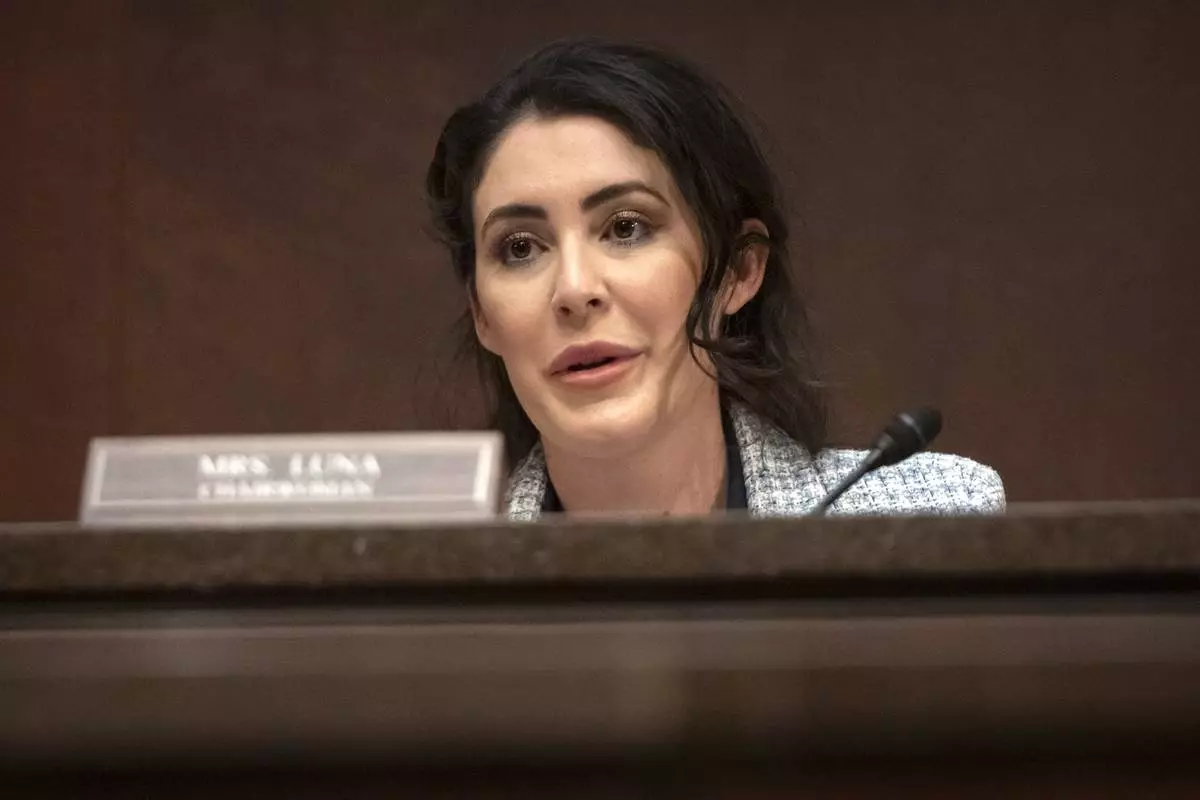
Rep. Anna Paulina Luna, R-Fla., speaks during a hearing of the House Task Force on the Declassification of Federal Secrets on Capitol Hill, Tuesday, April 1, 2025, in Washington. (AP Photo/Mark Schiefelbein)