Skip to Content Facebook Feature Image

EU launches supercomputer network to optimize AI models

China

China

China

EU launches supercomputer network to optimize AI models

2025-04-14 18:00 Last Updated At:18:57

The European Union is deploying a network of supercomputers to optimize artificial intelligence (AI) models across the continent, aiming to narrow the gap in this field with global rivals, as part of a multi-billion dollar push to regain technological competitiveness.

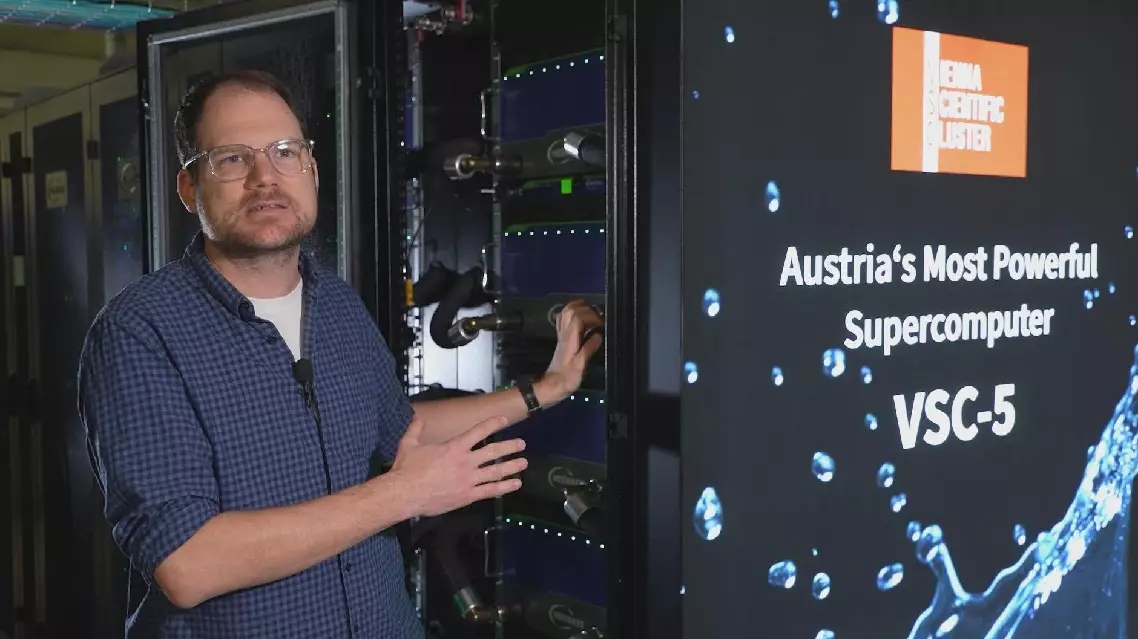
Thirteen "AI factories" - facilities enabling startups and smaller firms to train complex AI models - will begin operations next year, including one at Vienna Technical University.

"You can add many many computers over a network to get a supercomputer. Here we can use all the CPU and all the RAM of all the computers together for a single task," said Valentin Hirschbrich, IT infrastructure staff member at Vienna Technical University.

After U.S. President Donald Trump announced 500 billion dollars in private sector investment in AI infrastructure, the EU followed suit. The bloc has committed about two billion U.S. dollars to the initiative so far, with plans to build four larger "gigafactories" to further scale capacity and put Europe back on the international AI track.

"The boost that you can expect is - from our point of view - huge, because there's a lot of demand when it comes to training or fine-tuning of AI models," said Markus Stöhr, project manager at AI Factory Austria.

But some experts question its efficacy amid Europe's lack of homegrown cloud service giants.

"We do have American cloud providers that run local installations in Europe, but obviously it would be nice if we would also have European companies. I think for the future, that we are competitive in Europe, the importance is attracting and keeping talented people in Europe," said Edgar Weippl, Informatics professor at University of Vienna.

The EU-funded AI factory in Vienna is set to focus on trustworthy artificial intelligence, for instance AI models that run on public data and do not violate the privacy of individuals.

"You could go to cloud providers but then you always have this issue with data privacy. But we have an offer so we ensure that the data is here located in Vienna," Stöhr said.

Critics warn of risks in publicly funding hardware that may quickly become obsolete. Some argue software development offers better cost efficiency, but EU officials see the supercomputers as foundational for attracting AI investment.
EU launches supercomputer network to optimize AI models

EU launches supercomputer network to optimize AI models
Nigeria's fuel market is undergoing a rare shake-up as competition pushes prices lower, bringing relief to local consumers while raising concerns over business durability.

In the capital city of Abuja, the state oil firm Nigerian National Petroleum Company (NNPC) has been selling petrol at about 815 naira per liter (about 0.57 U.S. dollars per liter), down from about 0.66 U.S. dollars per liter earlier in 2026. Other stations supplied by private giant Dangote are offering even lower prices, selling at around 750 naira (about 0.53 U.S. dollars) per liter.

For millions of Nigerians, the drop has been easing pressure on transport, food and daily living costs.

"I spend relatively lower on fuel and, by implication, transportation now than what it used to be," said Salifu Usman, a local resident in Abuja.

"We are happy with what we are seeing, because, of course, for a very long time, we are witnessing the crash down of price, even during festive period," said Jonathan Madaki, another resident.

The price cut has also allowed for higher profit margins for local small business operators, who have long relied on petrol-powered generators to cope with chronic power shortages.

Behind the price cuts is a growing battle for market share. The Nigeria-based Dangote Refinery, the largest in Africa, has boosted domestic supply and slashed its wholesale price to around 700 naira (about 0.49 U.S. dollars) per liter.

The move has forced importers and the state oil company to lower their own prices to stay competitive. But as margins shrink, analysts warn, what now appears to be a price war may not last.

"My own interpretation is that we are going to that stage where, especially those that, if it keeps coming down, I think those that bring in products may find it not so attractive again. So I don't actually see how sustainable this price war, if I may use that term, will be," said energy expert Paul Ogwu.

Nigeria petrol price cuts ease living costs, raise durability concerns

Nigeria petrol price cuts ease living costs, raise durability concerns

Recommended Articles