LONDON (AP) — Outdated laws unfit for the social media age hampered police from countering false claims that helped fuel anti-immigrant violence in Britain last summer, an investigation by lawmakers said Monday.
Parliament’s Home Affairs Committee said limits on disclosing details of criminal investigations “created an information vacuum that allowed disinformation to flourish” after three children were stabbed to death at a summer dance party in July.
The attack in the northwest England town of Southport shocked the country and triggered days of disorder after far-right activists seized on incorrect reports that the attacker was a Muslim migrant who had recently arrived in the U.K.
Over several nights, crowds attacked housing for asylum-seekers, as well as mosques, libraries and community centers, in the worst street violence Britain had seen since riots in 2011.
Attacker Axel Rudakubana, who was 17 when he carried out the rampage at a Taylor Swift-themed dance class, is the British-born son of Rwandan Christian parents. He is serving a life sentence with no chance of parole for 52 years for killing Alice Da Silva Aguiar, 9, Elsie Dot Stancombe, 7, and Bebe King, 6, and wounding eight other children and two adults.
Longstanding contempt-of-court rules, intended to ensure fair trials, hampered police in correcting online misinformation, and a ban on naming suspects under 18 meant the attacker’s identity was withheld from the public for several days.
A tweet falsely identifying the attacker, posted on the day of the stabbings, was retweeted thousands of times and viewed by millions of people, the lawmakers said. Police did not state that the information was false until the next day, and even then did not release the attacker’s name.
Conservative lawmaker Karen Bradley, who heads the Home Affairs Committee, said “bad actors sought to exploit the unspeakable tragedy that unfolded in Southport.”
“By failing to disclose information to the public, false claims filled the gap and flourished online, further undermining confidence in the police and public authorities,” she said. “The criminal justice system will need to ensure its approach to communication is fit for the social media age.”
The committee of lawmakers from both government and opposition parties also said police struggled to monitor the sheer volume of content on social media. It called for government support “to monitor and respond to social media at a national level.”
The government said it agreed that “social media has put well-established principles around how we communicate after attacks like this under strain, and we must be able to tackle misinformation head on.” It has asked the Law Commission to carry out a review into contempt of court rules.
The government also has set up a public inquiry into how the system failed to stop the killer, who had been referred to the authorities multiple times over his obsession with violence.
The lawmakers’ committee, which heard from police, prosecutors and experts during its inquiry, also said there was no evidence to support allegations of “two-tier policing” in Britain. Politicians and activists on the political right have argued that those arrested over the summer disorder were treated more harshly than climate change activists or Black Lives Matter protesters.
More than 1,000 people have faced criminal charges over the violence, which saw 69 police officers treated in hospitals.
“Those participating in disorder were not policed more strongly because of their supposed political views but because they were throwing missiles, assaulting police officers and committing arson,” the lawmakers said. “It was disgraceful to see the police officers who bore the brunt of this violence being undermined by baseless claims of ‘two-tier policing.’”
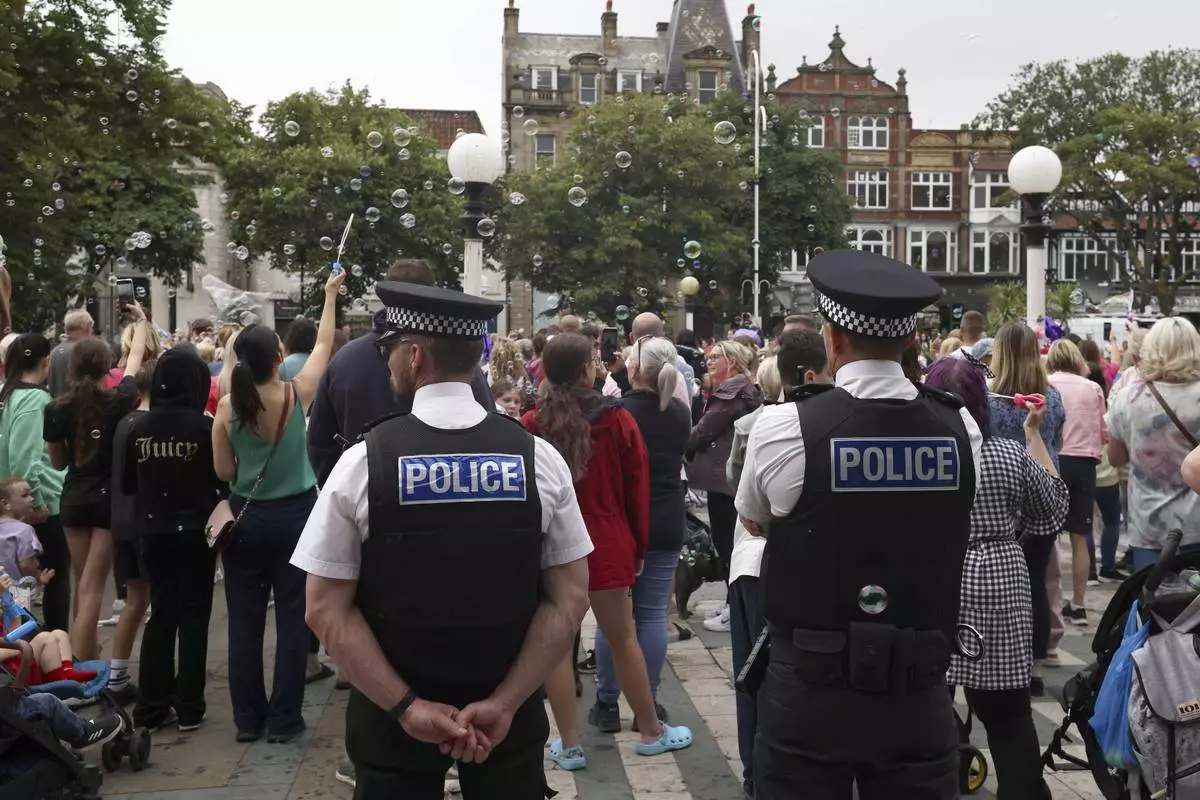
FILE - Police officers watch members of the public outside the Town Hall during a vigil to remember the victims of the stabbing attack last Monday in Southport, England, Monday, Aug. 5, 2024. (AP Photo/Darren Staples, File)

FILE - Floral tributes are left at the site in Southport, England, Sunday, Aug. 11, 2024 after three young girls were killed in a knife attack at a Taylor Swift-themed holiday club. (AP Photo/Scott Heppell, File)
RHO, Italy (AP) — No ice is colder and harder than speedskating ice. The precision it takes has meant that Olympic speedskaters have never competed for gold on a temporary indoor rink – until the 2026 Milan Cortina Winter Games.
In the pursuit of maximum glide and minimum friction, Olympic officials brought on ice master Mark Messer, a veteran of six previous Olympic speedskating tracks and the ice technician in charge of the Olympic Oval in Calgary, Canada — one of the fastest tracks in the world with over 300 records.
Messer has been putting that experience to work one thin layer of ice at a time since the end of October at the new Speed Skating Stadium, built inside adjacent trade fair halls in the city of Rho just north of Milan.
“It’s one of the biggest challenges I’ve had in icemaking,’’ Messer said during an interview less than two weeks into the process.
If Goldilocks were a speedskater, hockey ice would be medium hard, for fast puck movement and sharp turns. Figure skating ice would be softer, allowing push off for jumps and so the ice doesn’t shatter on landing. Curling ice is the softest and warmest of all, for controlled sliding.
For speedskating ice to be just right, it must be hard, cold and clean. And very, very smooth.
“The blades are so sharp, that if there is some dirt, the blade will lose the edge,’’ Messer said, and the skater will lose speed.
Speedskater Enrico Fabris, who won two Olympic golds in Turin in 2006, has traded in his skates to be deputy sports manager at the speedskating venue in Rho. For him, perfect ice means the conditions are the same for all skaters — and then if it's fast ice, so much the better.
"It's more of a pleasure to skate on this ice,'' he said.
Messer’s first Olympics were in Calgary in 1988 — the first time speedskating was held indoors. “That gave us some advantages because we didn’t have to worry about the weather, wind blowing or rain,’’ he said. Now he is upping the challenge by becoming the first ice master to build a temporary rink for the Olympics.
Before Messer arrived in Italy, workers spent weeks setting up insulation to level the floor and then a network of pipes and rubber tubes that carry glycol — an antifreeze — that is brought down to minus 7 or minus 8 degrees Celsius (17.6 to 19.4 degrees Fahrenheit) to make the ice.
Water is run through a purification system — but it can’t be too pure, or the ice that forms will be too brittle. Just the right amount of impurities “holds the ice together,’’ Messer said.
The first layers of water are applied slowly, with a spray nozzle; after the ice reaches a few centimeters it is painted white — a full day’s work — and the stripes are added to make lanes.
“The first one takes about 45 minutes. And then as soon as it freezes, we go back and do it again, and again and again. So we do it hundreds of times,’’ Messer said.
As the ice gets thicker, and is more stable, workers apply subsequent layers of water with hoses. Messer attaches his hose to hockey sticks for easier spreading.
What must absolutely be avoided is dirt, dust or frost — all of which can cause friction for the skaters, slowing them down. The goal is that when the skaters push “they can go as far as possible with the least amount of effort,’’ Messer said.
The Zamboni ice resurfacing machine plays a key role in keeping the track clean, cutting off a layer and spraying water to make a new surface.
One challenge is gauging how quickly the water from the resurfacing machine freezes in the temporary rink.
Another is getting the ice to the right thickness so that the Zamboni, weighing in at six tons, doesn’t shift the insulation, rubber tubing or ice itself.
“When you drive that out, if there’s anything moving it will move. We don’t want that,’’ Messer said.
The rink got its first big test on Nov. 29-30 during a Junior World Cup event. In a permanent rink, test events are usually held a year before the Olympics, leaving more time for adjustments. “We have a very small window to learn,’’ Messer acknowledged.
Dutch speedskater Kayo Vos, who won the men’s neo-senior 1,000 meters, said the ice was a little soft — but Messer didn’t seem too concerned.
“We went very modest to start, now we can start to change the temperatures and try to make it faster and still maintain it as a safe ice,’’ he said.
Fine-tuning the air temperature and humidity and ice temperature must be done methodically — taking into account that there will be 6,000 spectators in the venue for each event. The next real test will be on Jan. 31, when the Olympians take to the ice for their first training session.
“Eighty percent of the work is done but the hardest part is the last 20 percent, where we have to try to find the values and the way of running the equipment so all the skaters get the same conditions and all the skaters get the best conditions,’’ Messer said.
AP Winter Olympics: https://apnews.com/hub/milan-cortina-2026-winter-olympics

Serpentines are set on the ice of the stadium where speed skating discipline of the Milan Cortina 2026 Winter Olympics will take place, in Rho, outskirt of Milan, Tuesday, Nov. 11, 2025. (AP Photo/Luca Bruno)

Ice Master Mark Messer poses in the stadium where speed skating discipline of the Milan Cortina 2026 Winter Olympics will take place, in Rho, outskirt of Milan, Tuesday, Nov. 11, 2025. (AP Photo/Luca Bruno)
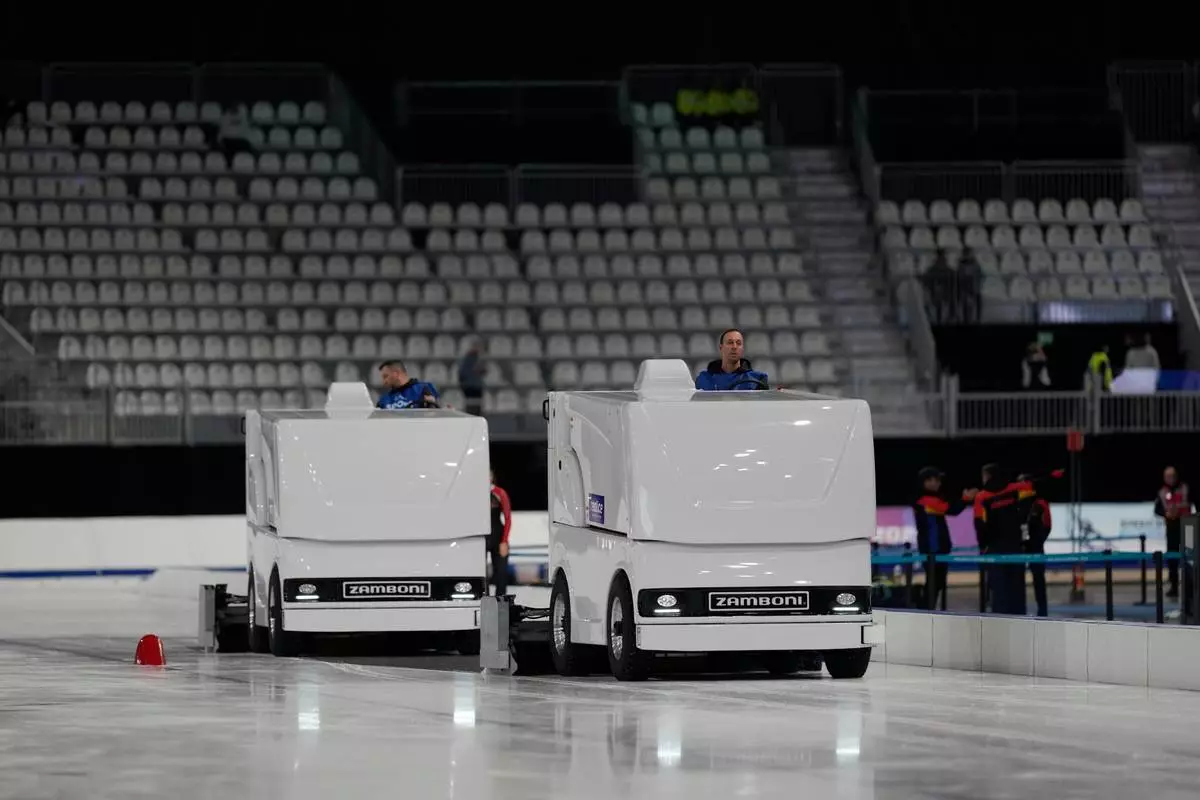
Workers clean the ice surface during a peed skating Junior World Cup and Olympic test event, in Rho, near Milan, Italy, Saturday, Nov. 29, 2025. (AP Photo/Luca Bruno)

Ice Master Mark Messer poses in the stadium where speed skating discipline of the Milan Cortina 2026 Winter Olympics will take place, in Rho, outskirt of Milan, Tuesday, Nov. 11, 2025. (AP Photo/Luca Bruno)

Ice Master Mark Messer poses in the stadium where speed skating discipline of the Milan Cortina 2026 Winter Olympics will take place, in Rho, outskirt of Milan, Tuesday, Nov. 11, 2025. (AP Photo/Luca Bruno)