MEUDON, France--(BUSINESS WIRE)--Apr 15, 2025--
Thales, the leading global technology and security provider, today announced the release of the2025 Imperva Bad Bot Report, a global analysis of automated bot traffic across the internet. This year’s report, the 12 th annual research study, reveals that generative artificial intelligence (AI) is revolutionizing the development of bots, allowing less sophisticated actors to launch a higher volume of bot attacks with increased frequency. Today’s attackers are also leveraging AI to scrutinize their unsuccessful attempts and refine techniques to evade security measures with heightened efficiency, amidst a growing Bots-As-A-Service (BaaS) ecosystem of commercialized bot services.
This press release features multimedia. View the full release here: https://www.businesswire.com/news/home/20250415432215/en/
Automated bot traffic surpassed human-generated traffic for the first time in a decade, constituting 51% of all web traffic in 2024. This shift is largely attributed to the rise of AI and Large Language Models (LLMs), which have simplified the creation and scaling of bots for malicious purposes. As AI tools become more accessible, cyber criminals are increasingly leveraging these technologies to create and deploy malicious bots which now account for 37% of all internet traffic – a significant increase from 32% in 2023. This is the sixth consecutive year of growth in bad bot activity, posing security challenges for organizations striving to safeguard their digital assets.
Both the Travel and the Retail sectors face an advanced bot problem, with bad bots making up 41% and 59% of their traffic respectively. In 2024, the travel industry became the most attacked sector, accounting for 27% of all bot attacks, up from 21% in 2023. The most notable shift in 2024 is the decline in advanced bot attacks targeting the travel industry (41%, down from 61% in 2023) and the sharp increase in simple bot attacks (52%, up from 34%). This shift indicates that AI-powered automation tools have lowered the barriers to entry for attackers, allowing less sophisticated actors to initiate more basic bot attacks. Rather than relying exclusively on sophisticated techniques, cybercriminals are increasingly utilizing high volumes of simpler bots to inundate travel sites, resulting in more frequent and widespread attacks.
The Rise of AI-Driven Bots: A New Era of Cybersecurity Challenges
The emergence of advanced AI tools, including ChatGPT, ByteSpider Bot, ClaudeBot, Google Gemini, Perplexity AI, and Cohere AI, are transforming not just user interactions but also the methods by which attackers execute cyber threats. According to the Imperva Threat Research team, widely used AI tools are being leveraged for cyberattacks, with ByteSpider Bot alone responsible for 54% of all AI-enabled attacks. Other significant contributors include AppleBot at 26%, ClaudeBot at 13%, and ChatGPT User Bot at 6%.
“The surge in AI-driven bot creation has serious implications for businesses worldwide,” said Tim Chang, General Manager of Application Security at Thales. “As automated traffic accounts for more than half of all web activity, organizations face heightened risks from bad bots, which are becoming more prolific every day.”
As attackers become more adept at utilizing AI, they can execute a variety of cyber threats—ranging from DDoS attacks to custom rules exploitation and API violations. While bot-driven attacks have become increasingly sophisticated, they pose significant challenges for detection efforts.
“This year’s report sheds light on the evolving tactics and techniques utilized by bot attackers. What were once deemed advanced evasion methods have now become standard practice for many malicious bots,” Chang said. “In this rapidly changing environment, businesses must evolve their strategies. It's crucial to adopt an adaptive and proactive approach, leveraging sophisticated bot detection tools and comprehensive cybersecurity management solutions to build a resilient defense against the ever-shifting landscape of bot-related threats.”
Bad Bots Targeting API Business Logic Pose Increased Threat to Modern Enterprises
Recent findings from the Imperva Threat Research team reveal a significant surge in API-directed attacks, with 44% of advanced bot traffic targeting APIs. These attacks aren't just limited to overwhelming API endpoints; rather, they target the intricate business logic that defines how APIs operate. Attackers deploy bots specifically designed to exploit vulnerabilities in API workflows, engaging in automated payment fraud, account hijacking, and data exfiltration.
Analysis in the report reveals a deliberate strategy by cyber attackers to exploit API endpoints that manage sensitive and high-value data. Implications of this trend are especially impactful for industries that rely on APIs for their critical operations and transactions. Financial services, healthcare, and e-commerce sectors are bearing the brunt of these sophisticated bot attacks, making them prime targets for malicious actors seeking to breach sensitive information.
APIs serve as the backbone of modern applications, enabling connectivity across services, streamlining operations, and delivering personalized customer experiences at scale. They underpin essential functions such as payment processing, supply chain management, and AI-driven analytics, making them indispensable for enhancing efficiency, accelerating product development, and unlocking new revenue streams.
“The business logic inherent to APIs is powerful, but it also creates unique vulnerabilities that malicious actors are eager to exploit,” Chang said. “As organizations embrace cloud-based services and microservices architectures, it’s vital to understand that the very features that make APIs essential can also leave them susceptible to risk of fraud and data breaches.”
Financial Services, Healthcare, and E-commerce Industries Face Heightened Risk
The 2025 Imperva Bad Bot Report provides an in-depth analysis highlighting the industries most at risk. Financial services, healthcare, and e-commerce are the most affected sectors, industries that rely on APIs for critical operations and sensitive transactions, making them attractive targets for sophisticated bot attacks.
The financial services sector was the most targeted industry for account takeover (ATO) attacks, accounting for 22% of all incidents, followed by Telecoms and ISPs with 18%, and Computing & IT with 17%. Financial Services has long been a prime target for ATO attacks due to the high value of accounts and the sensitive nature of the data at stake. Banks, credit card companies, and fintech platforms possess vast amounts of Personally Identifiable Information (PII), including credit card and bank account details, which can be profitably sold on the dark web. Additionally, the growing proliferation of APIs within the industry has broadened the attack surface, allowing cyber criminals to exploit vulnerabilities such as weak authentication and authorization methods, thereby facilitating account takeovers and data theft.
About the Research
The 12th Annual Imperva Bad Bot Report is based on insights from our Threat Research and Security Analyst Services (SAS) teams. Our analysis draws from data collected from across the Imperva global network in 2024, including the blocking of 13 trillion bad bot requests across thousands of domains and industries. This dataset provides key insights into bot activity to help organizations understand and address the growing risks of automated attacks.
About Thales
Thales (Euronext Paris: HO) is a global leader in advanced technologies for the Defence, Aerospace, and Cyber & Digital sectors. Its portfolio of innovative products and services addresses several major challenges: sovereignty, security, sustainability and inclusion.
The Group invests more than €4 billion per year in Research & Development in key areas, particularly for critical environments, such as Artificial Intelligence, cybersecurity, quantum and cloud technologies.
Thales has more than 83,000 employees in 68 countries. In 2024, the Group generated sales of €20.6 billion.
PLEASE VISIT
Thales Group
Cybersecurity Products
Cybersecurity Solutions

©Thales
ARCACHON, France (AP) — Large forest fires burned out of control in southwestern France and central Spain on Friday, prompting authorities to evacuate an estimated 87,000 people from their homes. Some even fled by boat when flames swept through the touristic Cap Ferret peninsula on France's Atlantic coast.
Dozens of firefighters were injured, authorities said, but no deaths were reported in either country.
Some 125 square kilometers (48 square miles) have been consumed by the blaze that has raged since Wednesday near Cap Ferret. Located just 60 kilometers (37 miles) from Bordeaux, the peninsula normally offers stunning landscapes and sandy beaches as well as oyster-farming villages and upmarket resorts.
About 67,000 residents in France escaped a larger area as authorities ordered additional evacuations further south after a separate wildfire broke out. Both France and Spain have asked fellow European Union members for help.
“It’s quite impressive and even frightening," said Laurent Moretti, a resident in the town of Arès. “An evacuation on this scale has never happened before. All we really hope is that the firefighters can quickly get it under control.”
More than 20,000 people had already been evacuated from towns and vacation resorts on Thursday. The new evacuations were carried out by road, with boat shuttles provided for people who could not travel by their own means.
Local authorities in the Gironde department said 53 homes and a camp site have been ravaged by flames, adding that 42 firefighters were injured. Around 1,500 people who fled the peninsula arrived by sea in the city of Arcachon, some aboard small water taxis and others on larger boats.
Hundreds of French firefighters have been deployed and additional ground and aerial reinforcements were sent Friday to tackle the blaze. Meanwhile, another major wildfire destroyed 25 square kilometers of land further south down the coast. It remained uncontained and strong winds hampered the work of firefighters.
Authorities believe the cause of both fires was accidental. Some 44,000 people have been evacuated in Gironde, and 23,000 in the Landes.
French President Emmanuel Macron said France will receive EU reinforcements including two Croatian Canadair firefighting aircraft, two Portuguese Air Tractor aircraft, and two heavy-lift Black Hawk helicopters from the Czech Republic and Slovakia. Spanish Interior Minister Fernando Grande-Marlaska said that Italy and Greece are each sending two Canadair water-dumping airplanes.
In Spain, the government declared a national emergency for wildfires for the first time as the blazes in Madrid and the nearby province of Ávila prompted the evacuation of some 20,000 people from towns.
The fires are being fanned by a heat wave with temperatures expected to top 39 degrees Celsius (102 Fahrenheit) in parts of Spain.
The two major fires west of Madrid merged into one single blaze that had quickly charred 30 square kilometers (11.5 square miles) by Friday afternoon. Regional President Isabel Díaz-Ayuso called it the worst in Madrid's history.
Francisco Martín, the central government representative for the region of Madrid, said that 40,000 people had been either evacuated or ordered to shelter at home in towns west of the capital. At least 19,000 people of that total are estimated to have been forced to leave their homes. Martín said more evacuations could be coming.
Meanwhile, a blaze in Ávila, less than two hours northwest of Madrid, had consumed 90 square kilometers (34 square miles), causing another 1,500 people to flee. Spain's Civil Guard arrested one man and is investigating another for allegedly having used heavy machinery in an area where it was prohibited for fire risk. Police believe a spark ignited the fire on Thursday.
“In my 60 years I have never seen something like this in my village, I have never seen fire of these dimensions,” Francisco Martínez, the mayor of Burgohondo, whose residents were preventively evacuated in Ávila, told Spain’s national broadcaster TVE.
Spanish television showed video taken by retreating residents of walls of flames topped by long plumes of smoke advancing through woods and scrublands. High winds and hilly terrain complicated efforts by firefighters, who combated the blazes with firetrucks and bulldozers.
“All around the town was smoke and fire, I was scared. Everything was fire and smoke, people were nervous,” 33-year-old Joaquin Espinosa told The Associated Press before he and his neighbors were evacuated from the village of Chapinería, located less than an hour's drive west of Madrid.
In one week, Spain has had the worst fires on record for both the regions of Castilla La Mancha and Madrid.
Firefighters were still trying to extinguish Spain’s second-largest ever fire in the Guadalajara province of Castilla La Mancha after it had destroyed some 320 square kilometers (120 square miles) over the last week. Thirteen people were also killed in a fire in southern Spain earlier this month, the deadliest fire in recent memory for Spain.
Spanish Minister for the Ecological Transition Sara Aagesen said that Spain has seen 1,140 square kilometers (440 square miles) already burned this year, more than five times the burned terrain it had through the first half of 2025. There were nine other serious fires in other parts of Spain active on Friday.
Sánchez called on Wednesday for a pact between political parties to fight climate change that he said is key to adapting to a more fire-prone climate. Spain has experienced record temperatures in recent summers and forest fires of increasing violence.
Wildfire analyst Raúl Quílez said that besides the impact of climate change, Spain’s rural areas have become more exposed to fires with the abandonment of farmlands that traditionally provided buffer zones around villages. Now, he said, trees and undergrowth often reach right to homes, putting them in harm’s way.
"That makes a perfect cocktail for this type of fires,” Quílez told the AP by phone from Valencia, where he works as an analyst for regional firefighters.
In Italy, as wildfires ravaged Sicily and other areas, civil protection officials said arsonists were behind some of the blazes and were using cats to help propagate the flames.
The head of the civil protection agency in Calabria, Domenico Costarella, said arsonists had attached rags soaked in flammable liquid to the tails of cats and then set them loose in fields to spread the fire.
Fueled by temperatures that have topped 40 C (104 F), low humidity and winds, the blazes have forced scattered evacuations and were blamed for the death of a firefighter responding to a fire in Caltanissetta.
Scientists warn that climate change is exacerbating the frequency and intensity of heat and dryness especially in southeastern Europe, making the region more vulnerable to wildfires.
Alicia León in Chapinería, Spain, and Nicole Winfield in Rome contributed to this story. Petrequin reported from Paris. Wilson reported from Barcelona, Spain.
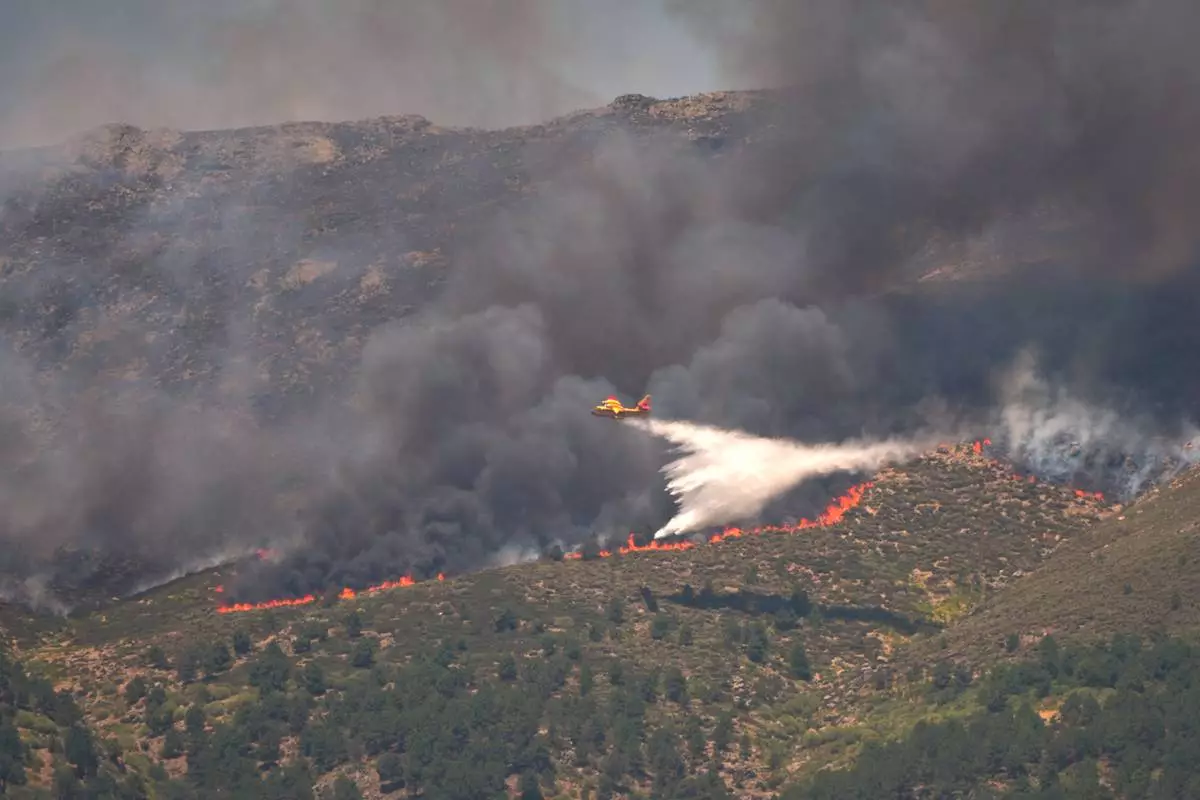
A seaplane drops water onto the fire as a wildfire advances near La Adrada, Ávila province, Spain, Friday, July 24, 2026. (AP Photo/Manu Fernandez)
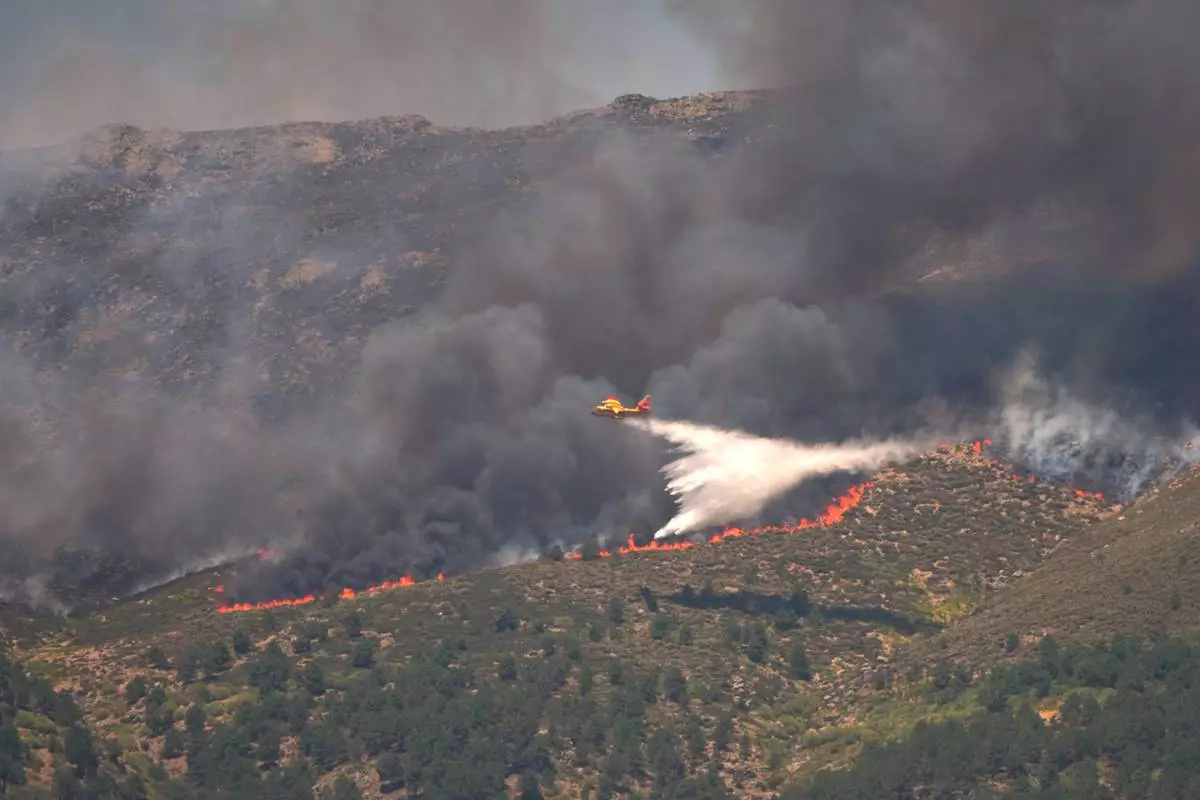
A seaplane drops water onto the fire as a wildfire advances near La Adrada, Ávila province, Spain, Friday, July 24, 2026. (AP Photo/Manu Fernandez)
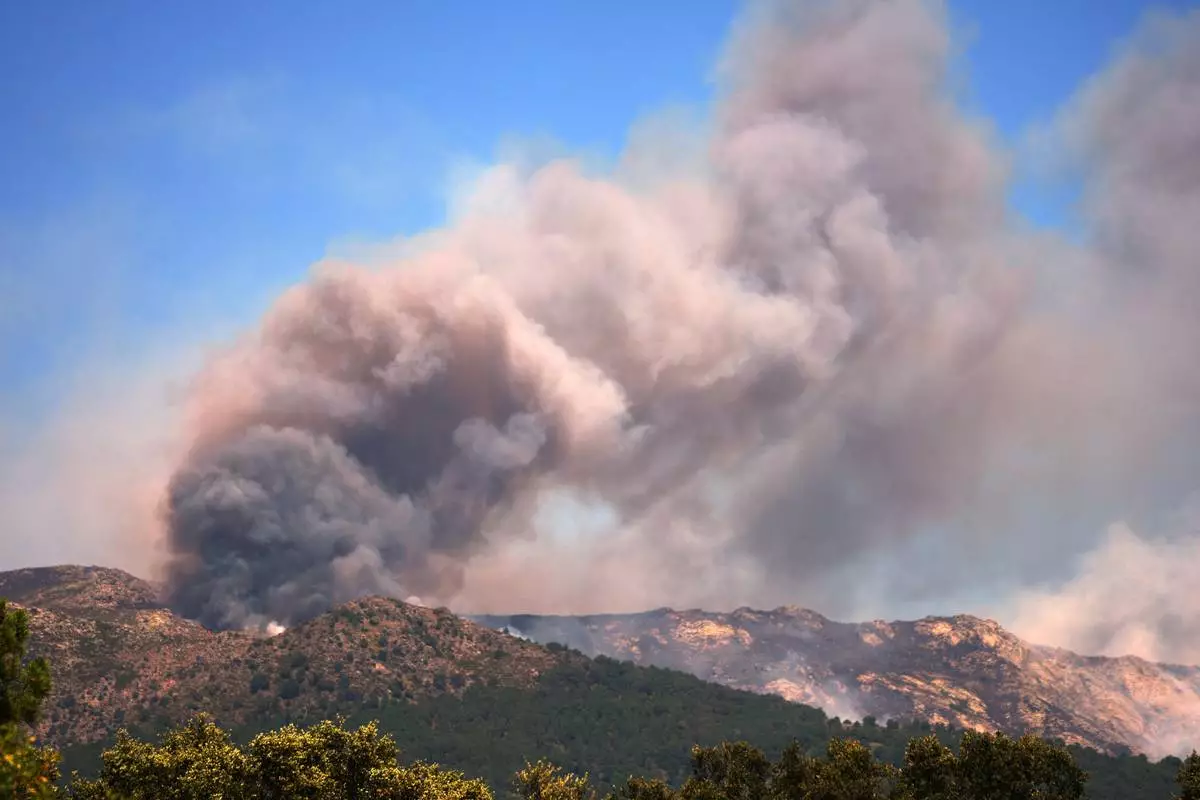
Smoke and flames rise as a wildfire advances near La Adrada, Ávila province, Spain, Friday, July 24, 2026. (AP Photo/Manu Fernandez)
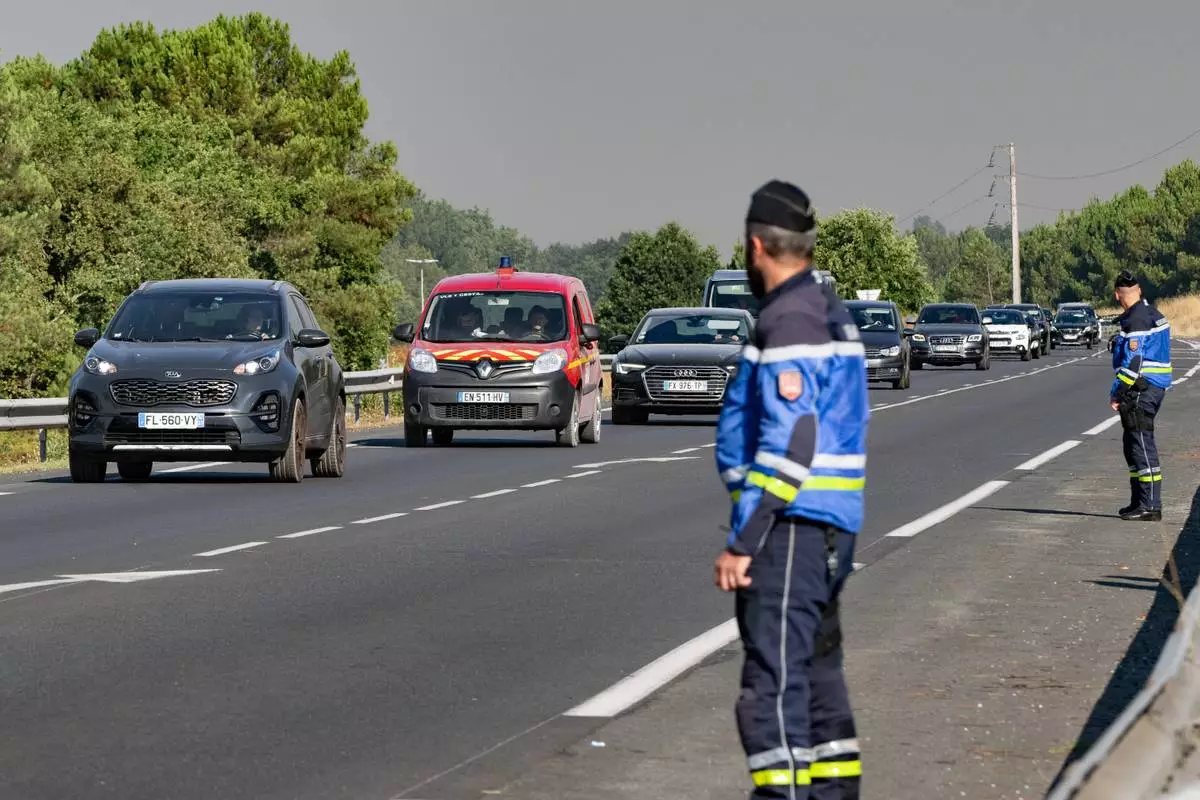
People leave the Ares region during wildfires, western France, Friday July 24, 2026. (AP Photo/Caroline Blumberg)
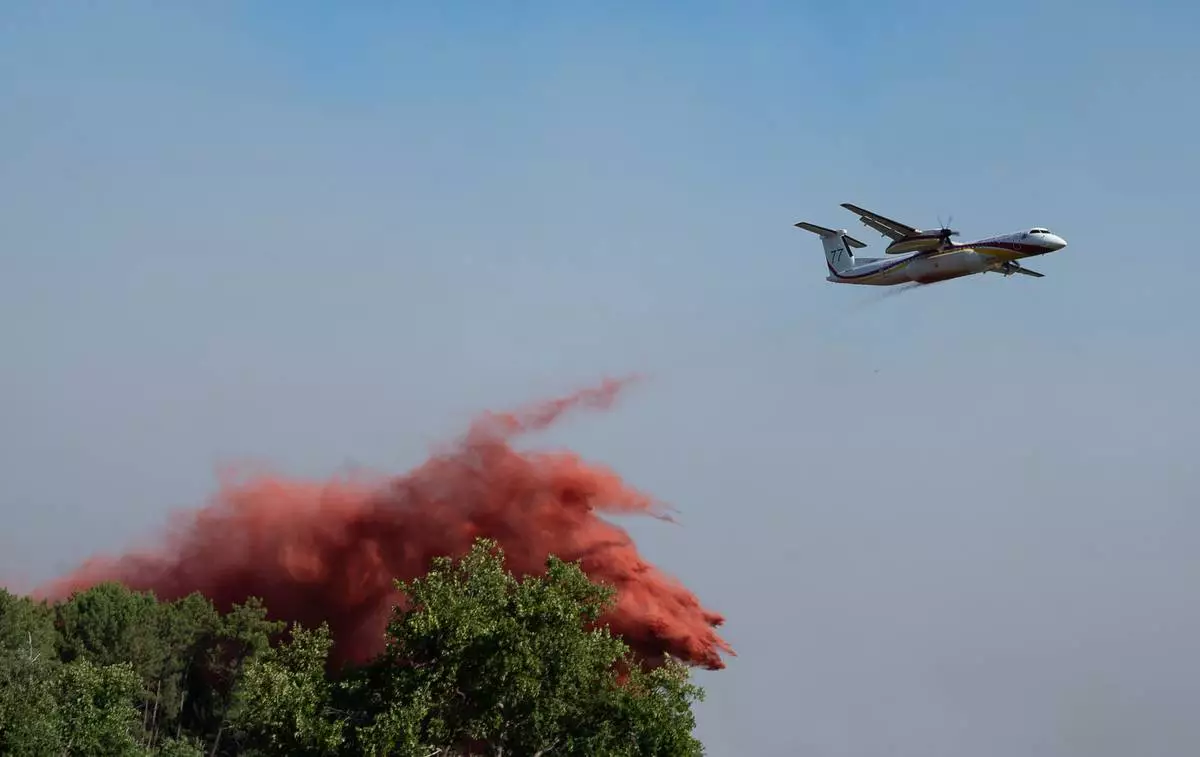
A water bomber drops water while fighting wildfires In Ares, western France, Friday July 24, 2026. (AP Photo/Caroline Blumberg)
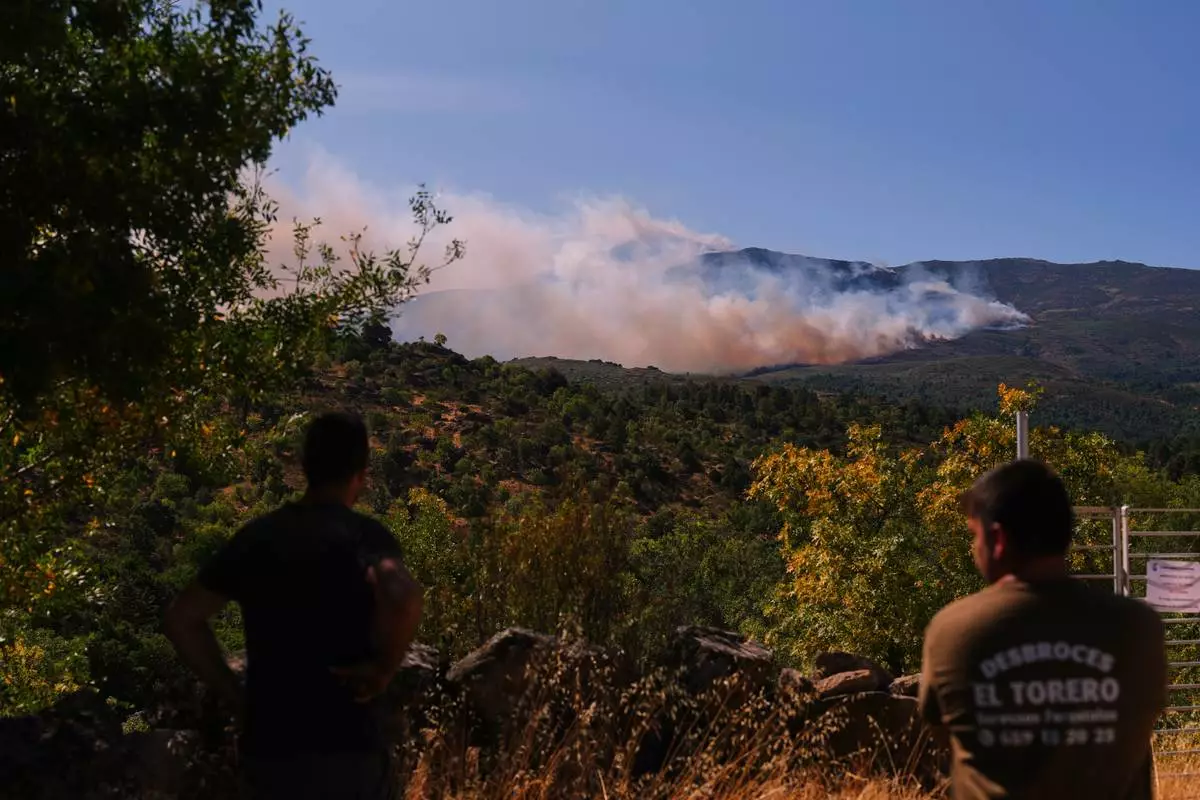
Smoke and flames rise as a wildfire advances near Burgohondo, Ávila province, Spain, Friday, July 24, 2026. (AP Photo/Manu Fernandez)
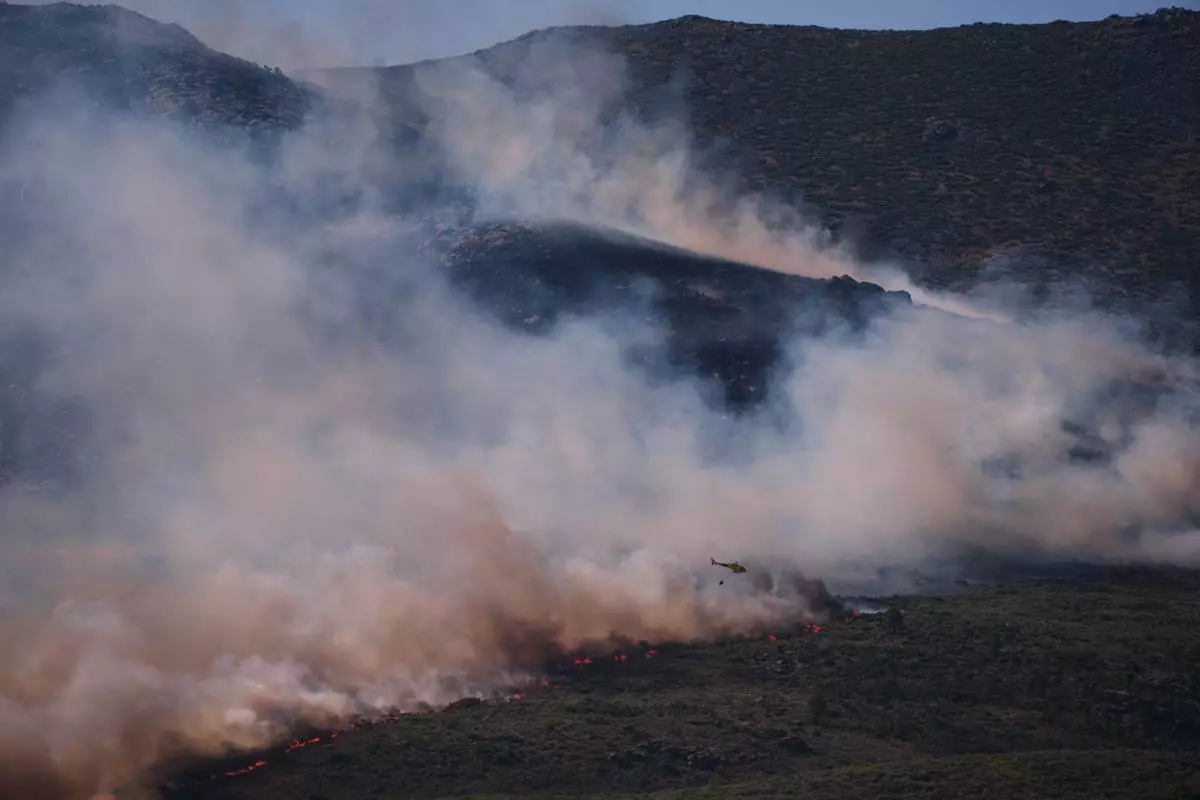
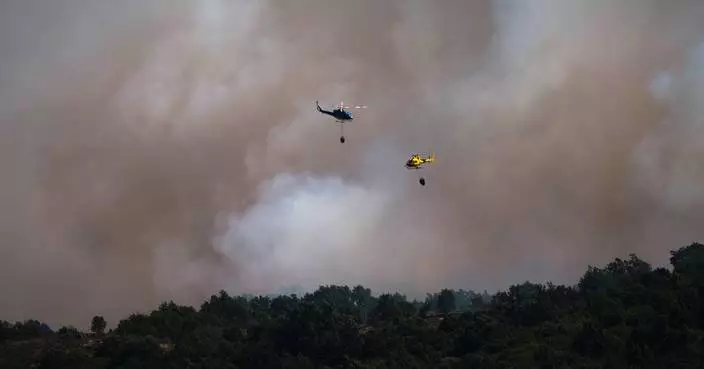
A firefighting helicopter drops water on the flames as a wildfire advances near Burgohondo, Ávila province, Spain, Friday, July 24, 2026. (AP Photo/Manu Fernandez)
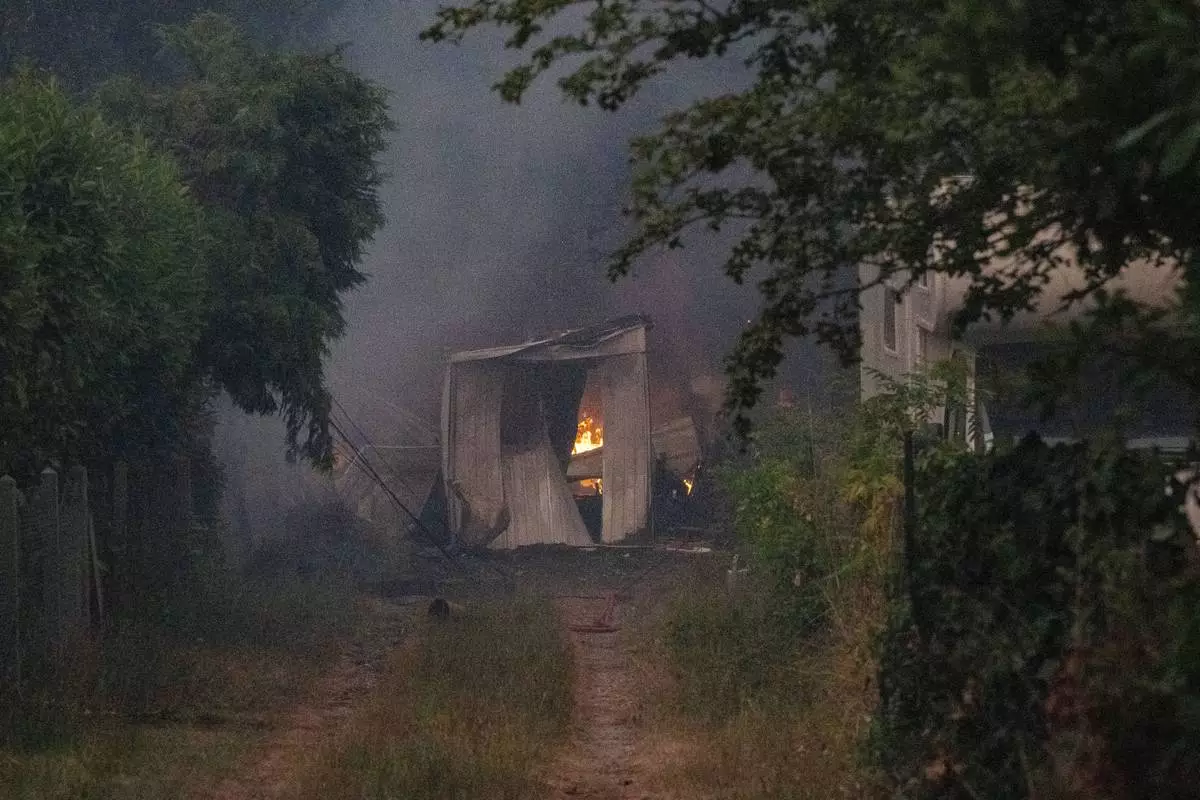
A burning barn is seen next to a farm house during wildfires near Le Porge, western France, Thursday, July 23, 2026. (AP Photo/Caroline Blumberg)
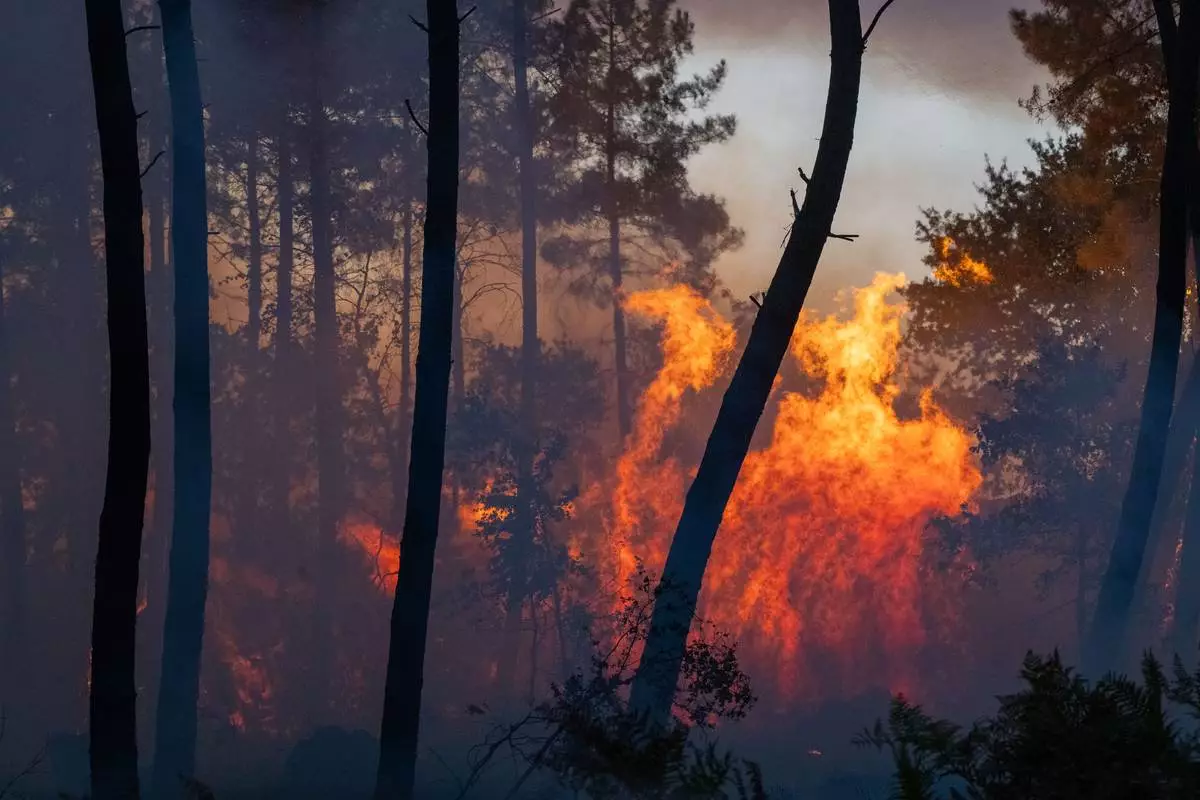
Wildfires advance near Le Proge region, western France, Thursday, July 23, 2026. (AP Photo/Caroline Blumberg)
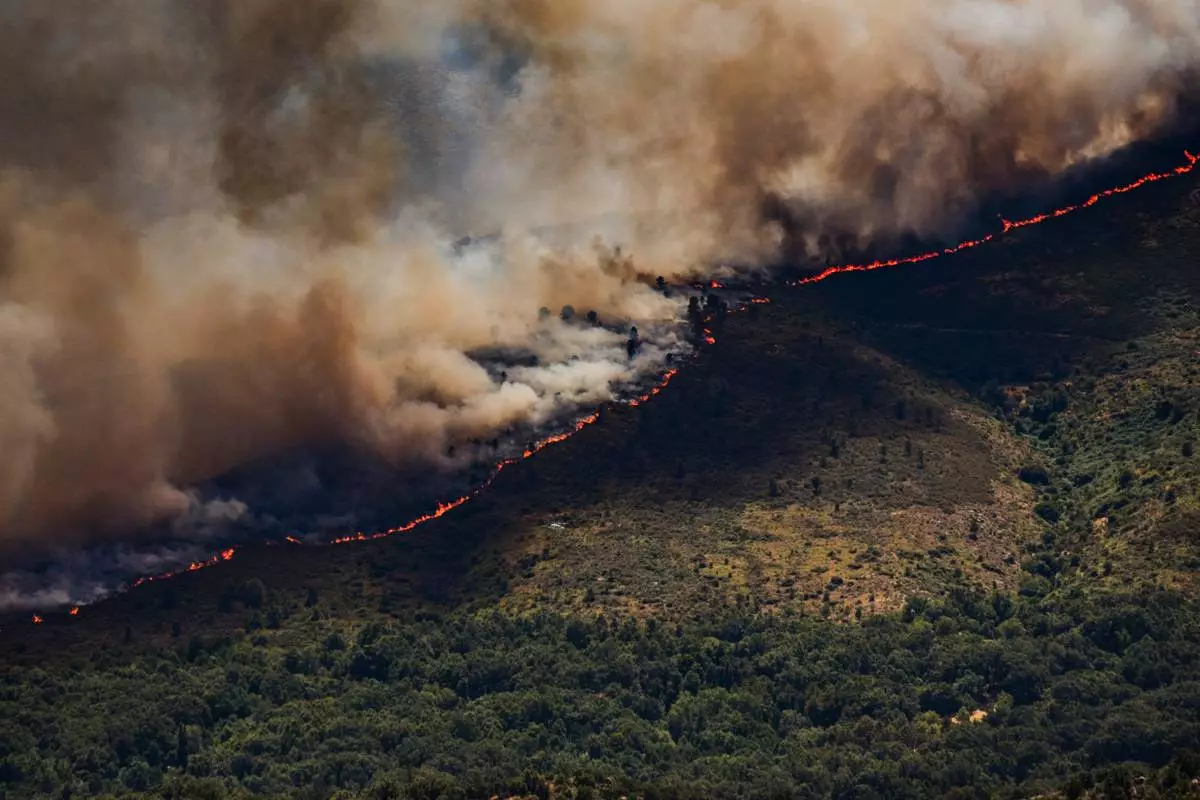
A wall of flames advances as a wildfire burns near Burgohondo, in Ávila province, Spain, Thursday, July 23, 2026. (Mateo Lanzuela/Europa Press via AP)

Residents spend the night at a sports center after being evacuated from their homes because of the threat of a wildfire in Cebreros, Ávila province, Spain, Friday, July 24, 2026. (AP Photo/Manu Fernandez)

Residents spend the night at a sports center after being evacuated from their homes because of the threat of a wildfire in Cebreros, Ávila province, Spain, Friday, July 24, 2026. (AP Photo/Manu Fernandez)

Residents spend the night at a sports center after being evacuated from their homes because of the threat of a wildfire in Cebreros, Ávila province, Spain, Friday, July 24, 2026. (AP Photo/Manu Fernandez)