Skip to Content Facebook Feature Image

UN agency sees US tariff increases as "wrong approach"
China

China

China

UN agency sees US tariff increases as "wrong approach"

2025-04-19 13:44 Last Updated At:19:57

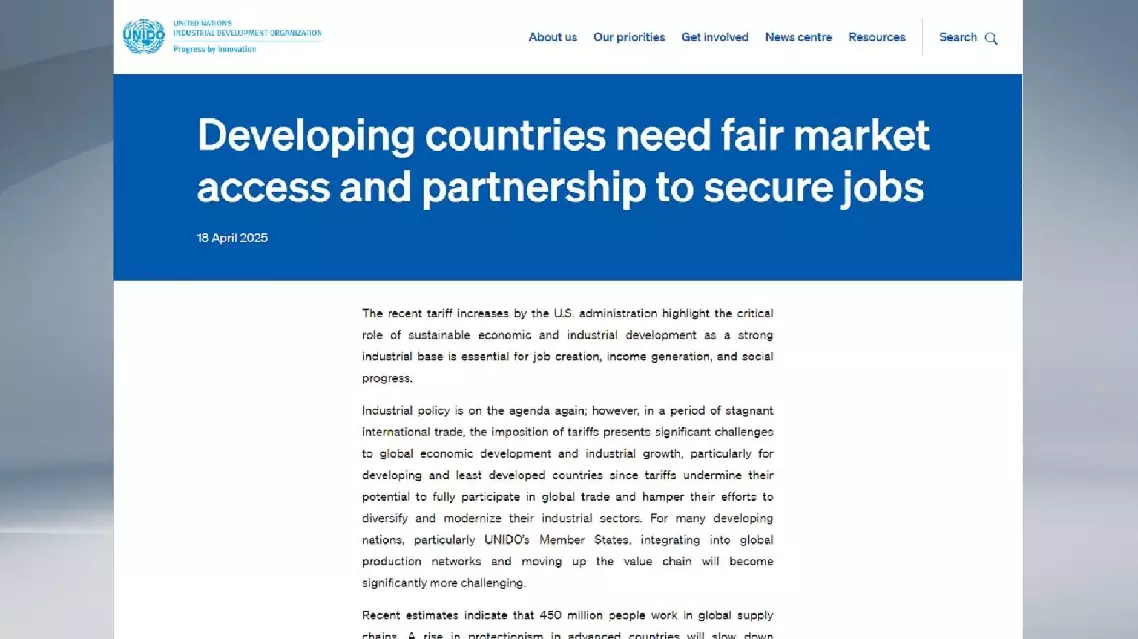
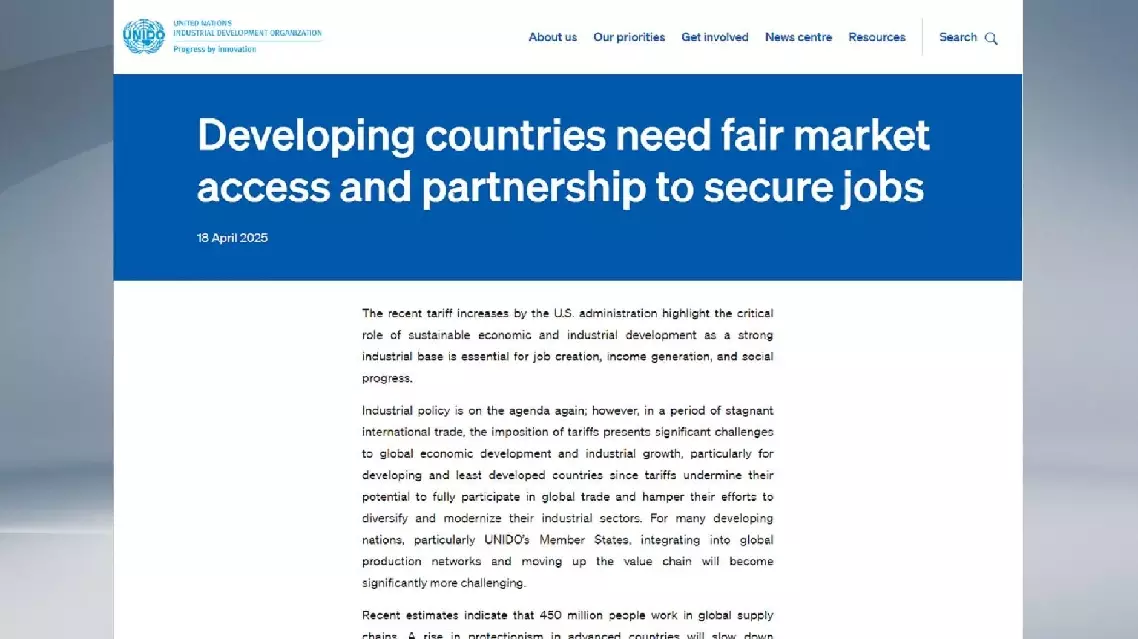
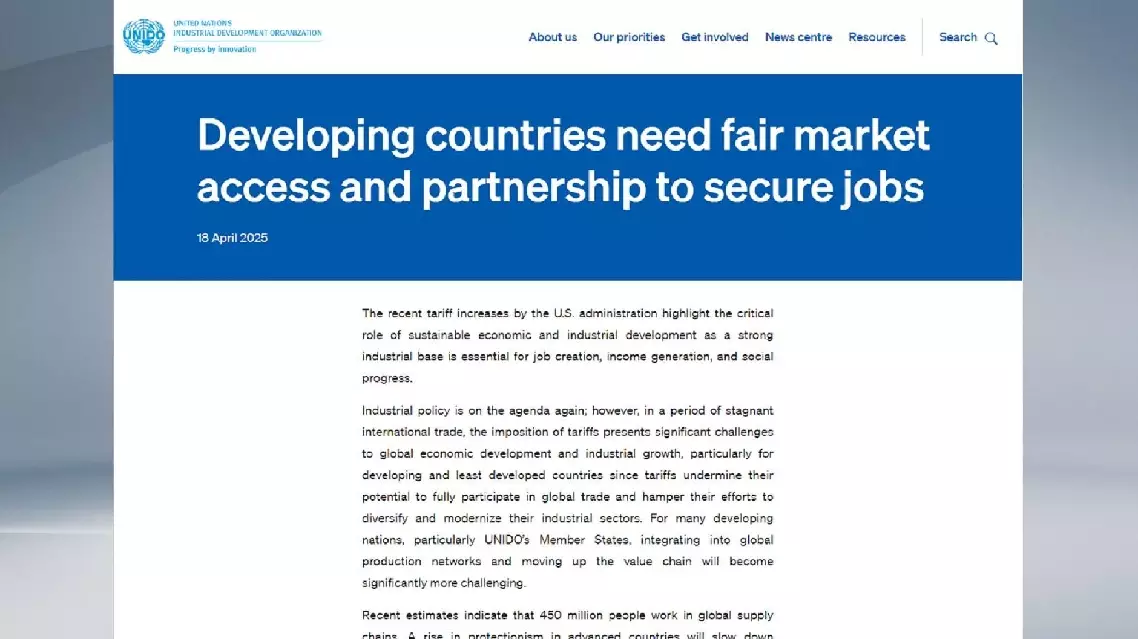
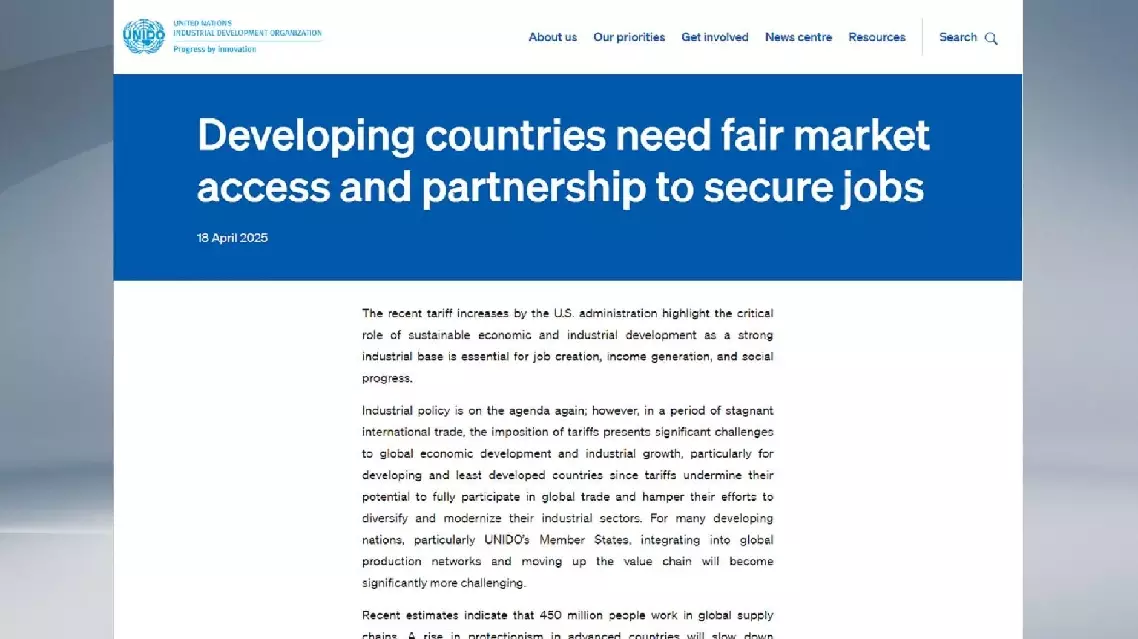
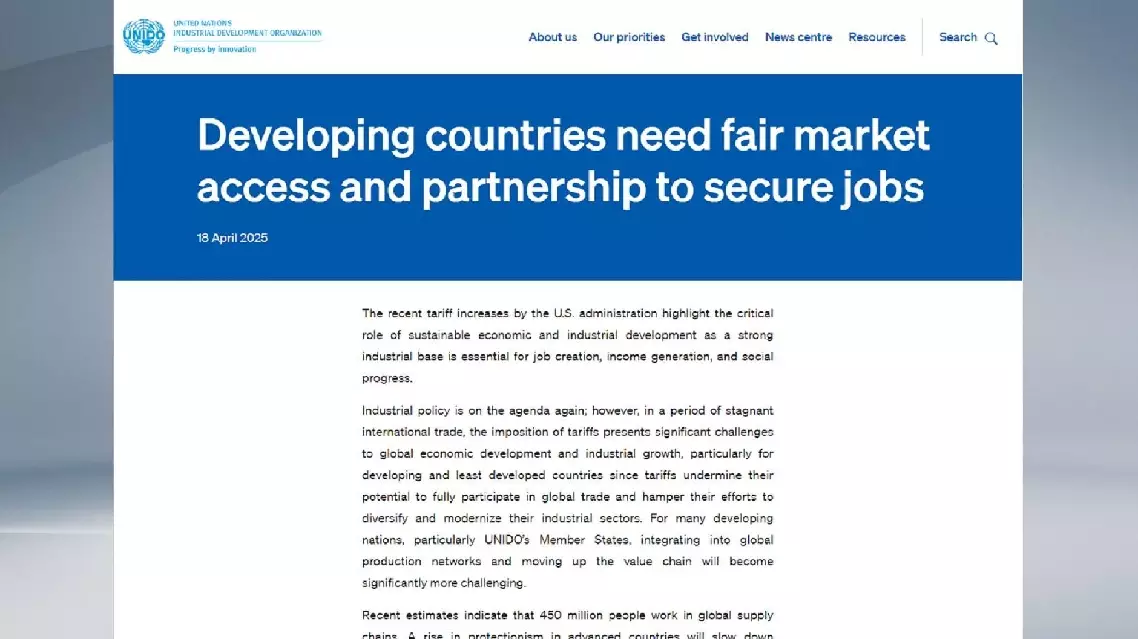
The recent tariff increases taken by the U.S. government is a "wrong approach" that presents significant challenges to global economic development and industrial growth, the United Nations Industrial Development Organization (UNIDO) said on Friday.

In an article published on its official website on Friday, UNIDO said the imposition of tariffs, in a period of stagnant international trade, particularly hurts developing and the least developed countries since tariffs undermine their potential to fully participate in global trade and hamper their efforts to diversify and modernize their industrial sectors.

More Images
UN agency sees US  tariff increases as "wrong approach"

UN agency sees US tariff increases as "wrong approach"
UN agency sees US  tariff increases as "wrong approach"
UN agency sees US tariff increases as "wrong approach"
UN agency sees US  tariff increases as "wrong approach"
UN agency sees US tariff increases as "wrong approach"
UN agency sees US  tariff increases as "wrong approach"
UN agency sees US tariff increases as "wrong approach"

UN agency sees US  tariff increases as "wrong approach"

UN agency sees US tariff increases as "wrong approach"
UN agency sees US  tariff increases as "wrong approach"

UN agency sees US tariff increases as "wrong approach"
By driving up the cost of industrial production, these tariffs undermine economic efficiency, diminish the benefits of trade, and weaken competitiveness, ultimately putting jobs at risk worldwide, thereby affecting the most vulnerable countries the hardest, it pointed out.

Noting that as 450 million people work in global supply chains, UNIDO said a rise in protectionism in advanced countries will slow down industrialization efforts and impede poverty reduction by limiting job creation and economic opportunities.

UNIDO warned that the negative effects of increasing tariffs will affect not only already vulnerable countries, but also the very countries implementing tariffs, exacerbating geopolitical tensions and uncertainty.

The UN agency asserted that these measures take the wrong approach, particularly as their calculation and implementation are not grounded in evidence to achieve the intended outcome.

Gerd Müller, director general of UNIDO said that rather than erecting barriers to industrial trade, a fairer and sustainable global economy should be the goal.

The U.S. withdrawal from development and economic cooperation and shared responsibility has set a dangerous chain in motion, with other industrialized countries reducing their commitments, Müller said.

Instead of cutting development budgets and now aggravating the situation by turning to economic protectionism and raising tariffs, the United States and all industrialized countries must work together with developing countries to create win-win situations and build a fairer and more sustainable global economy that ensures long-term prosperity for all, Müller emphasized.

Protectionism is not the answer to solving today's challenges, UNIDO said in the article reiterated, calling for the strengthening of global partnerships towards a more just international trade system, where all countries, especially developing and the least-developed countries, get to benefit from the global economy.

UN agency sees US  tariff increases as "wrong approach"

UN agency sees US tariff increases as "wrong approach"

UN agency sees US  tariff increases as "wrong approach"

UN agency sees US tariff increases as "wrong approach"

UN agency sees US  tariff increases as "wrong approach"

UN agency sees US tariff increases as "wrong approach"

UN agency sees US  tariff increases as "wrong approach"

UN agency sees US tariff increases as "wrong approach"

UN agency sees US  tariff increases as "wrong approach"

UN agency sees US tariff increases as "wrong approach"

UN agency sees US  tariff increases as "wrong approach"

UN agency sees US tariff increases as "wrong approach"

China's stock market demonstrated robust performance in 2025 with new records in various sectors.

Against the backdrop of global liquidity easing and evolving industrial policies, the A-share market experienced a landmark year. Multiple key metrics - including total market capitalization, trading volume, as well as margin trading and short selling balances - achieved historic breakthroughs, demonstrating remarkable vitality and resilience.

In terms of overall performance, as of Dec. 31, 2025, the total market capitalization of A-shares reached approximately 118.91 trillion yuan, marking a net increase of 25.30 trillion yuan from the year's opening level of 93.61 trillion yuan. This represents a growth rate of 27.03 percent, according to data from financial information provider Wind.

In 2025, major A-share indices extended their annual gains compared to 2024.

On Dec. 31, 2025, the Shanghai Composite Index stood at 3,968.84 points, marking an annual increase of 18.41 percent - the largest annual gain since 2020. The Shenzhen Component Index rose 29.87 percent for the year, while the ChiNext Index surged 49.57 percent. The Beijing Stock Exchange 50 Index recorded an annual gain of 38.80 percent, while the STAR Market 50 Index rose 35.92 percent for the year.

As major indices rose, market trading activity intensified. Throughout 2025, the A-share market recorded a total trading value of approximately 420 trillion yuan, marking a growth of over 60 percent compared to the previous year and nearly doubling the 2023 annual value. It also marked the first time in history that the annual trading value surpassed the 400 trillion yuan threshold.

The margin trading and short selling scale in the A-share market expanded rapidly in 2025. As of the year end, the outstanding margin trading and short selling balance in the A-share market increased by 690.7 billion yuan during the year to reach 2.5 trillion yuan, setting a new historical high.

Notably, the growth in the balance was primarily driven by the increase in the financing balance. Although the short selling balance also increased in 2025, its cumulative growth for the year was less than 10 billion yuan, with the absolute value of the short selling balance remaining at a low level in recent years.

As market sentiment continued to heat up, major sectors in the A-share market saw increases. Key industry sectors rose to varying degrees, with over half posting annual increases exceeding 30 percent.

Boosted by sharp rises in precious metal prices, the nonferrous metals sector delivered standout performance throughout 2025. Defense and military, telecommunications, machinery and equipment, automotive, power equipment, and electronics sectors also ranked among the top annual gainers. Sectors like food and beverages, coal, and banking showed relatively weaker annual performance but still managed modest gains.

Against the backdrop of a broad market rally, individual stocks also rose, with many delivering standout performances. Data indicates that over 4,200 A-shares saw price increases in 2025, accounting for more than three-quarters of the total. Specifically, after excluding newly listed stocks, over 500 A-shares still doubled in value, with more than 100 stocks achieving annual gains exceeding 200 percent.

China's stock market demonstrates strong performance with multiple new records in 2025

China's stock market demonstrates strong performance with multiple new records in 2025

Recommended Articles