JERUSALEM (AP) — An Israeli investigation into the killings of 15 Palestinian medics last month in Gaza by Israeli forces said Sunday it found a chain of “professional failures” and a deputy commander has been fired.
The shootings outraged many in the international community, with some calling the killings a war crime. Medical workers have special protection under international humanitarian law. The International Red Cross/Red Crescent called it the deadliest attack on its personnel in eight years.
Israel at first claimed that the medics' vehicles did not have emergency signals on when troops opened fire but later backtracked. Cellphone video recovered from one medic contradicted Israel’s initial account. Footage shows the ambulances had lights flashing and logos visible as they pulled up to help another ambulance that earlier came under fire.
The military investigation found that the deputy battalion commander acted under the incorrect assumption that all the ambulances belonged to Hamas militants. It said the deputy commander, operating under “poor night visibility,” felt his troops were under threat when the ambulances sped toward their position and medics rushed out to check the victims. The military said the flashing lights were less visible on night-vision drones and goggles.
The ambulances immediately came under a barrage of gunfire that went on for more than five minutes with brief pauses. Minutes later, soldiers opened fire at a U.N. car that stopped at the scene.
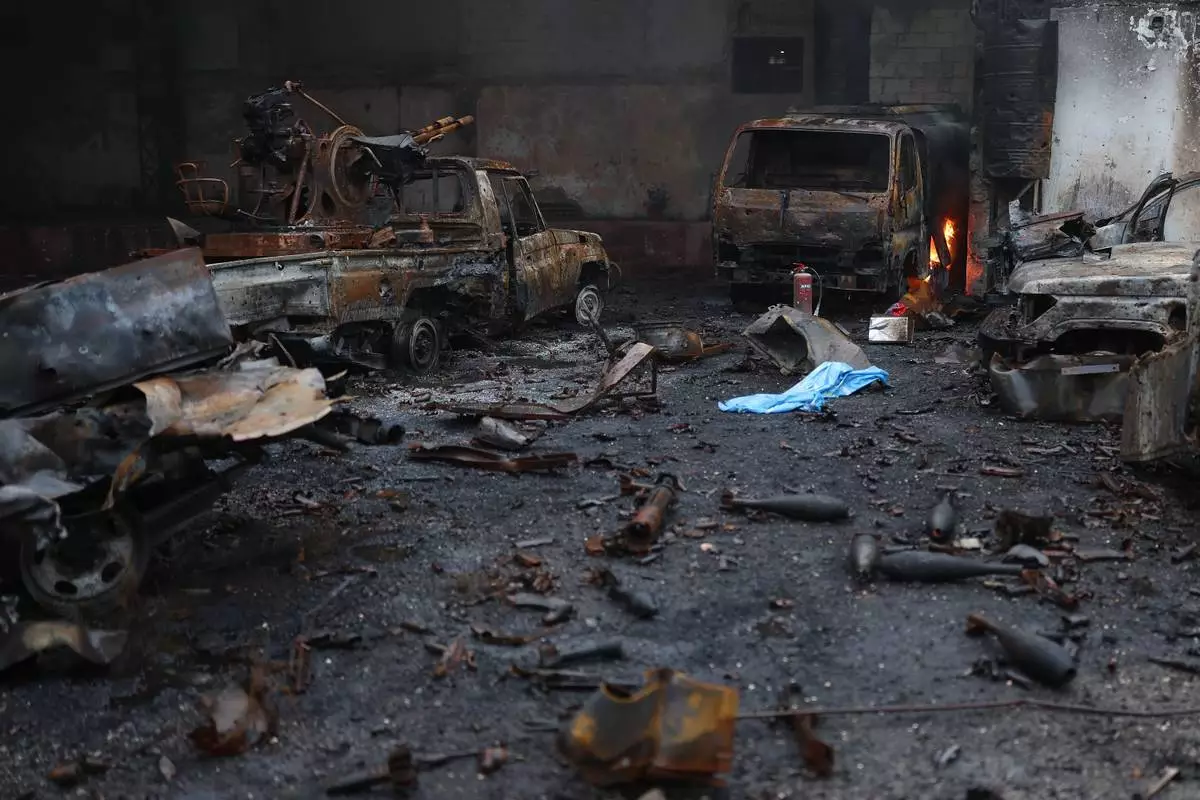
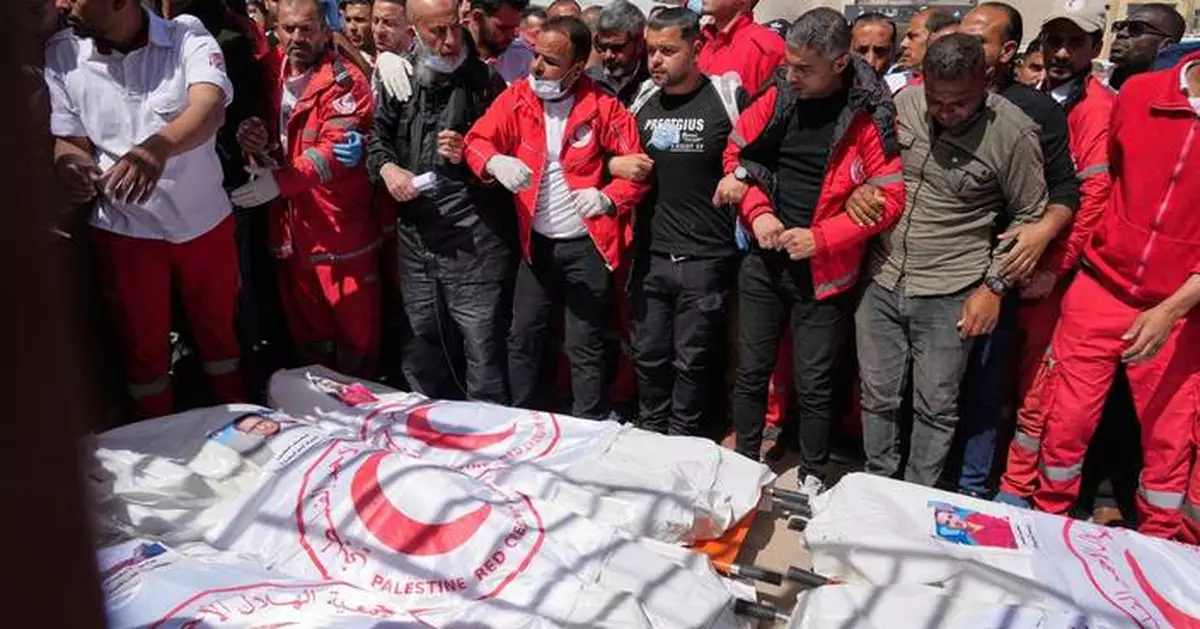
Eight Red Crescent personnel, six Civil Defense workers and a U.N. staffer were killed in the shooting before dawn on March 23 by troops conducting operations in Tel al-Sultan, a district of the southern Gaza city of Rafah. Troops bulldozed over the bodies along with their mangled vehicles, burying them in a mass grave. U.N. and rescue workers were only able to reach the site a week later.
The Israeli military said soldiers buried the bodies to prevent them from being mangled by stray dogs and coyotes until they could be collected, and that the ambulances were moved to allow the route to be used for civilian evacuations later that day.
The investigation found that the decision to crush the ambulances was wrong but said there was no attempt to conceal the shootings.
Mar. Gen. Yoav Har-Even, who oversees the military's investigations, said the military notified international organizations later that day and helped rescue workers locate the bodies.
The head of the Palestinian Red Crescent Society has said the men were “targeted at close range." Night-vision drone footage provided by the military shows soldiers were 20 to 30 meters away from the ambulances.
The deputy commander was the first to open fire, leading the rest of the soldiers to start shooting, Har-Even said. The investigation found the paramedics were killed due to an “operational misunderstanding” by Israeli forces, and that shooting at the U.N. car was a breach of orders.
The findings asserted that six of those killed were Hamas militants — it did not give their names — and said three other paramedics were originally misidentified as Hamas. The Civil Defense is part of the Hamas-run government.
No paramedic was armed and no weapons were found in any vehicle, Har-Even said.
One survivor was detained for investigation and remains in custody for further questioning. According to the military, soldiers who questioned the survivor thought he identified himself as a Hamas member, which was later refuted.
Har-Even said the deputy commander was fired for giving a not “completely accurate” report to investigators about the firing on a U.N. vehicle.
The statement on the findings concluded by saying that Israel’s military “regrets the harm caused to uninvolved civilians.”
“Without accountability, we risk continuing to watch atrocities unfolding, and the norms designed to protect us all, eroding. Too many civilians, including aid workers, have been killed in Gaza. Their stories have not all made the headlines,” Jonathan Whittall, interim head in Gaza of the U.N. humanitarian office OCHA, said in a statement responding to the findings.
There was no immediate public reaction from the Red Crescent or Civil Defense.
The findings have been turned over the Military Advocate General, which can decide whether to file civil charges. It is meant to be an independent body, with oversight by Israel’s attorney general and Supreme Court.
There are no outside investigations of the killings underway.
Israeli strikes have killed more than 150 emergency responders from the Red Crescent and Civil Defense, most of them while on duty, as well as over 1,000 health workers during the war, according to the U.N. The Israeli military rarely investigates such incidents.
Israel has accused Hamas of moving and hiding its fighters inside ambulances and emergency vehicles, as well as in hospitals and other civilian infrastructure, arguing that justifies strikes on them. Medical personnel largely deny the accusations.
Palestinians and international human rights groups have repeatedly accused Israel’s military of failing to properly investigate or whitewashing misconduct by its troops.
Har-Even said the Israeli military is currently investigating 421 incidents in Gaza during the war, with 51 concluded and sent to the Military Advocate General. There was no immediate information on the number of investigations involving potential wrongful deaths or how many times the MAG has pursued criminal charges.
The International Criminal Court, established by the international community as a court of last resort, has accused Israeli Prime Minister Benjamin Netanyahu and former defense minister Yoav Gallant of war crimes. Israel, which is not a member of the court, has long asserted that its legal system is capable of investigating the army, and Netanyahu has accused the ICC of antisemitism.
The war in Gaza began when Hamas-led militants attacked southern Israel on Oct. 7, 2023, killing about 1,200 people, mostly civilians, and abducting 251. Most of the hostages have been released in ceasefire agreements or other deals. Hamas currently holds 59 hostages, 24 of them believed to be alive.
Israel’s offensive has since killed over 51,000 Palestinians, mostly women and children, according to Gaza’s Health Ministry, which does not distinguish between civilians and combatants.
Frustration has been growing on both sides, with rare public protests against Hamas in Gaza and continued weekly rallies in Israel pressing the government to reach a deal to bring all hostages home.
Follow coverage of the war at https://apnews.com/hub/israel-hamas-war
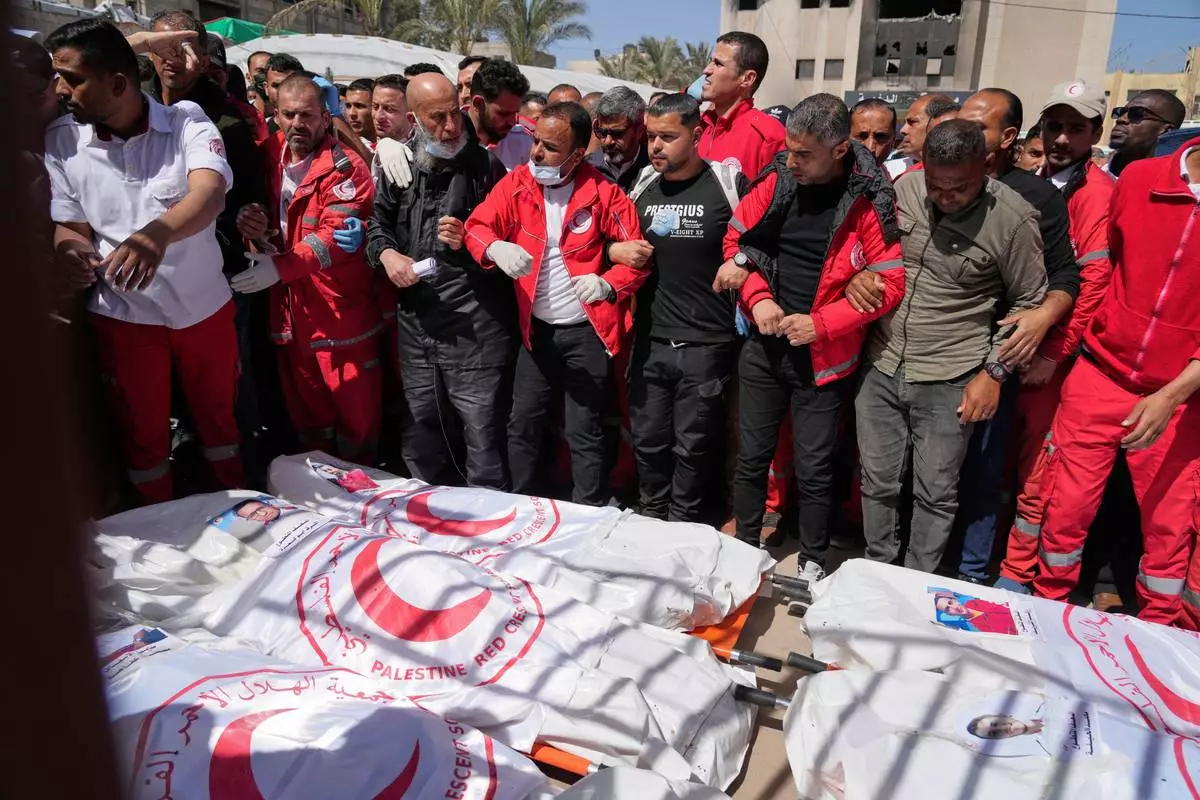
FILE.- Mourners gather around the bodies of 8 Red Crescent emergency responders, recovered in Rafah a week after an Israeli attack, as they are transported for burial from a hospital in Deir al-Balah, Gaza Strip, on Monday, March 31, 2025. (AP Photo/Abdel Kareem Hana, file)