ATLANTA (AP) — Georgia Democrat Jason Esteves announced on Monday that he's running for governor in 2026, entering a field that remains murky for his party after two top potential candidates backed away from a run.
The 41-year-old state senator, also a lawyer and business owner, remains largely unknown outside his state Senate district, which includes parts of Fulton and Cobb counties. An early announcement could help him to raise money and increase his visibility.
He's likely to emphasize his biography, including his young children and his past service as a public school teacher. Esteves has also served as treasurer of the state Democratic Party, giving him a network among Democratic activists.
In a video announcing his candidacy, Esteves sounded a note of opposition to Republican President Donald Trump while saying he would emphasize lowering the cost of living, including housing costs, as well as expanding health care, restoring abortion rights and increasing funding for schools.
“I’m running for Governor to make Georgia the number one place to work, start a business, and raise a family," Esteves said in a statement. "As extreme politicians in Georgia push Trump’s reckless agenda and rig the system for special interests, Georgians pay the price."
Incumbent Republican Gov. Brian Kemp is term-limited after two terms and can't seek reelection in 2026.
Former Atlanta Mayor Keisha Lance Bottoms has said she plans to run for governor as a Democrat, but has not yet filed papers to create a campaign. Former DeKalb County CEO Michael Thurmond has also expressed interest, and two-time nominee Stacey Abrams could yet choose to run again.
On the Republican side, Attorney General Chris Carr announced his run for governor last year and Lt. Gov. Burt Jones is expected to announce his candidacy soon.
Esteves enters the race as two potential Democratic candidates step back to focus on family health concerns.
Former state Sen. Jason Carter, Democrats’ 2014 nominee and grandson of the late former President Jimmy Carter, said he has no plans to seek the 2026 nomination because of his wife’s cancer diagnosis. Kate Carter has glioblastoma, an aggressive form of brain cancer. The couple has two teenage sons.
“For all intents and purposes, I can’t imagine making a decision to run because it’s the wrong time for my family,” Carter, 49, told The Associated Press on Monday.
U.S. Rep. Lucy McBath announced on March 31 that she was suspending her exploratory bid for governor in 2026, saying she needed to focus on her husband Curtis’ health after complications from cancer surgery. The four-term member of Congress, best known as a gun control advocate, had filed papers on March 5 to raise money for governor.
Carter has been mentioned as a centrist candidate with high name identification who could run as a bridge between the Democrats’ base and voters who might be up for grabs if President Donald Trump’s popularity and the Republican brand take a dip heading into 2026.
An Atlanta attorney who has been out of politics since losing the 2014 governor's race, Carter has drawn renewed attention in recent years as Carter Center board chairman and family spokesperson as his grandparents’ health declined. He eulogized his grandfather in January at the 39th president’s state funeral in Washington and did the same for his grandmother, Rosalynn Carter, at her Atlanta funeral in December 2023.
The younger Carter said he’s “not going to endorse anybody,” but added, “I’m very excited about Jason (Esteves)” and what he can offer voters and the party.
Esteves first won election to the state Senate in 2022 after nine years on the Atlanta school board. He was chair of the board for four years, including part of the time that the distict was heavily impacted by COVID-19. He touts increased graduation rates and higher pay for staff during that time, but some parents were displeased with how long it took the district to resume in-person classes.
While Esteves was leading the board, it also decided not to renew Superintendent Meria Carstarphen's contract, which causes a stir among those who supported Carstarphen's leadership following the school district's cheating scandal.
Esteves and his wife, Ariel, own Flying Biscuit restaurants in Macon and Columbus, Esteves' hometown. He and his wife also own an urgent and primary care clinic. They have two children.
Associated Press writer Bill Barrow contributed to this report.
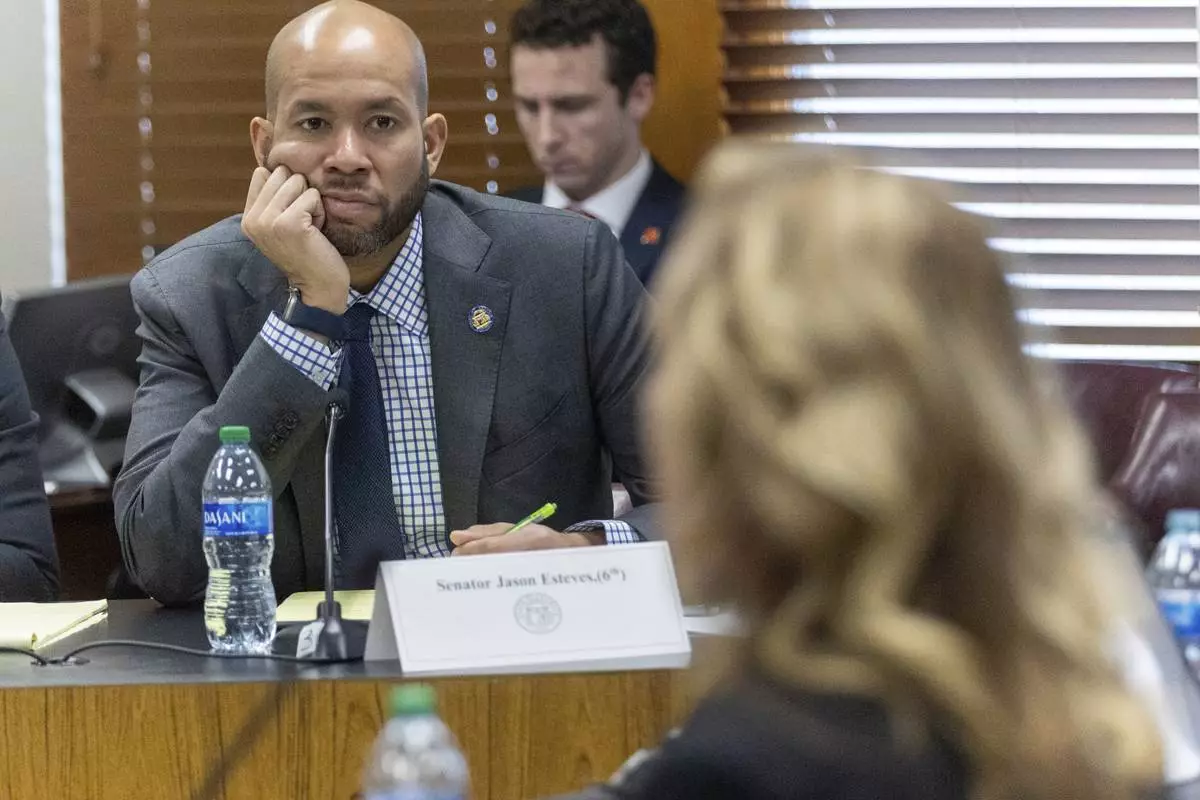
FILE -- Georgia state Sen. Jason Esteves, (D-Atlanta) listens to testimony during a Senate hearing at the Georgia State Capitol on Wednesday, March 6, 2024 in Atlanta. (Steve Schaefer/Atlanta Journal-Constitution via AP, File)
HONG KONG (AP) — From 18th place to 140th. That's how much Hong Kong's ranking plunged in a global press freedom index over some 20 years.
Behind the decline are the shutdown of pro-democracy newspaper Apple Daily, more red lines for journalists and increasing self-censorship across the territory. The erosion of press freedom parallels a broader curtailment of the city's Western-style civil liberties since 2020, when Beijing imposed a national security law to eradicate challenges to its rule.
Apple Daily founder Jimmy Lai was convicted in December under the security law, facing up to life in prison. Hearings began Monday for Lai and other defendants in the case to argue for a shorter sentence.
His trial has been watched closely by foreign governments and political observers as a barometer of media freedom in the former British colony, which returned to Chinese rule in 1997. The government insists that his case has nothing to do with press freedom.
Hong Kong's media environment was once freewheeling. Journalists often asked the government aggressive questions even as the owners of their outlets were pro-Beijing. News outlets regularly broke stories critical of politicians and officials.
But the space for reporters has drastically narrowed after China imposed the security law, which it deemed necessary for stability after huge anti-government protests in 2019.
In 2020, Lai became one of the first prominent figures charged under the law. Within a year, authorities used the same law to arrest senior executives of Apple Daily. They raided its office and froze $2.3 million of its assets, effectively forcing the newspaper to shut down in June 2021.
Online news site Stand News met a similar fate in December of that year, with arrests, police raids and asset freezes forcing its shutdown. By 2022, Hong Kong had plunged 68 places to 148th in the press-freedom index compiled by media freedom organization Reporters Without Borders.
In 2024, two Stand News editors became the first journalists since 1997 to be convicted of conspiracy to publish seditious articles under a separate, colonial-era law.
In December, Lai was found guilty of conspiring with others to collude with foreign forces and conspiracy to publish seditious articles. Six Apple Daily executives charged in the same case had entered guilty pleas, admitting they conspired with Lai to request sanctions, blockades or engage in other hostile activities against Hong Kong or China.
Francis Lee, a journalism and communication professor at the Chinese University of Hong Kong, said the Apple Daily and Stand News cases indicate that some common news practices of the past are no longer permitted. The Stand News case showed that some strongly critical commentaries with relatively intense expression might be considered seditious, he said. Lai's case involved allegations of calling for foreign sanctions.
“Maybe some advocacy journalism was at least permitted within the legal framework back then," he said, referring to before the security law was introduced. “Today, it’s no longer allowed.”
Self-censorship has become more prominent, but not only because of politics. Lee said mainstream news outlets face greater pressure not to upset their vital revenue streams, including advertisers and big companies, amid a difficult business environment.
Many large companies in the city value the vast mainland Chinese market and ties with the government.
Finding interviewees is not easy, either. “In Hong Kong nowadays, when some topics and perspectives cannot be reported, it's not just because of media outlets practicing self-censorship," Lee said. “No one is willing to speak. Self-censorship is a broad social phenomenon."
Many opposition politicians and leading activists were jailed under the security law. Dozens of civil society groups closed down. Facing potential risks, some residents also became more reluctant to talk to reporters.
Hong Kong Journalists Association chairperson Selina Cheng said many stories perceived to be politically sensitive or potentially questioning the authorities are not always easily published. There is an outsized concern over including responses from the government and pro-China groups to create balance, she said.
“To do journalism in Hong Kong means that people always have to worry at the back of their heads: What are the risks that they may get involved in?” said Cheng.
A massive fire that killed at least 161 people in an apartment complex in late November revealed some of these shifts.
After the fire broke out on Nov. 26, reporters, including those from newer online outlets, went out in force to cover Hong Kong’s deadliest blaze in decades. They interviewed affected residents, investigated scaffolding nettings that authorities said had contributed to the blaze's rapid spread, and reported on concerns over the government’s oversight.
Cheng was encouraged by the coverage of the aftermath. But warnings and arrests followed.
Beijing’s national security arm in Hong Kong summoned representatives of several foreign news outlets, including The Associated Press, on Dec. 6. The Office for Safeguarding National Security said some foreign media had spread false information and smeared the government’s relief efforts after the fire and attacked the legislative election.
After arrests of non-journalists who posted allegedly seditious content online or organized a petition, public voices grew quieter, leaving reporters with fewer interviewees, Lee said.
A planned news conference related to the fire, organized by people including former pro-democracy district councilors, was canceled. Bruce Liu, an organizer, was summoned by police for a meeting the same day. An investigative report on the maintenance project by a pro-Beijing newspaper is no longer viewable on its website.
Ellie Yuen, who wrote a social media post questioning regulators’ oversight that went viral, said she stopped posting about the fire for “obvious reasons” without elaborating.
Cheng raised concerns over what she called the “more covert muscling of people speaking out."
“If this keeps happening, then it’s much harder for the public to know what they’re missing out on," she said.
In an emailed reply to the AP's questions, the government strongly condemned attempts to use the fire as an excuse to smear the administration with baseless accusations.
“Human rights and freedoms of Hong Kong residents have all along been firmly protected by the constitution and the Basic Law,” it said.
Beyond reporting restrictions, Cheng’s trade union previously raised concerns about some journalists facing unwarranted tax audits and harassment through anonymous messages. The Inland Revenue Department has maintained that the background of a taxpayer has no bearing on its reviews.
Cheng has launched a lawsuit against her former employer, The Wall Street Journal, for allegedly firing her over her union role.
Both Cheng and Lee said journalists are still learning to survive in the narrowing space.
In October, Cheng’s association showed journalists’ ratings of the city’s press-freedom index rebounded slightly.
“Today’s situation is far from the previous state of freedom," Lee said. “Self-censorship throughout society is severe. Yet some media outlets are still finding ways.”
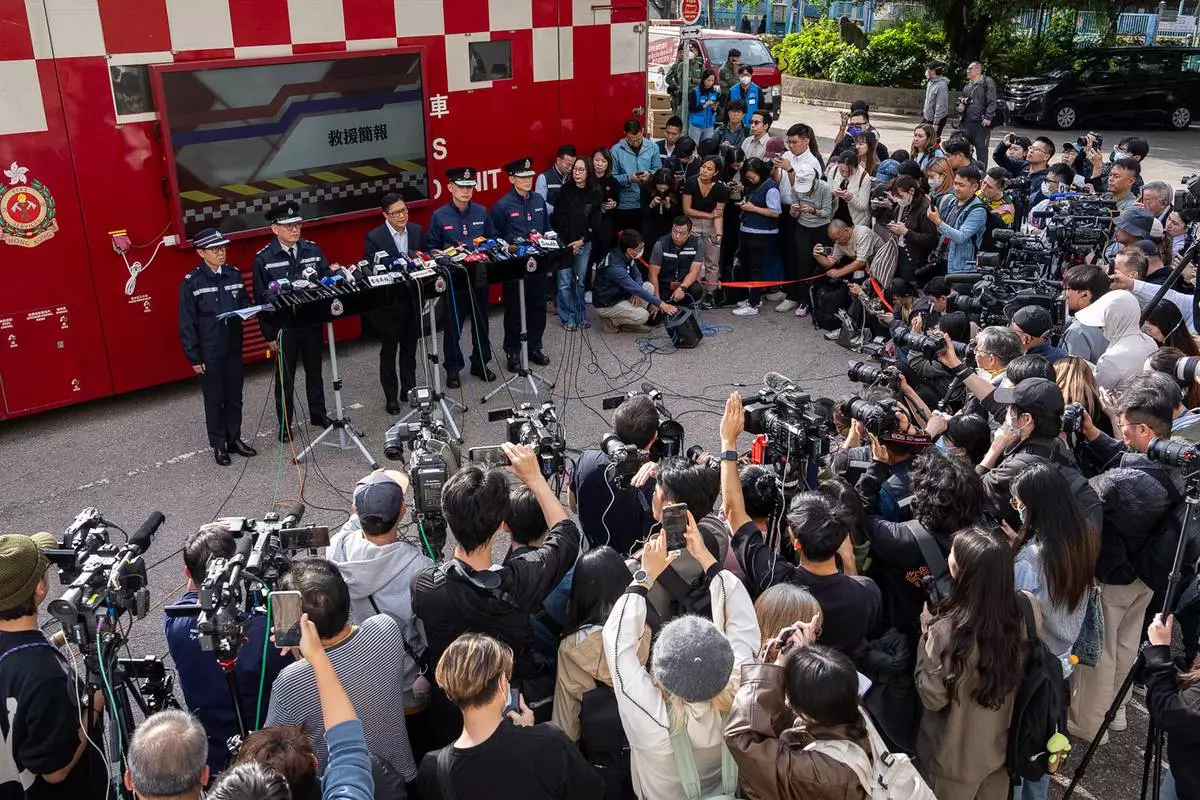
FILE- Hong Kong Secretary for Security Chris Tang, third from left at rear, speaks to the members of media after a deadly fire at Wang Fuk Court, a residential estate in the Tai Po district of Hong Kong's New Territories, Nov. 28, 2025. (AP Photo/Chan Long Hei, File)
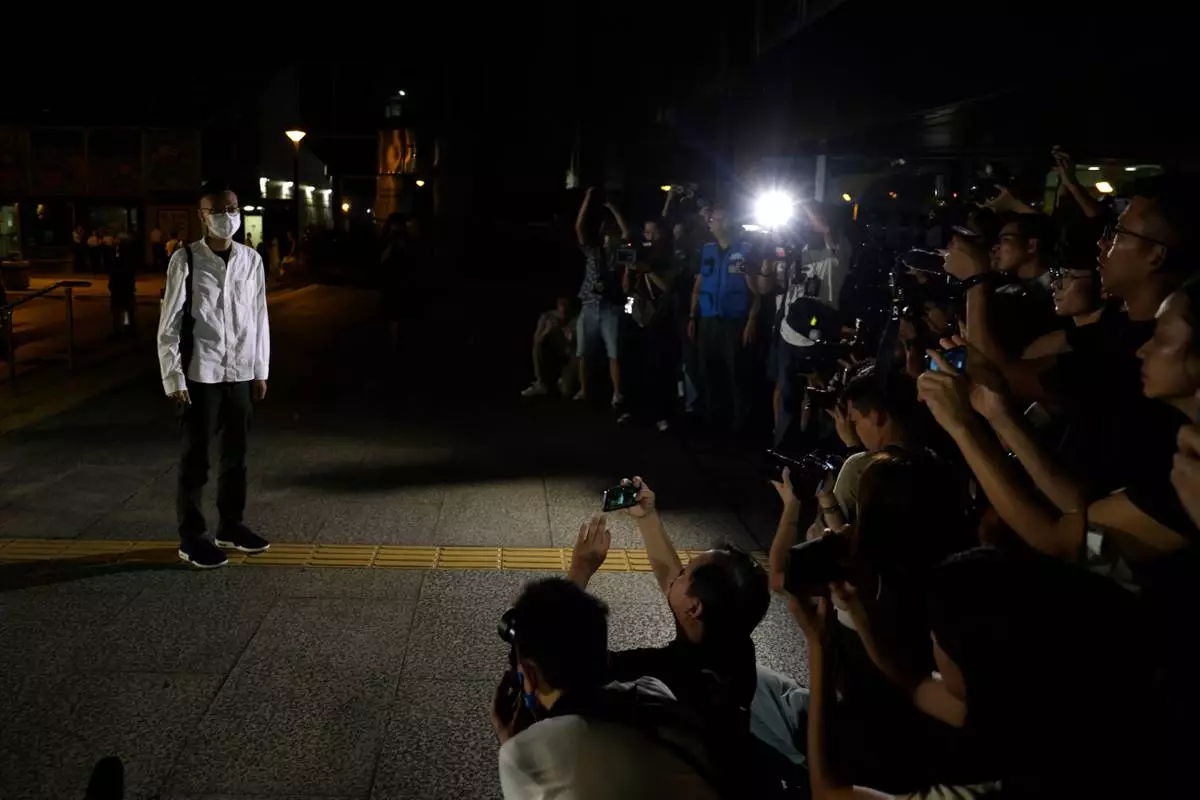
FILE- Patrick Lam, the former acting editor-in-chief of Hong Kong's now shuttered pro-democracy news outlet Stand News stands before the gathered media as he leaves the Wanchai District Court after the final sentencing in Wan Chai district court, in Hong Kong on Sept. 26, 2024. (AP Photo/May James, File)
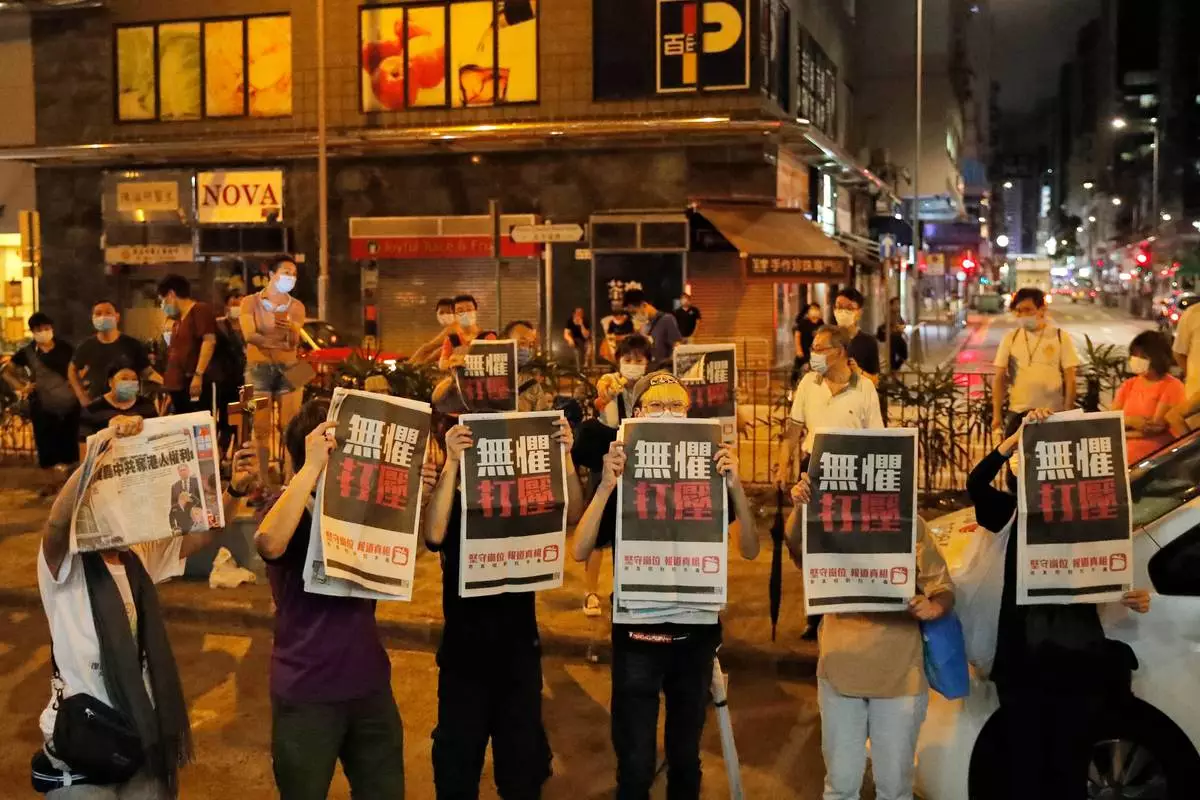
FILE -Supporters of Hong Kong media tycoon Jimmy Lai hold the copies of Apple Daily newspaper as Lai leaves a police station after being bailed out in Hong Kong, Wednesday, Aug. 12, 2020. (AP Photo/Kin Cheung, File)
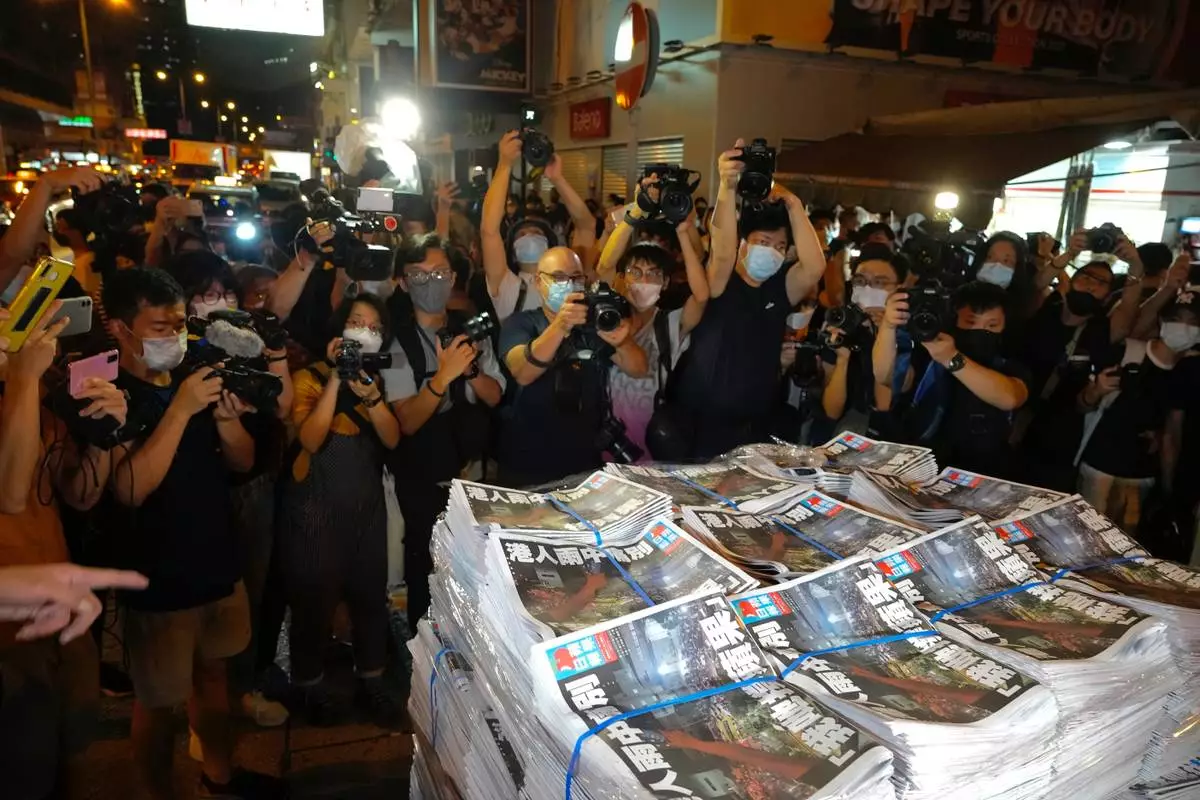
FILE - Members of the media take photos of stacks of the last issue of Apple Daily as they arrive at a newspaper booth in Hong Kong, June 24, 2021. (AP Photo/Vincent Yu, File)
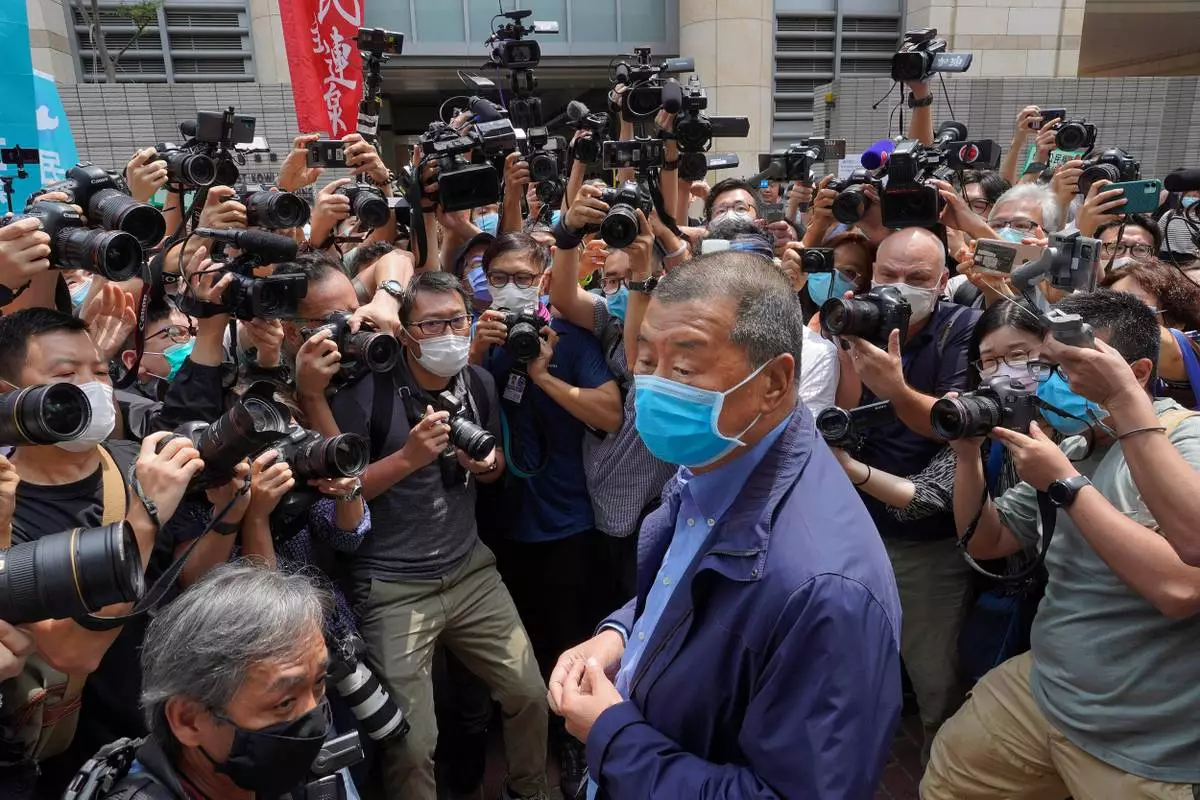
FILE - Hong Kong media tycoon Jimmy Lai, center, wearing a face mask arrives at court for charges relating to unlawful protests in Hong Kong, May 18, 2020. (AP Photo/Vincent Yu, File)