RHODES, Greece--(BUSINESS WIRE)--Apr 21, 2025--
On April 12, SenseRobot and the European Chess Union (ECU) officially signed a strategic partnership during a signing ceremony held in Rhodes, Greece. This collaboration represents a significant step toward modernizing chess education and development, combining ECU’s established institutional framework with SenseRobot’s AI-driven technology, contributing to the long-term growth and evolution of the sport.
This press release features multimedia. View the full release here: https://www.businesswire.com/news/home/20250414681411/en/
The partnership with ECU reflects a broader shift in how chess training is delivered. It moves away from traditional, passive methods toward more dynamic, data-driven approaches. At the event, SenseRobot donated its robots to the Italian Chess Federation, the Slovenian Chess Federation, and the Turkish Chess Federation, with the aim of jointly promoting exchanges and cooperation in the field of chess.
Apex Duel: Human vs AI
To commemorate the signing, SenseRobot took part in a high-profile Apex Duel on April 12 during the European Women's Chess Championship 2025 in Rhodes, Greece, featuring a face-off between the AI chess robot and Grandmaster Antoaneta Stefanova, former Women’s World Chess Champion.
The match of two 15min games offered a compelling demonstration of AI’s evolving capabilities in strategic gameplay. SenseRobot displayed remarkable positional understanding and tactical depth, engaging Stefanova in a closely contested battle that captivated the audience.
At the first game SenseRobot playing with white using its highest level of 3200 rating outplayed Antoaneta Stefanova. At the second game SenseRobot playing with black adjusted its level to 2200 rating. Antoaneta Stefanova achieved a winning position; she denied 3-repetition moves draw but she ran out of time and SenseRobot won the second game.
Driving Chess into the Age of AI
As part of the partnership agreement, each ECU member federation will be provided with a SenseRobot unit—an AI-powered chess robot designed to support training, education, and analytical practice. The technology incorporates adaptive learning features, including over 1,200 structured exercises, ELO-based matchmaking, and a range of endgame scenarios, making it suitable for users at various skill levels, from beginners to advanced players and coaches.
SenseRobot is capable of simulating playing strengths across a broad ELO spectrum (200–2900), offering users customized training experiences and real-time feedback. Its compatibility with international platforms such as Lichess.org also enables players to engage in global matches from home, expanding access to competitive gameplay and fostering continuous learning beyond traditional settings.
On April 11, SenseRobot has officially debut on the global crowdfunding platform Indiegogo, introducing its AI-Powered Smart Chess Coach and Companion to a broader international audience.
Follow the Indiegogo Page and get the super early bird price:
https://www.indiegogo.com/projects/senserobot-the-world-s-first-home-al-chess-robot/reft/38501287/
About SenseRobot
SenseRobot is a leading smart home robotic brand, pioneering the category of AI-powered household chess robots. As the world's first company to mass-produce intelligent robotic arms for domestic use, SenseRobot is committed to bringing cutting-edge AI technology into every home. Guided by a design philosophy centred on “innovative, eye-care, cognitive stimulation, and companionship,” SenseRobot aims to nurture the health, learning, and overall development of its users.

DUBAI, United Arab Emirates (AP) — The United States launched a second round of airstrikes on Iran into Thursday morning after U.S. President Donald Trump warned that Tehran would “pay the price” for stalled negotiations, and Iran responded with strikes targeting Bahrain, Kuwait and Jordan.
The new U.S. assault across multiple Iranian cities came as efforts to negotiate an end the war again appeared stuck, with Iran insisting it would maintain its chokehold on the Strait of Hormuz, which has disrupted global energy supplies and sent oil prices higher. The American attack appeared more intense and wider than the day before, but Iran released little information on the extent of the damage.
Kuwait closed its airspace for several hours because of the Thursday morning attack, but did not elaborate on any damage. Jordan didn't acknowledge the attack, though the U.S. Embassy in Amman warned about it. And in Bahrain, its Interior Ministry said an 11-year-old girl had been hurt and cars and homes were damaged by “falling debris” from interceptions targeting the Iranian attack.
The third back-and-forth strikes this week have tested a two-month shaky ceasefire. The first were attacks between Iran and Israel on Sunday into Monday, followed by the two rounds of fire between America and Tehran.
Trump has urged Iran to sign a deal to end the war and suggested earlier this week that an agreement could be reached in days.
But Iran has proved resilient despite weeks of heavy bombing. It is betting that its ability to effectively close the Strait of Hormuz — a crucial passageway for oil and natural gas — gives it a strong bargaining chip.
Still, both countries seem to be looking for a way to end the conflict — if they can manage to sell it as a win at home.
Meanwhile, Israeli Prime Minister Benjamin Netanyahu appears intent on pursuing goals that make compromise harder: the collapse of Iran’s theocratic government, the elimination of its nuclear program, and the destruction of the Iranian-allied Hezbollah militant group in Lebanon.
The U.S. Central Command said its latest round of airstrikes ended just before sunrise Thursday in Iran. The military command said the strikes came “in response to Iran’s unwarranted and continued aggression” and targeted “Iranian military surveillance capabilities, communication systems and air defense sites.” It did not elaborate on the damage done by the strikes, which it said were carried out by the U.S. Air Force, Marines and Navy.
Explosions from the strikes echoed around Iran’s capital, Tehran, as well as the port city of Bandar Abbas and other southern areas along the Strait of Hormuz. Iran's paramilitary Revolutionary Guard later said sites hit by the Americans included a manufacturing complex, a military barracks and a local Guard base outside of Tehran.
Iran responded by launching strikes on Bahrain, Kuwait and Jordan for a second day.
Israel early Thursday also warned residents in the north to seek shelter after the detection of suspected incoming fire from Lebanon.
Since the U.S. and Israel started the war with Feb. 28 attacks on Iran, the conflict has shaken the global economy, driven up energy prices and made food and other basics more expensive.
The international benchmark for crude oil traded above $93 a barrel on Wednesday, up more than 25% since the start of the war.
Trump said the U.S. military has since last month undertaken a “secret mission” to sneak oil shipments past Iran’s forces in the Strait of Hormuz. He said ships were slipping through at night, aided by the destruction of Iranian radar equipment.
Trump said as a result more than 100 million barrels of oil have evaded Iran’s chokehold on the strait. There was no immediate confirmation of that figure, which roughly equals five days of oil shipments through the waterway before the war began.
The military’s role was not immediately clear. The U.S. Central Command on Wednesday disputed Iran’s claims that the Strait of Hormuz is closed, saying commercial ships are continuing to transit in and out.
Wary of high gas prices in the run-up to midterm elections in November, Trump seems to be looking for a quick win. But he is also making demands that will be tough for Iran to swallow.
The U.S. wants to see Iran give up its stockpile of highly enriched uranium. While Iran insists its nuclear program is peaceful, that uranium is a short technical step from weapons-grade levels.
Iran is refusing to give up the uranium and demanding relief from sanctions. It also wants the release of frozen assets even before a final agreement is in place, something Trump rejected.
Iran has insisted that any deal to end the war must also end fighting between its ally Hezbollah and Israel.
A Qatari diplomatic delegation, negotiating in coordination with the U.S., left Tehran on Thursday morning after holding talks, said an official with knowledge of the team who spoke on condition of anonymity to discuss the mediation.
Price and Toropin reported from Washington. AP journalist Victoria Eastwood in Cairo contributed to this report.

A woman adjusts her headscarf as she crosses an intersection in northern Tehran, Wednesday, June 10, 2026. (AP Photo/Vahid Salemi)

A projectile streaks through the sky over central Israel during an Iranian missile attack, Sunday, June 7, 2026. (AP Photo/Ohad Zwigenberg)
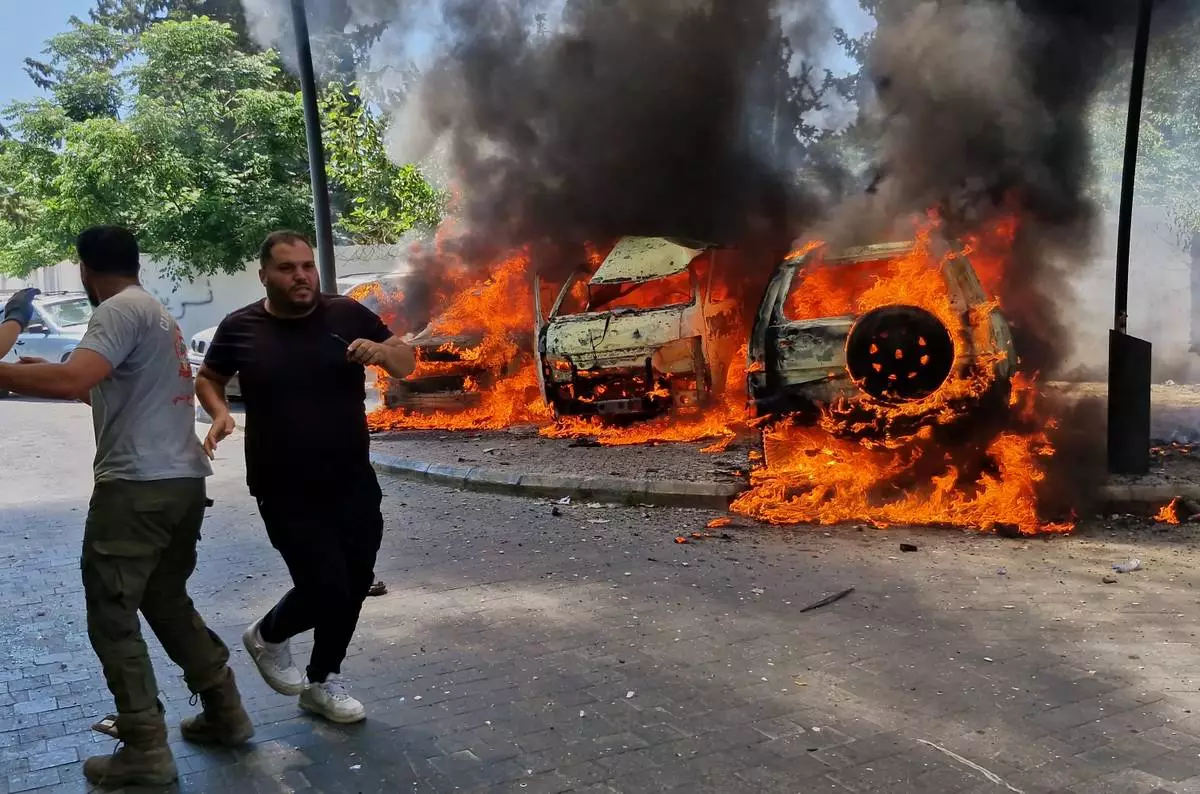
A man runs past burning cars following an Israeli airstrike in the southern port city of Sidon, Lebanon, Wednesday, June 10, 2026. (AP Photo/Mohammed Zaatari)
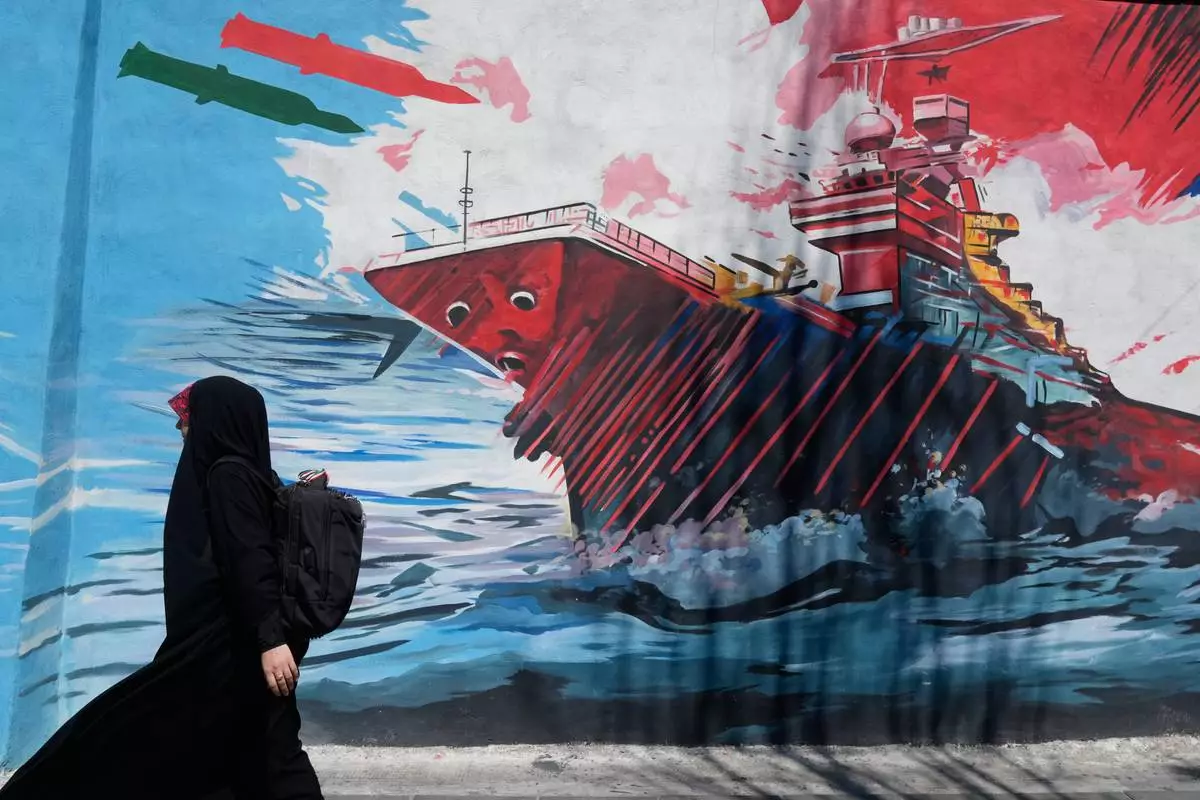
A woman walks past a mural depicting a U.S. aircraft carrier under missile attack in downtown Tehran, Iran, Monday, June 8, 2026. (AP Photo/Vahid Salemi)
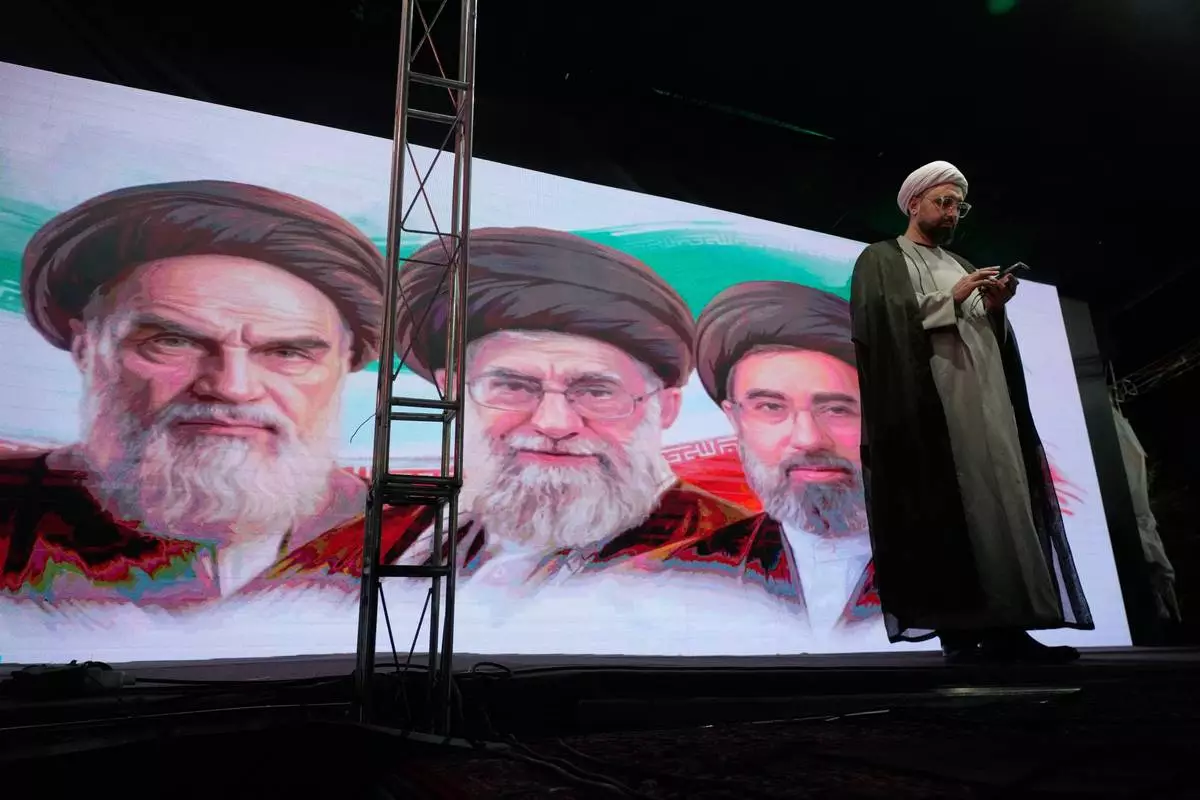
A cleric checks his cell phone on stage in front of a screen displaying portraits of the late Iranian revolutionary founder Ayatollah Khomeini, left, late Supreme Leader Ayatollah Ali Khamenei, center, and Supreme Leader Ayatollah Mojtaba Khamenei, during a pro-government gathering in Tehran, Iran, Sunday, June 7, 2026. (AP Photo/Vahid Salemi)