NASHVILLE, Tenn. (AP) — The Tennessee Board of Parole on Tuesday recommended a pardon for country music star Jelly Roll, a Nashville native who has spoken openly about his criminal record and what it has taken to overcome it. The board's action leaves the final decision on a pardon up to Gov. Bill Lee.
The rapper-turned-country singer wants to be able to travel internationally to perform and share his message of redemption, after spending time behind bars as a young person.
The board issued its nonbinding recommendation unanimously after a hearing that lasted about an hour and 45 minutes with several witnesses, including Nashville Sheriff Daron Hall, advocating for the 40-year-old musician named Jason DeFord. One board member recused themselves from voting.
Jelly Roll broke into country music with the 2023 album “Whitsitt Chapel” and crossover songs like “Need a Favor.” He has won multiple CMT Awards, a CMA Award and earned four Grammy nominations, including for new artist of the year.
“This was incredible,” he said of the board's decision. “I pray this goes through. But today was special for me, regardless.”
His most serious convictions include a robbery at age 17 and drug charges at 23. In the first case, a female acquaintance helped Jelly Roll and two other young men enter a house in 2002. Both of the others were carrying guns, although Jelly Roll was unarmed. They demanded money, and received $350 and a wallet with no money in it. Because the victims knew the female acquaintance, she and Jelly Roll were arrested right away. He was sentenced to serve a year in prison and additional time on probation.
Later, in 2008, police on patrol found both marijuana and crack cocaine in his car. He was sentenced to eight years of court-ordered supervision.
He also has two misdemeanor offenses for driving without a license and possession of drug paraphernalia.
Lee, a Republican, said every case seeking clemency, such as pardons, is equally important and goes through a thorough process.
“The reporting on Jelly Roll, that’s encouraging for his situation, but there are steps yet to happen in that case,” he told reporters Tuesday.
Jelly Roll told the board that while in a detention center, he fell in love with songwriting. “It started as a passion project that felt therapeutic and would end up changing my life in ways that I never dreamed imaginable and opened doors that I’ve never thought possible,” he said.
These days, he often visits jails and rehabilitation centers before performing concerts. He has bought restaurants out for the day to feed people who are homeless and played basketball with kids at a youth center the same day that he performed in Winnipeg. He said he generally doesn't seek out news coverage when he makes these visits.
As a part of the pardon application, friends and civic leaders wrote to the board about Jelly Roll’s transformation and generosity. Hall, who runs Nashville’s jail, wrote that Jelly Roll had an awakening in one of the jails he managed. Live Nation Entertainment CEO and President Michael Rapino also wrote in his favor, pointing out all the money he has given from his performances to charities for at-risk youth.
One of the reasons Jelly Roll gave for needing a pardon is to be able to travel to Canada to perform, which his criminal record makes difficult. Currently, he would need to apply for a special permit that can include long wait times for a decision, according to a letter from an immigration attorney submitted with his clemency packet.
“I want to be an inspiration for people who are now where I used to be — to let them know that change is truly possible," Jelly Roll told the board. “One of the reasons I’m asking for your recommendation for this pardon is because I’m looking to take my message of redemption through the power of music and faith through the rest of the world.”
He said he would use the pardon for much more than going on tour, though.
“I’ll still be using this same pardon, God willing, to go do missionary work in my 50s and 60s,” he said.
Due to his criminal record, he told the board that every time he travels it “takes a team of lawyers and a mountain of paperwork to secure my entry into those countries.” He said he recently was able to make his first tour in Canada and took his first trip to the United Kingdom, where he spoke about a rehabilitation program.
The parole board began considering Jelly Roll's pardon application in October 2024, which marks at least five years since his sentence expired.
Lee has issued more than 90 pardons since taking office in 2019, all of them since 2021.
Associated Press writer Kristin M. Hall contributed from Nashville.

FILE - Jelly Roll onstage during the Pollstar Awards on Wednesday, April 16, 2025, at The Beverly Hilton Hotel in Beverly Hills, Calif. (Photo by Richard Shotwell/Invision/AP,File)
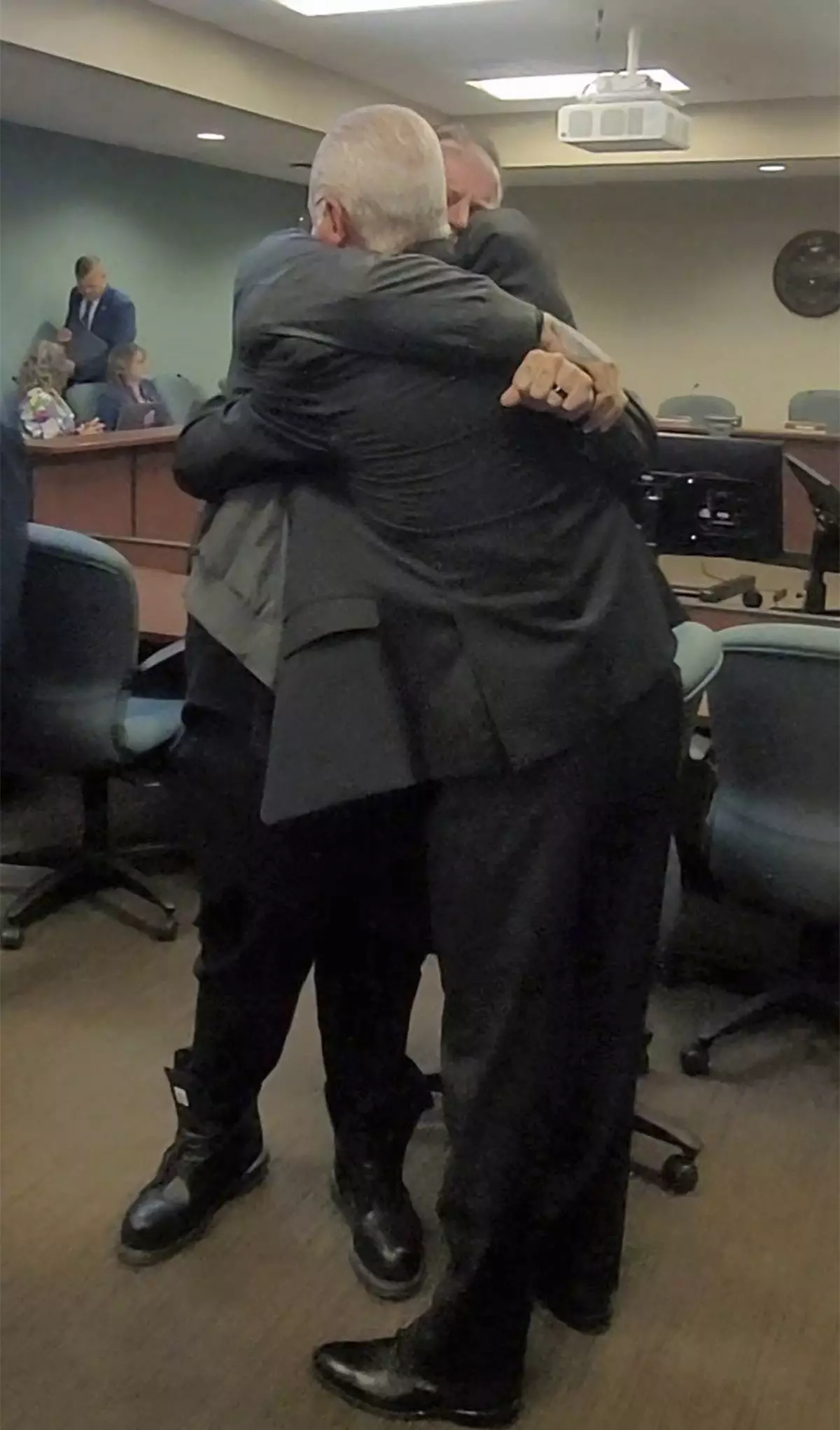
Davidson County Sheriff's Office shows singer Jelly Roll giving a hub to Nashville Sheriff Daron Hall at his Tennessee Board of Parole hearing on Tuesday, April 22, 2025 in Nashville, Tenn. (Davidson County Sheriff's Office via AP)
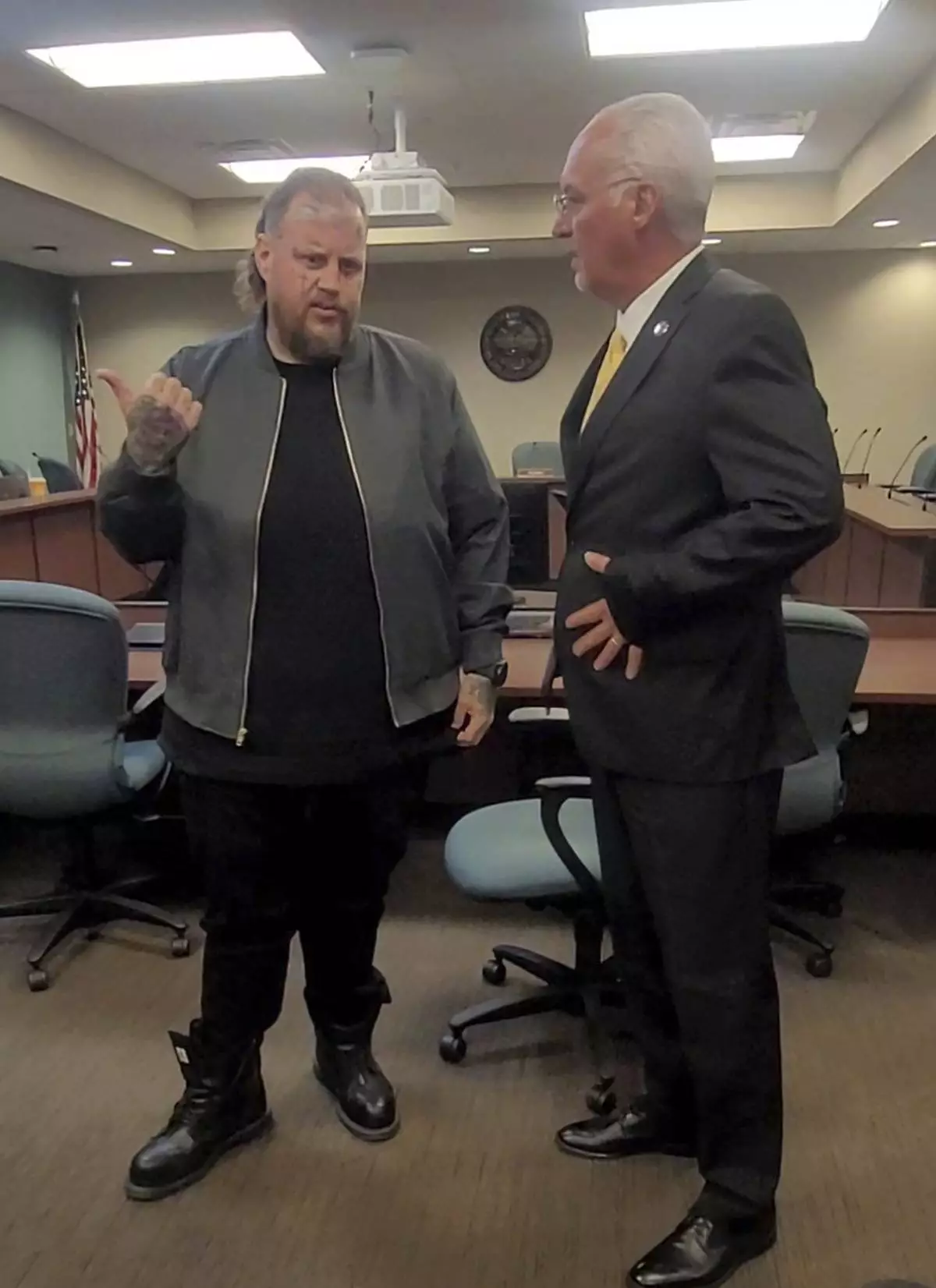
Davidson County Sheriff's Office shows singer Jelly Roll with with Nashville Sheriff Daron Hall at his Tennessee Board of Parole hearing on Tuesday, April 22, 2025 in Nashville, Tenn. (Davidson County Sheriff's Office via AP)
RHO, Italy (AP) — No ice is colder and harder than speedskating ice. The precision it takes has meant that Olympic speedskaters have never competed for gold on a temporary indoor rink – until the 2026 Milan Cortina Winter Games.
In the pursuit of maximum glide and minimum friction, Olympic officials brought on ice master Mark Messer, a veteran of six previous Olympic speedskating tracks and the ice technician in charge of the Olympic Oval in Calgary, Canada — one of the fastest tracks in the world with over 300 records.
Messer has been putting that experience to work one thin layer of ice at a time since the end of October at the new Speed Skating Stadium, built inside adjacent trade fair halls in the city of Rho just north of Milan.
“It’s one of the biggest challenges I’ve had in icemaking,’’ Messer said during an interview less than two weeks into the process.
If Goldilocks were a speedskater, hockey ice would be medium hard, for fast puck movement and sharp turns. Figure skating ice would be softer, allowing push off for jumps and so the ice doesn’t shatter on landing. Curling ice is the softest and warmest of all, for controlled sliding.
For speedskating ice to be just right, it must be hard, cold and clean. And very, very smooth.
“The blades are so sharp, that if there is some dirt, the blade will lose the edge,’’ Messer said, and the skater will lose speed.
Speedskater Enrico Fabris, who won two Olympic golds in Turin in 2006, has traded in his skates to be deputy sports manager at the speedskating venue in Rho. For him, perfect ice means the conditions are the same for all skaters — and then if it's fast ice, so much the better.
"It's more of a pleasure to skate on this ice,'' he said.
Messer’s first Olympics were in Calgary in 1988 — the first time speedskating was held indoors. “That gave us some advantages because we didn’t have to worry about the weather, wind blowing or rain,’’ he said. Now he is upping the challenge by becoming the first ice master to build a temporary rink for the Olympics.
Before Messer arrived in Italy, workers spent weeks setting up insulation to level the floor and then a network of pipes and rubber tubes that carry glycol — an antifreeze — that is brought down to minus 7 or minus 8 degrees Celsius (17.6 to 19.4 degrees Fahrenheit) to make the ice.
Water is run through a purification system — but it can’t be too pure, or the ice that forms will be too brittle. Just the right amount of impurities “holds the ice together,’’ Messer said.
The first layers of water are applied slowly, with a spray nozzle; after the ice reaches a few centimeters it is painted white — a full day’s work — and the stripes are added to make lanes.
“The first one takes about 45 minutes. And then as soon as it freezes, we go back and do it again, and again and again. So we do it hundreds of times,’’ Messer said.
As the ice gets thicker, and is more stable, workers apply subsequent layers of water with hoses. Messer attaches his hose to hockey sticks for easier spreading.
What must absolutely be avoided is dirt, dust or frost — all of which can cause friction for the skaters, slowing them down. The goal is that when the skaters push “they can go as far as possible with the least amount of effort,’’ Messer said.
The Zamboni ice resurfacing machine plays a key role in keeping the track clean, cutting off a layer and spraying water to make a new surface.
One challenge is gauging how quickly the water from the resurfacing machine freezes in the temporary rink.
Another is getting the ice to the right thickness so that the Zamboni, weighing in at six tons, doesn’t shift the insulation, rubber tubing or ice itself.
“When you drive that out, if there’s anything moving it will move. We don’t want that,’’ Messer said.
The rink got its first big test on Nov. 29-30 during a Junior World Cup event. In a permanent rink, test events are usually held a year before the Olympics, leaving more time for adjustments. “We have a very small window to learn,’’ Messer acknowledged.
Dutch speedskater Kayo Vos, who won the men’s neo-senior 1,000 meters, said the ice was a little soft — but Messer didn’t seem too concerned.
“We went very modest to start, now we can start to change the temperatures and try to make it faster and still maintain it as a safe ice,’’ he said.
Fine-tuning the air temperature and humidity and ice temperature must be done methodically — taking into account that there will be 6,000 spectators in the venue for each event. The next real test will be on Jan. 31, when the Olympians take to the ice for their first training session.
“Eighty percent of the work is done but the hardest part is the last 20 percent, where we have to try to find the values and the way of running the equipment so all the skaters get the same conditions and all the skaters get the best conditions,’’ Messer said.
AP Winter Olympics: https://apnews.com/hub/milan-cortina-2026-winter-olympics

Serpentines are set on the ice of the stadium where speed skating discipline of the Milan Cortina 2026 Winter Olympics will take place, in Rho, outskirt of Milan, Tuesday, Nov. 11, 2025. (AP Photo/Luca Bruno)

Ice Master Mark Messer poses in the stadium where speed skating discipline of the Milan Cortina 2026 Winter Olympics will take place, in Rho, outskirt of Milan, Tuesday, Nov. 11, 2025. (AP Photo/Luca Bruno)
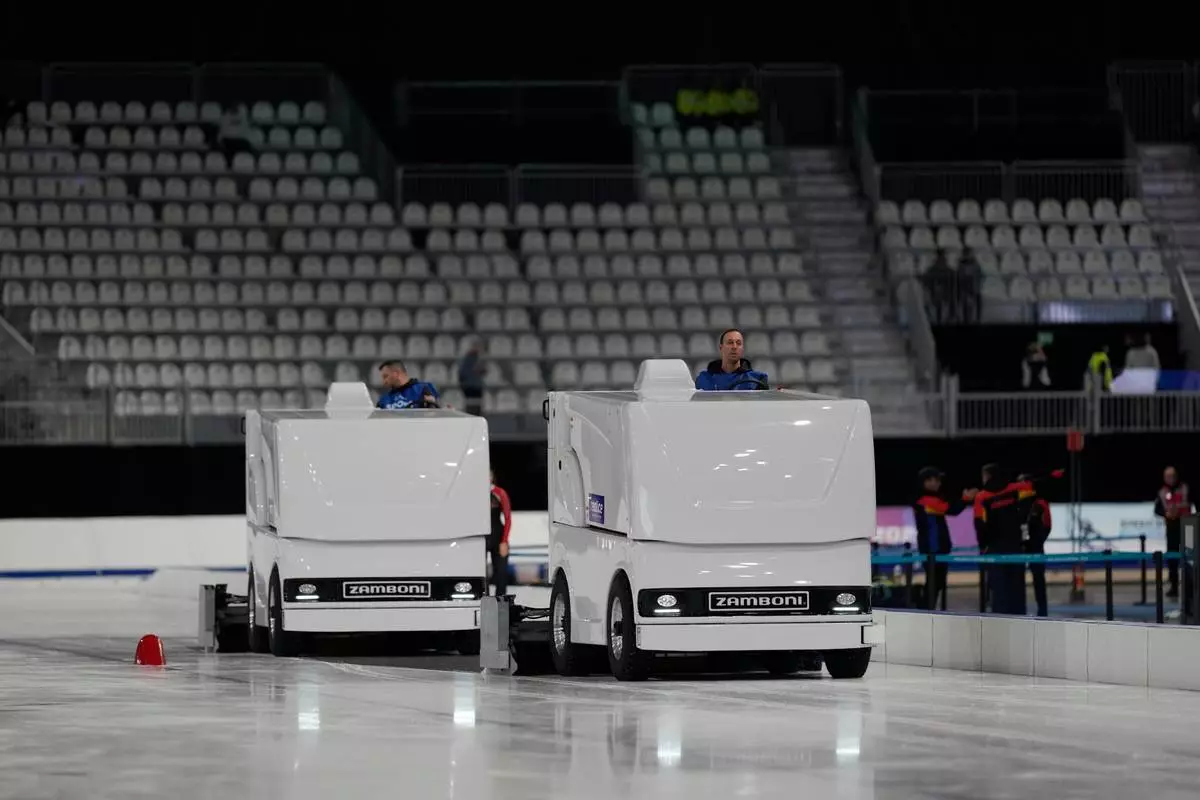
Workers clean the ice surface during a peed skating Junior World Cup and Olympic test event, in Rho, near Milan, Italy, Saturday, Nov. 29, 2025. (AP Photo/Luca Bruno)

Ice Master Mark Messer poses in the stadium where speed skating discipline of the Milan Cortina 2026 Winter Olympics will take place, in Rho, outskirt of Milan, Tuesday, Nov. 11, 2025. (AP Photo/Luca Bruno)

Ice Master Mark Messer poses in the stadium where speed skating discipline of the Milan Cortina 2026 Winter Olympics will take place, in Rho, outskirt of Milan, Tuesday, Nov. 11, 2025. (AP Photo/Luca Bruno)