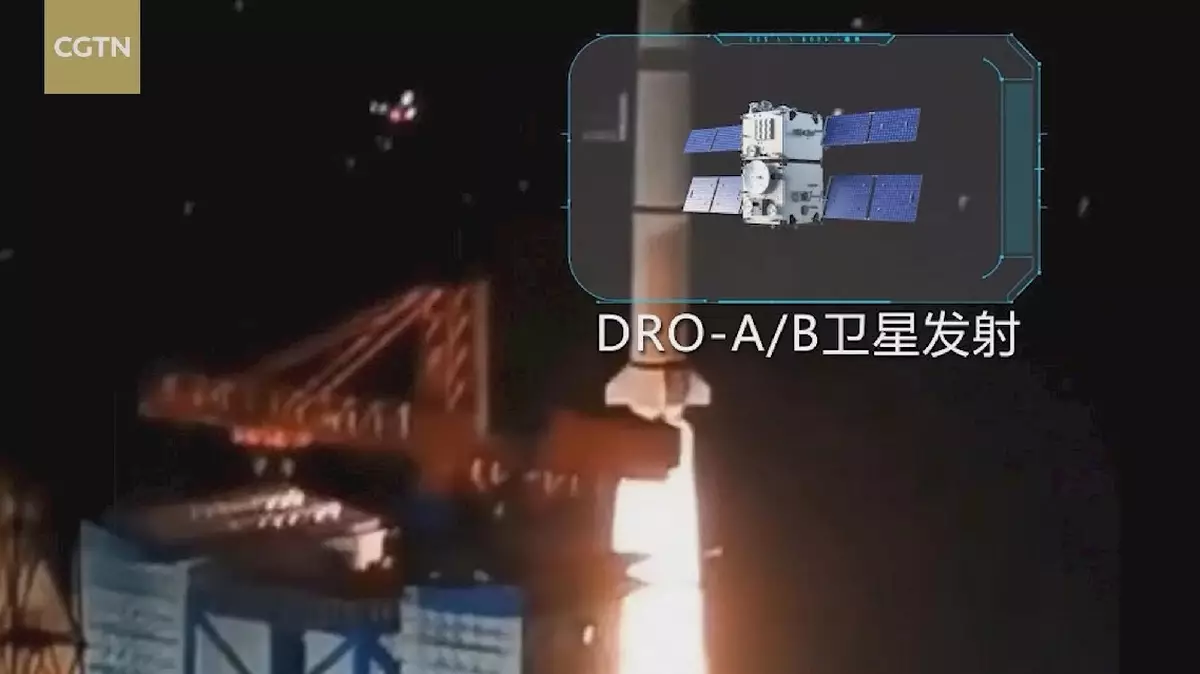
Chinese space engineers recently shared with CGTN the story of saving two stranded satellites, which are now part of the world's first three-satellite constellation based on the distant retrograde orbit (DRO) in Earth-moon space.
China faced an unexpected challenge when a rocket launch failed in March 2024, leaving two satellites stranded in the wrong orbit. However, what seemed like a disastrous setback turned into one of the most ambitious space rescue missions ever attempted.
In a clip documenting the rescue published by CGTN on Sunday, researchers of the Chinese Academy of Sciences' Technology and Engineering Center for Space Utilization (CSU) details about the operation.
The following is a transcript of the clip:
China now launches dozens of rockets every year, each one a testament to precision engineering. But in March 2024, a routine mission went off script. Though the rockets soar perfectly from the launch pad, its precious cargo - two satellites named DRO-A and DRO-B, didn't reach their intended orbit.
Tumbling uncontrollably, the satellites were over 100,000 kilometers away from their plotted destination, in a dangerously low orbit and almost out of juice. In other words, they were stuck.
Perhaps other teams would write it off a bust and go back to the drawing board, but for the team at China technology and engineering CSU, this wasn't just about hardware. It was years of work, millions investment and the dreams of a crew who refused to give up.
Their first challenge was stabilizing the satellites before they run out of power completely.
"We split into two teams, one focused on firing thrusters in short bursts to slow the spin. My team, we had to calculate a new path to orbit," said Zhang Hao, a researcher at the CSU.
For two sleepless nights, Zhang's team crunched the numbers, testing every possible route. The satellites were too damaged for a direct fix. They needed a miracle. And then they found it.
With their solar panels damaged, the satellites couldn't generate enough power for a traditional course correction. So the engineers turn to nature's oldest force - gravity.
"We used the Moon's gravity like a slingshot. When we got close to the Moon, its pull was strongest, it basically flung our satellite toward the next destination. Then Earth became another slingshot and the sun with its enormous mass acted like a third slingshot even further away. That's how we completed the entire orbital transfer. Eight point six million kilometers over 123 days," said CSU researcher Mao Xinyuan.
After four grueling months, the impossible became reality, the satellites not only survived, they reached their target, a distance retrograde orbit or DRA - a cosmic sweet spot between Earth and the Moon.
"It's the crossroads to deep space and a transport hub to even further," Mao said.
"The low Earth orbit is full of satellites because of those large constellations, but the Earth-moon space is about 10,000 times larger. We see it as a new unknown frontier," said CSU researcher Wang Wenbin.
This rescue wasn't just a victory for engineering; it secured China's next leap into deep space. The two DRO satellites, together with a previously launched DRO-L, form a navigation network that enables autonomous spacecraft, turning the DRO into humanity's first space harbor.
"You can see it as an autopilot in space. We only need to specify the destination and the spacecraft will automatically find the path to go there. Just like when we use car hailing apps," Wang said.
The team is in talks with China's manned space program about using this system in future lunar missions.
Ultimately, this story isn't just about math, gravity, or even satellites. It is about the people who refuse to accept failure, who turned desperation into one of the space history's greatest rescues.
Chinese space engineers recall 123-day satellites rescue