Skip to Content Facebook Feature Image

$50 million prize funded by Musk foundation goes to carbon-removal company that helps Indian farmers

News

$50 million prize funded by Musk foundation goes to carbon-removal company that helps Indian farmers
News

News

$50 million prize funded by Musk foundation goes to carbon-removal company that helps Indian farmers

2025-04-23 23:54 Last Updated At:04-24 00:01

A company that spreads crushed rock on farmers' fields to help draw climate-warming carbon dioxide from the atmosphere has been awarded a $50 million grand prize in a global competition funded by Elon Musk's foundation.

Mati Carbon was among more than 1,300 teams from 88 countries that participated in the four-year XPRIZE Carbon Removal competition, launched in 2021 to encourage deployment of carbon-removal technologies. Many scientists believe removing carbon is crucial in the fight against global warming, caused by the burning of fossil fuels like gasoline, coal and oil, which release carbon dioxide.

More Images
XPRIZE Carbon Removal winners from Mati Carbon, Founder & CEO Shantanu Agarwal, left, and Chief Science Officer Jake Jordan, visit the trading floor of the New York Stock Exchange, Tuesday, April 22, 2025. (AP Photo/Richard Drew)

XPRIZE Carbon Removal winners from Mati Carbon, Founder & CEO Shantanu Agarwal, left, and Chief Science Officer Jake Jordan, visit the trading floor of the New York Stock Exchange, Tuesday, April 22, 2025. (AP Photo/Richard Drew)

XPRIZE Carbon Removal winners from Mati Carbon, Founder & CEO Shantanu Agarwal, left, and Chief Science Officer Jake Jordan, visit the trading floor of the New York Stock Exchange, Tuesday, April 22, 2025. (AP Photo/Richard Drew)

XPRIZE Carbon Removal winners from Mati Carbon, Founder & CEO Shantanu Agarwal, left, and Chief Science Officer Jake Jordan, visit the trading floor of the New York Stock Exchange, Tuesday, April 22, 2025. (AP Photo/Richard Drew)

XPRIZE Carbon Removal winners from Mati Carbon, Founder & CEO Shantanu Agarwal, center, and Chief Science Officer Jake Jordan, right, talk with Specialist Philip Finale during their visit to the trading floor of the New York Stock Exchange, Tuesday, April 22, 2025. (AP Photo/Richard Drew)

XPRIZE Carbon Removal winners from Mati Carbon, Founder & CEO Shantanu Agarwal, center, and Chief Science Officer Jake Jordan, right, talk with Specialist Philip Finale during their visit to the trading floor of the New York Stock Exchange, Tuesday, April 22, 2025. (AP Photo/Richard Drew)

XPRIZE Carbon Removal winners from Mati Carbon, Founder & CEO Shantanu Agarwal, left, and Chief Science Officer Jake Jordan, visit the trading floor of the New York Stock Exchange, Tuesday, April 22, 2025. (AP Photo/Richard Drew)

XPRIZE Carbon Removal winners from Mati Carbon, Founder & CEO Shantanu Agarwal, left, and Chief Science Officer Jake Jordan, visit the trading floor of the New York Stock Exchange, Tuesday, April 22, 2025. (AP Photo/Richard Drew)

“It's important that we not promote carbon dioxide removal as a replacement for emissions reduction,” said Michael Leitch, the technical lead for the competition. “But the race is really on both to dramatically reduce our existing emissions (and) also ... deploy carbon dioxide removal solutions at very, very large scales globally.”

The prize is being awarded at a time when Musk and his Department of Government Efficiency are making steep cuts to federal funding and staff at the National Oceanic and Atmospheric Administration, the National Weather Service and other science-based agencies that carry out important climate research. The Trump administration has also moved to roll back myriad environmental regulations, including some that regulate carbon emissions.

While the Musk Foundation sponsored XPRIZE Carbon Removal, which distributed a total of $100 million, it is not formally affiliated with the California-based organization, XPRIZE officials said.

XPRIZE runs other contests to try to solve societal challenges. Executive director Nikki Batchelor said the organization is considering more climate-related competitions addressing such issues as removal of the potent greenhouse gas methane, reforestation and climate adaptation and resilience.

Mati Carbon CEO Shantanu Agarwal believes his company's relatively low-cost approach “has a potential to really solve some planetary scale problems” while helping small farmers in countries like India who often bear the brunt of climate change, including extreme weather events like drought and floods that destroy crops.

The method, called enhanced rock weathering, is fairly straightforward, said Jake Jordan, the company's chief science officer: When it rains, water and carbon dioxide mix in the atmosphere, forming acid that breaks down rock. Carbon dioxide is converted to bicarbonate, which eventually is washed to the ocean, where it is stored for about 10,000 years.

U.S.-based Mati Carbon spreads powdered basalt rock — plentiful in many parts of the world — on the fields “to speed up (rock weathering) that happens anyway,” Jordan said. The powdered rock also releases nutrients that help rejuvenate soils and increase crop productivity.

Smaller prizes were awarded to several other teams that also successfully removed 1,000 tons of carbon dioxide, a threshold that demonstrates an ability to scale up to remove gigatons in the coming decades.

That included $15 million to runner-up NetZero, which turns crop residues such as coffee husks into biochar, charcoal-like particles that can be used on fields to help store carbon in soils while also improving nutrient and water retention.

Other projects involved storing organic waste deep underground, enhancing oceans' ability to store carbon and removing carbon directly from the air.

Scientists have been exploring the gamut of so-called geoengineering solutions to climate change, from drying the upper atmosphere to pumping minerals into the ocean to absorb carbon.

Rick Spinrad, former administrator at NOAA, called the finalists' solutions “scientifically extraordinary concepts” and said the best approach to reducing carbon probably will be a combination of technologies.

Leitch, from XPRIZE, said some solutions that did not win — including direct air and direct ocean capture of carbon dioxide — might have an advantage when deployed on a large scale.

“It takes a lot of time and money to build, so I think time will tell,” Leitch said.

The story has been updated to correct that Mati is based in the U.S., not in India, but works in countries like India.

The Associated Press’ climate and environmental coverage receives financial support from multiple private foundations. AP is solely responsible for all content. Find AP’s standards for working with philanthropies, a list of supporters and funded coverage areas at AP.org.

XPRIZE Carbon Removal winners from Mati Carbon, Founder & CEO Shantanu Agarwal, left, and Chief Science Officer Jake Jordan, visit the trading floor of the New York Stock Exchange, Tuesday, April 22, 2025. (AP Photo/Richard Drew)

XPRIZE Carbon Removal winners from Mati Carbon, Founder & CEO Shantanu Agarwal, left, and Chief Science Officer Jake Jordan, visit the trading floor of the New York Stock Exchange, Tuesday, April 22, 2025. (AP Photo/Richard Drew)

XPRIZE Carbon Removal winners from Mati Carbon, Founder & CEO Shantanu Agarwal, left, and Chief Science Officer Jake Jordan, visit the trading floor of the New York Stock Exchange, Tuesday, April 22, 2025. (AP Photo/Richard Drew)

XPRIZE Carbon Removal winners from Mati Carbon, Founder & CEO Shantanu Agarwal, left, and Chief Science Officer Jake Jordan, visit the trading floor of the New York Stock Exchange, Tuesday, April 22, 2025. (AP Photo/Richard Drew)
XPRIZE Carbon Removal winners from Mati Carbon, Founder & CEO Shantanu Agarwal, center, and Chief Science Officer Jake Jordan, right, talk with Specialist Philip Finale during their visit to the trading floor of the New York Stock Exchange, Tuesday, April 22, 2025. (AP Photo/Richard Drew)
XPRIZE Carbon Removal winners from Mati Carbon, Founder & CEO Shantanu Agarwal, center, and Chief Science Officer Jake Jordan, right, talk with Specialist Philip Finale during their visit to the trading floor of the New York Stock Exchange, Tuesday, April 22, 2025. (AP Photo/Richard Drew)

XPRIZE Carbon Removal winners from Mati Carbon, Founder & CEO Shantanu Agarwal, left, and Chief Science Officer Jake Jordan, visit the trading floor of the New York Stock Exchange, Tuesday, April 22, 2025. (AP Photo/Richard Drew)
XPRIZE Carbon Removal winners from Mati Carbon, Founder & CEO Shantanu Agarwal, left, and Chief Science Officer Jake Jordan, visit the trading floor of the New York Stock Exchange, Tuesday, April 22, 2025. (AP Photo/Richard Drew)

DUBAI, United Arab Emirates (AP) — U.S. President Donald Trump said Iran wants to negotiate with Washington after his threat to strike the Islamic Republic over its bloody crackdown on protesters, a move coming as activists said Monday the death toll in the nationwide demonstrations rose to at least 544.

Iran had no immediate reaction to the news, which came after the foreign minister of Oman — long an interlocutor between Washington and Tehran — traveled to Iran this weekend. It also remains unclear just what Iran could promise, particularly as Trump has set strict demands over its nuclear program and its ballistic missile arsenal, which Tehran insists is crucial for its national defense.

Meanwhile Monday, Iran called for pro-government demonstrators to head to the streets in support of the theocracy, a show of force after days of protests directly challenging the rule of 86-year-old Supreme Leader Ayatollah Ali Khamenei. Iranian state television aired chants from the crowd, who shouted “Death to America!” and “Death to Israel!”

Trump and his national security team have been weighing a range of potential responses against Iran including cyberattacks and direct strikes by the U.S. or Israel, according to two people familiar with internal White House discussions who were not authorized to comment publicly and spoke on condition of anonymity.

“The military is looking at it, and we’re looking at some very strong options,” Trump told reporters on Air Force One on Sunday night. Asked about Iran’s threats of retaliation, he said: “If they do that, we will hit them at levels that they’ve never been hit before.”

Trump said that his administration was in talks to set up a meeting with Tehran, but cautioned that he may have to act first as reports of the death toll in Iran mount and the government continues to arrest protesters.

“I think they’re tired of being beat up by the United States,” Trump said. “Iran wants to negotiate.”

He added: “The meeting is being set up, but we may have to act because of what’s happening before the meeting. But a meeting is being set up. Iran called, they want to negotiate.”

Iran through country's parliamentary speaker warned Sunday that the U.S. military and Israel would be “legitimate targets” if America uses force to protect demonstrators.

More than 10,600 people also have been detained over the two weeks of protests, said the U.S.-based Human Rights Activists News Agency, which has been accurate in previous unrest in recent years and gave the death toll. It relies on supporters in Iran crosschecking information. It said 496 of the dead were protesters and 48 were with security forces.

With the internet down in Iran and phone lines cut off, gauging the demonstrations from abroad has grown more difficult. The Associated Press has been unable to independently assess the toll. Iran’s government has not offered overall casualty figures.

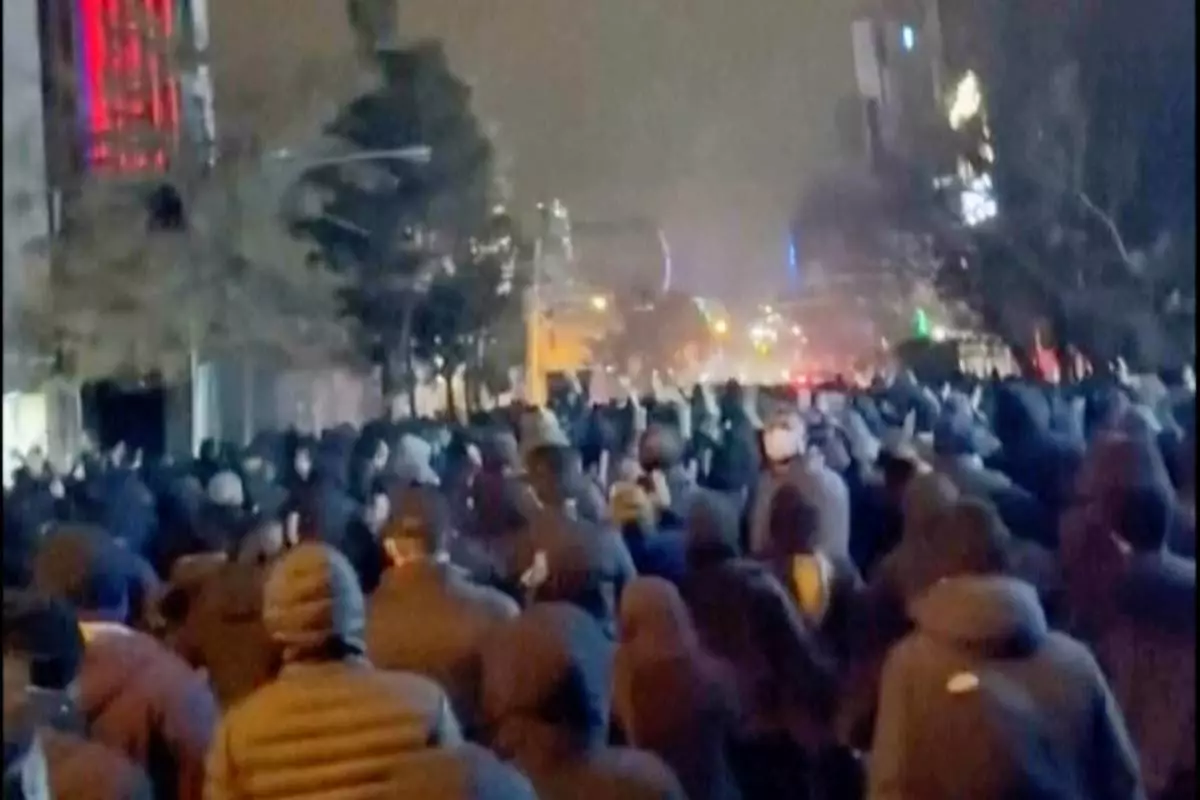
Those abroad fear the information blackout is emboldening hard-liners within Iran’s security services to launch a bloody crackdown. Protesters flooded the streets in the country’s capital and its second-largest city on Saturday night into Sunday morning. Online videos purported to show more demonstrations Sunday night into Monday, with a Tehran official acknowledging them in state media.

In Tehran, a witness told the AP that the streets of the capital empty at the sunset call to prayers each night. By the Isha, or nighttime prayer, the streets are deserted.

Part of that stems from the fear of getting caught in the crackdown. Police sent the public a text message that warned: “Given the presence of terrorist groups and armed individuals in some gatherings last night and their plans to cause death, and the firm decision to not tolerate any appeasement and to deal decisively with the rioters, families are strongly advised to take care of their youth and teenagers.”

Another text, which claimed to come from the intelligence arm of the paramilitary Revolutionary Guard, also directly warned people not to take part in demonstrations.

“Dear parents, in view of the enemy’s plan to increase the level of naked violence and the decision to kill people, ... refrain from being on the streets and gathering in places involved in violence, and inform your children about the consequences of cooperating with terrorist mercenaries, which is an example of treason against the country,” the text warned.

The witness spoke to the AP on condition of anonymity due to the ongoing crackdown.

The demonstrations began Dec. 28 over the collapse of the Iranian rial currency, which trades at over 1.4 million to $1, as the country’s economy is squeezed by international sanctions in part levied over its nuclear program. The protests intensified and grew into calls directly challenging Iran’s theocracy.

Nikhinson reported from aboard Air Force One.

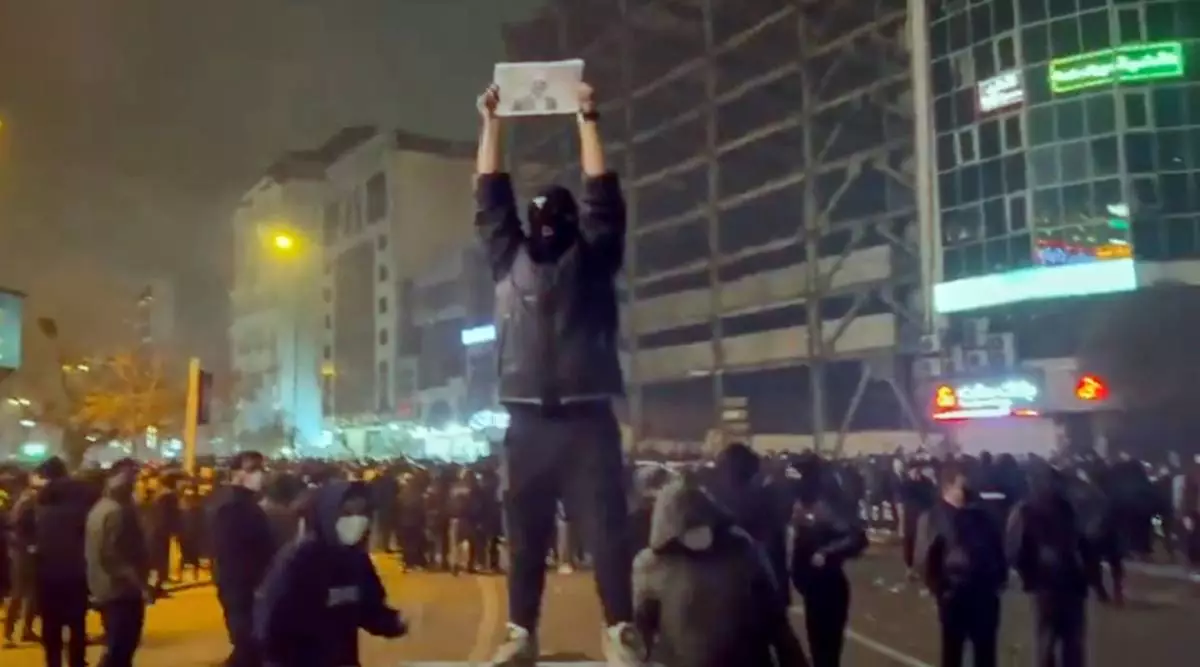
In this frame grab from video obtained by the AP outside Iran, a masked demonstrator holds a picture of Iran's Crown Prince Reza Pahlavi during a protest in Tehran, Iran, Friday, January. 9, 2026. (UGC via AP)

In this frame grab from video obtained by the AP outside Iran, a masked demonstrator holds a picture of Iran's Crown Prince Reza Pahlavi during a protest in Tehran, Iran, Friday, January. 9, 2026. (UGC via AP)

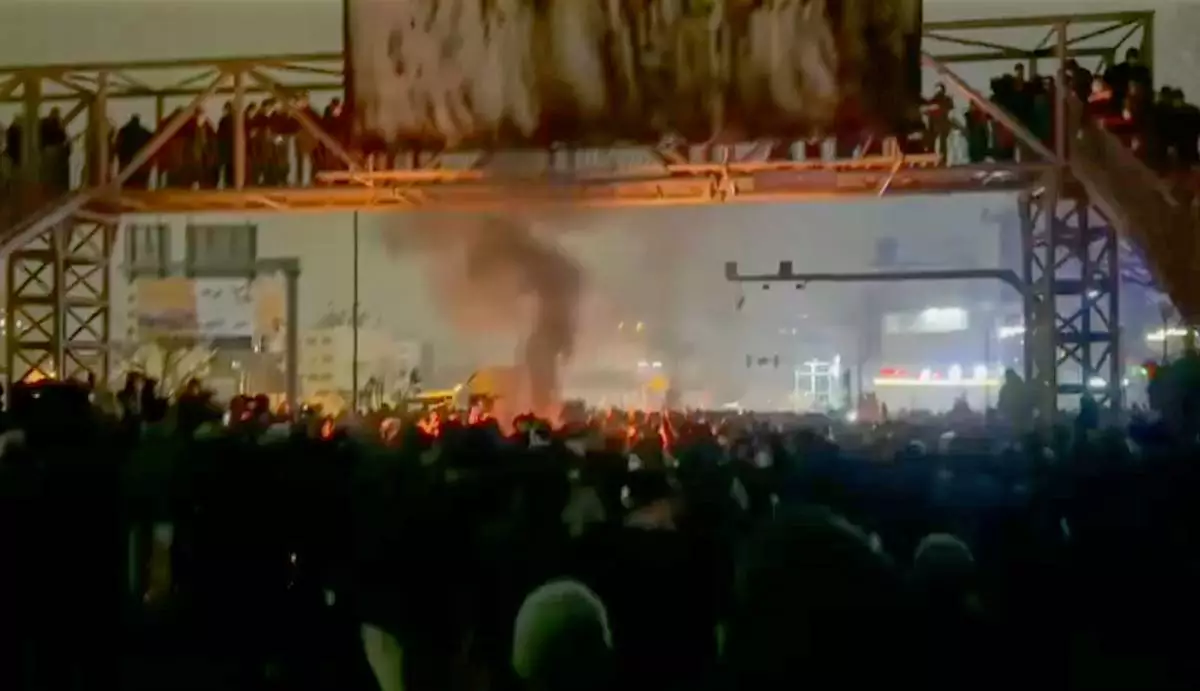
In this frame grab from footage circulating on social media from Iran shows protesters taking to the streets despite an intensifying crackdown as the Islamic Republic remains cut off from the rest of the world in Tehran, Iran, Friday, Jan. 9, 2026.(UGC via AP)

In this frame grab from footage circulating on social media from Iran shows protesters taking to the streets despite an intensifying crackdown as the Islamic Republic remains cut off from the rest of the world in Tehran, Iran, Friday, Jan. 9, 2026.(UGC via AP)

In this frame grab from footage circulating on social media from Iran showed protesters once again taking to the streets of Tehran despite an intensifying crackdown as the Islamic Republic remains cut off from the rest of the world in Tehran, Iran, Saturday Jan. 10, 2026. (UGC via AP)

In this frame grab from footage circulating on social media from Iran showed protesters once again taking to the streets of Tehran despite an intensifying crackdown as the Islamic Republic remains cut off from the rest of the world in Tehran, Iran, Saturday Jan. 10, 2026. (UGC via AP)

Recommended Articles