WASHINGTON (AP) — President Donald Trump has ordered sharper scrutiny of America’s colleges and the accreditors that oversee them, part of his escalating campaign to end what he calls " wokeness ” and diversity efforts in education.
In a series of executive actions signed Wednesday, Trump targeted universities that he views as liberal adversaries to his political agenda. One order called for harder enforcement of a federal law requiring colleges to disclose their financial ties with foreign sources, while another called for a shakeup of the accrediting bodies that decide whether colleges can accept federal financial aid awarded to students.
Click to Gallery
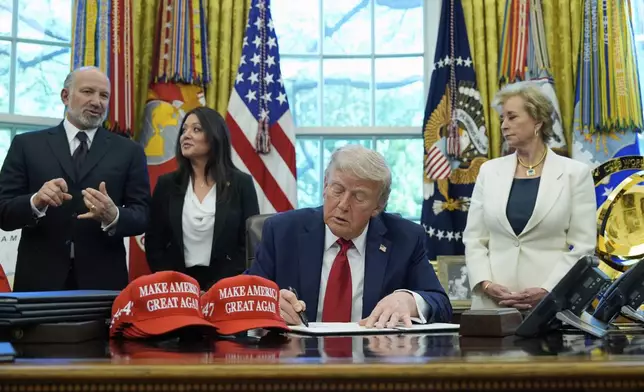
President Donald Trump holds an executive order relating to education in the Oval Office of the White House, Wednesday, April 23, 2025, in Washington, as Commerce Secretary Howard Lutnick, Labor Secretary Lori Chavez-DeRemer and Education Secretary Linda McMahon watch. (AP Photo/Alex Brandon)
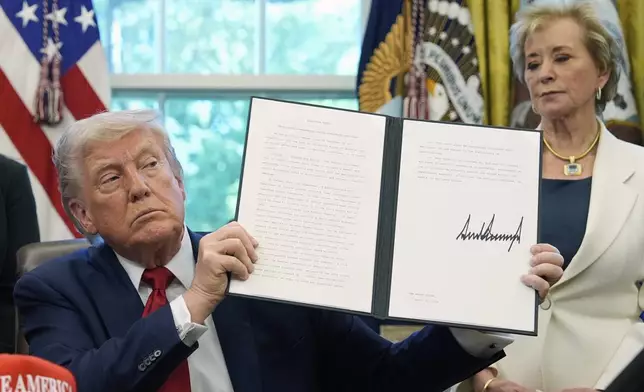
President Donald Trump holds a signed an executive order relating to school discipline policies as Education Secretary Linda McMahon listens in the Oval Office of the White House, Wednesday, April 23, 2025, in Washington. (AP Photo/Alex Brandon)
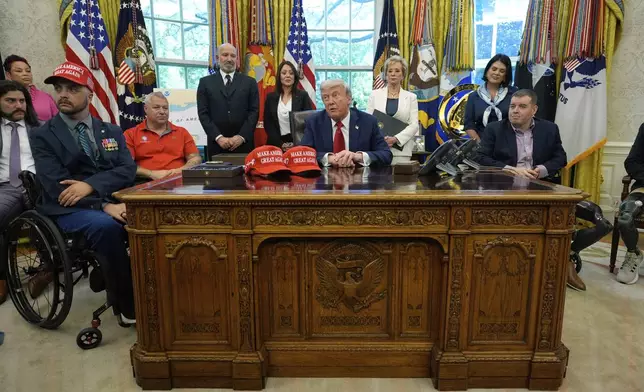
President Donald Trump speaks with reporters after signing executive orders in the Oval Office of the White House, Wednesday, April 23, 2025, in Washington. (AP Photo/Alex Brandon)
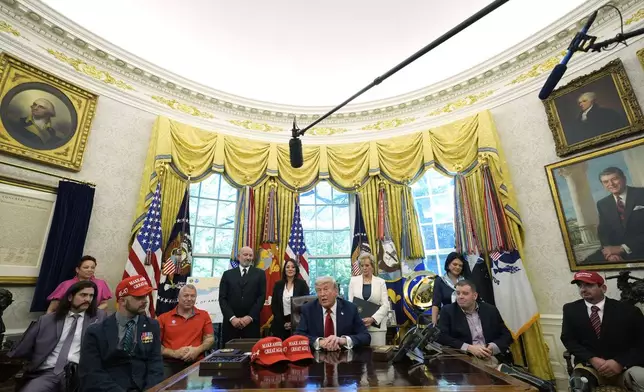
President Donald Trump speaks with reporters after signing executive orders in the Oval Office of the White House, Wednesday, April 23, 2025, in Washington. (AP Photo/Alex Brandon)
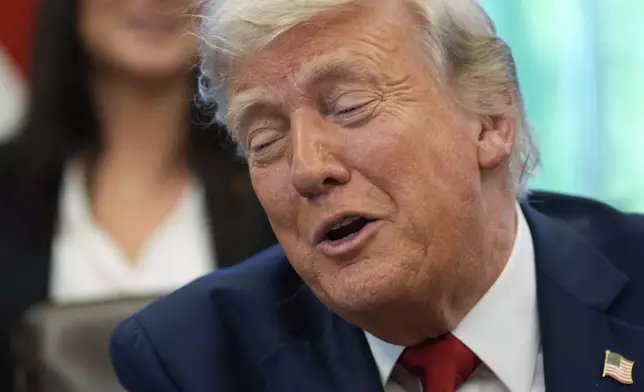
President Donald Trump speaks with reporters after signing executive orders in the Oval Office of the White House, Wednesday, April 23, 2025, in Washington. (AP Photo/Alex Brandon)
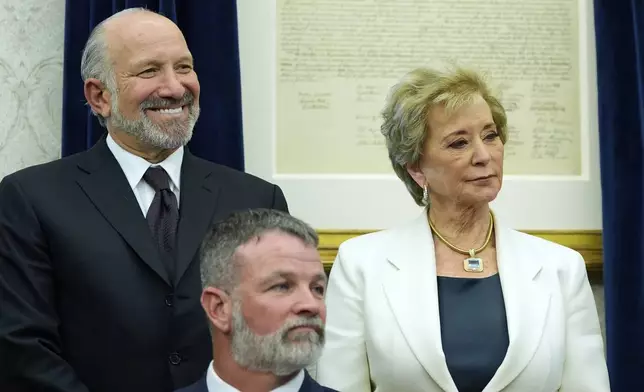
Commerce Secretary Howard Lutnick and Education Secretary Linda McMahon watch as President Donald Trump speaks with reporters in the Oval Office of the White House, Wednesday, April 23, 2025, in Washington. (AP Photo/Alex Brandon)

President Donald Trump is handed an executive order to sign by White House staff secretary Will Scharf in the Oval Office of the White House, Wednesday, April 23, 2025, in Washington. (AP Photo/Alex Brandon)
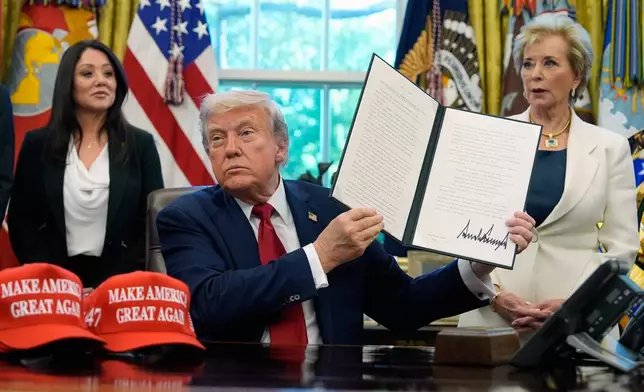
President Donald Trump holds a signed executive order relating to Historically Black Colleges and Universities in the Oval Office of the White House, Wednesday, April 23, 2025, in Washington. (AP Photo/Alex Brandon)
Trump also ordered the Education Department to root out efforts to ensure equity in discipline in the nation's K-12 schools. Previous guidance from Democratic administrations directed schools not to disproportionately punish underrepresented minorities such as Black and Native American students. The administration says equity efforts amount to racial discrimination.
Colleges’ financial ties with foreign sources have long been a concern among Republicans, especially ties with China and other countries with adversarial relationships with the U.S. It became a priority during Trump’s first term and reemerged last week as the White House grasped for leverage in its escalating battle with Harvard University.
The White House said it needed to take action because Harvard and other colleges have routinely violated a federal disclosure law, which has been unevenly enforced since it was passed in the 1980s. Known as Section 117 of the Higher Education Act, the law requires colleges to disclose foreign gifts and contracts valued at $250,000 or more.
Last week, the Education Department demanded records from Harvard over foreign financial ties spanning the past decade, accusing the school of filing “incomplete and inaccurate disclosures.” Trump's administration is sparring with Harvard over the university's refusal to accept a list of demands over its handling of pro-Palestinian protests as well as its diversity, equity and inclusion efforts.
In the executive order, Trump calls on the Education Department and the attorney general to step up enforcement of the law and take action against colleges that violate it, including a cutoff of federal money.
The Trump administration intends to “end the secrecy surrounding foreign funds in American educational institutions” and protect against “foreign exploitation,” the order said.
It was applauded by Republicans, including Rep. Tim Walberg of Michigan, chair of the House Committee on Education and the Workforce. He accused China of exploiting academic ties to steal research and “indoctrinate students.”
Another order aims at accrediting bodies that set standards colleges must meet to accept federal financial aid from students. Trump campaigned on a promise to overhaul the industry, saying it was “dominated by Marxist Maniacs and lunatics.”
Often overlooked as an obscure branch of college oversight, accreditors play an important role in shaping colleges in many aspects, with standards that apply all the way from colleges’ governing boards to classroom curriculum.
Trump's executive order is the opening salvo in what could be a lengthy battle to overhaul the accrediting industry. Chief among his priorities is to strip accreditors of DEI requirements imposed on colleges. Some accreditors have already dropped or stopped enforcing such standards amid Trump’s DEI crackdown.
Trump’s order calls on the government to suspend or terminate accreditors that discriminate in the name of DEI. Instead, it calls on accreditors to focus more squarely on the student outcomes of colleges and programs they oversee.
The president wants to make it easier for new accreditors to compete with the 19 that are now authorized to work on behalf of the federal government. As it stands, new accreditors looking to be recognized by the government must undergo an arduous process that traditionally takes years. Trump’s order said it should be “transparent, efficient, and not unduly burdensome.”
“Instead of pushing schools to adopt a divisive DEI ideology, accreditors should be focused on helping schools improve graduation rates and graduates’ performance in the labor market,” Education Secretary Linda McMahon said in a statement.
Trump also invoked opposition to equity efforts in his order on school discipline. The edict signed Wednesday seeks a return to “common sense school discipline,” allowing decisions to be based solely on students’ behavior and actions, McMahon said.
Another executive order instructs government agencies and departments to no longer rely on “disparate impact theories.” Under the disparate impact standard, policies and practices that disproportionately impact minorities and other protected groups could be challenged regardless of their intent.
In many schools around the country, Black students have been more likely to receive punishments that remove them from the classroom, including suspensions, expulsions and being transferred to alternative schools. A decade ago, those differences became the target of a reform movement spurred by the same reckoning that gave rise to Black Lives Matter. The movement elevated the concept of the “school-to-prison pipeline” — the notion that being kicked out of school, or dropping out, increases the chance of arrest and imprisonment years later.
Federal guidelines to address racial disparities in school discipline first came from President Barack Obama’s administration in 2014. Federal officials urged schools not to suspend, expel or refer students to law enforcement except as a last resort, and encouraged restorative justice practices that did not push students out of the classroom. Those rules were rolled back by Trump’s first administration, but civil rights regulations at federal and state levels still mandate the collection of data on discipline.
On Wednesday, Trump directed McMahon to issue new school discipline guidance within 60 days. The order also calls for a review of nonprofit organizations that have promoted discipline policies rooted in equity and ensure they don’t receive federal money.
Another order creates a federal task force focused on giving America’s students training on artificial intelligence as early as kindergarten. It would work to develop new online learning resources.
Trump is also establishing a White House initiative to empower Historically Black Colleges and Universities. Among other efforts, it would seek to promote private-sector partnerships with HBCUs and schools’ workforce preparation in industries like technology and finance.
The Associated Press’ education coverage receives financial support from multiple private foundations. AP is solely responsible for all content. Find AP’s standards for working with philanthropies, a list of supporters and funded coverage areas at AP.org.

President Donald Trump holds an executive order relating to education in the Oval Office of the White House, Wednesday, April 23, 2025, in Washington, as Commerce Secretary Howard Lutnick, Labor Secretary Lori Chavez-DeRemer and Education Secretary Linda McMahon watch. (AP Photo/Alex Brandon)

President Donald Trump holds a signed an executive order relating to school discipline policies as Education Secretary Linda McMahon listens in the Oval Office of the White House, Wednesday, April 23, 2025, in Washington. (AP Photo/Alex Brandon)

President Donald Trump speaks with reporters after signing executive orders in the Oval Office of the White House, Wednesday, April 23, 2025, in Washington. (AP Photo/Alex Brandon)

President Donald Trump speaks with reporters after signing executive orders in the Oval Office of the White House, Wednesday, April 23, 2025, in Washington. (AP Photo/Alex Brandon)

President Donald Trump speaks with reporters after signing executive orders in the Oval Office of the White House, Wednesday, April 23, 2025, in Washington. (AP Photo/Alex Brandon)

Commerce Secretary Howard Lutnick and Education Secretary Linda McMahon watch as President Donald Trump speaks with reporters in the Oval Office of the White House, Wednesday, April 23, 2025, in Washington. (AP Photo/Alex Brandon)

President Donald Trump is handed an executive order to sign by White House staff secretary Will Scharf in the Oval Office of the White House, Wednesday, April 23, 2025, in Washington. (AP Photo/Alex Brandon)

President Donald Trump holds a signed executive order relating to Historically Black Colleges and Universities in the Oval Office of the White House, Wednesday, April 23, 2025, in Washington. (AP Photo/Alex Brandon)