Skip to Content Facebook Feature Image

Google's parent begins year with robust growth despite legal, competitive and economic threats

TECH

Google's parent begins year with robust growth despite legal, competitive and economic threats
TECH

TECH

Google's parent begins year with robust growth despite legal, competitive and economic threats

2025-04-25 05:44 Last Updated At:05:51

Google's profits soared 50% in this year's opening quarter, overcoming the competitive and legal threats that its internet empire is facing amid an economy roiled by a global trade war.

The numbers released Thursday by Google parent Alphabet Inc. indicated the company is rising to the challenge so far, but investors are likely to remain concerned about the turbulent times ahead.

The Mountain View, California, company earned $34.5 billion, or $2.81 per share, during the January-March period, up from $23.7 billion, or $1.89 per share, at the same time last year. Revenue rose 12% from last year to $90.2 billion. The results easily exceeded analysts’ projections, according to FactSet Research.

“We continued to see healthy growth and momentum across the business,” Alphabet CEO Sundar Pichai told analysts Thursday during a conference call.

Alphabet's stock gained more than 4% in extended trading after the numbers came out. The shares had fallen by 16% since the end of last year.

Google’s first-quarter performance illustrated the continuing power of its long-dominant search engine in a sea of uncertainty. While grappling with competitive threats emerging as artificial intelligence reshapes technology, Google is also battling court decisions condemning its search engine and digital ad network as illegal monopolies.

The AI-driven upheaval has opened new opportunities for people to find helpful advice, insights and information through more conversational search options from the likes of OpenAI and Perplexity.

Google's long-dominant search engine is countering the new competition with a feature called AI Overviews that appear above web links in its results. It is also testing a conversational tool called AI Mode that would usher in an even more radical change to its business model.

“The company delivered a sound response to those questioning the solidity of the search business amid ever-increasing AI demand,” Investing.com analyst Thomas Monteiro said.

But Google is trying to keep its business intact as by the U.S. Justice Department attempts to break up the company and impose other restraints after a federal judge last year branded its search engine an illegal monopoly. To make matters worse, its digital ad network also was found to be illegally abusing its power earlier this month in another case brought by the Justice Department.

President Donald Trump’s trade war has injected more uncertainty into the mix by rattling the financial markets amid fears the tariffs will reignite inflation while dragging the economy into a recession. Although Google’s digital services aren’t directly impacted by the tariffs, a recession would likely curtail the spending on ads that generate most of Alphabet’s revenue.

But there were few signs of a slowdown in the past quarter. Google's ad revenue during the period totaled $66.9 billion, an 8% increase from the same time a year ago.

Although Google's executives are mostly upbeat during Thursday's call, they also acknowledged conditions should the trade war trigger a recession.

“We are obviously not immune to the macro environment,” said Philipp Schindler, Alphabet's chief business officer.

The past quarter's steady growth emboldened Alphabet to stand firm on plans to invest $75 billion on AI and other technologies this year while also pursuing approval of a $32 billion deal to buy cybersecurity firm Wiz.

This story has been corrected to reflect Alphabet's first-quarter profit increased 50% from the same time last year, or $2.81 per share, and that its revenue for the January-March period totaled $90.2 billion. The story also has been corrected to reflect Google's ad revenue for the first quarter totaled $66.9 billion, an 8% increase from a year ago. An earlier version reported the incorrect dollar amounts and percentage change.
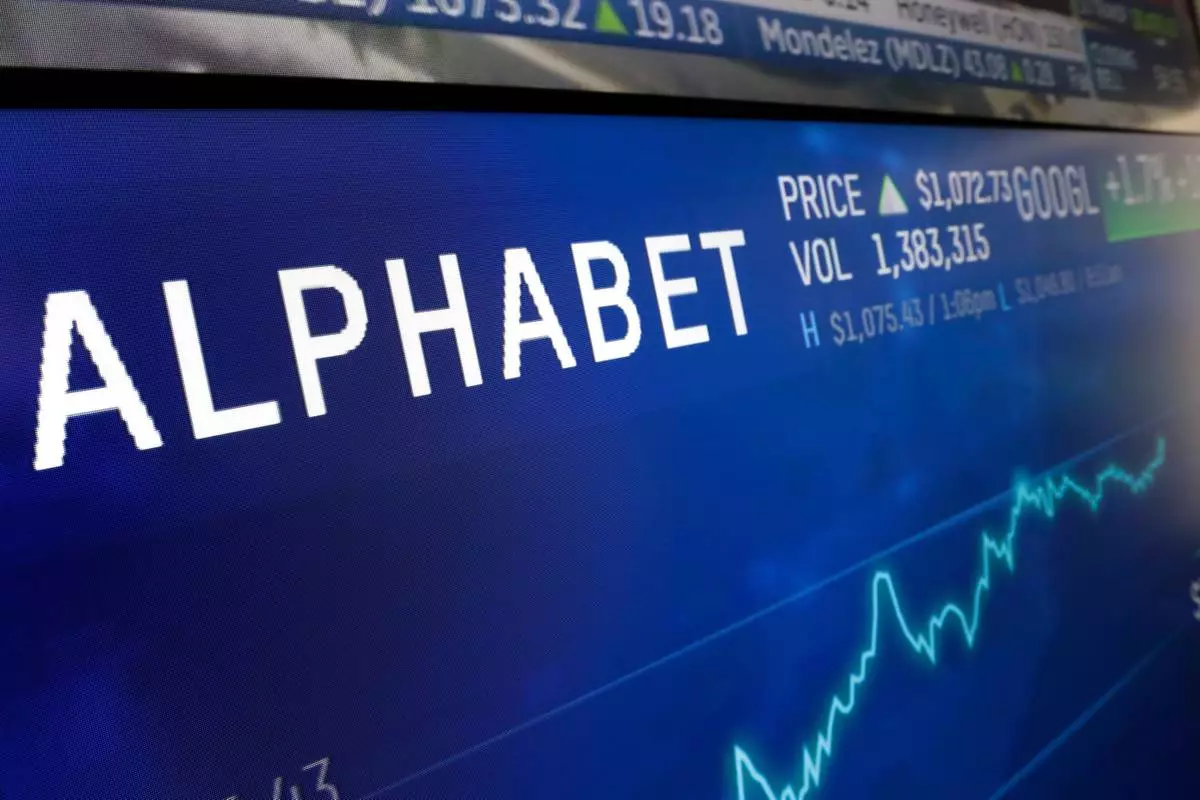
FILE - In this Feb. 14, 2018, file photo the logo for Alphabet appears on a screen at the Nasdaq MarketSite in New York. Alphabet reports earnings on Oct. 24, 2023. (AP Photo/Richard Drew, File)
FILE - In this Feb. 14, 2018, file photo the logo for Alphabet appears on a screen at the Nasdaq MarketSite in New York. Alphabet reports earnings on Oct. 24, 2023. (AP Photo/Richard Drew, File)

FILE - A sign is displayed on a Google building at their campus in Mountain View, Calif., on Sept. 24, 2019. (AP Photo/Jeff Chiu, File)


FILE - A sign is displayed on a Google building at their campus in Mountain View, Calif., on Sept. 24, 2019. (AP Photo/Jeff Chiu, File)

WASHINGTON (AP) — President Donald Trump is meeting with oil executives at the White House on Friday in hopes of securing $100 billion in investments to revive Venezuela’s ability to fully tap into its expansive reserves of petroleum — a plan that rides on their comfort in making commitments in a country plagued by instability, inflation and uncertainty.

Since the U.S. military raid to capture former Venezuelan leader Nicolás Maduro on Saturday, Trump has quickly pivoted to portraying the move as a newfound economic opportunity for the U.S., seizing tankers carrying Venezuelan oil, saying the U.S. is taking over the sales of 30 million to 50 million barrels of previously sanctioned Venezuelan oil and will be controlling sales worldwide indefinitely.

On Friday, U.S. forces seized their fifth tanker over the past month that has been linked to Venezuelan oil. The action reflected the determination of the U.S. to fully control the exporting, refining and production of Venezuelan petroleum, a sign of the Trump administration's plans for ongoing involvement in the sector as it seeks commitments from private companies.

It's all part of a broader push by Trump to keep gasoline prices low. At a time when many Americans are concerned about affordability, the incursion in Venezuela melds Trump’s assertive use of presidential powers with an optical spectacle meant to convince Americans that he can bring down energy prices.

The meeting, set for 2:30 p.m. EST, will be open to the news media, according to an update to the president's daily schedule. “At least 100 Billion Dollars will be invested by BIG OIL, all of whom I will be meeting with today at The White House,” Trump said Friday in a pre-dawn social media post.

Trump is set to meet with executives from 17 oil companies, according to the White House. Among the companies attending are Chevron, which still operates in Venezuela, and ExxonMobil and ConocoPhillips, which both had oil projects in the country that were lost as part of a 2007 nationalization of private businesses under Maduro’s predecessor, Hugo Chávez.

The president is meeting with a wide swath of domestic and international companies with interests ranging from construction to the commodity markets. Other companies slated to be at the meeting include Halliburton, Valero, Marathon, Shell, Singapore-based Trafigura, Italy-based Eni and Spain-based Repsol.

Large U.S. oil companies have so far largely refrained from affirming investments in Venezuela as contracts and guarantees need to be in place. Trump has suggested on social media that America would help to backstop any investments.

Venezuela’s oil production has slumped below one million barrels a day. Part of Trump's challenge to turn that around will be to convince oil companies that his administration has a stable relationship with Venezuela’s interim President Delcy Rodríguez, as well as protections for companies entering the market.

Secretary of State Marco Rubio, Energy Secretary Chris Wright and Interior Secretary Doug Burgum are slated to attend the oil executives meeting, according to the White House.

Meanwhile, the United States and Venezuelan governments said Friday they were exploring the possibility of r estoring diplomatic relations between the two countries, and that a delegation from the Trump administration arrived to the South American nation on Friday.

The small team of U.S. diplomats and diplomatic security officials traveled to Venezuela to make a preliminary assessment about the potential re-opening of the U.S. Embassy in Caracas, the State Department said in a statement.

Trump also announced on Friday he’d meet with President Gustavo Petro in early February, but called on the Colombian leader to make quick progress on stemming flow of cocaine into the U.S.

Trump, following the ouster of Maduro, had made vague threats to take similar action against Petro. Trump abruptly changed his tone Wednesday about his Colombian counterpart after a friendly phone call in which he invited Petro to visit the White House.

President Donald Trump waves as he walks off stage after speaking to House Republican lawmakers during their annual policy retreat, Tuesday, Jan. 6, 2026, in Washington. (AP Photo/Evan Vucci)

President Donald Trump waves as he walks off stage after speaking to House Republican lawmakers during their annual policy retreat, Tuesday, Jan. 6, 2026, in Washington. (AP Photo/Evan Vucci)

Recommended Articles