Business expectations for the second quarter of 2025
The Census and Statistics Department (C&SD) released today (April 25) the results of the Quarterly Business Tendency Survey for the second quarter (Q2) of 2025.
Business Situation
For all surveyed sectors taken together, the proportion of respondents expecting their business situation to be better (9%) in Q2 2025 over the preceding quarter is lower than that expecting it to be worse (18%).
When compared with the results of the Q1 2025 survey round, the proportion of respondents expecting a better business situation in Q2 2025 is 9%, broadly the same as the corresponding proportion in Q1 2025. On the other hand, the proportion of respondents expecting a worse business situation had slightly decreased from 19% in Q1 2025 to 18% in Q2 2025.
Analysed by sector, respondents in most of the surveyed sectors expect their business situation to decrease on balance in Q2 2025 as compared with Q1 2025. In particular, significantly more respondents in the accommodation and food services and transportation, storage and courier services sectors expect their business situation to be worse in Q2 2025 as compared with Q1 2025.
The results of the survey should be interpreted with care. In this type of survey on expectations, the views collected in the survey are affected by the events in the community occurring around the time of enumeration, and it is difficult to establish precisely the extent to which respondents' perception of the future accords with the underlying trends. The enumeration period for this survey round was from March 4, 2025 to April 10, 2025.
Volume of Business / Output
Respondents in all of the surveyed sectors expect their volume of business/ output to decrease on balance or remain broadly unchanged in Q2 2025 as compared with Q1 2025. In particular, significantly more respondents in the accommodation and food services sector expect their volume of business to decrease in Q2 2025 over Q1 2025.
Employment
Respondents in most of the surveyed sectors expect their employment to decrease on balance or remain broadly unchanged in Q2 2025 as compared with Q1 2025. In particular, more respondents in the accommodation and food services and construction sectors expect their employment to decrease in Q2 2025 over Q1 2025. In the real estate sector, however, more respondents expect their employment to increase, as compared to those expecting it to decrease.
Selling Price/ Service Charge
Respondents in most of the surveyed sectors expect their selling prices/ service charges to remain broadly unchanged in Q2 2025 as compared with Q1 2025. However, significantly more respondents in the construction and accommodation and food services sectors expect their tender prices/ charges for services rendered/ prices of food provided to go down in Q2 2025 over Q1 2025.
Commentary
A Government spokesman said that according to the survey conducted earlier, the near-term business outlook and hiring appetite among large enterprises for the second quarter of 2025 were largely stable compared with expectations for the previous quarter.
The spokesman pointed out that the survey captured largely the views of enterprises before the abrupt escalation of trade tensions due to the significant increases in import tariffs by the US in early April. Looking forward, as the downside risk and uncertainties of the global economy have increased notably, business sentiment should be subject to pressure. The Government has been providing support to enterprises through various measures, and will monitor the situation closely.
Further Information
The survey gathers views on short-term business performance from the senior management of about 570 prominent establishments in various sectors in Hong Kong with a view to providing a quick reference, with minimum time lag, for predicting the short-term future economic performance of the local economy.
The survey covers 10 major sectors in Hong Kong, namely manufacturing; construction; import / export trade and wholesale; retail; accommodation and food services (mainly covering services rendered by hotels and restaurants); transportation, storage and courier services; information and communications; financing and insurance; real estate; and professional and business services sectors.
Views collected in the survey refer only to those of respondents on their own establishments rather than those on the respective sectors they are engaged in, and are limited to the expected direction of quarter-to-quarter change (e.g. "up", "same" or "down") but not the magnitude of change. In collecting views on the quarter-to-quarter changes, if the variable in question is subject to seasonal variations, respondents are asked to provide the expected changes after excluding the normal seasonal variations.
Survey results are generally presented as "net balance", i.e. the difference between the percentage of respondents choosing "up" and that choosing "down". The percentage distribution of respondents among various response categories (e.g. "up", "same" and "down") reflects how varied their business expectations are. The "net balance", with its appropriate sign, indicates the direction of expected change in the variable concerned. A positive sign indicates a likely upward trend while a negative sign indicates a likely downward trend. However, the magnitude of the "net balance" reflects only the prevalence of optimism or pessimism, but not the magnitude of expected change, since information relating to such magnitude is not collected in the survey.
Furthermore, owing to sample size constraint, care should be taken in interpreting survey results involving a small percentage (e.g. less than 10%) of respondents in individual sectors.
Chart 1 shows the views on expected changes in business situation for the period Q2 2024 to Q2 2025.
Table 1 shows the net balances of views on expectations in respect of different variables for Q2 2025.
The survey results are published in greater detail in the "Report on Quarterly Business Tendency Survey, Q2 2025". Users can browse and download the publication at the website of the C&SD (www.censtatd.gov.hk/en/EIndexbySubject.html?pcode=B1110008&scode=300).
Users who have enquiries about the survey results may contact the Business Expectation Statistics Section of the C&SD (Tel: 3903 7263; E-mail: business-prospects@censtatd.gov.hk).
EDB reminds parents to choose primary schools under Central Allocation process for their children
The Education Bureau (EDB) today (January 12) reminded parents that children who have joined the Primary One Admission (POA) System for 2026 but have not yet secured a discretionary place can take part in the Central Allocation process for a Primary One (P1) place in a government or aided primary school. Parents concerned should make their choice of schools within the period from January 19 to 25.
Digitalisation of POA
---------------------------
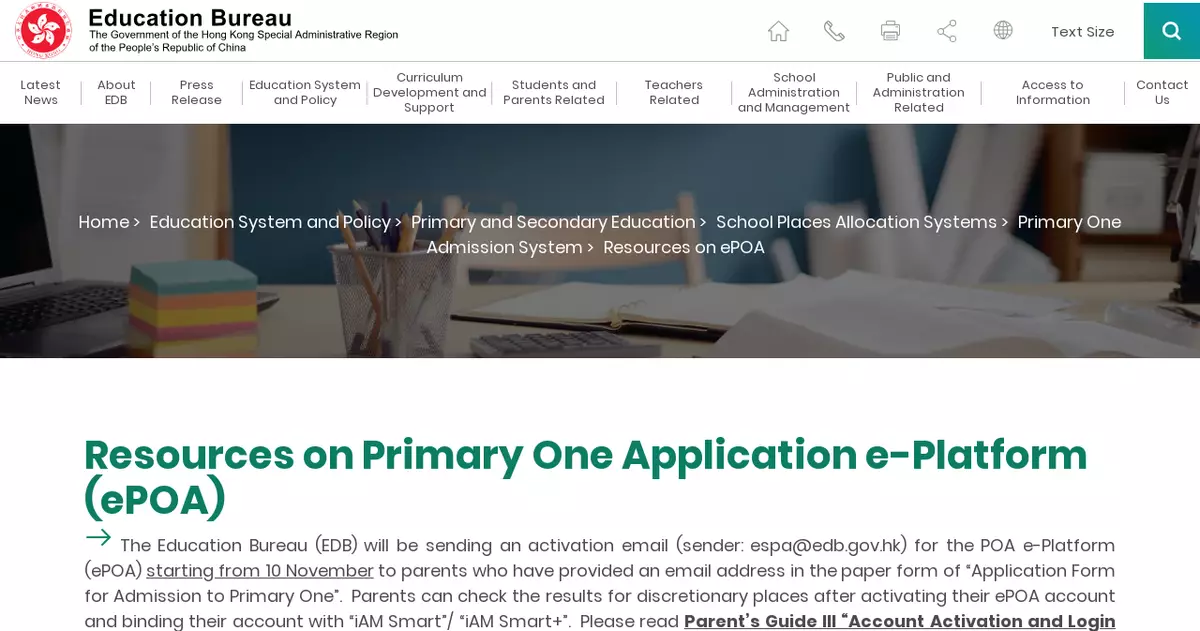
In line with the Smart Government strategy, the EDB has fully implemented digitalisation of the POA. Parents who have registered as POA e-Platform (ePOA) users and have bound their account to "iAM Smart+" may submit the Choice of Schools Form for Central Allocation from January 19 to 25 through the ePOA. Please refer to the related videos and Parent's Guide on the EDB's website (www.edb.gov.hk/en/edu-system/primary-secondary/spa-systems/primary-1-admission/poa_eplatform/index.html) for details of the procedures for activating and logging into an ePOA account and for making school choices for the Central Allocation of POA via the e-Platform.
Making school choices at Central Allocation Centres
-----------------------------------------------------------------
The EDB will send letters to parents on January 14 inviting them to make their choice of schools. To cater for the needs of different parents, parents can still submit the Choice of Schools Form in paper form by visiting the designated Central Allocation Centre at the suggested time slot (i.e. 9.30am to 12.30pm or 1.30pm to 4.30pm on January 24 (Saturday) or 9.30am to 12.30pm on January 25 (Sunday)) stated in the letter.
Parents who are ePOA users may choose to submit the Central Allocation Application via the ePOA or in paper form to the Central Allocation Centre but should not submit duplicate applications. Parents who have not yet received the letter by January 19 should call the School Places Allocation Section of the EDB (Hotline: 2832 7700) as soon as possible.
Only one parent of an applicant child is required to complete the school choice-making procedures. Parents are advised not to take their children to the Central Allocation Centre if possible. Parents who cannot make school choices within the suggested time slot can go to the designated Central Allocation Centre from 1.30pm to 4.30pm on January 25. The Choice of Schools Form will be sent together with the letter to parents who have submitted a paper Application Form at the Discretionary Places stage for filling out in advance.
In the event of adverse weather or other special conditions on any day during the period of making school choices, please pay heed to radio or television announcements on the relevant special arrangements.
Unable to submit application within specified choice-making period
------------------------------------------------------------------------------------
For individual parents who are unable to use the ePOA or go to the Central Allocation Centre to make school choices, they can authorise in writing a representative to bring the completed Choice of Schools Form and their signed Letter of Authorisation to the Central Allocation Centre to proceed with the related procedures.
To apply for POA 2026 for their children after January 25, parents need to complete necessary procedures with the School Places Allocation Section, which will separately arrange P1 places for the applicant children in June.
Change of residential address
--------------------------------------
An EDB spokesman reminded parents that, if they have recently moved their residence or have such plans in the near future, they are required to inform the School Places Allocation Section as soon as possible so that they can make school choices in the POA School Net where their new home is located. Parents should fill in the actual residential address of their child. If they provide a false address for securing a P1 place, the POA application of their child will be rendered void and the P1 place allocated will be withdrawn.
The EDB has put in place a monitoring mechanism to verify the residential addresses of applicant children as given by the parents. Random checks have also been stepped up. The public may call the School Places Allocation Section to report suspected cases of using a false address by parents for their children's POA application. The EDB will take action against false address cases.
Mechanism of Central Allocation
----------------------------------------
Central Allocation is composed of two parts. Part A, which takes up 10 per cent of the P1 places earmarked for Central Allocation, is for unrestricted school choices. Parents can choose up to three government or aided primary schools in any school net. Part B takes up the remaining 90 per cent of the P1 places earmarked for Central Allocation. Parents of applicant children residing in the school net concerned are to select schools from the "Choice of Schools List for Central Allocation (Primary One Admission 2026)" of their school net, while parents of applicant children who intend to commute daily to schools in Hong Kong are to select schools from the "2026 Choice of Schools List for Central Allocation (For Applicant Children who intend to commute daily to schools in Hong Kong)". Parents should fill in the Choice of Schools Form in the order of their preference.
The mechanism of the Central Allocation is based on parents' choices in general. The computer-programmed allocation will first process the school choices in Part A and then the school choices in Part B. For oversubscribed schools, the order of priority in allocating places will be determined by random numbers generated by the computer for individual applicants to ensure fairness.
For information about the procedures for Central Allocation, please call the EDB's 24-hour automatic telephone enquiry service at 2891 0088.
Release of Central Allocation results
----------------------------------------------
For parents who have already activated their ePOA account via "iAM Smart" or "iAM Smart+", they will receive their Central Allocation results through the ePOA from 10am on June 3. Parents who wish to receive the allocation results via SMS on June 3 may choose such an option in the Choice of Schools Form. In addition, the allocation results will be sent to parents by post on June 3 and 4.
Source: AI-found images