Eight more trial projects on hydrogen fuel technology given agreement-in-principle by Inter-departmental Working Group on Using Hydrogen as Fuel
A spokesman for the Environment and Ecology Bureau (EEB) said that the Inter-departmental Working Group on Using Hydrogen as Fuel (Working Group) led by the EEB has given agreement-in-principle to eight more applications of trial projects on hydrogen fuel technology at its meeting today (April 25).
The relevant projects involve:
(a) an application jointly submitted by International New Energy Industry Alliance Limited, Wing Tat Cargo & Trading (HK) Limited, H2 Powertrains Limited and Ontime International Logistics (HK) Co Limited, to try out 10 hydrogen fuel cell (HFC) goods vehicles for cross-boundary transport;
(b) an application submitted by Wilson Logistics Limited to try out two HFC goods vehicles for cross-boundary transport;
(c) an application submitted by Kam Wai Tourist Bus (HK) Company Limited to try out two HFC coaches for local passenger services;
(d) an application jointly submitted by China Travel Tours Transportation Services HK Ltd, Allenbus Automotive Technology Co Limited and REFIRE Hong Kong Limited to try out two HFC coaches for cross-boundary passenger services;
(e) an application submitted by Affluent Coach Services Company Limited to test out two HFC coaches for local passenger services;
(f) an application jointly submitted by the Hong Kong and China Gas Company Limited and CIMC Enric Hong Kong Limited, which involves provision of electricity with hydrogen power generation equipment for charging electric vehicles at a commercial building in North Point;
(g) an application jointly submitted by the Hong Kong and China Gas Company Limited and the Hong Kong Housing Society, which involves extracting hydrogen from the existing towngas network at a construction site in Shau Kei Wan to generate electricity for charging electric vehicles and providing electricity for the site office; and
(h) an application jointly submitted by the Hong Kong and China Gas Company Limited and the Hong Kong Science and Technology Parks Corporation, which involves extracting hydrogen from the existing towngas network at Hong Kong Science Park to generate electricity for charging electric vehicles.
The spokesperson for the EEB stated, "The Working Group has promptly initiated the examination process upon receipt of detailed information of the trial projects. Following the applicants' enhancement on the designs and technical details according to feedback from government departments to ensure that the trial projects can be carried out smoothly and safely, the Working Group has given agreement-in-principle to the eight applications at its meeting today."
To date, the Working Group has given agreement-in-principle in stages to a total of 26 applications of hydrogen energy trial projects. Among them, the three HFC street washing vehicles from the Food and Environmental Hygiene Department have passed the examination with the Certificate of Roadworthiness issued, and Sinopec (Hong Kong) Limited has completed all commissioning and testing for the public hydrogen filling station at Au Tau, Yuen Long. The operational trials are expected to be launched in the first half of this year.
The Working Group will continue to make reference to the operational data and experience collected from all local trials, in order to provide advice for the continuous enhancement of the safety and technical guidelines on the local application of hydrogen energy.
The spokesman said, "The Government announced the Strategy of Hydrogen Development in Hong Kong (the Strategy) in June last year, establishing an action timeline across five key areas: regulatory framework, standards formulation, supporting infrastructure, regional co-operation, and capacity building. At the meeting, the EEB and the Electrical and Mechanical Services Department (EMSD) briefed the Working Group on the latest implementation progress of the Strategy, including introducing the Gas Safety (Amendment) Bill 2025 to the Legislative Council to incorporate safety regulations for hydrogen fuel, taking forward the consultancy study on establishing a green and low-carbon hydrogen certification standard, setting up safety training courses for hydrogen technology professionals, stepping up publicity and education work and promote local, regional, and international collaboration on hydrogen energy development, including organising science popularisation activities and seminars (such as the International Hydrogen Development Symposium 2025 held this year). The Working Group will continue to regularly review the progress of the Strategy and provide recommendations to facilitate the implementation of its various measures."
The spokesman supplemented, "To promote the green transformation of transport, the Chief Executive's 2024 Policy Address announced the earmarking of funding under the New Energy Transport Fund to launch a new Subsidy Scheme for Trials of HFC Heavy Vehicles. The EEB has announced the acceptance of applications in December last year."
The spokesman further supplemented, "The Government is also committed to promoting hydrogen development through regional collaboration. The working plan of the Pearl River Delta Air Quality Management and Monitoring Special Panel under the Hong Kong-Guangdong Joint Working Group on Environmental Protection and Combating Climate Change covers demonstration projects of cross-boundary delivery vehicles transiting into HFC vehicles. Moreover, the liaisons between the EMSD and the State Administration for Market Regulation as well as the General Administration of Customs of the People's Republic of China on the technical level, and the EEB's exchanges with the Mainland authorities regarding exchanges involving hydrogen development in the Guangdong-Hong Kong-Macao Greater Bay Area, have all been making good progress."
The Working Group is formed by the EEB, the Transport and Logistics Bureau, the Development Bureau, the Security Bureau, the Environmental Protection Department, the EMSD, the Fire Services Department, the Transport Department, the Marine Department, the Planning Department, the Lands Department, the Buildings Department, the Architectural Services Department and the Labour Department.
EDB reminds parents to choose primary schools under Central Allocation process for their children
The Education Bureau (EDB) today (January 12) reminded parents that children who have joined the Primary One Admission (POA) System for 2026 but have not yet secured a discretionary place can take part in the Central Allocation process for a Primary One (P1) place in a government or aided primary school. Parents concerned should make their choice of schools within the period from January 19 to 25.
Digitalisation of POA
---------------------------
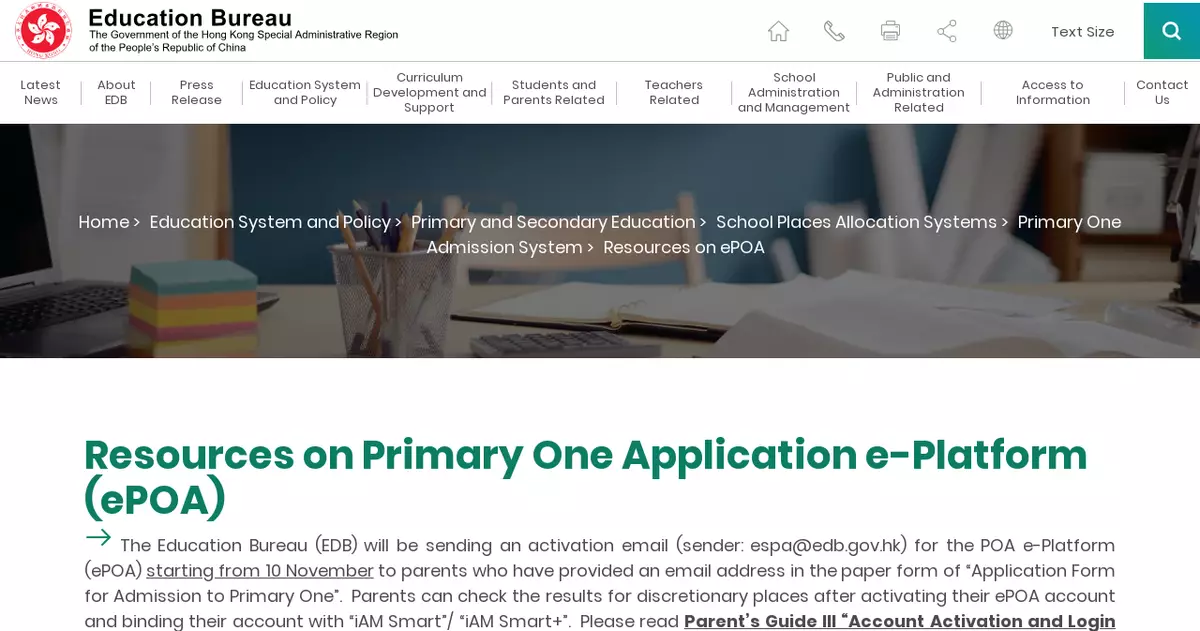
In line with the Smart Government strategy, the EDB has fully implemented digitalisation of the POA. Parents who have registered as POA e-Platform (ePOA) users and have bound their account to "iAM Smart+" may submit the Choice of Schools Form for Central Allocation from January 19 to 25 through the ePOA. Please refer to the related videos and Parent's Guide on the EDB's website (www.edb.gov.hk/en/edu-system/primary-secondary/spa-systems/primary-1-admission/poa_eplatform/index.html) for details of the procedures for activating and logging into an ePOA account and for making school choices for the Central Allocation of POA via the e-Platform.
Making school choices at Central Allocation Centres
-----------------------------------------------------------------
The EDB will send letters to parents on January 14 inviting them to make their choice of schools. To cater for the needs of different parents, parents can still submit the Choice of Schools Form in paper form by visiting the designated Central Allocation Centre at the suggested time slot (i.e. 9.30am to 12.30pm or 1.30pm to 4.30pm on January 24 (Saturday) or 9.30am to 12.30pm on January 25 (Sunday)) stated in the letter.
Parents who are ePOA users may choose to submit the Central Allocation Application via the ePOA or in paper form to the Central Allocation Centre but should not submit duplicate applications. Parents who have not yet received the letter by January 19 should call the School Places Allocation Section of the EDB (Hotline: 2832 7700) as soon as possible.
Only one parent of an applicant child is required to complete the school choice-making procedures. Parents are advised not to take their children to the Central Allocation Centre if possible. Parents who cannot make school choices within the suggested time slot can go to the designated Central Allocation Centre from 1.30pm to 4.30pm on January 25. The Choice of Schools Form will be sent together with the letter to parents who have submitted a paper Application Form at the Discretionary Places stage for filling out in advance.
In the event of adverse weather or other special conditions on any day during the period of making school choices, please pay heed to radio or television announcements on the relevant special arrangements.
Unable to submit application within specified choice-making period
------------------------------------------------------------------------------------
For individual parents who are unable to use the ePOA or go to the Central Allocation Centre to make school choices, they can authorise in writing a representative to bring the completed Choice of Schools Form and their signed Letter of Authorisation to the Central Allocation Centre to proceed with the related procedures.
To apply for POA 2026 for their children after January 25, parents need to complete necessary procedures with the School Places Allocation Section, which will separately arrange P1 places for the applicant children in June.
Change of residential address
--------------------------------------
An EDB spokesman reminded parents that, if they have recently moved their residence or have such plans in the near future, they are required to inform the School Places Allocation Section as soon as possible so that they can make school choices in the POA School Net where their new home is located. Parents should fill in the actual residential address of their child. If they provide a false address for securing a P1 place, the POA application of their child will be rendered void and the P1 place allocated will be withdrawn.
The EDB has put in place a monitoring mechanism to verify the residential addresses of applicant children as given by the parents. Random checks have also been stepped up. The public may call the School Places Allocation Section to report suspected cases of using a false address by parents for their children's POA application. The EDB will take action against false address cases.
Mechanism of Central Allocation
----------------------------------------
Central Allocation is composed of two parts. Part A, which takes up 10 per cent of the P1 places earmarked for Central Allocation, is for unrestricted school choices. Parents can choose up to three government or aided primary schools in any school net. Part B takes up the remaining 90 per cent of the P1 places earmarked for Central Allocation. Parents of applicant children residing in the school net concerned are to select schools from the "Choice of Schools List for Central Allocation (Primary One Admission 2026)" of their school net, while parents of applicant children who intend to commute daily to schools in Hong Kong are to select schools from the "2026 Choice of Schools List for Central Allocation (For Applicant Children who intend to commute daily to schools in Hong Kong)". Parents should fill in the Choice of Schools Form in the order of their preference.
The mechanism of the Central Allocation is based on parents' choices in general. The computer-programmed allocation will first process the school choices in Part A and then the school choices in Part B. For oversubscribed schools, the order of priority in allocating places will be determined by random numbers generated by the computer for individual applicants to ensure fairness.
For information about the procedures for Central Allocation, please call the EDB's 24-hour automatic telephone enquiry service at 2891 0088.
Release of Central Allocation results
----------------------------------------------
For parents who have already activated their ePOA account via "iAM Smart" or "iAM Smart+", they will receive their Central Allocation results through the ePOA from 10am on June 3. Parents who wish to receive the allocation results via SMS on June 3 may choose such an option in the Choice of Schools Form. In addition, the allocation results will be sent to parents by post on June 3 and 4.
Source: AI-found images