Skip to Content Facebook Feature Image

US airstrikes, sanctions deepen Yemen's humanitarian crisis

China

China

China

US airstrikes, sanctions deepen Yemen's humanitarian crisis

2025-04-25 19:44 Last Updated At:20:27

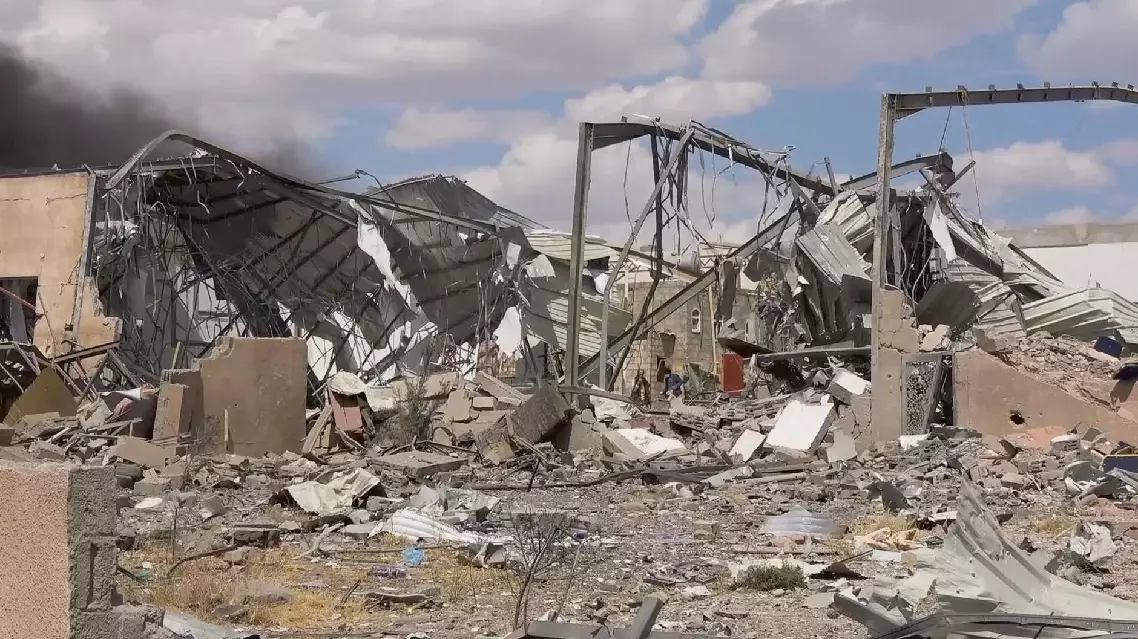
Recent U.S. airstrikes and sanctions against Yemen have dramatically worsened the country's humanitarian crisis, with bombings causing widespread civilian devastation and economic restrictions accelerating poverty nationwide.

The U.S. airstrikes in Yemen have targeted numerous residential areas. Survivors have described how these attacks have not only caused damage to their homes but have also completely devastated their lives.

"The children were extremely frightened by the missiles that came suddenly, while people were safe in their homes. We came out to see what had happened, only to discover entire families -- women and children -- had been completely wiped out," said Waleed Al-Adibi, one of the survivors.

"We were safe in our homes, unaware there was any bombing. We live in a residential neighborhood -- there are no military camps near us, nothing at all. The first missile terrified all of us, and the second one completely blew the house apart," said Ismail Al-Harbi, another survivor.

Since the start of this year, U.S. airstrikes have continued to bring terror to the people of Yemen.

Additionally, the United Nations and the World Health Organization encounter mounting obstacles in assisting those in need, with reports of logistical and security challenges and aid workers at risk.

Yemen is currently experiencing its most severe humanitarian crisis in modern history, with millions of children suffering from severe malnutrition and thousands of families losing their sources of income. Poverty is rapidly spreading across the country.

"We're talking about full-scale suffering caused by the blockade and restrictions on Hodeidah Port. The first to suffer is the ordinary citizen. More than five million Yemenis now live below the poverty line, with almost no purchasing power," said Sanad Al-Sayyadi, a humanitarian and human rights activist.

Apart from the escalation in bombing, the U.S. has also imposed a series of new sanctions. These include limitations on fuel entering Hodeidah Port, which serves as Yemen's primary economic artery, supporting millions of people.

The U.S. stated that the aim is to weaken the Houthis and safeguard freedom of navigation in the Red Sea. But the Yemeni side denounced the airstrikes as a "direct assault" on Yemen's sovereignty. They stated that the strikes are a Western response to Yemen's support for Gaza -- and that its people are paying the price.

"This is savage. This is barbaric. This is unjustified aggression. The U.S. acts like it owns the seas and wants to control everything. It believes it is above international and humanitarian law -- above the International Criminal Court. That's why we try to respond in the strongest way we can," said Ali Al-Dailami, a member of the Houthi Political Bureau.
US airstrikes, sanctions deepen Yemen's humanitarian crisis
US airstrikes, sanctions deepen Yemen's humanitarian crisis
The Iranian government is focusing on public concerns and maintaining stable supplies of essential goods amid recent protests, Iranian President Masoud Pezeshkian said in a televised interview on Sunday.

In the city of Karaj, northwest of the capital Tehran, daily life has largely continued as normal. A video filmed by a local resident on Sunday shows food stores open and grocery shelves fully stocked.

"This is the block near my home, and there are some food stores here. Daily life continues here. Last night we did not see many protests in Karaj. Right now the city is very safe. This is a grocery store close to my home. All the food is available; nothing is in shortage. Here are noodles and different types of beans. Here are dairy products, cheese, and yogurt. I also checked other grocery stores and didn't see any shortages. Everything is available," said local resident Ali Reza.

Iranian officials have described recent disturbances as acts orchestrated by the "enemy," including some carried out by well-trained and armed "terrorists." The incidents have caused casualties among security personnel and civilians, as well as property damage.

The Secretary of Iran's Supreme National Security Council Ali Larijani has directed authorities to severely punish the "terrorists."

Meanwhile, Iran's police chief Ahmad-Reza Radan said on Sunday that the police had raised alert levels and arrested several leaders of the troublemakers during the operations on Saturday.

President Pezeshkian noted in the interview that the normal demands of the Iranian people are reasonable and justified, but they must realize that triggering riots and carrying out terrorist acts are the enemy's attempts to undermine the country. He urged the public to remain vigilant.

Also on Sunday, Iranian Parliament Speaker Mohammad Baqer Qalibaf warned that Tehran would regard U.S. and Israeli bases and facilities in the Middle East as "legitimate targets" if Washington takes military action against Iran. His remarks followed media reports saying U.S. President Donald Trump is "seriously considering authorizing a strike" against Iran.

Iranian state media reported that at least 109 members of Iran's security forces have been killed in clashes since the protests began 14 days ago. Meanwhile, human rights groups based outside the country said the number of protesters killed has exceeded 200, though the figure could not be independently verified.

The protests initially erupted over a sharp depreciation of the rial and sweeping subsidy reforms. Iranian authorities have blamed the unrest on foreign-linked agents and sanctions imposed by the United States.

Iranian president says government focusing on ensuring supplies amid protests

Iranian president says government focusing on ensuring supplies amid protests

Recommended Articles