Skip to Content Facebook Feature Image

China Mobile spearheads 6G development, aims for commercialization by 2030

China

China

China

China Mobile spearheads 6G development, aims for commercialization by 2030

2025-04-26 19:38 Last Updated At:20:17

China Mobile, China's leading telecommunications company, is making significant strides in advancing the development of 6G technology, aligning with the country's efforts to realize its goal of commercializing 6G, the next-generation wireless technology, by 2030.

This year's government work report for the first time clearly proposes the development of future industries such as 6G, marking that 6G has officially become an important part of the national strategies.

6G, the sixth generation of mobile communication technology, aims to provide faster internet speed, lower latency, higher reliability, and integrated communications, perception, computing, AI and big data capabilities, to support more application scenarios.

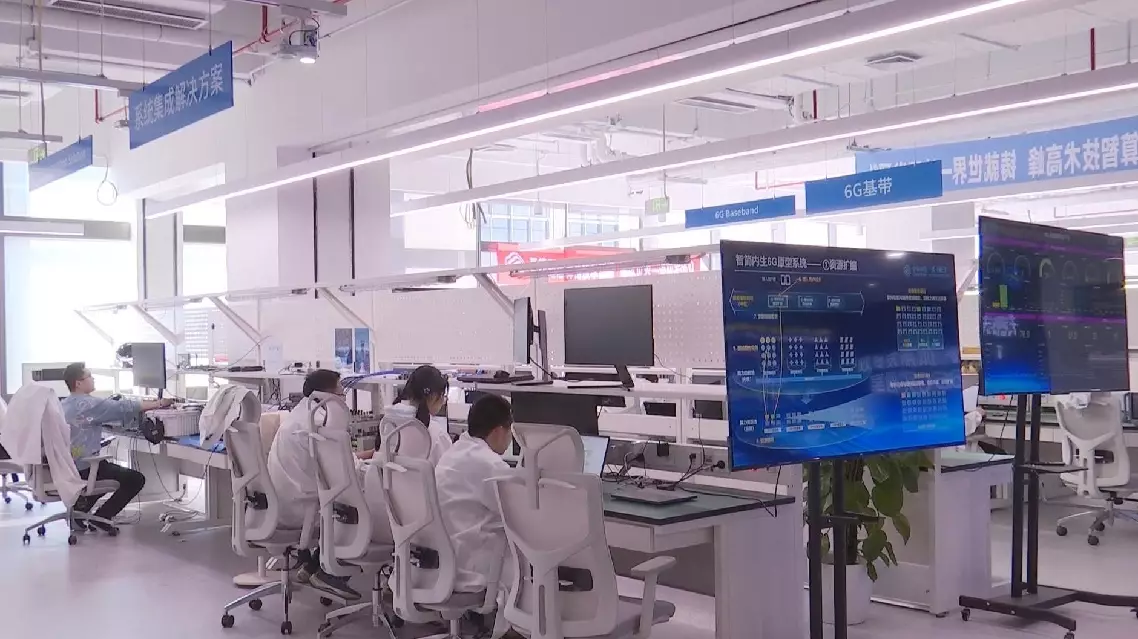
In the northern suburbs of Beijing, engineers of the China Mobile Research Institute (CMRI) under China Mobile are busy working on the next-generation wireless infrastructure in a 6G lab.

"6G will be beyond communication. That means it will integrate communication together with computing, big data, AI and also security," said Liu Guangyi, chief expert of the CMRI.

Enabling these new capabilities means redesigning the network and putting up new types of base stations. Prototype 6G base stations are currently undergoing trials in the park, showcasing enhanced data transmission at higher frequencies with broader bandwidth for accelerated speeds.

These stations interact with autonomous driving robots, simulating how future mobile devices will engage with 6G stations, foreshadowing a realm where devices and networks exchange a wealth of information.

Liu envisions a future where devices and networks exchange richer data than ever before.

"Take factories for example, we used to think offering ultra-low latency and high reliability was enough, but it's not, in fact. The factories also need precise positioning, sensing, computing, storage and AI capabilities. They even hope to integrate their entire IT systems into the network. 5G, due to limitations in its design and capabilities, can't fully meet these demands. That's why we hope 6G can solve these issues once and for all," said Liu.

To foster collaboration across the supply chain, the team has integrated a board into their base station, facilitating testing of third-party technologies in a 6G environment. This collaborative ecosystem aims to create commercial value, a goal that 5G has faced challenges in achieving.

"We need more vendors, more friends to join us. We can work together, try to push everything to go ahead, and we expect by year of 2030, our apps, new service, and also the new business models can be mature. By that way, we can start the launch of the 6G," said Liu.
China Mobile spearheads 6G development, aims for commercialization by 2030


China Mobile spearheads 6G development, aims for commercialization by 2030

The Iranian government is focusing on public concerns and maintaining stable supplies of essential goods amid recent protests, Iranian President Masoud Pezeshkian said in a televised interview on Sunday.

In the city of Karaj, northwest of the capital Tehran, daily life has largely continued as normal. A video filmed by a local resident on Sunday shows food stores open and grocery shelves fully stocked.

"This is the block near my home, and there are some food stores here. Daily life continues here. Last night we did not see many protests in Karaj. Right now the city is very safe. This is a grocery store close to my home. All the food is available; nothing is in shortage. Here are noodles and different types of beans. Here are dairy products, cheese, and yogurt. I also checked other grocery stores and didn't see any shortages. Everything is available," said local resident Ali Reza.

Iranian officials have described recent disturbances as acts orchestrated by the "enemy," including some carried out by well-trained and armed "terrorists." The incidents have caused casualties among security personnel and civilians, as well as property damage.

The Secretary of Iran's Supreme National Security Council Ali Larijani has directed authorities to severely punish the "terrorists."

Meanwhile, Iran's police chief Ahmad-Reza Radan said on Sunday that the police had raised alert levels and arrested several leaders of the troublemakers during the operations on Saturday.

President Pezeshkian noted in the interview that the normal demands of the Iranian people are reasonable and justified, but they must realize that triggering riots and carrying out terrorist acts are the enemy's attempts to undermine the country. He urged the public to remain vigilant.

Also on Sunday, Iranian Parliament Speaker Mohammad Baqer Qalibaf warned that Tehran would regard U.S. and Israeli bases and facilities in the Middle East as "legitimate targets" if Washington takes military action against Iran. His remarks followed media reports saying U.S. President Donald Trump is "seriously considering authorizing a strike" against Iran.

Iranian state media reported that at least 109 members of Iran's security forces have been killed in clashes since the protests began 14 days ago. Meanwhile, human rights groups based outside the country said the number of protesters killed has exceeded 200, though the figure could not be independently verified.

The protests initially erupted over a sharp depreciation of the rial and sweeping subsidy reforms. Iranian authorities have blamed the unrest on foreign-linked agents and sanctions imposed by the United States.

Iranian president says government focusing on ensuring supplies amid protests

Iranian president says government focusing on ensuring supplies amid protests

Recommended Articles