Nanyang Pyrography, a delicate ancient Chinese craft that paints with a "fire needle," is experiencing a vibrant revival in the modern era, thanks to dedicated preservation efforts and creative adaptations that are captivating a new generation.
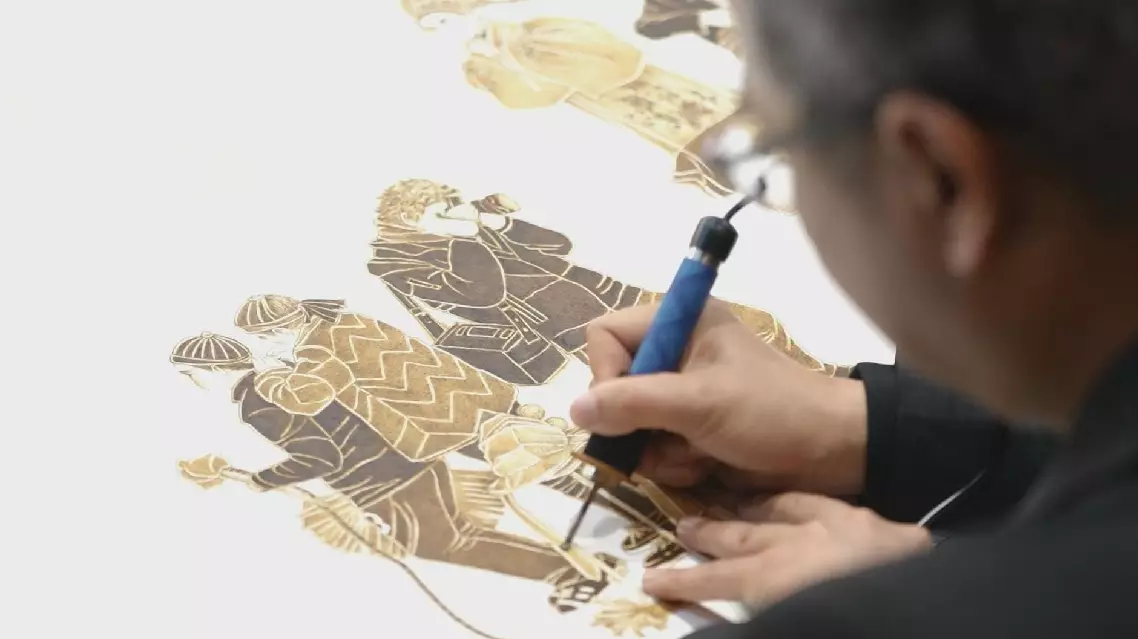
This traditional art form uses high-temperature tools to burn patterns onto wood, silk, paper, and other carbonizable materials, creating visual effects that resemble traditional Chinese ink paintings. It was recognized as a national-level intangible cultural heritage in 2021.
At the Nanyang Pyrography Preservation Center in central China's Henan Province, master artists and inheritors are meticulously crafting a 45-meter-long silk pyrography scroll — one of the most ambitious contemporary projects pushing the boundaries of the art.
"It depicts the entire process of Shehuo [folk celebration] — from makeup and performances to the conclusion— featuring over 600 figures," said the pyrographer Yan Guihai.
Originating during the Western Han Dynasty (202 BC–25 AD) and flourishing in the Ming and Qing dynasties (1368–1911 AD), Nanyang Pyrography involves a sophisticated process, including composition planning, material selection, sketching, controlled scorching, inscription, and mounting. Artists must skillfully balance the heat and pressure of their pyrography pens to achieve subtle gradations of color — from pale yellow and warm brown to deep black — mimicking the ink-wash style of traditional Chinese paintings.
Working at temperatures between 300 and 800 degrees Celsius, pyrography on fragile materials like silk and rice paper demands not only artistic talent but also extraordinary precision. One misstep can ruin an entire piece.
"The finer the details we depict, the lower the temperature we need. For example, we literally hold our breath when burning facial lines or adding shading to a figure," said Cao Yanhong, a pyrography inheritor.
From the delicate tracing of lines to the nuanced blending of light and shadow, a pyrography artist must not only master traditional painting techniques but also precisely control both the temperature of the tool and the timing of each burn.
Beyond traditional themes such as landscapes, birds, and flowers, modern pyrography incorporates pop-culture motifs and 3D effects to captivate younger audiences.
"When selecting subjects, we choose more animated works that resonate with young people. In terms of presentation, while traditional Nanyang Pyrography is mostly two-dimensional, we have adopted more three-dimensional forms and incorporated modern elements such as light and shadow effects," said the pyrography inheritor Ma Jinghui.
Today, pyrography ranges from large installations like folding screens and murals to smaller items such as tea sets and decorative ornaments, offering an evolving fusion of artistry and functionality.
To better preserve and pass on the craft, authorities in Nanyang have organized exhibitions, launched training workshops, and partnered with local universities to establish specialized programs, allowing more people to learn about and fall in love with this traditional art form.
"Through government subsidies, financial support, and other incentives, we are encouraging more young people to embrace the art of pyrography and carry on its traditions. In the future, we will continue to explore creative ways to revitalize intangible cultural heritage, making Nanyang Pyrography a cultural symbol that can be touched, experienced, and passed down," said Yu Sen, director of the Nanyang Intangible Cultural Heritage Protection Center.
Millennia-old pyrography revives through contemporary innovation in Nanyang