Skip to Content Facebook Feature Image

Expert warns of U.S. tariffs disrupting cross-border e-commerce amid supply chain strains

China

China

China

Expert warns of U.S. tariffs disrupting cross-border e-commerce amid supply chain strains

2025-04-27 15:53 Last Updated At:04-28 00:07

U.S. tariffs are disrupting cross-border e-commerce, squeezing businesses and stalling supply chains, warned a U.S. cross-border e-commerce practitioner on Friday.

Michael Michelini, a seasoned U.S. cross-border e-commerce practitioner, sources goods primarily from China and Thailand while offering consulting services to e-commerce enterprises. Reflecting on the tariff hikes imposed during Donald Trump's administration, Michelini expressed helplessness, emphasizing how these measures have stifled e-commerce businesses and stagnated the broader supply chain. "Unfortunately, some companies right now are just freezing shipments, I mean, nobody's buying from the factories. They are waiting because everybody's waiting, hoping the tariffs come down. Again, this hurts any importer, not really the factory, the supplier, it hurts the importer into the country it's going like the U.S. So, if you're U.S. business and you buy 100,000 dollars of products and you have to pay 150,000 dollars on top for tariffs, you are paying 250,000 dollars up front, hoping you make it back. So, some people have just frozen shipments and not even like paid for the duties that are stuck at port," he said.

A price comparison platform revealed that since April 9, when new U.S. tariffs took effect, prices for 930 Amazon products have surged by an average of 29 percent. These products span categories including clothing, household goods, electronics, and toys.

Meanwhile, other e-commerce platforms have announced rising operating costs due to "recent changes in global trade rules and tariffs," leading to price adjustments starting April 25. The soaring commodity prices are piling pressure on both consumers and businesses.

In response, Michelini remarked that it would be difficult for the U.S. government to achieve its goal of "manufacturing return" merely by imposing tariffs, as they have disrupted supply chains and hindered competitiveness.

"I saw the gutting of the American middle class and the gutting of the American manufacturing base in the 1990s. And I was just a kid and I had to hear from my uncles losing their jobs. Yes, it was really hard. And to just now flip a finger and bring it back, I'm not sure if I'm being clear," he said.

Expert warns of U.S. tariffs disrupting cross-border e-commerce amid supply chain strains

Expert warns of U.S. tariffs disrupting cross-border e-commerce amid supply chain strains

Expert warns of U.S. tariffs disrupting cross-border e-commerce amid supply chain strains

Expert warns of U.S. tariffs disrupting cross-border e-commerce amid supply chain strains

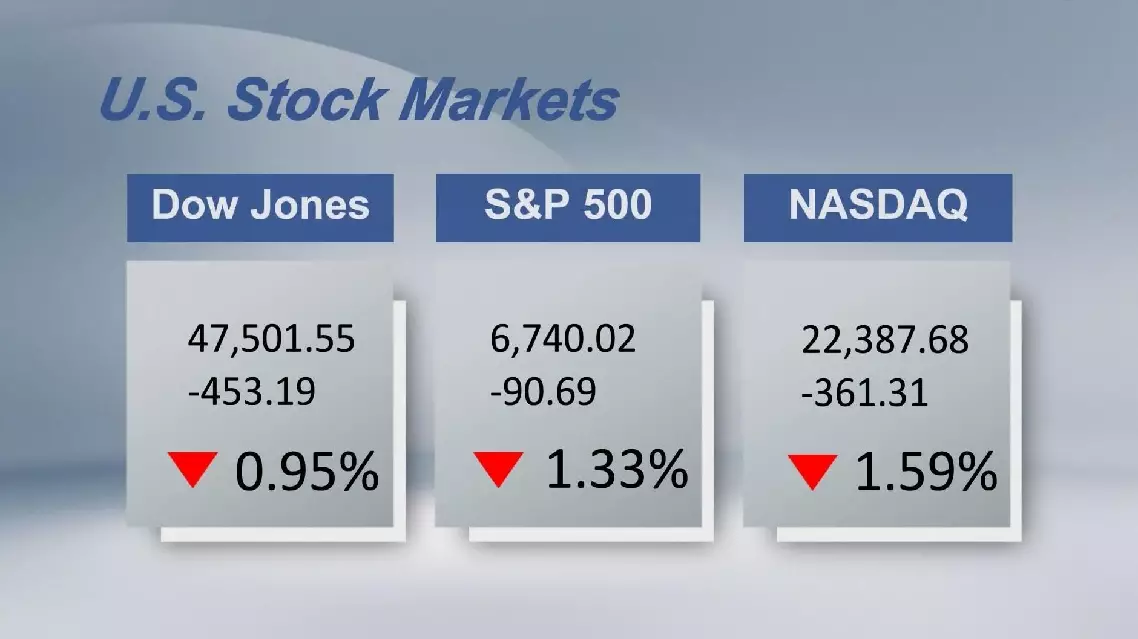
U.S. stocks extended losses on Friday as an unexpectedly weak employment report and surging oil prices tied to the ongoing Middle East conflict heavily weighed on investor sentiment.

The Dow Jones Industrial Average fell 0.95 percent to 47,501.55. The S and P 500 sank 1.33 percent to 6,740.02. The Nasdaq Composite Index shed 1.59 percent to 22,387.68.

Nine of the 11 primary S and P 500 sectors ended in the red. The consumer discretionary and materials sectors led the laggards, dropping 1.96 percent and 1.89 percent, respectively. Consumer staples and energy managed slight gains, advancing 0.29 percent and 0.13 percent, respectively.

The February jobs report dealt a blow to market confidence, revealing that non-farm payrolls unexpectedly contracted by 92,000, widely missing market expectations of a 55,000-job addition. Consequently, the national unemployment rate rose to 4.4 percent.

While the weak data quashed notions of a stabilizing labor market, analysts suggested the Federal Reserve is unlikely to cut interest rates this month because the energy price shock poses a significant risk of reigniting inflation.

San Francisco Federal Reserve President Mary Daly noted in a media interview that the report commands attention, acknowledging that the labor market may be weaker than previously observed.

Global oil prices surpassed 90 U.S. dollars per barrel on Friday. Tanker traffic in the critical Strait of Hormuz has slowed to a near-standstill, raising concerns that Gulf exporters may soon be forced to halt production due to depleted storage capacity.

The broader market sell-off dragged down major technology shares, with the "Magnificent Seven" closing mostly lower. In earnings news, Marvell Technology soared 18.35 percent to pace the Nasdaq, while Gap dropped 14.41 percent.

Financial equities also faced pressure with BlackRock down 7.17 percent, marking its worst trading session since April 4. The steep decline followed the investment management firm's unprecedented decision to cap client withdrawals from one of its private credit funds, signaling potential growing stress within the broader credit markets.

U.S. stocks drop amid weak jobs data

U.S. stocks drop amid weak jobs data

Recommended Articles