China's nationwide consumer goods trade-in programs have yielded remarkable results, with the sales so far topping 720 billion yuan (98.7 billion U.S. dollars), Vice Minister of Commerce Sheng Qiuping said on Monday.
Facing the current complex and severe international environment, vigorously boosting consumption and expanding domestic demand in all aspects is of special significance, said Sheng, adding that the government will continue to enhance the effectiveness of the trade-in policies for consumer goods so as to enable consumers to fully enjoy the policy benefits.
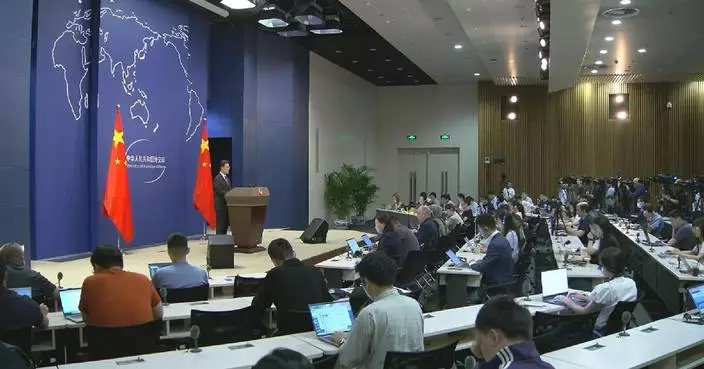
"By the end of Sunday, the nationwide trade-ins had covered 2.814 million vehicles, 49.416 million units of 12 types of home appliances, 37.855 million digital products such as smartphones, 40.906 million units of home decoration and kitchenware and bathroom ware, as well as over 4.2 million electric bicycles. The combined sales generated from the trade-in programs had exceeded 720 billion yuan (98.7 billion U.S. dollars)," he said at a press conference in Beijing.
March 2024 saw the launch of an action plan to promote large-scale equipment renewal and trade-in of consumer goods, as part of efforts to boost domestic demand and support economic growth. At the Central Economic Work Conference in early December last year, the country's policymakers highlighted the need to vigorously boost consumption, improve investment efficiency, and expand domestic demand on all fronts. China has also launched several rounds of activities to expand the trade-in programs in 2025.

China's consumer goods trade-in programs drive sales of over 720 bln yuan
The recently signed memorandum of understanding (MoU) between the United States and Iran has sparked major concern among Israeli officials, who fear that Israel's interests are being abandoned by its most crucial ally, according to analysts.
The development comes as Israel braces for a pivotal election later this year, with Prime Minister Benjamin Netanyahu potentially facing severe political fallout from the agreement.
"Israel views the MoU signed with Iran as a complete capitulation where the Americans were desperate to reach a deal because they clearly failed abysmally to plan for the blocking of the Strait of Hormuz. So they feel that all of Israel's interests have been abandoned," said Dan Perry, an American world affairs and political analyst.
Following the signing of the MoU, Iran and the United States held the first round of high-stakes indirect talks, mediated by Pakistan and Qatar, at the Swiss mountain resort of Buergenstock on Sunday.
On Monday, mediators announced encouraging outcomes from the talks, including a 60-day roadmap toward a final deal, and mechanisms to ensure the security of commercial shipping through the Strait of Hormuz and to end the fighting between Israel and Hezbollah, a close ally of Iran in Lebanon.
However, there have been concerns that Israel may jeopardize the negotiations.
"No doubt that the Americans, some of the Americans, definitely some of the Americans that are negotiating, like the Vice President JD Vance, think that Israel can put some obstacles and jeopardize the negotiations," said Yaki Dayan, former Israeli consul in Los Angeles.
With Israeli elections looming later this year, Netanyahu's core strategy to get re-elected was to portray the very good relations he holds with U.S. President Donald Trump. However, the MoU and the ensuing negotiations between the U.S. and Iran may dramatically affect the election results.
"Unless something dramatically changes, this is devastating for Netanyahu, not only because he pursued a strategy that has failed - the Iranian regime still stands, the nuclear program still exists, Hamas and Hezbollah are still fighting against Israel, but also because he was long perceived as Mr. America, with his incredible eloquence in American English. He could run circles around any American president to get America to do Israel's bidding," said Perry.
Perry added that instead of maintaining that influence, Netanyahu has brought Israel to an unbelievably low point in its relationship with the United States.
Although Netanyahu did practically everything to persuade the U.S. to withdraw from the previous Iran nuclear deal signed more than a decade ago under President Barack Obama, analysts doubt that he can repeat it again this time because Israel and its prime minister rely entirely on just one side of the American political spectrum.
"When you look at alternatives now, you don't have because Israel has lost the Democratic side as well. So you don't have an alternative in the American politics," said Dayan.

Israel feels its interests "abandoned" in US-Iran deal: analysts