BANGKOK (AP) — They'd watched overnight as the bombardments grew closer, and observed through binoculars as the last U.S. Marines piled into a helicopter on the roof of the embassy to be whisked away from Saigon.
So when the reporters who had stayed behind heard the telltale squeak of the rubber sandals worn by North Vietnamese and Viet Cong troops in the stairs outside The Associated Press office, they weren't surprised, and braced themselves for possible detention or arrest.
Click to Gallery
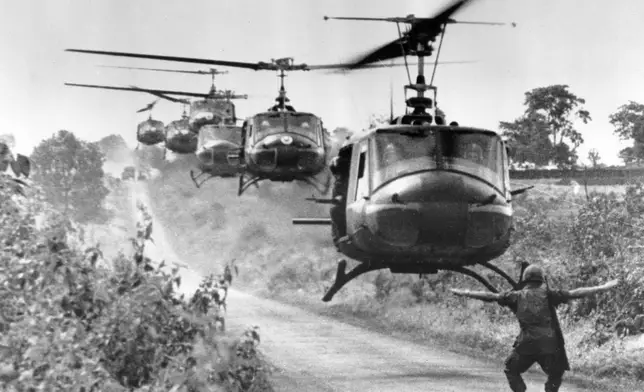
FILE- Huey helicopters, carrying troops of the U.S. 173rd Airborne Brigade, settle in for a landing near the Montagnard village of Plei Ho Drong in August 1965. The unit found friendly mountain tribal people, but no Viet Cong. (AP Photo/Horst Faas, File)
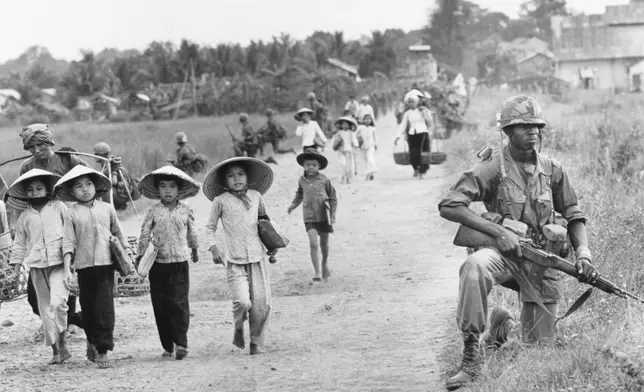
FILE- In an area heavily infiltrated by Viet Cong, a U.S. 1st Division soldier guards Route 7 as Vietnamese market women and schoolchildren return home to the village of Xuan Dien from Ben Cat, December 1965. (AP Photo/Horst Faas, File)
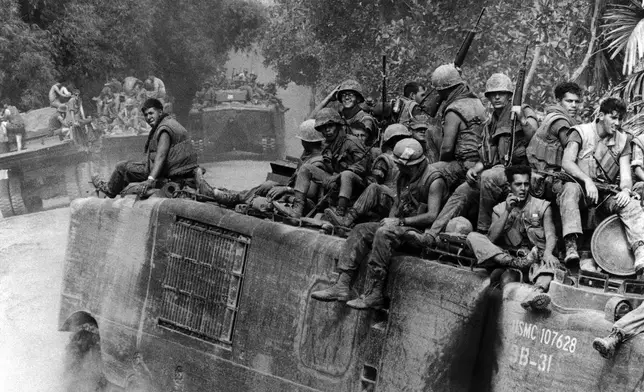
FILE- An amphibious tracked vehicle with a load of fully-armed Marines approaches a river southwest of Danang, South Vietnam, Aug. 22, 1969. (AP Photo/Horst Faas, File)
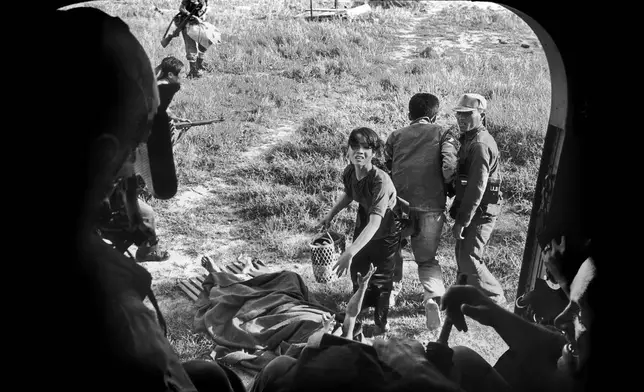
FILE- As her wounded husband raises his arm, a Vietnamese woman begs to be taken aboard a U.S. evacuation helicopter so they can escape a Viet Cong attack in Ba Gia, July 1965. The couple was left behind. (AP Photo/Eddie Adams, File)
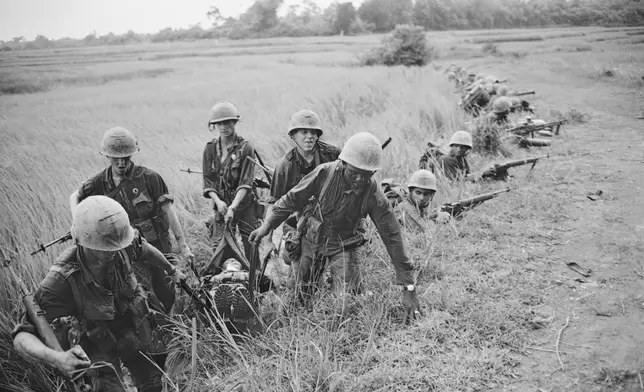
FILE- U.S. corpsmen carry the body of a dead Marine as fellow Marines crouch along a road through a rice paddy, about a mile south of the demilitarized zone, in September 1966. The Marines had taken heavy automatic weapons fire from the treeline at the edge of the paddy. (AP Photo/Horst Faas)
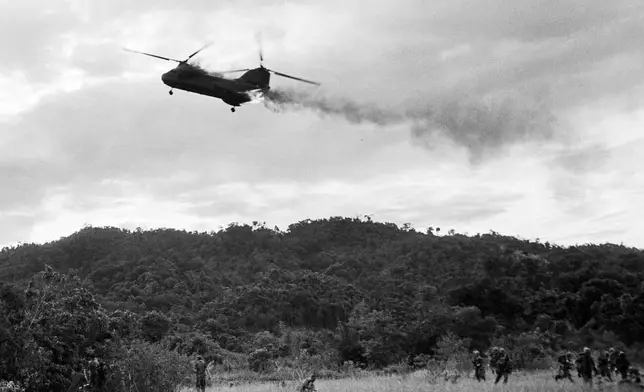
FILE- A U.S. Marine CH-46 Sea Knight helicopter comes down in flames after being hit by enemy ground fire during Operation Hastings, just south of the Demilitarized Zone between North and South Vietnam, July 15, 1966. The helicopter crashed and exploded on a hill, killing one crewman and 12 Marines. Three crewman escaped with serious burns. (AP Photo/Horst Faas. File)
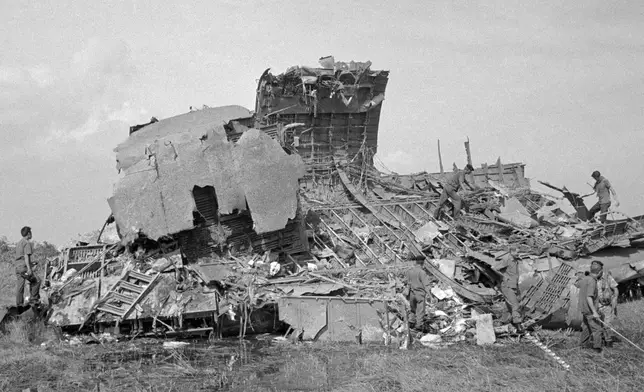
FILE- Rescue and recovery workers search the wreckage of a C-5A Galaxy transport plane on April 5, 1975, one day after the plane carrying Vietnamese orphans crashed shortly after takeoff from Saigon's Tan Son Nhut Airport during the initial flight of Operation Babylift. Seventy-eight children and about 50 adults died in the crash; about 170 people survived. Subsequent flights of Operation Babylift evacuated more than 2,500 children to the United States and other countries for adoption. (AP Photo/Dang Van Phuoc, File)
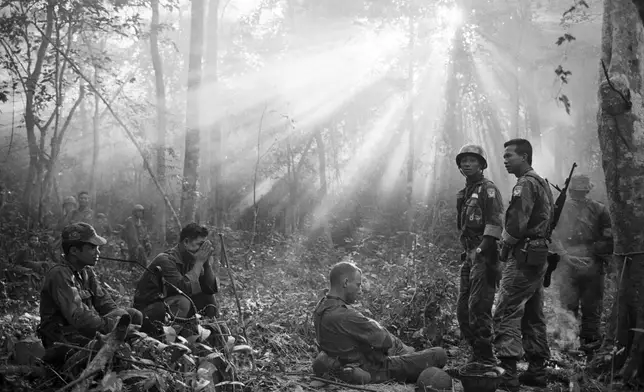
FILE- The sun breaks through the dense jungle foliage around the embattled town of Binh Gia, 40 miles east of Saigon, in early January 1965, as South Vietnamese troops, apparently joined by U.S. advisers, rest after a cold, damp and tense night of waiting in an ambush position for a Viet Cong attack that didn't come. One hour later, as the possiblity of an overnight attack by the Viet Cong diasappeared, the troops moved out for another long, hot day hunting the elusive communist guerrillas in the jungles. (AP Photo/Horst Faas, File)
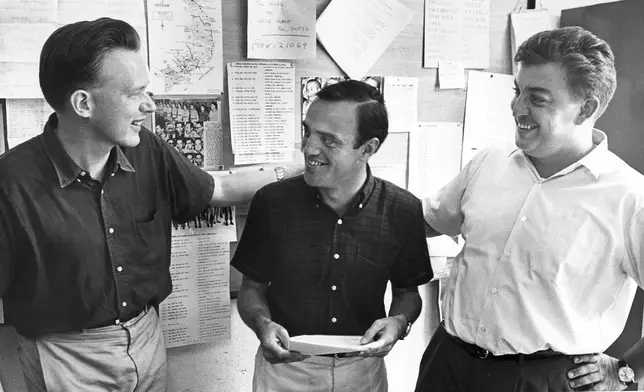
Upon learning that he has won the 1966 Pulitzer Prize for International Reporting, AP reporter Peter Arnett, center, accepts congratulations at the Saigon bureau from fellow Pulitzer winners Malcolm Browne, left, and Horst Faas. Browne shared the 1964 Pulitzer for International Reporting, and Faas won the 1965 Pulitzer for Photography. AP's Saigon bureau would eventually win five Pulitzers during the war. (AP Photo)
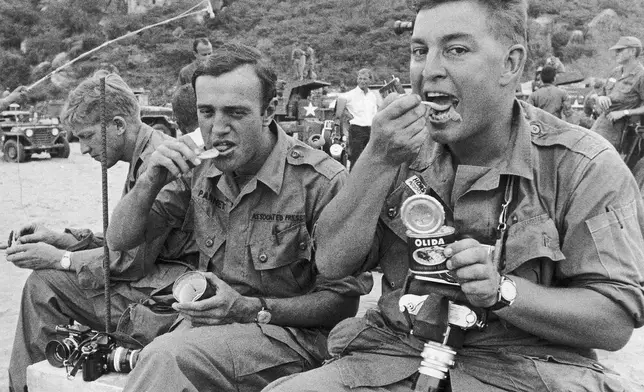
AP correspondent Peter Arnett and AP staff photographer Horst Faas eat while waiting for the arrival of the U.S. 1st Division in July 1965 in Cam Ranh Bay. Faas eats a French-made sausage sauerkraut meal from a can while Arnett has a C-ration. (AP Photo/AP Corporate Archives)
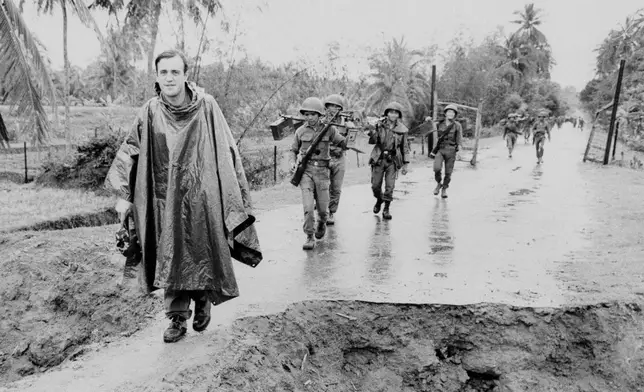
Associated Press correspondent Peter Arnett, left, marches in column with Vietnamese troops as he covers the war in Vietnam, Nov. 11, 1965. The conflict is described as one of the most difficult and dangerous for those who cover it because of the way it is fought. There are no front lines or clearly marked friendly or enemy territories. (AP Photo)
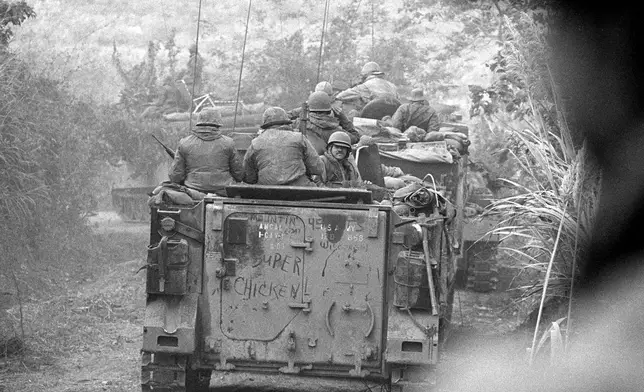
Soldiers of the Americal Divison ride on armored personnel carriers toward Lang Vel Special Forces camp, half a mile from the Laotian border during the Vietnam War, 1971. The Americans had to clear Route 9 to the Laotian border for Operation Lam Son 719, the South Vietnamese invasion into Laos. Photo from one of the last rolls of film before photographer Henri Huet was killed with three other photojournalists covering the operation. (AP Photo/Henri Huet)
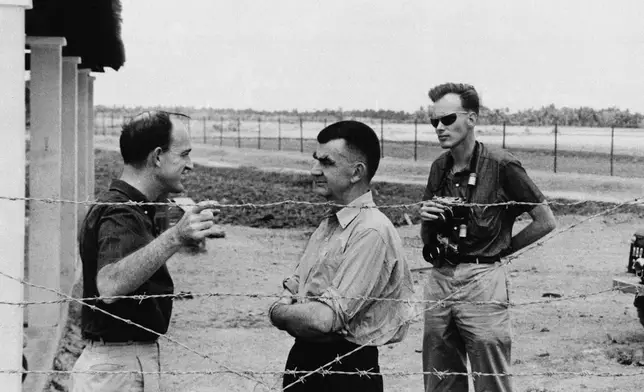
Wes Gallagher, center, general manager of the Associated Press, and Malcolm Browne, right, AP Saigon correspondent, speak with colleague Peter Arnett in Tan An, capital city of the Long An province in the Mekong Delta of Vietnam, March 23, 1964. (AP Photo)
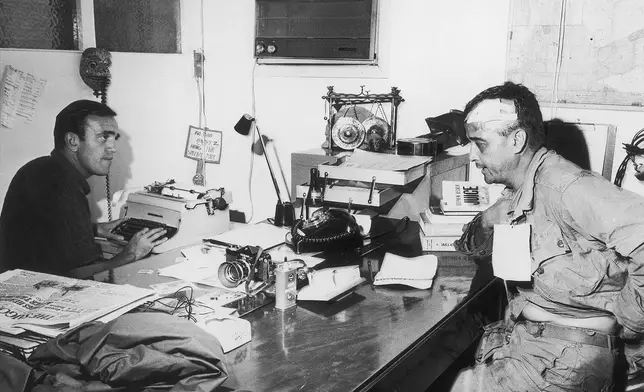
Wounded Associated Press photographer Al Chang gives an account of the battle in which he was injured at Bien Hoa, to AP correspondent Peter Arnett in Saigon, Dec. 1965. Chang was wounded Dec. 18 in a fight with Viet Cong in which five paratroopers died. (AP PhotoAP Corporate Archives)
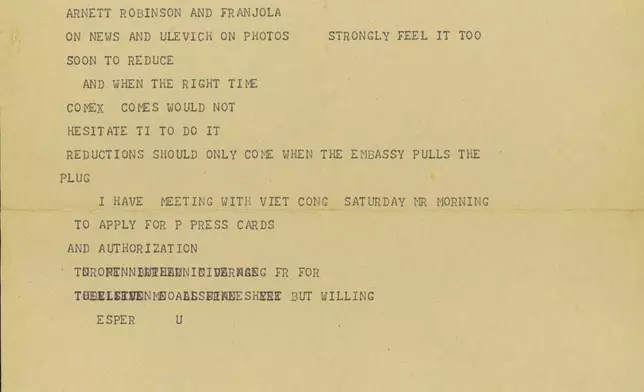
Message from AP's Saigon bureau chief George Esper to General Manager Wes Gallagher concerning AP staff covering the fall of Saigon in April, 1975. (AP Photo/Corporate Archives)
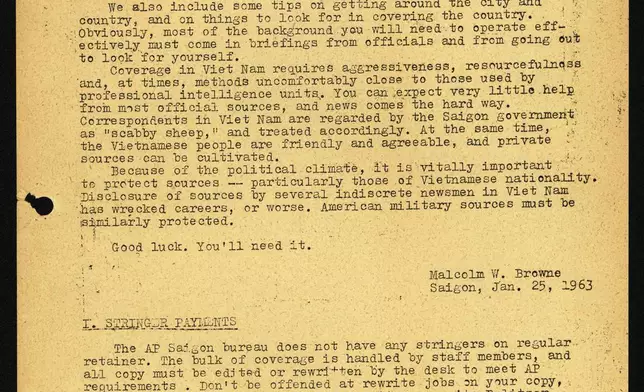
Page 1 of 25 of The Associated Press Short Guide to News Coverage in Vietnam for staffers and stringers covering the Vietnam War, composed in January 1963 by AP Saigon Bureau Chief Malcolm Browne (1931-2012). The 25-page primer, originally written for Horst Faas and Peter Arnett, provides detailed guidance on all aspects of war coverage, including how to move with troops, how to discern accurate information from propaganda and, most importantly, how to stay safe. After Browne left AP, the manual followed him to the ABC bureau in Saigon. (AP Photo/AP Corporate Archives)
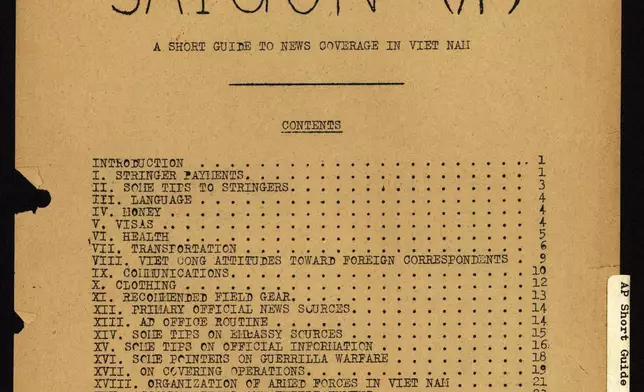
The cover (page i of 25) of The Associated Press Short Guide to News Coverage in Vietnam for staffers and stringers covering the Vietnam War, composed in January 1963 by AP Saigon Bureau Chief Malcolm Browne (1931-2012). The 25-page primer, originally written for Horst Faas and Peter Arnett, provides detailed guidance on all aspects of war coverage, including how to move with troops, how to discern accurate information from propaganda and, most importantly, how to stay safe. After Browne left AP, the manual followed him to the ABC bureau in Saigon. (AP Photo/AP Corporate Archives)
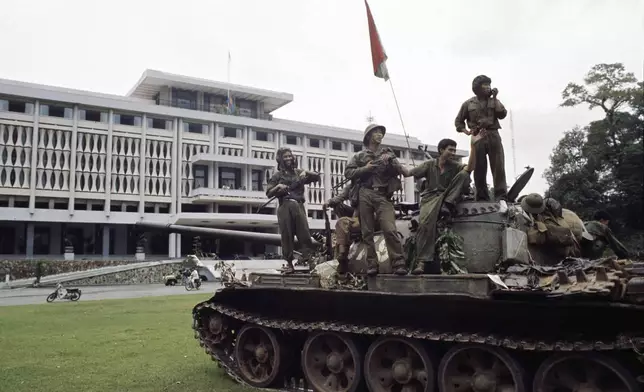
FILE- Victorious North Vietnamese troops aboard a tank take a position outside Independence Palace in Saigon, April 30, 1975, the day the South Vietnamese government surrendered, ending the Vietnam War. Communist flags fly from the palace and the tank. (AP Photo/Yves Billy, File)
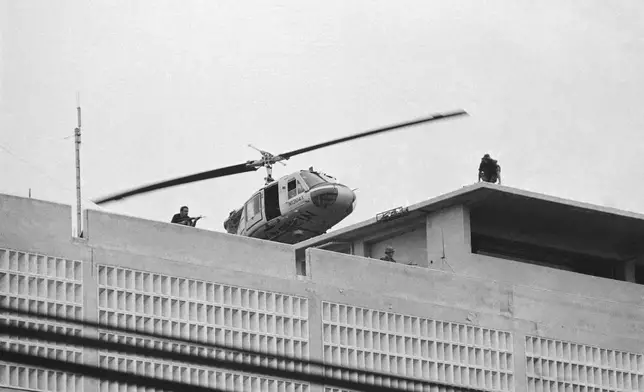
FILE- A U.S. Marine helicopter takes off from helipad on top of the American Embassy in Saigon, Vietnam, April 30, 1975. (AP Photo/Phu)
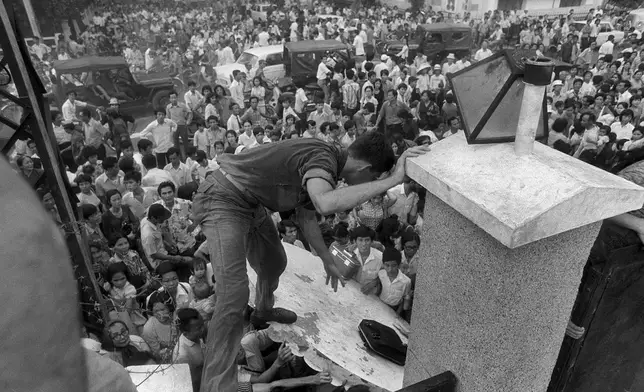
FILE - In this April 29, 1975, file photo, South Vietnamese civilians try to scale the 14-foot wall of the U.S. embassy in Saigon, trying to reach evacuation helicopters as the last Americans departed from Vietnam. (AP Photo/File)
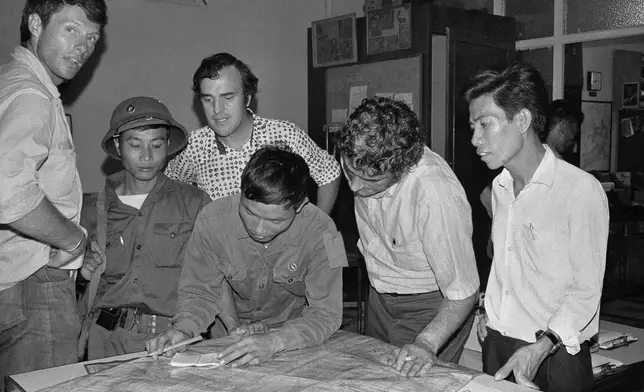
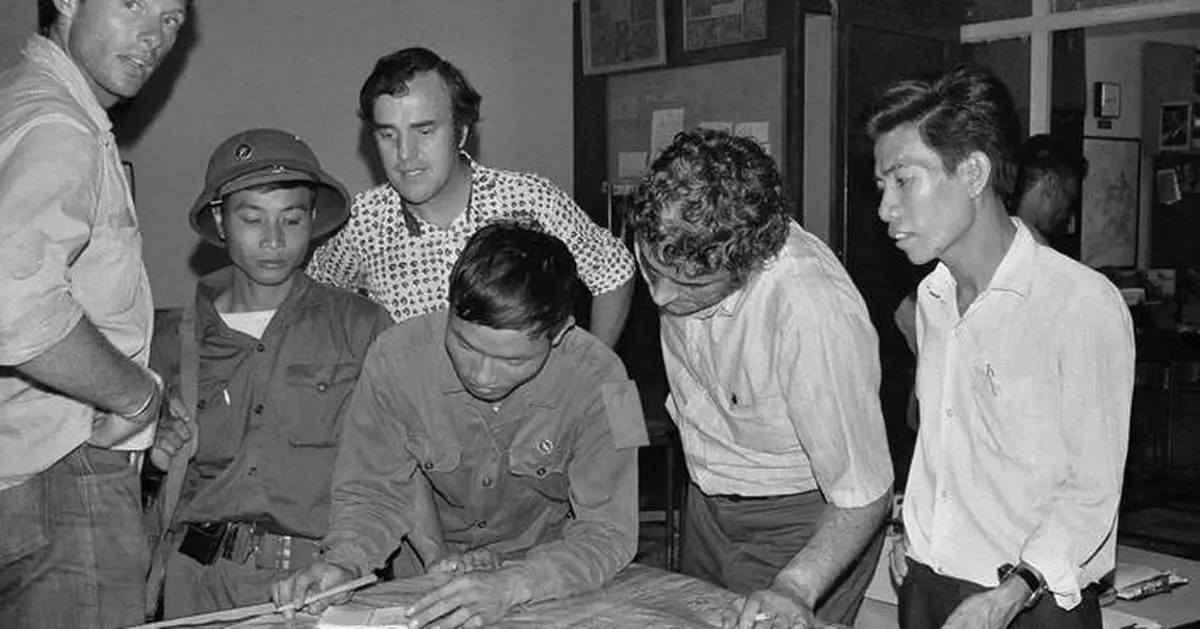
The last three staffers in The Associated Press' Saigon bureau, reporters Matt Franjola, left, Peter Arnett, rear, and George Esper, second from right, are joined by two North Vietnamese soldiers and a member of the Viet Cong on the day the government of South Vietnam surrendered, April 30, 1975. One of the soldiers is showing Esper the route of his final advance into the city. (AP Photo/Sarah Errington)
But when the two young soldiers who entered showed no signs of malice, the journalists just kept reporting.
Offering the men a Coke and day-old cake, Peter Arnett, George Esper and Matt Franjola started asking about their march into Saigon. As the men detailed their route on a bureau map, photographer Sarah Errington emerged from the darkroom and snapped what would become an iconic picture, published around the world.
Fifty years later, Arnett recalled the message he fed into the teletype transmitter to AP headquarters in New York after the improbable scene had played out.
“In my 13 years of covering the Vietnam War, I never dreamed it would end as it did today,” he remembers writing. “A total surrender following a few hours later with a cordial meeting in the AP bureau with an armed and battle-garbed North Vietnamese officer with his aide over warm Coke and pastries? That is how the Vietnamese war ended for me today.”
The message never made it: After a day of carrying alerts and stories on the fall of Saigon and the end of a 20-year war that saw more than 58,000 Americans killed and many times that number of Vietnamese, the wire had been cut.
The fall of Saigon on April 30, 1975 was the end of an era for the AP in Vietnam. Arnett left in May, and then Franjola was expelled, followed by Esper, and the bureau wouldn't be reestablished until 1993.
The AP opened its first office in Saigon in 1950 as the fight for independence from France by Viet Minh forces under communist leader Ho Chi Minh intensified.
The Viet Minh’s decisive victory over the U.S.-supported French at Dien Bien Phu in 1954 marked the end of French Indochina and sparked major changes in the region with the partitioning of Vietnam into Communist North Vietnam and U.S.-aligned South Vietnam. The official U.S. military engagement began in 1955 and slowly escalated.
Malcolm Browne took over as AP bureau chief in Saigon in November 1961 and was joined in June 1962 by Arnett and photo chief Horst Faas.
The trio soon won consecutive Pulitzer Prizes: Browne in 1964, Faas in 1965 and Arnett in 1966 — the first of five the AP would receive for its coverage from Vietnam.
Four AP photographers were killed covering the war, and at least 16 other AP journalists were injured, some multiple times, as they reported from the front lines, seeking to record the news as completely and accurately as possible.
From the start, a lot of the reporting contradicted the official version from Washington, revealing a deeper American commitment than admitted, a lack of measurable success against the Viet Cong guerillas, and a broad dislike of the ineffective and corrupt American-backed South Vietnamese President Ngo Dinh Diem, Arnett said.
That prompted managers in New York to wonder why the Saigon staffers' stories were sometimes “180 degrees” different from those AP reporters wrote from press conferences at the U.S. State Department, the Pentagon and the White House, he recalled.
“We had a strategic advantage because we were 12,000 miles away from our administration critics, with our boots on the ground," said Arnett, 90, who lives in California today. "Within a year, our reporting was vindicated.”
At the height of the war there were roughly 30 staffers assigned to the bureau, divided between news, photos and administration, and the AP made regular use of freelancers as well, usually photographers. It was a diverse group that included people from 11 different countries, including many local Vietnamese.
During upticks in the fighting, staffers would rotate in from from other bureaus to help.
When the U.S. government took umbrage with AP’s coverage in 1966 and claimed its staffers were young and inexperienced, AP’s General Manager Wes Gallagher penned a salty reply, noting their combined decades as reporters.
"Three covered World War II and Korea. Two, Pulitzer Prize winners Peter Arnett and Horst Faas, have been in Vietnam four years each, which is longer than Ambassador (Henry Cabot) Lodge, General (William) Westmoreland and nine-tenths of the Americans over there,” Gallagher wrote.
In an attempt to manage the news reports out of Vietnam, the U.S. established a daily news conference in Saigon to feed information to the growing American press corps. They came to be colloquially known as the “Five O'clock Follies” because, as Esper reflected, “they were such a joke.”
Esper said in a 2005 interview that sometimes he'd show up to evening briefings the same day he had covered a battle firsthand and was left puzzled by the official version.
“I'm thinking to myself, ‘Is this the same battle I just witnessed?’" said Esper, who died in 2012. “So there was some confrontation at the ‘follies’ because we would question the briefer's reports, and they also withheld tremendous amounts of information.”
Esper said it helped that Gallagher took a personal hand in Vietnam coverage, frequently calling and visiting in support of his journalists.
“He took a lot of heat from the Pentagon, from the White House, but he never faltered,” Esper said. “He always said to us: ‘I support you 100%. You know the press is under scrutiny, just make sure you’re accurate, just make sure your stories are fair and balanced,’ and we did.”
In 1969, the American commitment in Vietnam had grown to more than a half million troops, before being drawn down to a handful after the 1973 Paris Peace Accords in which U.S. President Richard Nixon agreed to a withdrawal, leaving the South Vietnamese to fend for themselves.
By 1975, the AP's bureau had shrunk as well, and as the North Vietnamese Army and its allied Viet Cong guerrilla force in the south pushed toward Saigon, most staff members were evacuated.
Arnett, Esper and Franjola volunteered to stay behind, anxious to see through to the end what they had committed so many years of their lives to covering — and conspiring to ignore New York if any of their managers got the jitters and ordered them to leave at the last minute.
“I saw it from the beginning, I wanted to see the end,” Esper said. “I was a bit apprehensive and frightened, but I knew that if I left, the rest of my life I would have been second guessing myself.”
On April 30, 1975, the monsoon rains had arrived and Arnett watched in the early morning hours from the slippery roof of the AP's building as helicopters evacuated Americans and selected Vietnamese from the embassy four blocks away.
After catching a few hours of sleep, he awoke at 6:30 a.m. to the loud voices of looters on the streets. An hour later, from the rooftop of his hotel, he watched through binoculars as a small group of U.S. Marines that had accidentally been left behind clambered aboard a Sea Knight helicopter from the roof of the embassy — the last American evacuees.
He called it in to Esper in the office, and the story was in newsrooms around the world before the helicopter had cleared the coast.
Franjola and Arnett then took to the streets to see what was going on, while Esper manned the desk. When they got to the U.S. Embassy, a mob of people were grinning and laughing as they looted the building — a sharp contrast to the desperation of people the day before hoping to be evacuated.
“On a pile of wet documents and broken furniture on the back lawn, we find the heavy bronze plaque engraved with the names of the five American soldiers who died in the attack on the Embassy in the opening hours of the Tet Offensive in 1968,” Arnett recalled in an email detailing the day's events. “Together we carry it back to the AP office.”
At 10:24 a.m. Arnett was writing the story of the embassy looting when Esper heard on Saigon Radio that South Vietnam had surrendered and immediately filed an alert.
“Esper rushes to the teleprinter and messages New York, and soon receives the satisfying news that AP is five minutes ahead of UPI with the surrender story,” Arnett said, citing AP's biggest rival at the time, United Press International. “In war or peace, the wire services place a premium on competition.”
Esper then dashed outside to try and gather some reaction from South Vietnamese soldiers to the news of the capitulation, and came across a police colonel standing by a statue in a main square.
“He was waving his arms, ‘fini, fini,’ you know, ‘it’s all over, we lost,” Esper remembered. “And he was also fingering his holstered pistol and I figured, this guy is really crazy, he will kill me, and after 10 years here with barely a scratch, I'm going to die on this final day.”
Suddenly, the colonel did an about-face, saluted the memorial statue, drew his pistol and shot himself in the head.
Shaken, Esper ran back to the bureau, up the four flights of stairs to the office and punched out a quick story on the incident, his hands trembling as he typed.
Back on the streets, Franjola, who died in 2015, was nearly sideswiped by a Jeep packed with men brandishing Russian rifles and wearing the black Viet Cong garb. Arnett then saw a convoy of Russian trucks loaded with North Vietnamese soldiers driving down the main street and scrambled back into the office.
“'George,' I shout, ‘Saigon has fallen. Call New York,’” Arnett said. “I check my watch. It's 11:43 a.m.”
Over the next few hours, more soldiers, supported by tanks, pushed into the city, engaging in sporadic fighting while the AP reporters kept filing their copy.
It was about 2:30 p.m. when they heard the rubber sandals outside the office, and the two NVA soldiers burst in, one with an AK-47 assault rifle swinging from his shoulder, the other with a Russian pistol holstered on his belt. To their shock, the soldiers were accompanied by Ky Nhan, a freelance photographer who worked for the AP, who proudly announced himself as a longtime member of the Viet Cong.
“I have guaranteed the safety of the AP office,” Arnett recalled the normally reserved photographer saying. “You have no reason to be concerned.”
As Arnett, Esper and Franjola pored over the map with the two NVA soldiers, they chatted through an interpreter about the attack on Saigon, which had been renamed Ho Chi Minh City as soon as it fell.
The interview with the two soldiers turned to the personal, and the young men showed the reporters photos of their families and girlfriends, telling them how much they missed them and wanted to get home.
“I was thinking in my own mind these are North Vietnamese, there are South Vietnamese, Americans — we're all the same,” Esper said.
“People have girlfriends, they miss them, they have the same fears, the same loneliness, and in my head I’m tallying up the casualties, you know nearly 60,000 Americans dead, a million North Vietnamese fighters dead, 224,000 South Vietnamese military killed, and 2 million civilians killed. And that’s the way the war ended for me.”
Komor, the retired director of AP Corporate Archives, reported from New York.
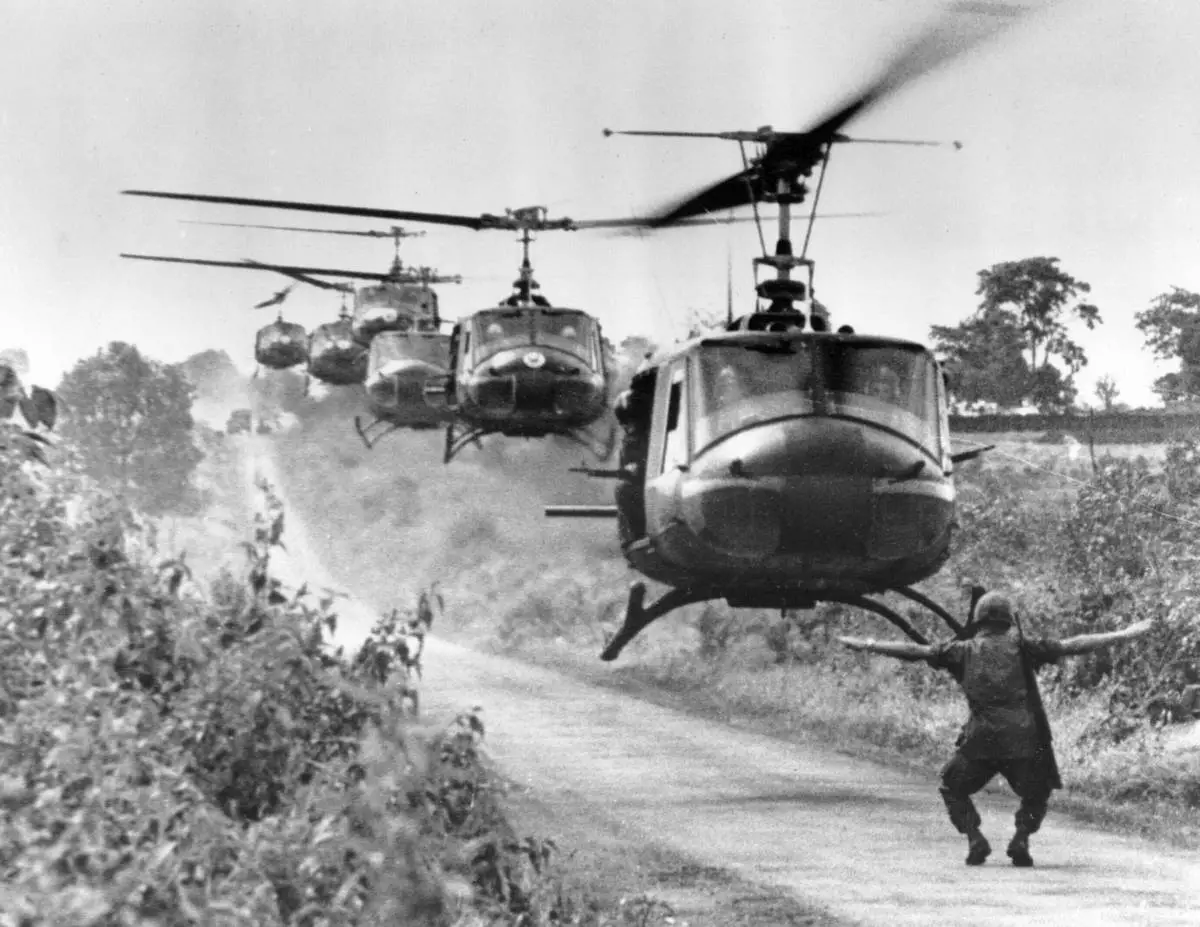
FILE- Huey helicopters, carrying troops of the U.S. 173rd Airborne Brigade, settle in for a landing near the Montagnard village of Plei Ho Drong in August 1965. The unit found friendly mountain tribal people, but no Viet Cong. (AP Photo/Horst Faas, File)
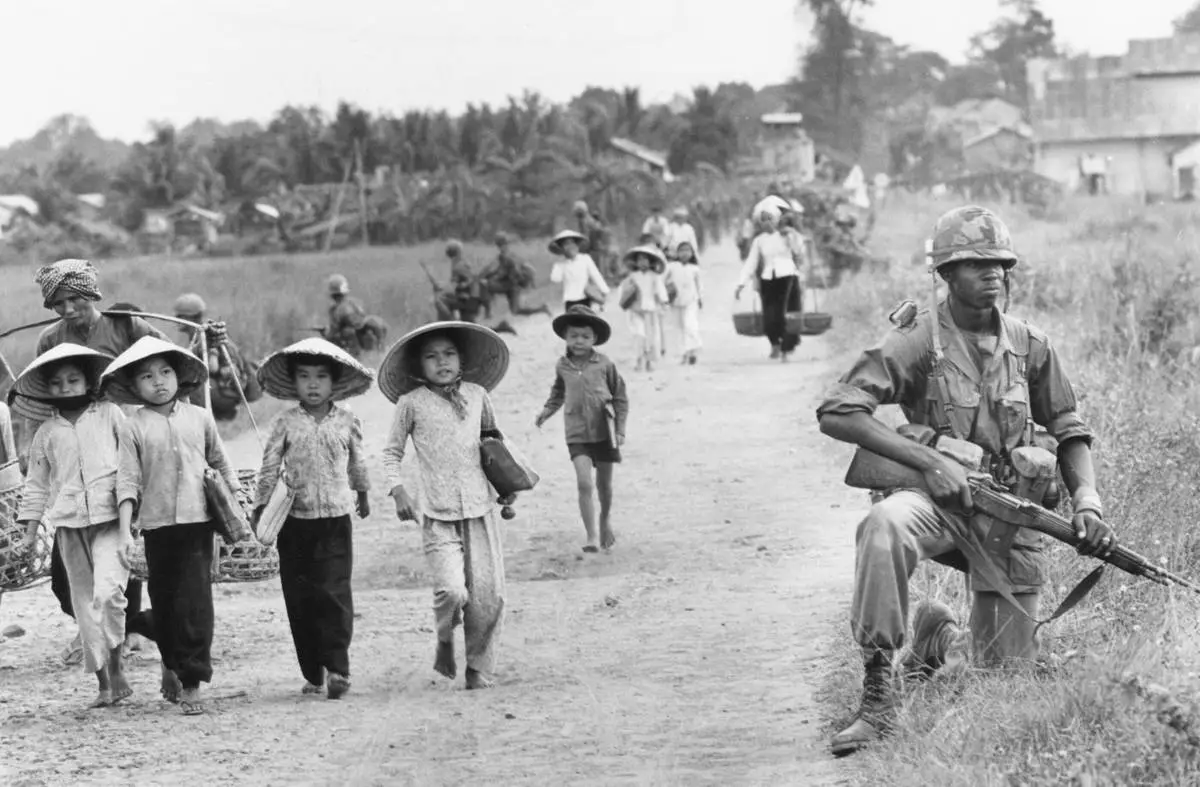
FILE- In an area heavily infiltrated by Viet Cong, a U.S. 1st Division soldier guards Route 7 as Vietnamese market women and schoolchildren return home to the village of Xuan Dien from Ben Cat, December 1965. (AP Photo/Horst Faas, File)
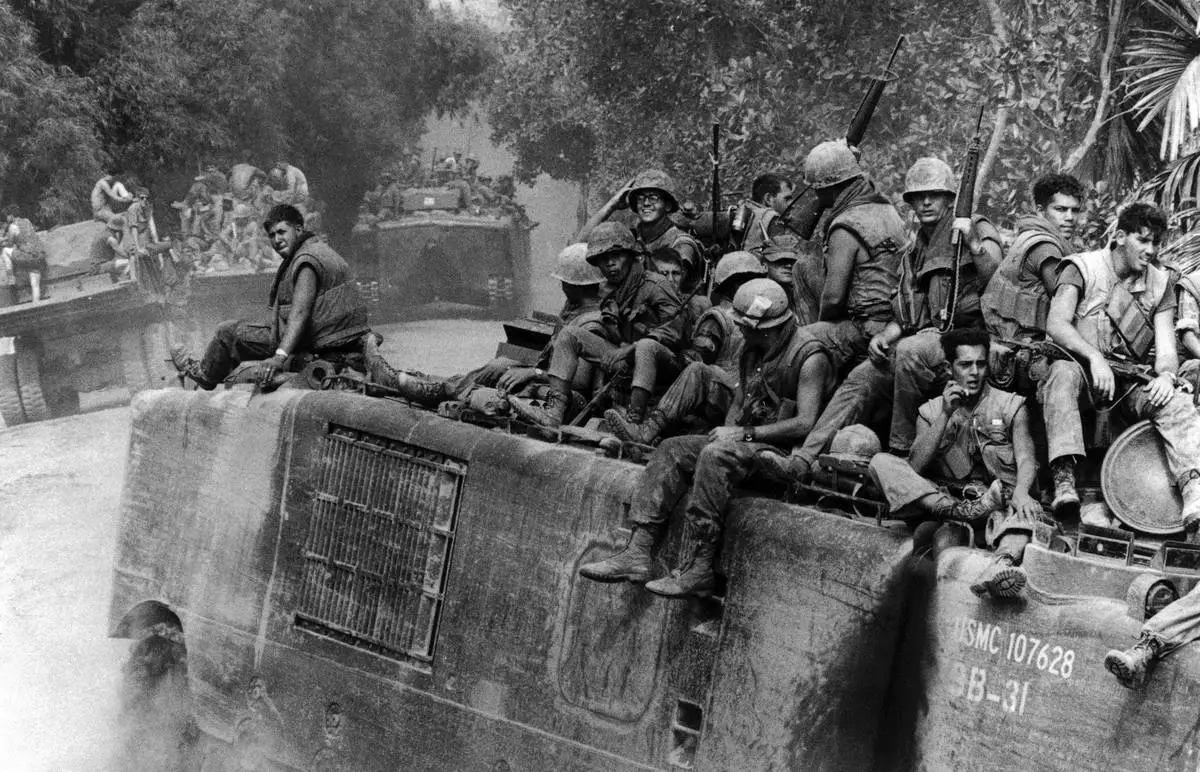
FILE- An amphibious tracked vehicle with a load of fully-armed Marines approaches a river southwest of Danang, South Vietnam, Aug. 22, 1969. (AP Photo/Horst Faas, File)
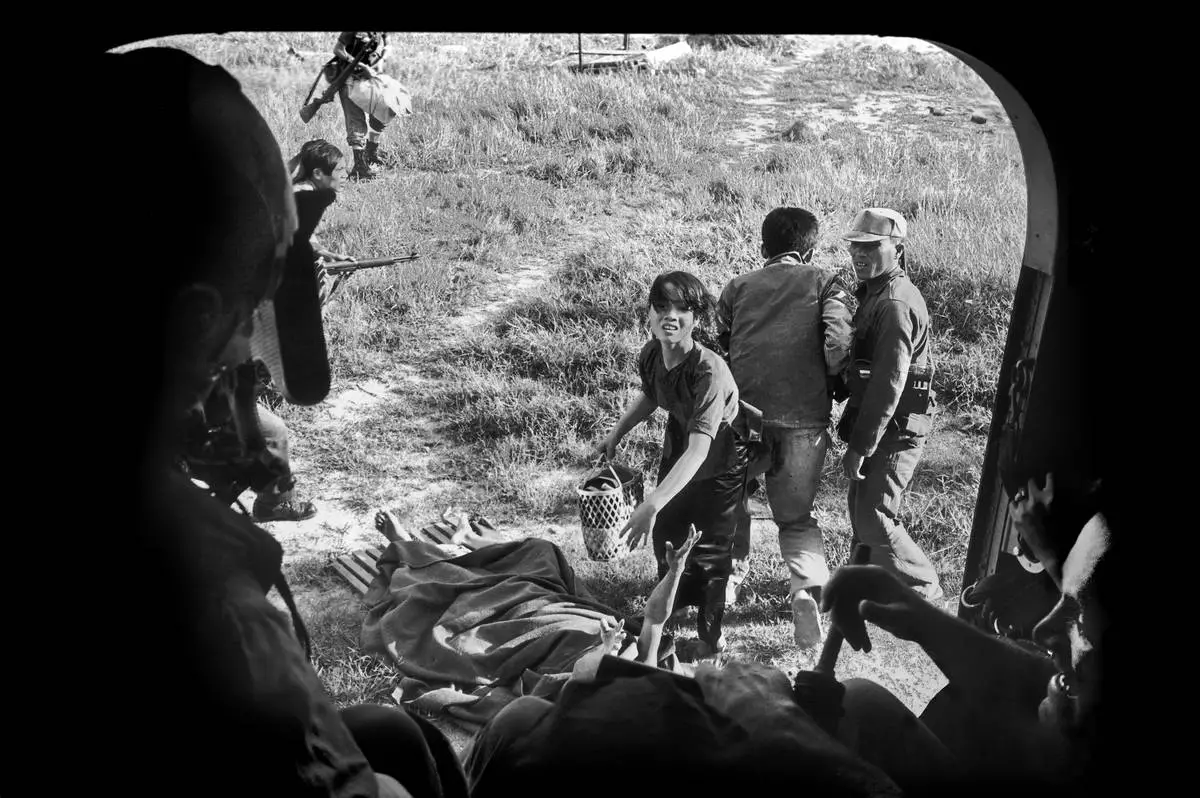
FILE- As her wounded husband raises his arm, a Vietnamese woman begs to be taken aboard a U.S. evacuation helicopter so they can escape a Viet Cong attack in Ba Gia, July 1965. The couple was left behind. (AP Photo/Eddie Adams, File)
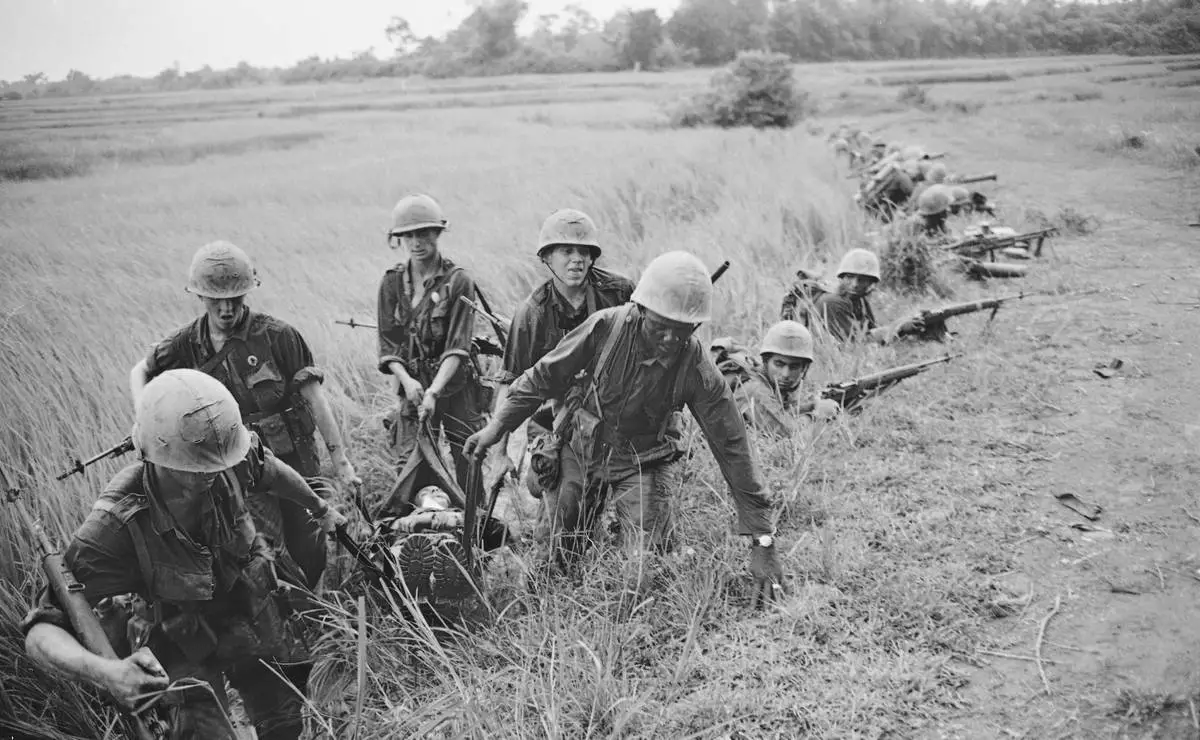
FILE- U.S. corpsmen carry the body of a dead Marine as fellow Marines crouch along a road through a rice paddy, about a mile south of the demilitarized zone, in September 1966. The Marines had taken heavy automatic weapons fire from the treeline at the edge of the paddy. (AP Photo/Horst Faas)
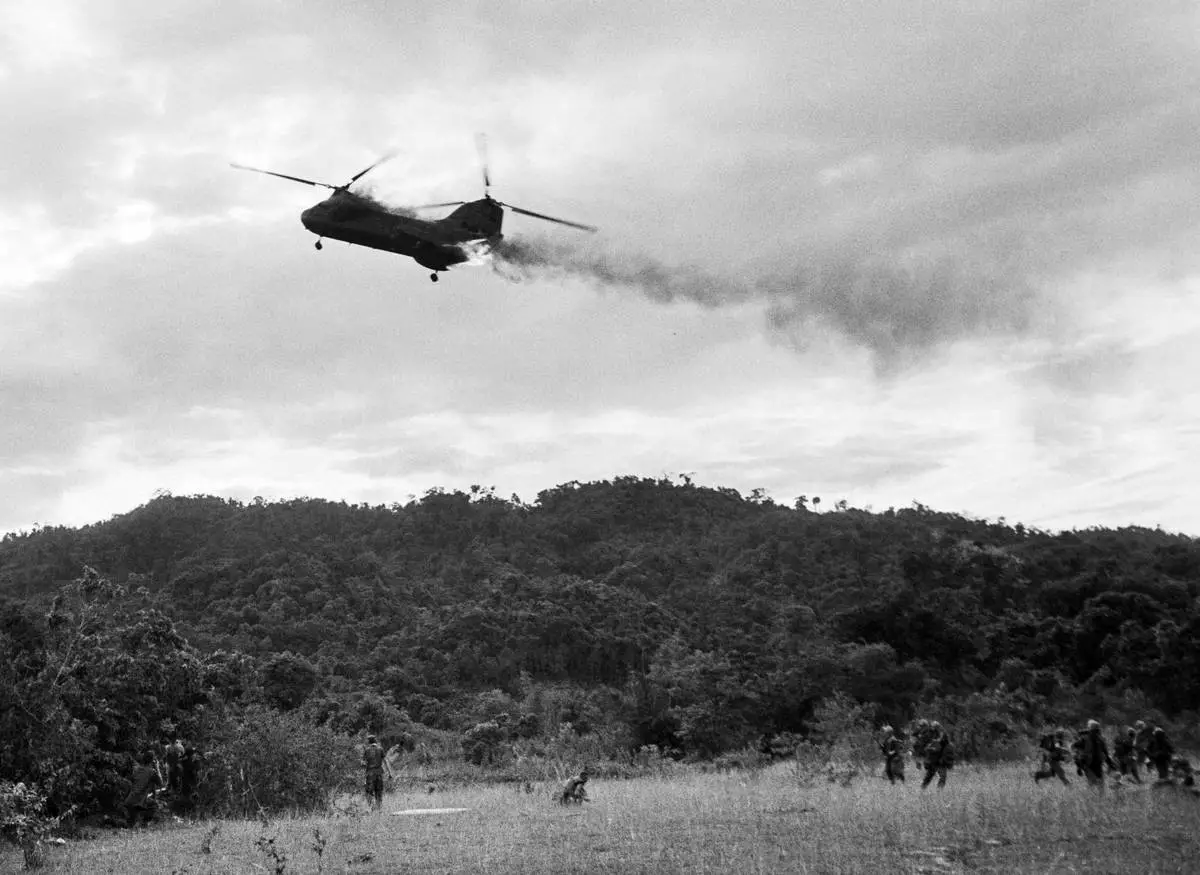
FILE- A U.S. Marine CH-46 Sea Knight helicopter comes down in flames after being hit by enemy ground fire during Operation Hastings, just south of the Demilitarized Zone between North and South Vietnam, July 15, 1966. The helicopter crashed and exploded on a hill, killing one crewman and 12 Marines. Three crewman escaped with serious burns. (AP Photo/Horst Faas. File)
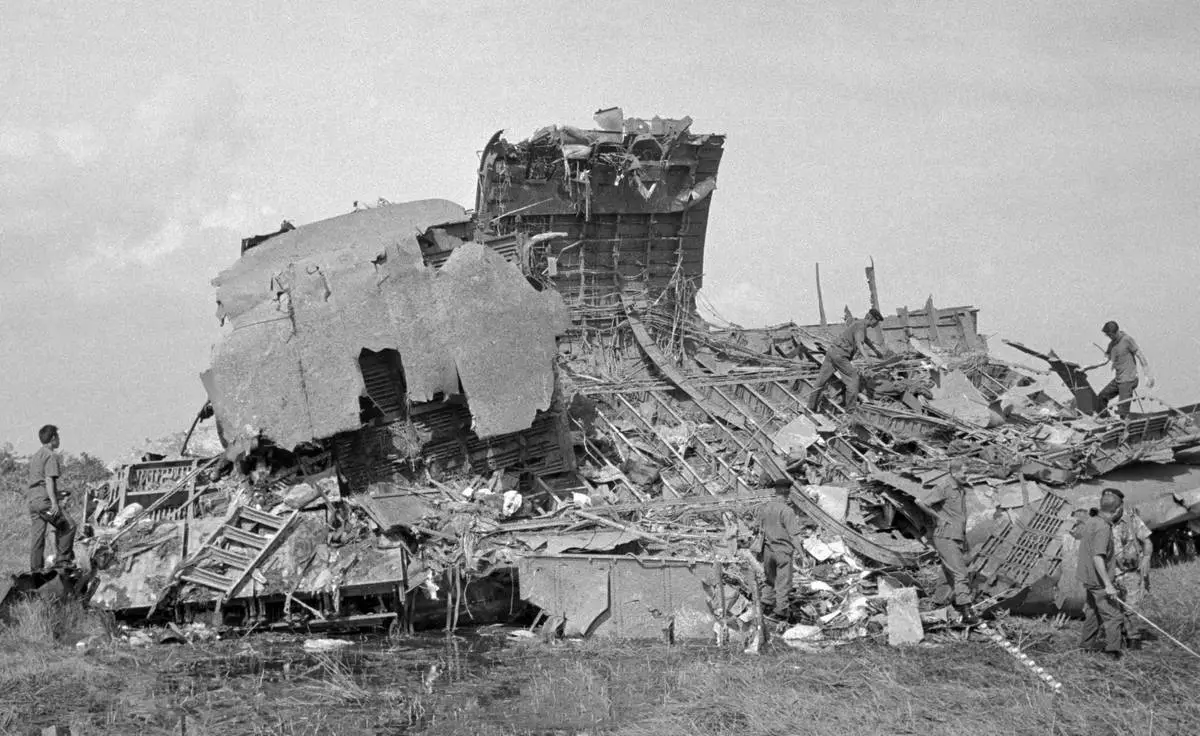
FILE- Rescue and recovery workers search the wreckage of a C-5A Galaxy transport plane on April 5, 1975, one day after the plane carrying Vietnamese orphans crashed shortly after takeoff from Saigon's Tan Son Nhut Airport during the initial flight of Operation Babylift. Seventy-eight children and about 50 adults died in the crash; about 170 people survived. Subsequent flights of Operation Babylift evacuated more than 2,500 children to the United States and other countries for adoption. (AP Photo/Dang Van Phuoc, File)
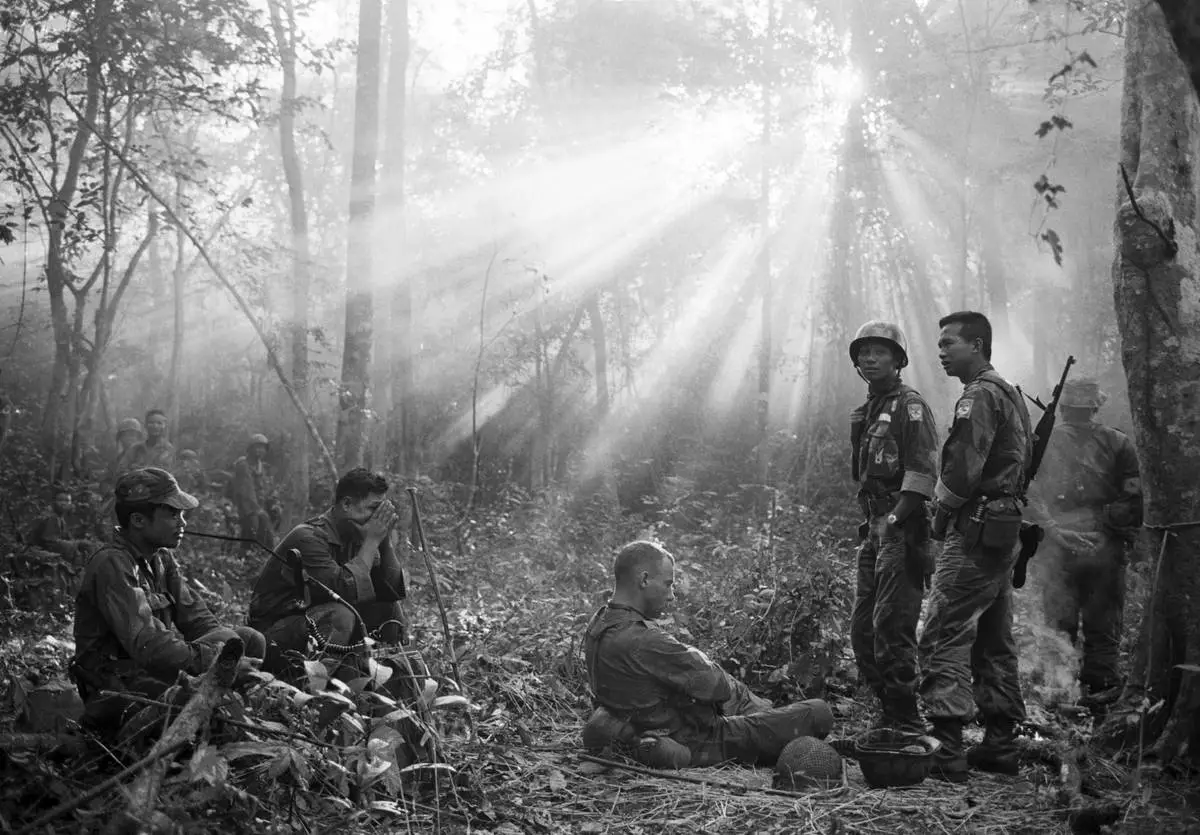
FILE- The sun breaks through the dense jungle foliage around the embattled town of Binh Gia, 40 miles east of Saigon, in early January 1965, as South Vietnamese troops, apparently joined by U.S. advisers, rest after a cold, damp and tense night of waiting in an ambush position for a Viet Cong attack that didn't come. One hour later, as the possiblity of an overnight attack by the Viet Cong diasappeared, the troops moved out for another long, hot day hunting the elusive communist guerrillas in the jungles. (AP Photo/Horst Faas, File)
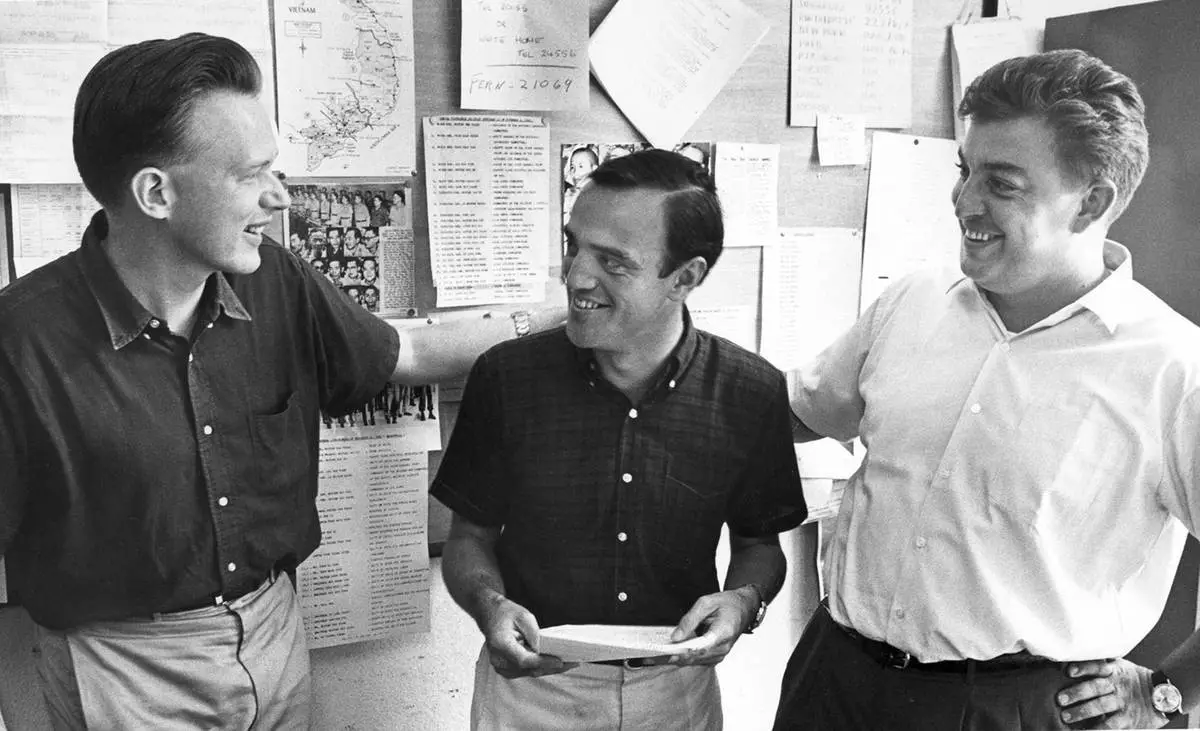
Upon learning that he has won the 1966 Pulitzer Prize for International Reporting, AP reporter Peter Arnett, center, accepts congratulations at the Saigon bureau from fellow Pulitzer winners Malcolm Browne, left, and Horst Faas. Browne shared the 1964 Pulitzer for International Reporting, and Faas won the 1965 Pulitzer for Photography. AP's Saigon bureau would eventually win five Pulitzers during the war. (AP Photo)
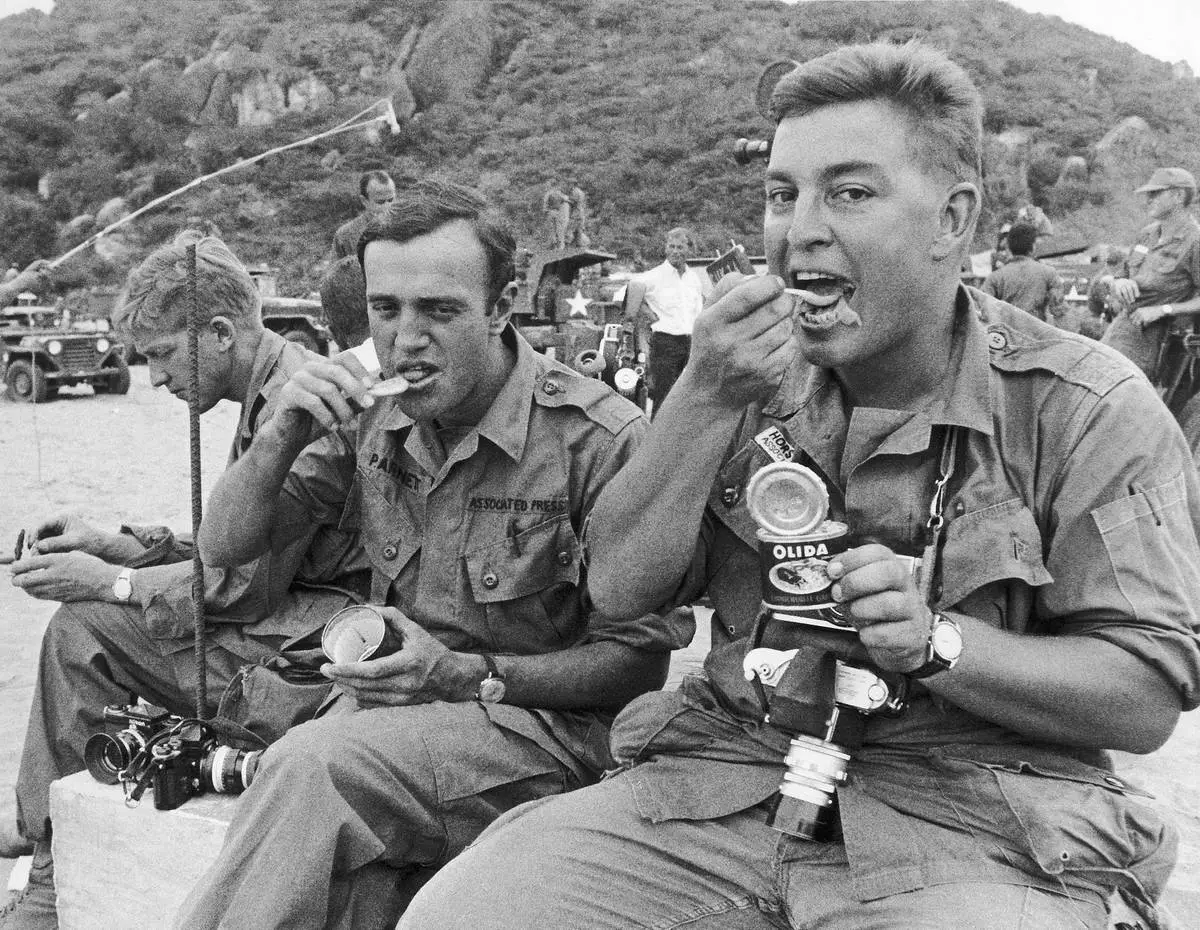
AP correspondent Peter Arnett and AP staff photographer Horst Faas eat while waiting for the arrival of the U.S. 1st Division in July 1965 in Cam Ranh Bay. Faas eats a French-made sausage sauerkraut meal from a can while Arnett has a C-ration. (AP Photo/AP Corporate Archives)
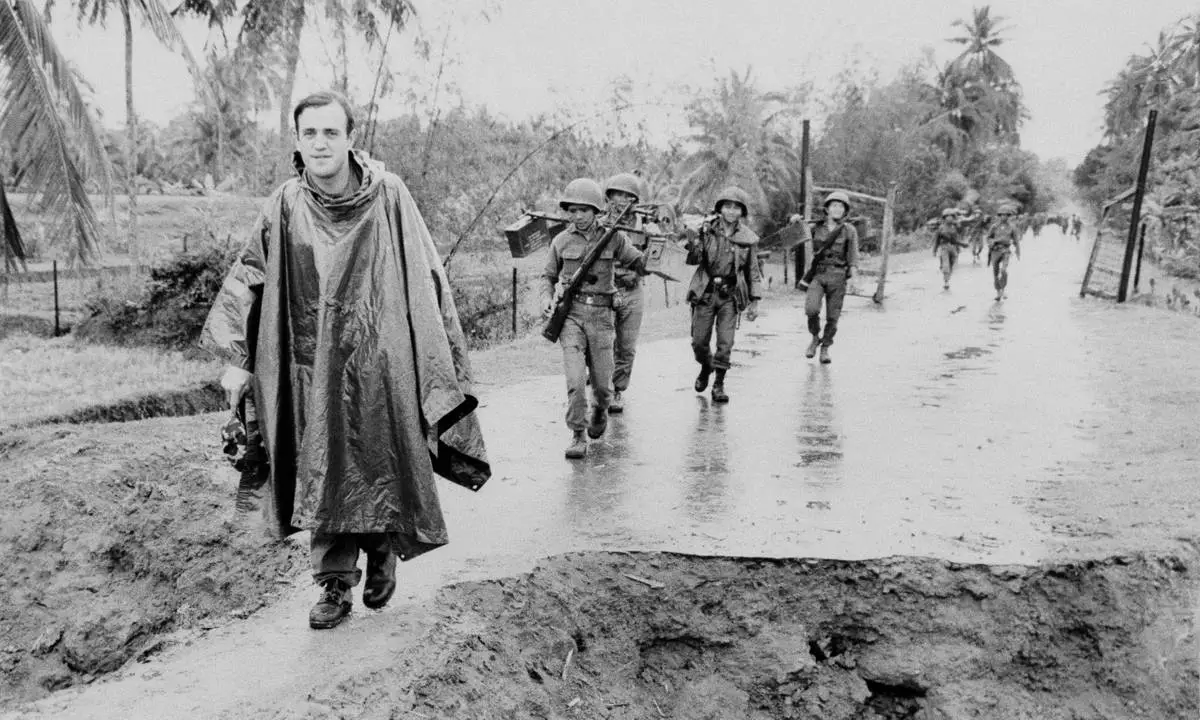
Associated Press correspondent Peter Arnett, left, marches in column with Vietnamese troops as he covers the war in Vietnam, Nov. 11, 1965. The conflict is described as one of the most difficult and dangerous for those who cover it because of the way it is fought. There are no front lines or clearly marked friendly or enemy territories. (AP Photo)
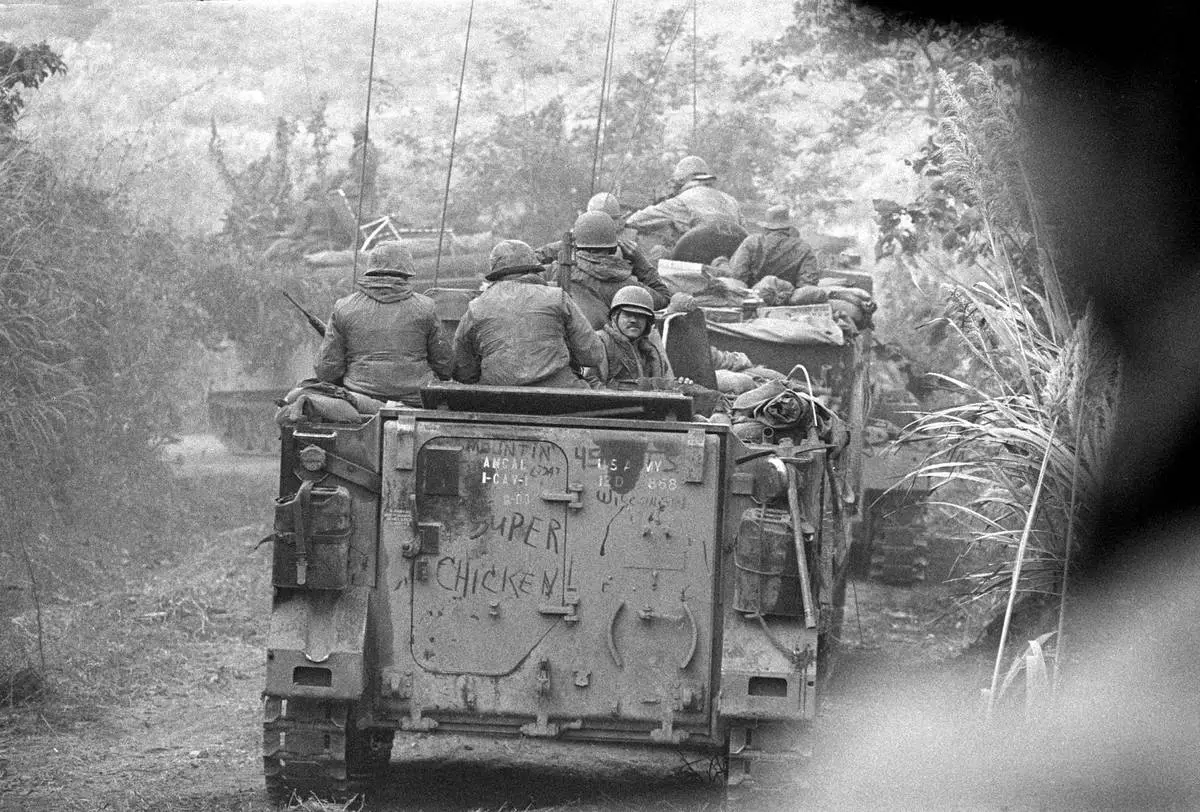
Soldiers of the Americal Divison ride on armored personnel carriers toward Lang Vel Special Forces camp, half a mile from the Laotian border during the Vietnam War, 1971. The Americans had to clear Route 9 to the Laotian border for Operation Lam Son 719, the South Vietnamese invasion into Laos. Photo from one of the last rolls of film before photographer Henri Huet was killed with three other photojournalists covering the operation. (AP Photo/Henri Huet)
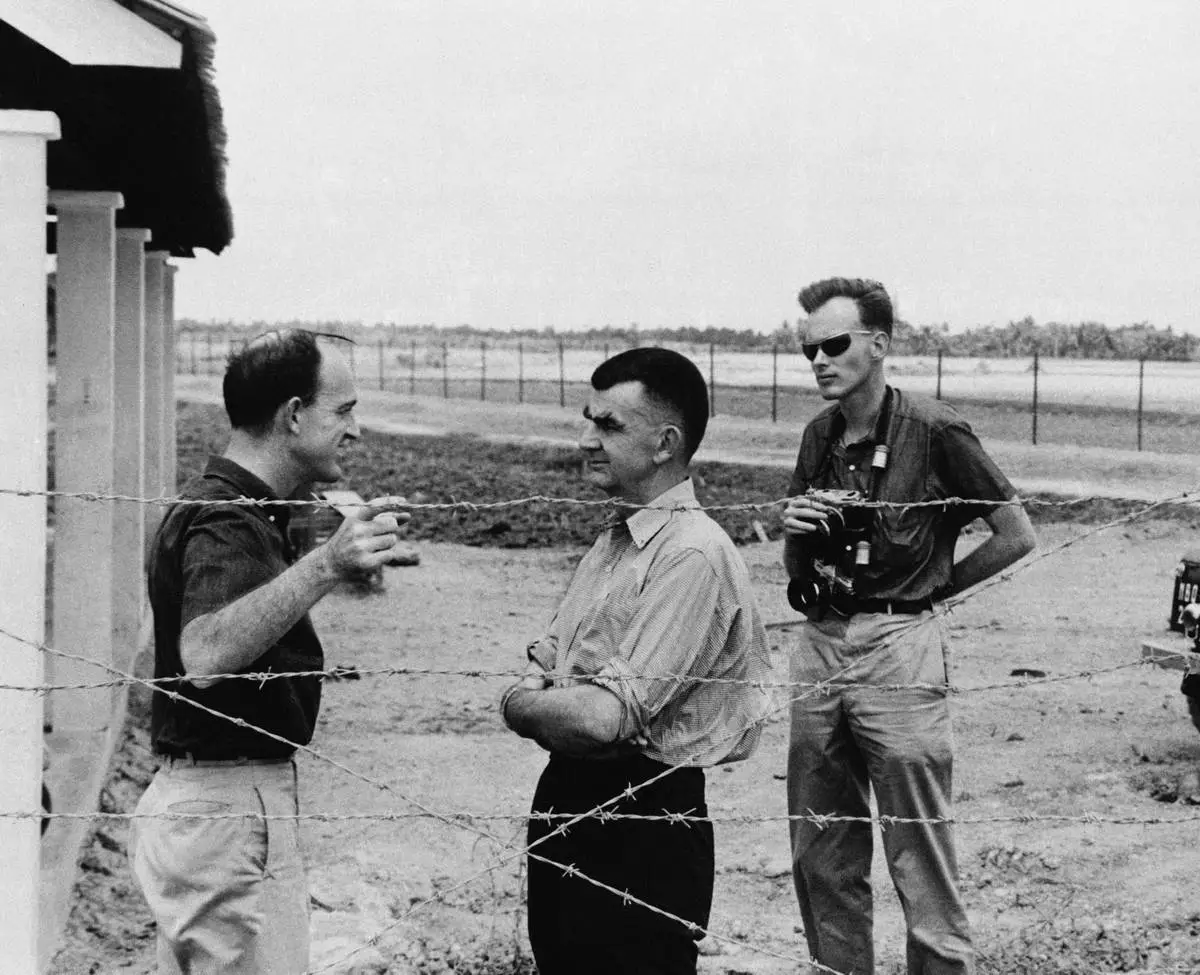
Wes Gallagher, center, general manager of the Associated Press, and Malcolm Browne, right, AP Saigon correspondent, speak with colleague Peter Arnett in Tan An, capital city of the Long An province in the Mekong Delta of Vietnam, March 23, 1964. (AP Photo)
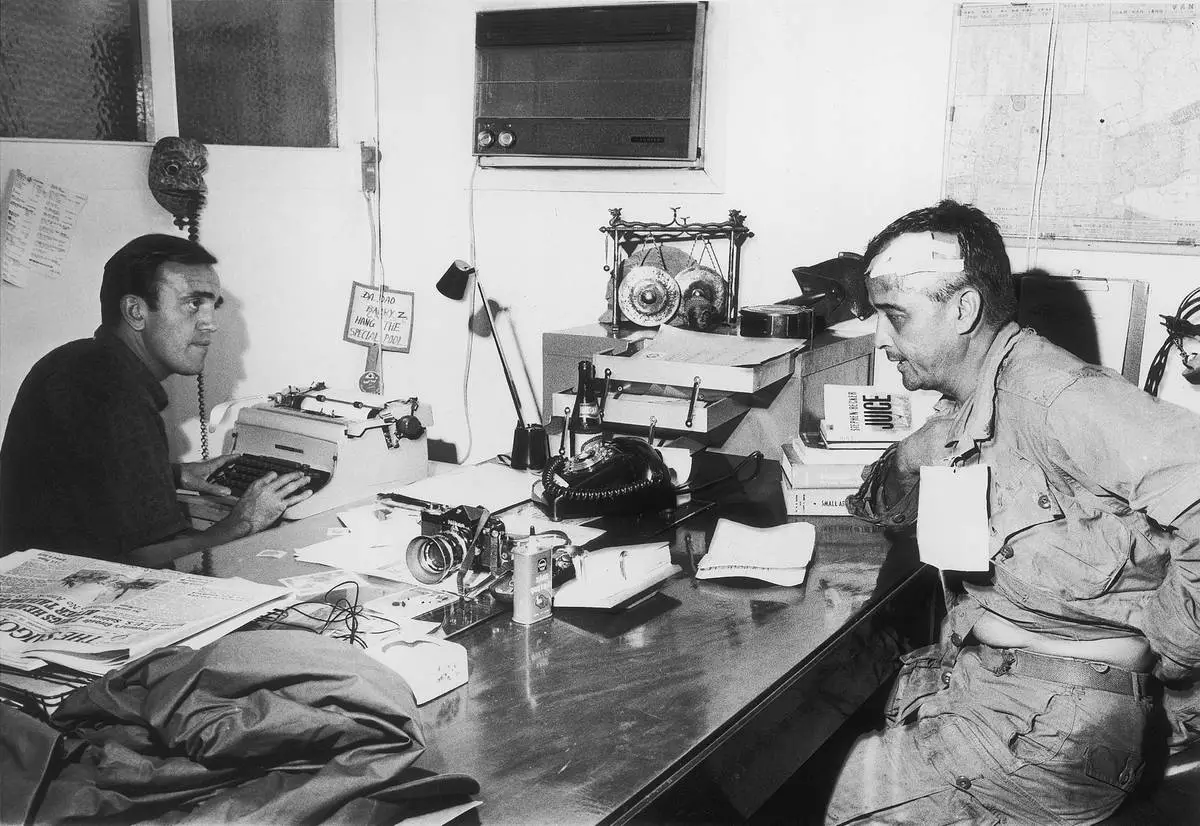
Wounded Associated Press photographer Al Chang gives an account of the battle in which he was injured at Bien Hoa, to AP correspondent Peter Arnett in Saigon, Dec. 1965. Chang was wounded Dec. 18 in a fight with Viet Cong in which five paratroopers died. (AP PhotoAP Corporate Archives)
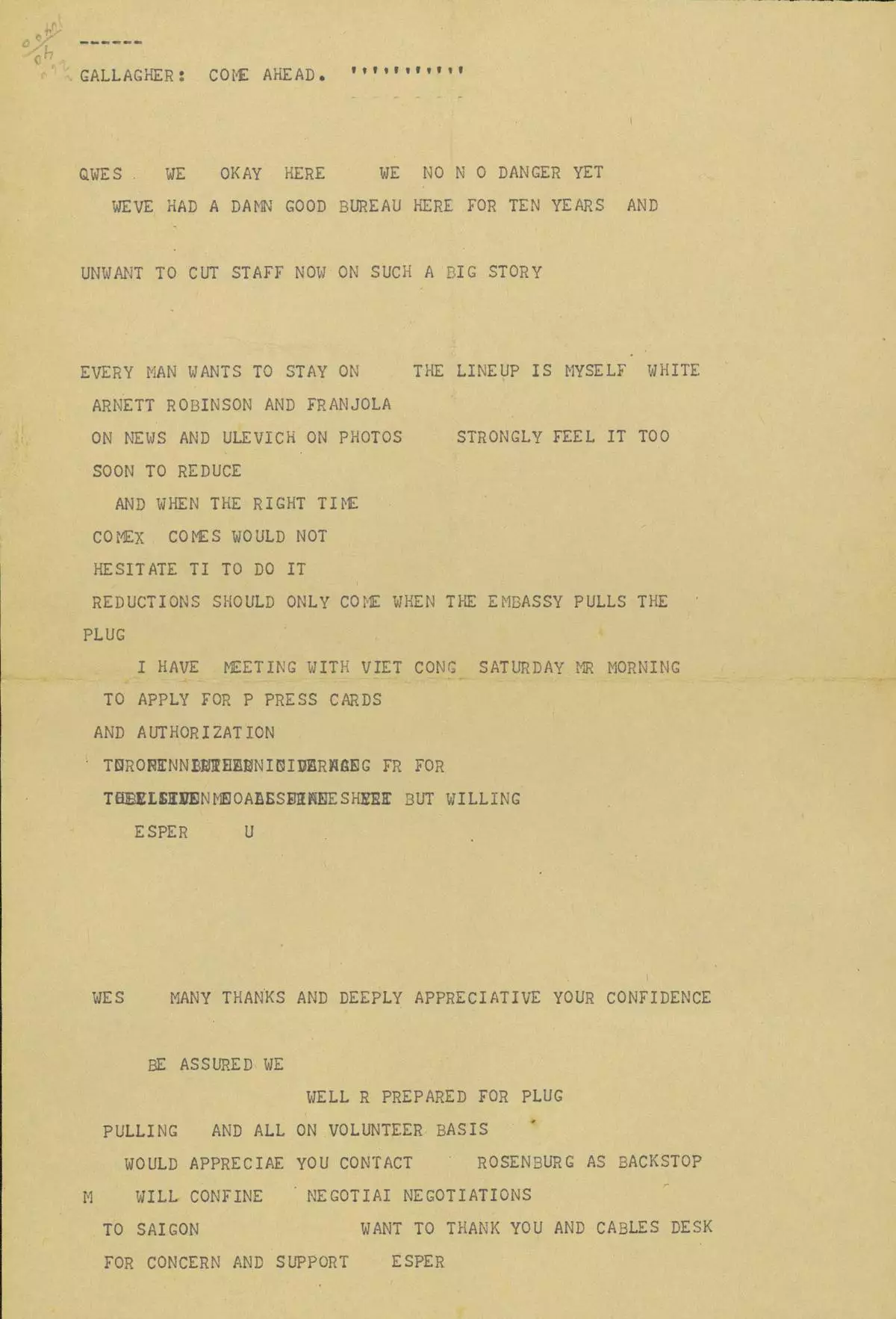
Message from AP's Saigon bureau chief George Esper to General Manager Wes Gallagher concerning AP staff covering the fall of Saigon in April, 1975. (AP Photo/Corporate Archives)
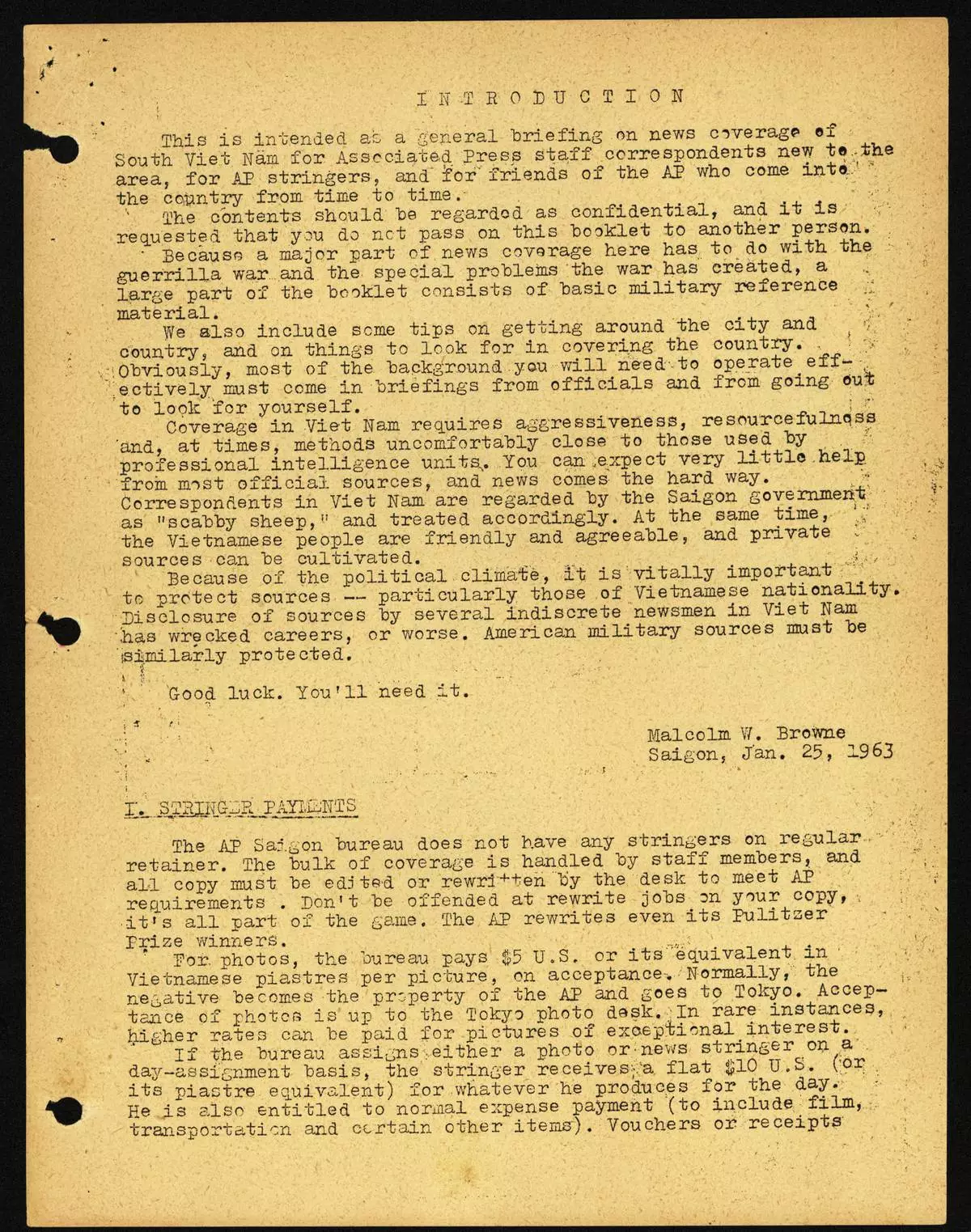
Page 1 of 25 of The Associated Press Short Guide to News Coverage in Vietnam for staffers and stringers covering the Vietnam War, composed in January 1963 by AP Saigon Bureau Chief Malcolm Browne (1931-2012). The 25-page primer, originally written for Horst Faas and Peter Arnett, provides detailed guidance on all aspects of war coverage, including how to move with troops, how to discern accurate information from propaganda and, most importantly, how to stay safe. After Browne left AP, the manual followed him to the ABC bureau in Saigon. (AP Photo/AP Corporate Archives)
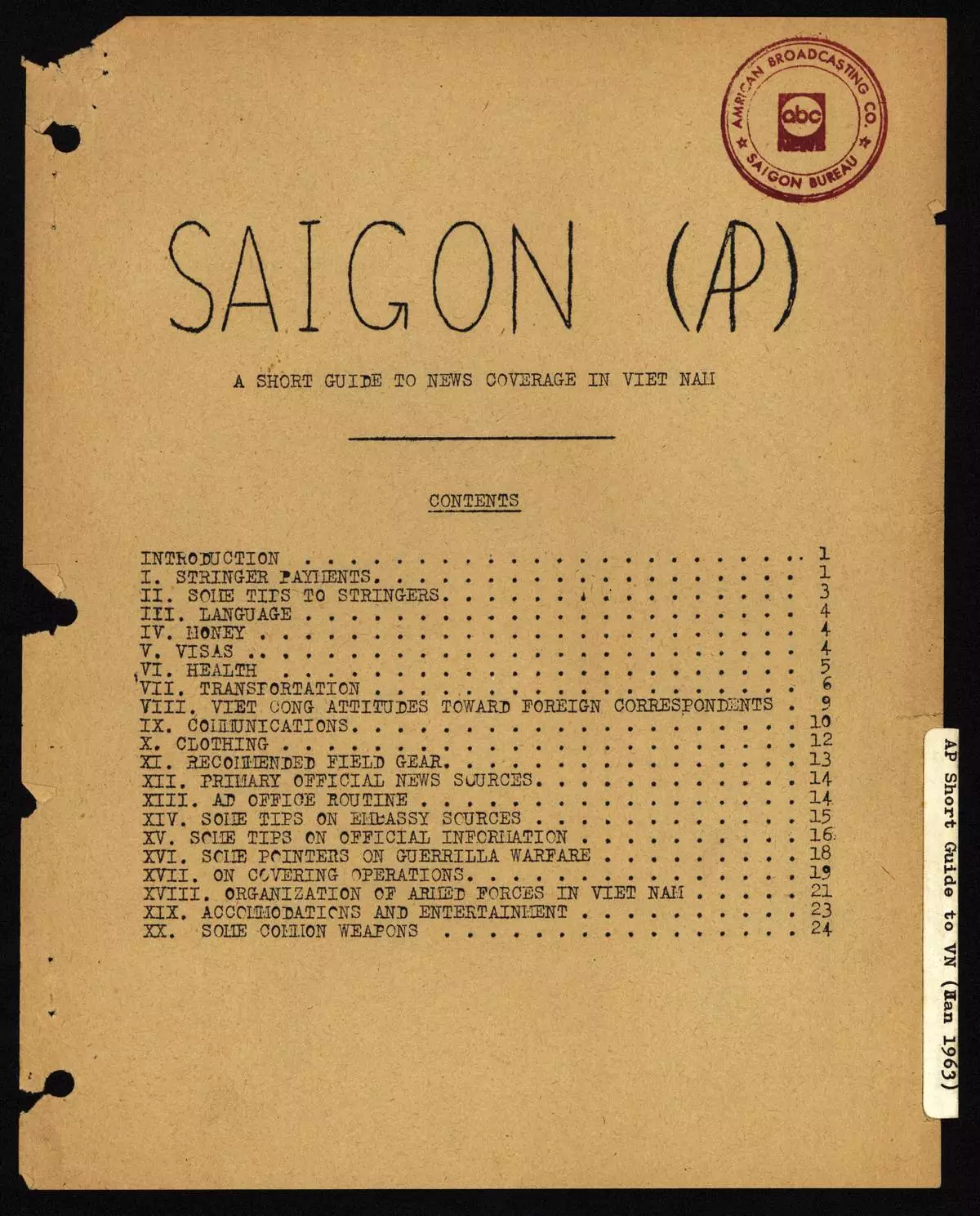
The cover (page i of 25) of The Associated Press Short Guide to News Coverage in Vietnam for staffers and stringers covering the Vietnam War, composed in January 1963 by AP Saigon Bureau Chief Malcolm Browne (1931-2012). The 25-page primer, originally written for Horst Faas and Peter Arnett, provides detailed guidance on all aspects of war coverage, including how to move with troops, how to discern accurate information from propaganda and, most importantly, how to stay safe. After Browne left AP, the manual followed him to the ABC bureau in Saigon. (AP Photo/AP Corporate Archives)
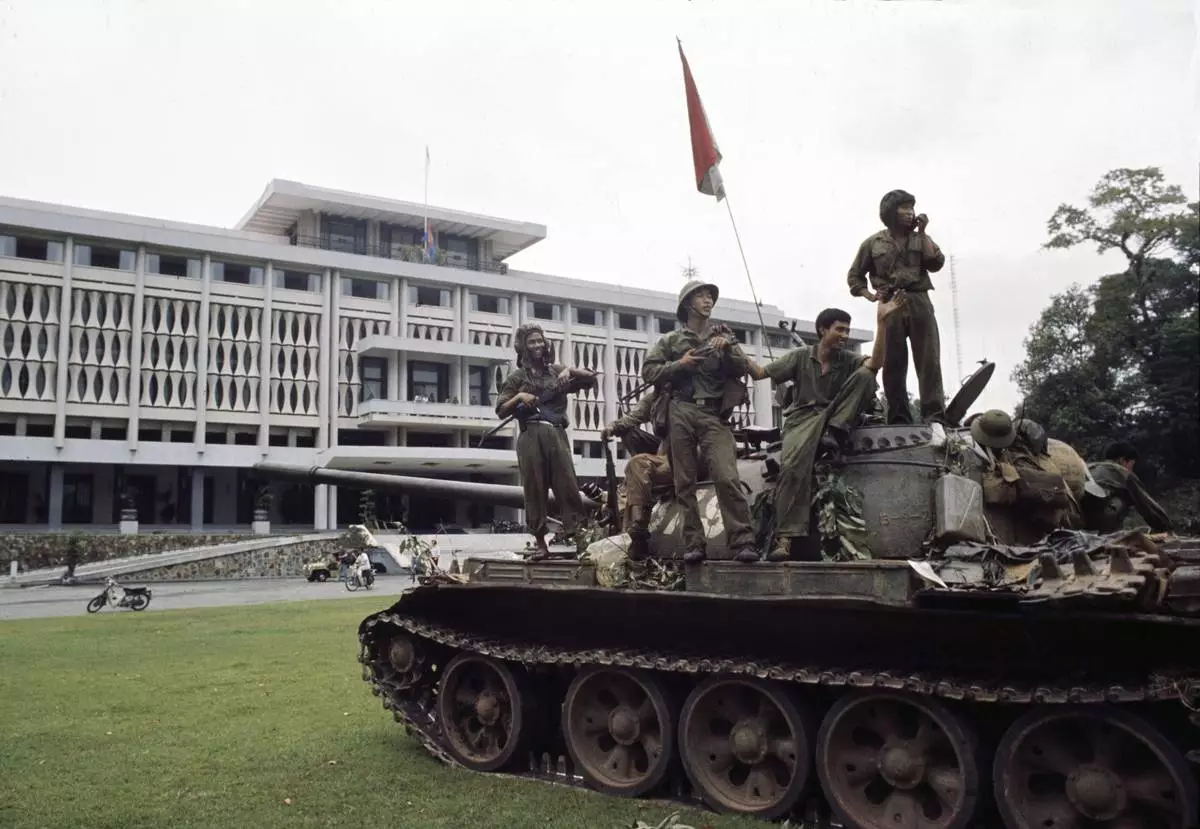
FILE- Victorious North Vietnamese troops aboard a tank take a position outside Independence Palace in Saigon, April 30, 1975, the day the South Vietnamese government surrendered, ending the Vietnam War. Communist flags fly from the palace and the tank. (AP Photo/Yves Billy, File)
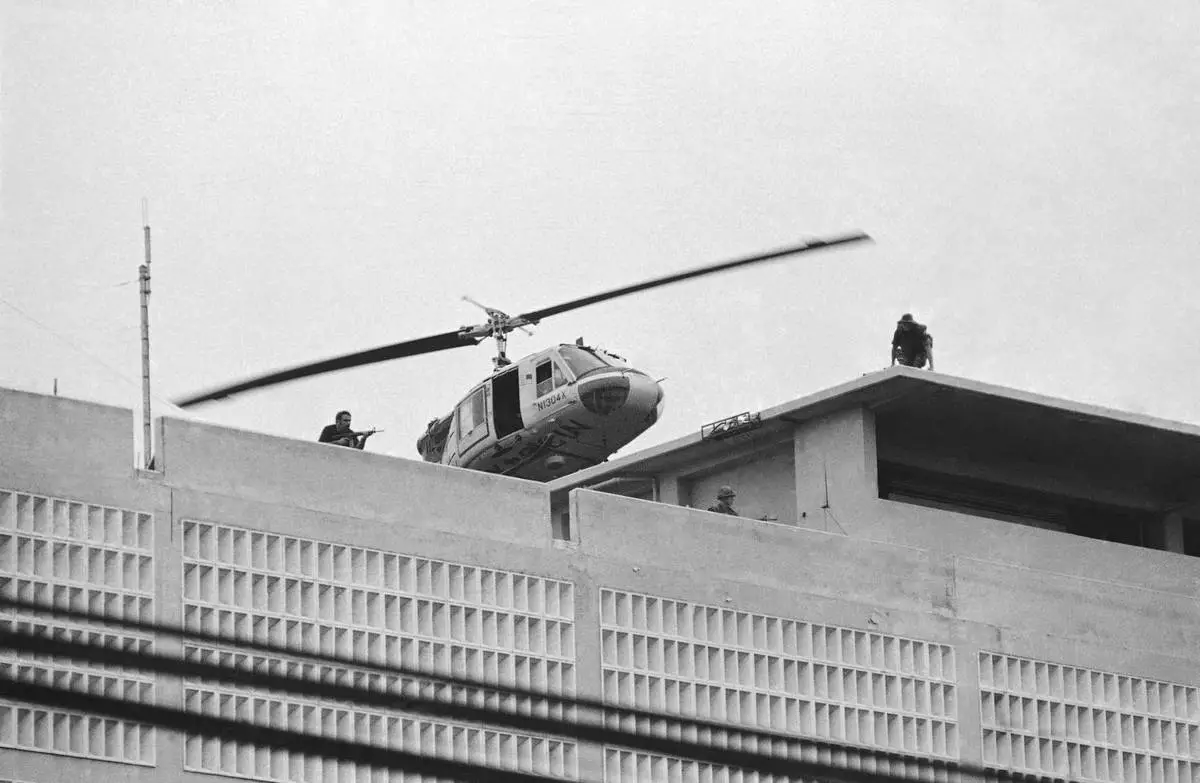
FILE- A U.S. Marine helicopter takes off from helipad on top of the American Embassy in Saigon, Vietnam, April 30, 1975. (AP Photo/Phu)
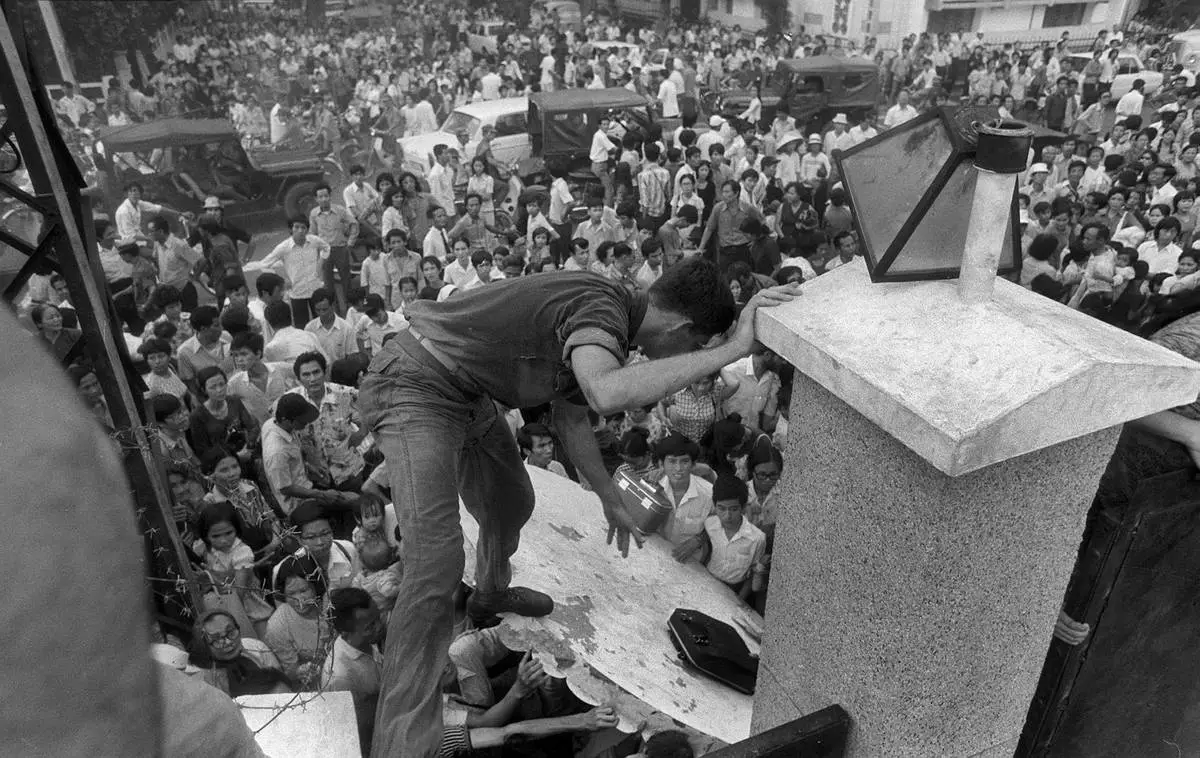
FILE - In this April 29, 1975, file photo, South Vietnamese civilians try to scale the 14-foot wall of the U.S. embassy in Saigon, trying to reach evacuation helicopters as the last Americans departed from Vietnam. (AP Photo/File)
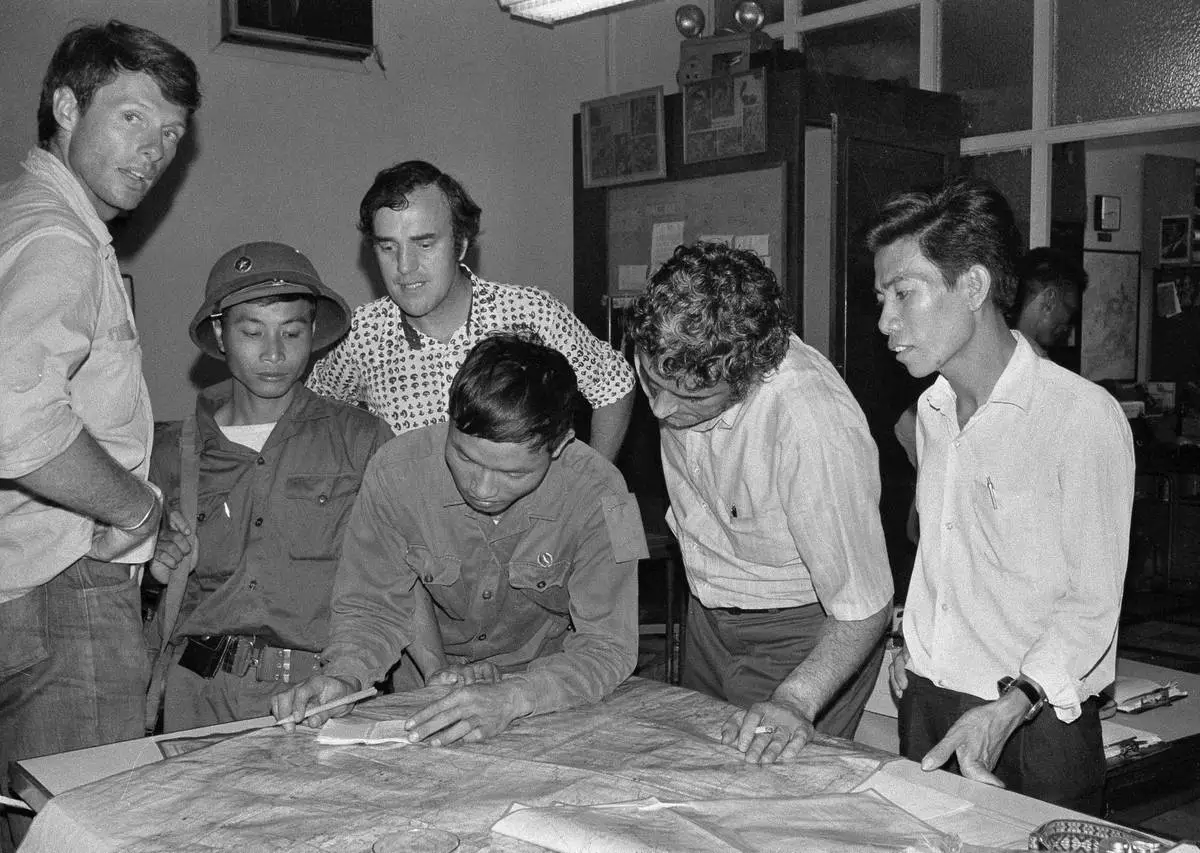
The last three staffers in The Associated Press' Saigon bureau, reporters Matt Franjola, left, Peter Arnett, rear, and George Esper, second from right, are joined by two North Vietnamese soldiers and a member of the Viet Cong on the day the government of South Vietnam surrendered, April 30, 1975. One of the soldiers is showing Esper the route of his final advance into the city. (AP Photo/Sarah Errington)