DENVER (AP) — The letter from Sen. Chuck Grassley to the person now in charge of steadying the U.S. Center for SafeSport laid bare his views of festering problems at an agency he portrayed as having lost its way.
Among the concerns the Iowa Republican outlined in that March 31 letter to the center’s board chair and now its interim CEO, April Holmes, included “repeated failure to adequately supervise SafeSport’s officers,” and a “concern that SafeSport is not prioritizing serious sexual and child abuse cases over other cases.”
Four months after The Associated Press revealed the center’s firing of an investigator — former police officer Jason Krasley, who would later be charged with sex crimes — the board took care of one of the concerns by ousting the center’s CEO, Ju’Riese Colon.
But as Grassley’s questions to Holmes indicate, Colon’s departure last week does not by itself guarantee an end to turmoil at the troubled 8-year-old agency.
The AP spoke to more than a dozen people familiar with the center to gauge the next moves it must take to rebuild trust. A consensus emerged that the center is a good idea that is ultimately worth taking the time to repair.
“It is definitely worth saving,” Phil Andrews, the CEO of USA Fencing, wrote in a text, before ticking off areas that need improvement.
They included finding a strong, new leader; additional funding to “clean up the mess”; and further improvement of processes that critics view as cumbersome, not transparent and too drawn-out.
“They have made some real progress in stemming incidents of abuse and weeding abusers out of the system,” said Sarah Hirshland, the CEO of the U.S. Olympic and Paralympic Committee, which bankrolls most of the center’s $23 million annual budget with help from its 52 affiliated sports organizations. “That’s undeniable. But there’s also more work to be done.”
Currently, that task belongs to Holmes, 52, a 2008 Paralympic sprint gold medalist who became the board chair in 2023. Her mission, she said, is to ensure “operational continuity” and conduct the search for new leadership.
“Any large-scale changes to the Center should and will be led by the new CEO with input and support from the leadership team, our stakeholders, and Center staff,” Holmes wrote in answers emailed in response to a series of questions from the AP.
In 2017, in the wake of scandals involving Larry Nassar and others, the independently run center was created to investigate and levy sanctions for abuse cases as part of a remit that covers some 11 million people who play Olympic sports in the U.S.
Over the past two years, around two dozen people — some accusers, some accused, some parents of minors involved with the center — have approached the AP with stories about cases that took months, if not years, to resolve, some of which led to emotional or financial devastation.
One such person, equestrian Zoubair Bennani, has received a permanent ban from the center, been forced to sell his 14 horses and says he has spent more than $275,000 in attorney’s fees fighting allegations of sexual and physical misconduct brought against him by former girlfriends. He has no criminal record and insists the women used the center to punish him.
“That’s all I think about every day, is how to get my status back, at any cost, because I am innocent,” Bennani said.
In outlining a problem that came up frequently in the AP reporting — creating a safe space for survivors while also protecting the rights of the accused — he asked; “Why can’t SafeSport have transparency where they’re doing more vetting on the people who bring the accusations?”
Bennani’s case began as one of the more than 8,000 reports the center receives a year — a 2,500% increase from when it opened. His name is among more than 2,300 on the center’s Centralized Disciplinary Database.
The steady growth of both numbers could be the most tangible measures of success for what is, in essence, still a start-up among this country’s tangled Olympic infrastructure.
Other achievements include establishing a SafeSport Code that standardized rules across the country; developing educational resources it says have reached millions; and establishing an audit process for the nation’s Olympic-focused sports organizations — a mission that has created accountability but also tension between the center and the agencies.
“The Center has also continued to build relationships with athletes and survivor organizations, seeking their engagement on policy improvements and much needed research in the area of abuse prevention in sport,” Holmes said.
Grassley's letter to Holmes conjured long-running complaints about a process that takes too long and isn’t clearly defined to either accusers or the accused.
He questioned whether the center was prioritizing the worst of abuse cases over “other cases.”
The center has authority to take cases involving bullying and harassment of a nonsexual nature. It also can investigate cases involving the millions of athletes who aren’t on the Olympic track but participate in those sports.
Before the center was created, Olympic leaders debated whether its scope should have been this wide. The shock from the Nassar scandal, and the failure of the Olympics' existing agencies to prevent it, essentially shut down that debate and locked in the center's wider mandate.
“If you were starting an organization, you would never start it with 12 product lines at once and say, ‘We’re going to do all of these,’” said Hirshland, who took over at the USOPC about a year after SafeSport’s founding. “It feels like that’s how they got started. Maybe that’s not their fault, but that’s where it is. That’s been challenging.”
Some insiders suggest a streamlining of the center’s scope might be in order.
One path could be narrowing the now-unlimited statute of limitations, which has opened the window for the center to adjudicate abuse cases from as far back as the 1960s.
Another would be shrinking the types of cases it will accept, perhaps by fencing off grassroots sports into a different category.
This was, in essence, one of the recommendations from a congressionally appointed commission that released a report on the U.S. Olympic movement last year. Among its findings were that people lacked confidence in the center, which it said was “in potential crisis.”
The commission co-chair, Dionne Koller, said other suggestions in the report — increasing athlete control over the center and bringing its funding — and thus oversight — under congressional control are radical changes that would improve its performance.
“You can keep making incremental tweaks in response to issues that come up, and they can do some good,” Koller said, in a nod to a series of reforms that were made last year. “But we’re just going to keep repeating the same type of problems” unless bigger changes are made.
As things stand, it is Grassley, along with a handful of other lawmakers in Washington, who appear to be keeping the best watch over the center. They, along with Holmes and her fellow board members, will play a pivotal role in what, and who, comes next.
AP sports: https://apnews.com/sports
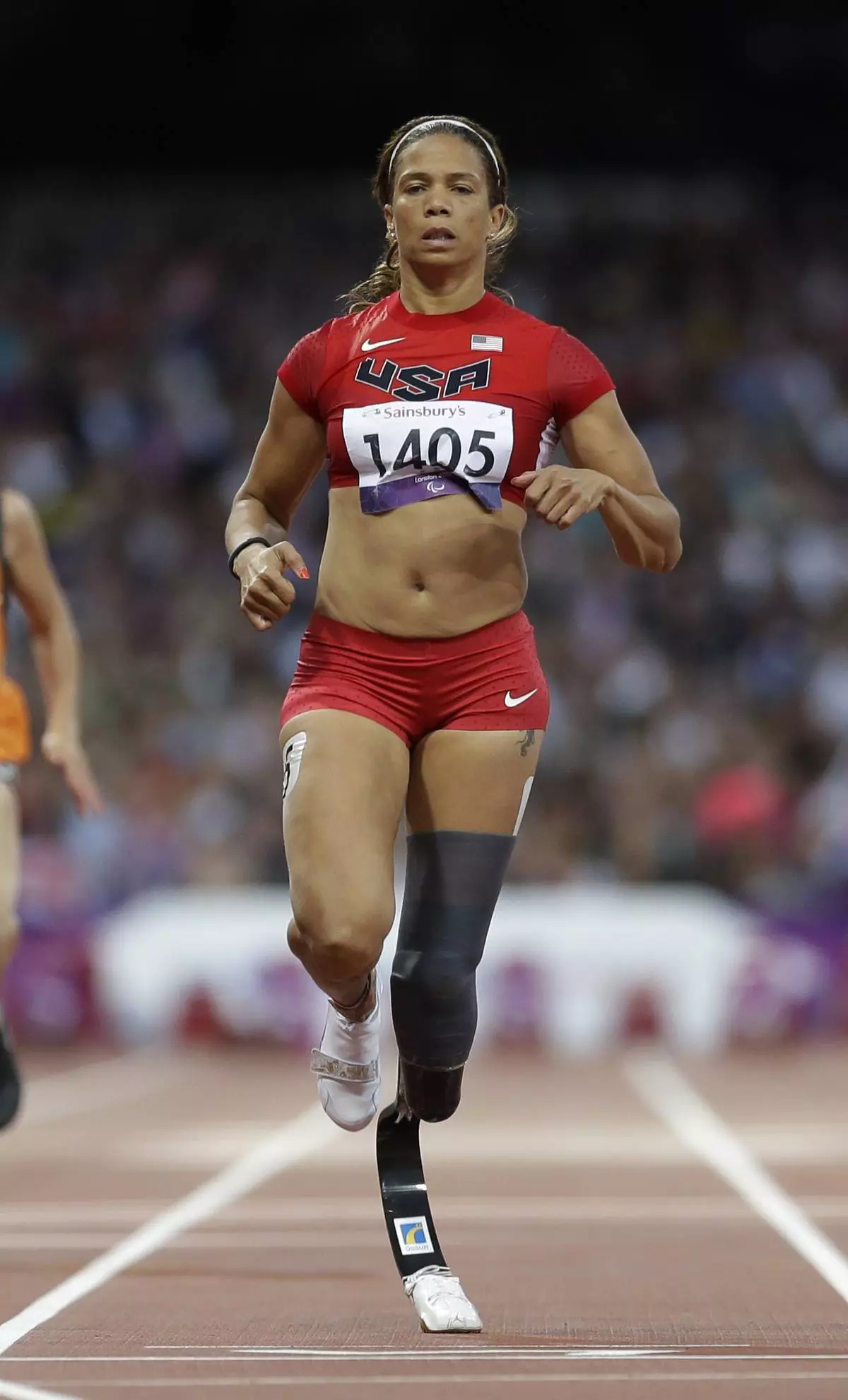
FILE - United States' April Holmes competes at a women's 100m T44 round 1 race at the 2012 Paralympics in London, Sept. 1, 2012. (AP Photo/Lefteris Pitarakis, file)