About two dozen states sued the Trump administration Tuesday over the dismantling of AmeriCorps, the 30-year-old federal agency for volunteer service, and over the cancellation of hundreds of millions of dollars in grant funding for state and community projects across the U.S.
The federal lawsuit was filed against the agency and its interim head by Democratic state officials. It alleges that President Donald Trump's cost-cutting efforts through the Department of Government Efficiency illegally gutted the agency created by Congress and reneged on grants funded through the AmeriCorps State and National program, which was budgeted $557 million in congressionally approved funding this year.
The agency oversees a number of programs that dispatch hundreds of millions of dollars and tens of thousands of people to serve in communities across the country.
“In an attempt to dismantle the agency, the Trump administration and its DOGE demolition team made abrupt and drastic cuts to staff and volunteers and terminated grants,” said Colorado Attorney General Phil Weiser in a statement. “We are suing to stop this illegal dismantling of AmeriCorps and preserve the spirit of community service in our state and nation.”
At least 85% of AmeriCorps staff were put on administrative leave this month, according to the complaint, with at least some notified last week that they would be let go because of a reduction in force.
The White House on Tuesday pointed to improper payments reported by AmeriCorps, totaling over $40 million in 2024 and attributed to insufficient documentation from grantees, calculation errors and miscoded expenses.
"President Trump has the legal right to restore accountability to the entire Executive Branch,” Anna Kelly, White House deputy press secretary, said in an email.
AmeriCorps employs more than 500 full-time federal workers and has an operating budget of roughly $1 billion.
In addition, it sends roughly 200,000 corps members across the country as part of its service programs. Most corps members get a living stipend during their service and become eligible for funding for future education expenses or to apply for certain student loans.
A specific program, AmeriCorps’ National Civilian Community Corps, also covers basic expenses and housing for some 2,000 young people participating in a roughly 10-month service term. Those corps members, who work with community organizations and respond to natural disasters, were informed earlier this month they would be dismissed early.
As part of the AmeriCorps State and National grant program, state volunteer commissions distributed more than $177 million in formula-based distributions, as well as $370 million in competitive grants that supported nearly 35,000 corps members serving at 300 organizations, according to announcements in May.
Notices of grants being terminated were sent late Friday, explaining “the award no longer effectuates agency priorities” and directing grantees to immediately shut down the projects, according to a copy reviewed by The Associated Press.
Corps members would no longer be participating in the program and would no longer receive a stipend.
Hundreds of millions of dollars in grants to each of the 52 state and territory volunteer commissions were impacted, according to Rachel Bruns, chief engagement officer with America’s Service Commissions. That includes Washington, Puerto Rico and Guam; South Dakota does not have a state volunteer commission.
Bruns said commissions in Wisconsin, Alabama, Wyoming, Oregon and Maine have reported that their entire portfolios for that grant program have been cut.
There was no “rhyme or reason” given to the grantees that were affected, Bruns said, noting that there are cases of one organization seeing their funding cut in one state but not another. The cuts affect projects like after-school programs, services for veterans, food pantries, efforts to prevent child abuse and home builds.
“We don’t know what this means for these services in some of these communities that were impacted,” Bruns said.
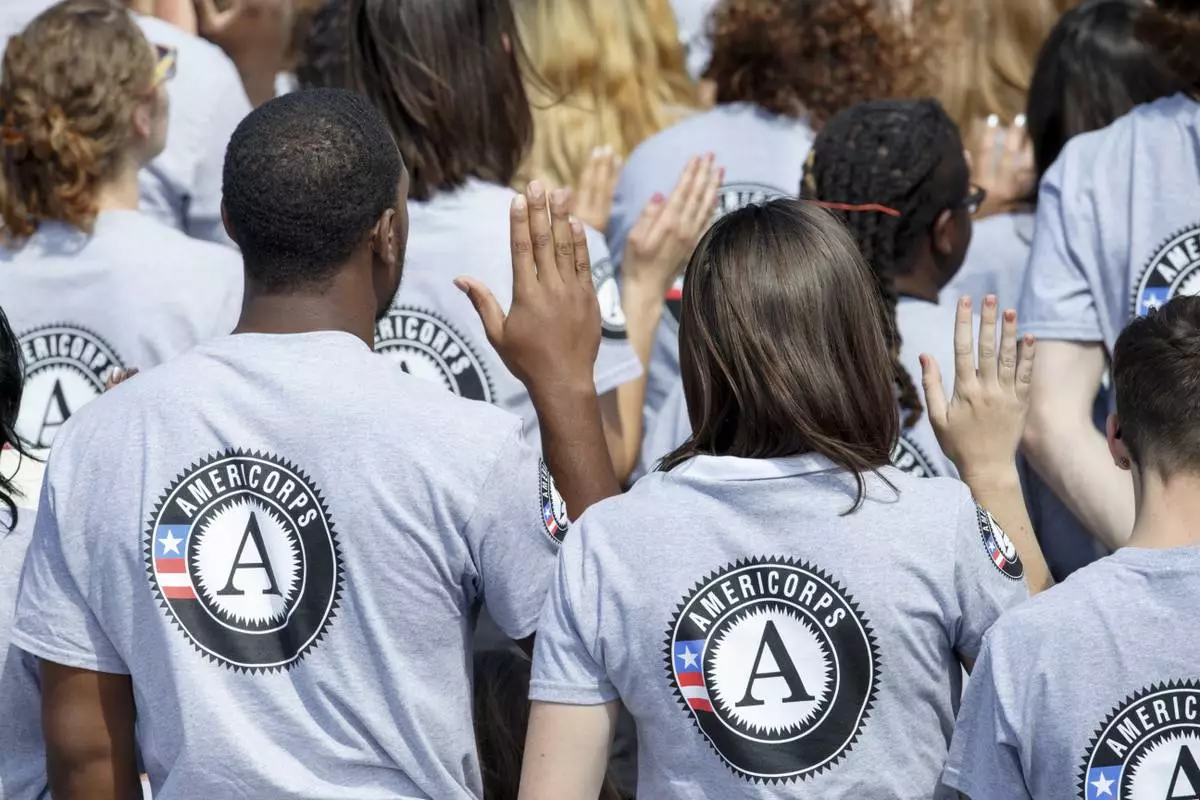
FILE - As President Barack Obama and former President Bill Clinton mark the 20th anniversary of the AmeriCorps national service program, hundreds of new volunteers are sworn in for duty at a ceremony, Friday, Sept. 12, 2014, on the South Lawn of the White House in Washington. (AP Photo/J. Scott Applewhite, File)
RHO, Italy (AP) — No ice is colder and harder than speedskating ice. The precision it takes has meant that Olympic speedskaters have never competed for gold on a temporary indoor rink – until the 2026 Milan Cortina Winter Games.
In the pursuit of maximum glide and minimum friction, Olympic officials brought on ice master Mark Messer, a veteran of six previous Olympic speedskating tracks and the ice technician in charge of the Olympic Oval in Calgary, Canada — one of the fastest tracks in the world with over 300 records.
Messer has been putting that experience to work one thin layer of ice at a time since the end of October at the new Speed Skating Stadium, built inside adjacent trade fair halls in the city of Rho just north of Milan.
“It’s one of the biggest challenges I’ve had in icemaking,’’ Messer said during an interview less than two weeks into the process.
If Goldilocks were a speedskater, hockey ice would be medium hard, for fast puck movement and sharp turns. Figure skating ice would be softer, allowing push off for jumps and so the ice doesn’t shatter on landing. Curling ice is the softest and warmest of all, for controlled sliding.
For speedskating ice to be just right, it must be hard, cold and clean. And very, very smooth.
“The blades are so sharp, that if there is some dirt, the blade will lose the edge,’’ Messer said, and the skater will lose speed.
Speedskater Enrico Fabris, who won two Olympic golds in Turin in 2006, has traded in his skates to be deputy sports manager at the speedskating venue in Rho. For him, perfect ice means the conditions are the same for all skaters — and then if it's fast ice, so much the better.
"It's more of a pleasure to skate on this ice,'' he said.
Messer’s first Olympics were in Calgary in 1988 — the first time speedskating was held indoors. “That gave us some advantages because we didn’t have to worry about the weather, wind blowing or rain,’’ he said. Now he is upping the challenge by becoming the first ice master to build a temporary rink for the Olympics.
Before Messer arrived in Italy, workers spent weeks setting up insulation to level the floor and then a network of pipes and rubber tubes that carry glycol — an antifreeze — that is brought down to minus 7 or minus 8 degrees Celsius (17.6 to 19.4 degrees Fahrenheit) to make the ice.
Water is run through a purification system — but it can’t be too pure, or the ice that forms will be too brittle. Just the right amount of impurities “holds the ice together,’’ Messer said.
The first layers of water are applied slowly, with a spray nozzle; after the ice reaches a few centimeters it is painted white — a full day’s work — and the stripes are added to make lanes.
“The first one takes about 45 minutes. And then as soon as it freezes, we go back and do it again, and again and again. So we do it hundreds of times,’’ Messer said.
As the ice gets thicker, and is more stable, workers apply subsequent layers of water with hoses. Messer attaches his hose to hockey sticks for easier spreading.
What must absolutely be avoided is dirt, dust or frost — all of which can cause friction for the skaters, slowing them down. The goal is that when the skaters push “they can go as far as possible with the least amount of effort,’’ Messer said.
The Zamboni ice resurfacing machine plays a key role in keeping the track clean, cutting off a layer and spraying water to make a new surface.
One challenge is gauging how quickly the water from the resurfacing machine freezes in the temporary rink.
Another is getting the ice to the right thickness so that the Zamboni, weighing in at six tons, doesn’t shift the insulation, rubber tubing or ice itself.
“When you drive that out, if there’s anything moving it will move. We don’t want that,’’ Messer said.
The rink got its first big test on Nov. 29-30 during a Junior World Cup event. In a permanent rink, test events are usually held a year before the Olympics, leaving more time for adjustments. “We have a very small window to learn,’’ Messer acknowledged.
Dutch speedskater Kayo Vos, who won the men’s neo-senior 1,000 meters, said the ice was a little soft — but Messer didn’t seem too concerned.
“We went very modest to start, now we can start to change the temperatures and try to make it faster and still maintain it as a safe ice,’’ he said.
Fine-tuning the air temperature and humidity and ice temperature must be done methodically — taking into account that there will be 6,000 spectators in the venue for each event. The next real test will be on Jan. 31, when the Olympians take to the ice for their first training session.
“Eighty percent of the work is done but the hardest part is the last 20 percent, where we have to try to find the values and the way of running the equipment so all the skaters get the same conditions and all the skaters get the best conditions,’’ Messer said.
AP Winter Olympics: https://apnews.com/hub/milan-cortina-2026-winter-olympics

Serpentines are set on the ice of the stadium where speed skating discipline of the Milan Cortina 2026 Winter Olympics will take place, in Rho, outskirt of Milan, Tuesday, Nov. 11, 2025. (AP Photo/Luca Bruno)

Ice Master Mark Messer poses in the stadium where speed skating discipline of the Milan Cortina 2026 Winter Olympics will take place, in Rho, outskirt of Milan, Tuesday, Nov. 11, 2025. (AP Photo/Luca Bruno)
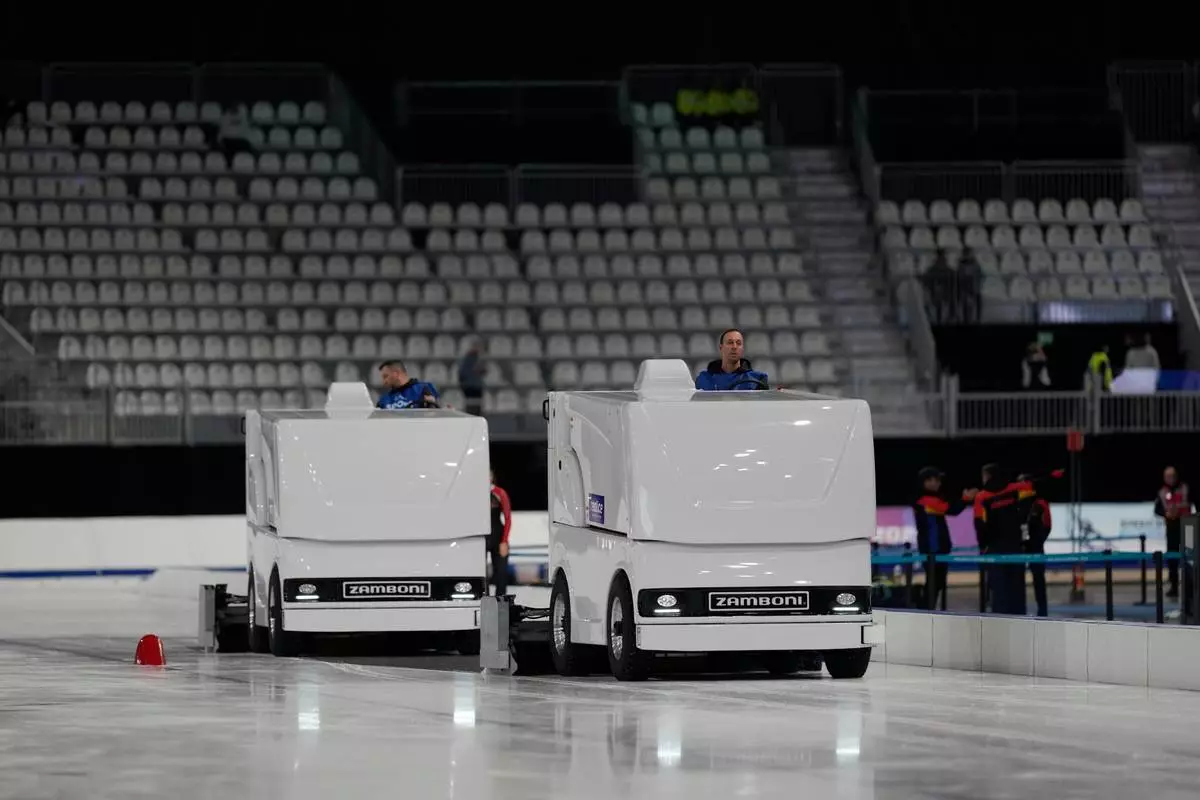
Workers clean the ice surface during a peed skating Junior World Cup and Olympic test event, in Rho, near Milan, Italy, Saturday, Nov. 29, 2025. (AP Photo/Luca Bruno)

Ice Master Mark Messer poses in the stadium where speed skating discipline of the Milan Cortina 2026 Winter Olympics will take place, in Rho, outskirt of Milan, Tuesday, Nov. 11, 2025. (AP Photo/Luca Bruno)

Ice Master Mark Messer poses in the stadium where speed skating discipline of the Milan Cortina 2026 Winter Olympics will take place, in Rho, outskirt of Milan, Tuesday, Nov. 11, 2025. (AP Photo/Luca Bruno)