LOS ANGELES (AP) — Conservative activist Robby Starbuck has filed a defamation lawsuit against Meta alleging that the social media giant's artificial intelligence chatbot spread false statements about him, including that he participated in the riot at the U.S. Capitol on Jan. 6, 2021.
Starbuck, known for targeting corporate DEI programs, said he discovered the claims made by Meta's AI in August 2024, when he was going after “woke DEI” policies at motorcycle maker Harley-Davidson.
“One dealership was unhappy with me and they posted a screenshot from Meta’s AI in an effort to attack me,” he said in a post on X. “This screenshot was filled with lies. I couldn’t believe it was real so I checked myself. It was even worse when I checked.”
Since then, he said he has “faced a steady stream of false accusations that are deeply damaging to my character and the safety of my family.”
The political commentator said he was in Tennessee during the Jan. 6 riot. The suit, filed in Delaware Superior Court on Tuesday, seeks more than $5 million in damages.
In an emailed statement, a spokesperson for Meta said that “as part of our continuous effort to improve our models, we have already released updates and will continue to do so.”
Starbuck's lawsuit joins the ranks of similar cases in which people have sued AI platforms over information provided by chatbots. In 2023, a conservative radio host in Georgia filed a defamation suit against OpenAI alleging ChatGPT provided false information by saying he defrauded and embezzled funds from the Second Amendment Foundation, a gun-rights group.
James Grimmelmann, professor of digital and information law at Cornell Tech and Cornell Law School, said there is “no fundamental reason why” AI companies couldn't be held liable in such cases. Tech companies, he said, can't get around defamation “just by slapping a disclaimer on.”
“You can’t say, ‘Everything I say might be unreliable, so you shouldn’t believe it. And by the way, this guy’s a murderer.' It can help reduce the degree to which you’re perceived as making an assertion, but a blanket disclaimer doesn’t fix everything," he said. “There’s nothing that would hold the outputs of an AI system like this categorically off limits.”
Grimmelmann said there are some similarities between the arguments tech companies make in AI-related defamation and copyright infringement cases, like those brought forward by newspapers, authors and artists. The companies often say that they are not in a position to supervise everything an AI does, he said, and they claim they would have to compromise the tech's usefulness or shut it down entirely "if you held us liable for every harmful, infringing output, it’s produced.”
“I think it is an honestly difficult problem, how to prevent AI from hallucinating in the ways that produce unhelpful information, including false statements,” Grimmelmann said. “Meta is confronting that in this case. They attempted to make some fixes to their models of the system, and Starbuck complained that the fixes didn’t work.”
When Starbuck discovered the claims made by Meta's AI, he tried to alert the company about the error and enlist its help to address the problem. The complaint said Starbuck contacted Meta’s managing executives and legal counsel, and even asked its AI about what should be done to address the allegedly false outputs.
According to the lawsuit, he then asked Meta to "retract the false information, investigate the cause of the error, implement safeguards and quality control processes to prevent similar harm in the future, and communicate transparently with all Meta AI users about what would be done.”
The filing alleges that Meta was unwilling to make those changes or “take meaningful responsibility for its conduct.”
“Instead, it allowed its AI to spread false information about Mr. Starbuck for months after being put on notice of the falsity, at which time it ‘fixed’ the problem by wiping Mr. Starbuck’s name from its written responses altogether,” the suit said.
Joel Kaplan, Meta's chief global affairs officer, responded to a video Starbuck posted to X outlining the lawsuit and called the situation “unacceptable.”
“This is clearly not how our AI should operate," Kaplan said on X. "We’re sorry for the results it shared about you and that the fix we put in place didn’t address the underlying problem.”
Kaplan said he is working with Meta's product team to “understand how this happened and explore potential solutions.”
Starbuck said that in addition to falsely saying he participated in the the riot at the U.S. Capitol, Meta AI also falsely claimed he engaged in Holocaust denial, and said he pleaded guilty to a crime despite never having been “arrested or charged with a single crime in his life.”
Meta later “blacklisted” Starbuck's name, he said, adding that the move did not solve the problem because Meta includes his name in news stories, which allows users to then ask for more information about him.
“While I’m the target today, a candidate you like could be the next target, and lies from Meta’s AI could flip votes that decide the election,” Starbuck said on X. “You could be the next target too.”
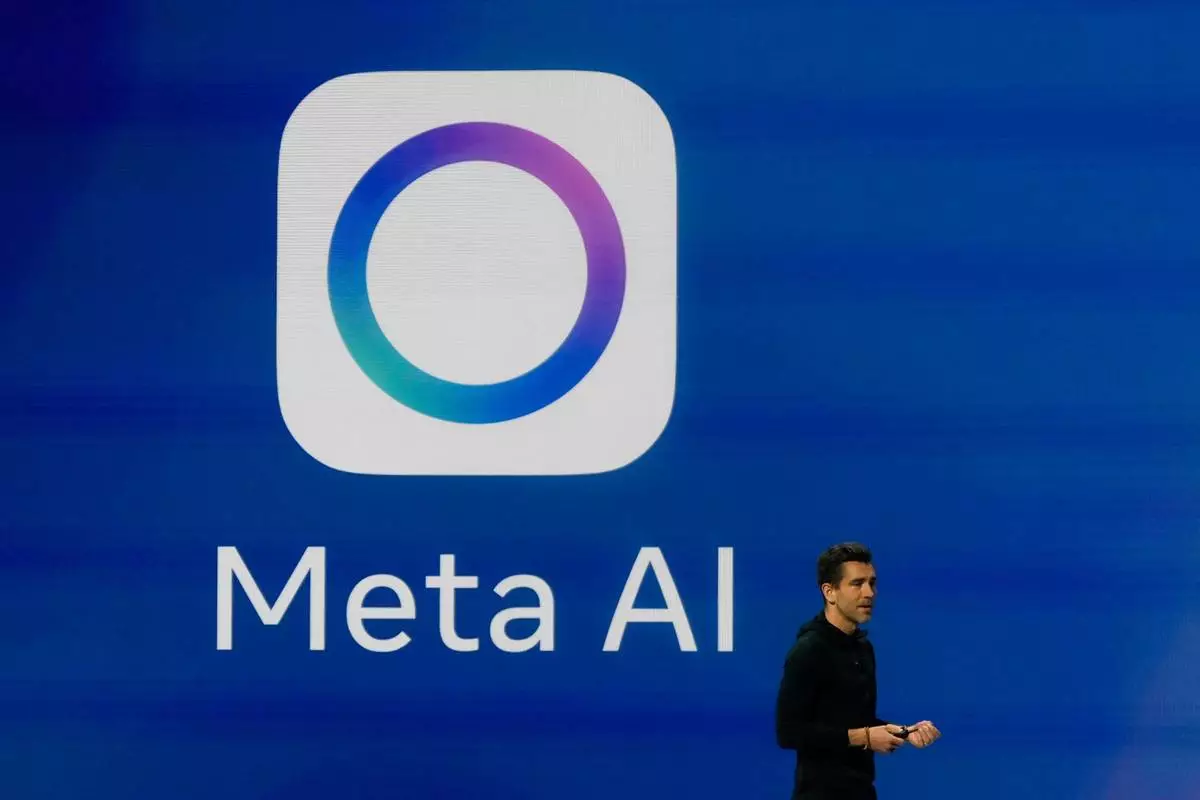
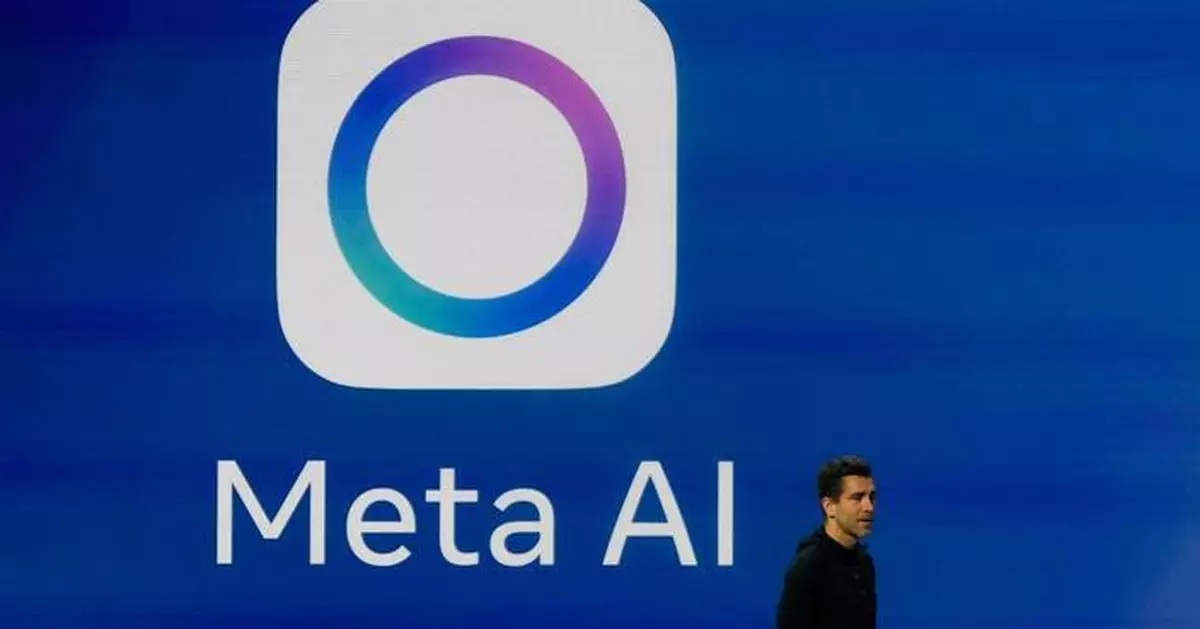
Meta Chief Product Officer Chris Cox speaks at LlamaCon 2025, an AI developer conference, in Menlo Park, Calif., Tuesday, April 29, 2025. (AP Photo/Jeff Chiu)
WASHINGTON (AP) — Venezuelan opposition leader María Corina Machado discussed her country's future with President Donald Trump at the White House on Thursday, even though he has dismissed her credibility to take over after an audacious U.S. military raid captured then-President Nicolás Maduro.
Trump has raised doubts about his stated commitment to backing democratic rule in Venezuela and signaled his willingness to work with acting President Delcy Rodríguez, who was Maduro’s No. 2. Along with others in the deposed leader’s inner circle, Rodríguez remains in charge of day-to-day government operations and was set to deliver her first state of the union speech Thursday.
In endorsing Rodríguez so far, Trump has sidelined Machado, who has long been a face of resistance in Venezuela. She also had sought to cultivate relationships with Trump and key administration voices like Secretary of State Marco Rubio among the American right wing in a gamble to ally herself with the U.S. government.
White House press secretary Karoline Leavitt said Trump had been looking forward to the lunchtime meeting with Machado and called her “a remarkable and brave voice” for the people of Venezuela. But Leavitt also said Trump's opinion of Machado had not changed, calling it "a realistic assessment."
Trump has said it would be difficult for Machado to lead because she “doesn’t have the support within or the respect within the country.” Her party is widely believed to have won 2024 elections rejected by Maduro.
Leavitt went on to say that Trump supported new Venezuelan elections “when the time is right” but did not say when he thought that might be.
Leavitt said Machado sought the face-to-face meeting without setting expectations for what would occur. Machado previously offered to share with Trump the Nobel Peace Prize she won last year, an honor he has coveted.
“I don’t think he needs to hear anything from Ms. Machado," the press secretary said, other than to have a ”frank and positive discussion about what’s taking place in Venezuela.”
Machado spent about two and a half hours at the White House but left without answering questions on whether she'd offered to give her Nobel prize to Trump, saying only “gracias."
After her White House stop, Machado plans to have a meeting at the Senate. Her Washington visit began after U.S. forces in the Caribbean Sea seized another sanctioned oil tanker that the Trump administration says had ties to Venezuela.
It is part of a broader U.S. effort to take control of the South American country’s oil after U.S. forces seized Maduro and his wife at a heavily guarded compound in the Venezuelan capital of Caracas and brought them to New York to stand trial on drug trafficking charges.
Leavitt said Venezuela's interim authorities have been fully cooperating with the Trump administration and that Rodríguez's government said it planned to release more prisoners detained under Maduro. Among those released were five Americans this week.
Rodríguez has adopted a less strident position toward Trump then she did immediately after Maduro's ouster, suggesting that she can make the Republican administration's “America First” policies toward the Western Hemisphere, work for Venezuela — at least for now.
Trump said Wednesday that he had a “great conversation” with Rodríguez, their first since Maduro was ousted.
“We had a call, a long call. We discussed a lot of things,” Trump said during an Oval Office bill signing. “And I think we’re getting along very well with Venezuela.”
Even before indicating the willingness to work with Venezuela's interim government, Trump was quick to snub Machado. Just hours after Maduro's capture, Trump said of Machado that “it would be very tough for her to be the leader.”
Machado has steered a careful course to avoid offending Trump, notably after winning the peace prize. She has since thanked Trump, though her offer to share the honor with him was rejected by the Nobel Institute.
Machado’s whereabouts have been largely unknown since she went into hiding early last year after being briefly detained in Caracas. She briefly reappeared in Oslo, Norway, in December after her daughter received the Nobel Peace Prize on her behalf.
The industrial engineer and daughter of a steel magnate began challenging the ruling party in 2004, when the nongovernmental organization she co-founded, Súmate, promoted a referendum to recall then-President Hugo Chávez. The initiative failed, and Machado and other Súmate executives were charged with conspiracy.
A year later, she drew the anger of Chávez and his allies again for traveling to Washington to meet President George W. Bush. A photo showing her shaking hands with Bush in the Oval Office lives in the collective memory. Chávez considered Bush an adversary.
Almost two decades later, she marshaled millions of Venezuelans to reject Chávez’s successor, Maduro, for another term in the 2024 election. But ruling party-loyal electoral authorities declared him the winner despite ample credible evidence to the contrary. Ensuing anti-government protests ended in a brutal crackdown by state security forces.
Garcia Cano reported from Caracas, Venezuela, and Janetsky from Mexico City. AP Diplomatic Writer Matthew Lee in Washington contributed to this report.
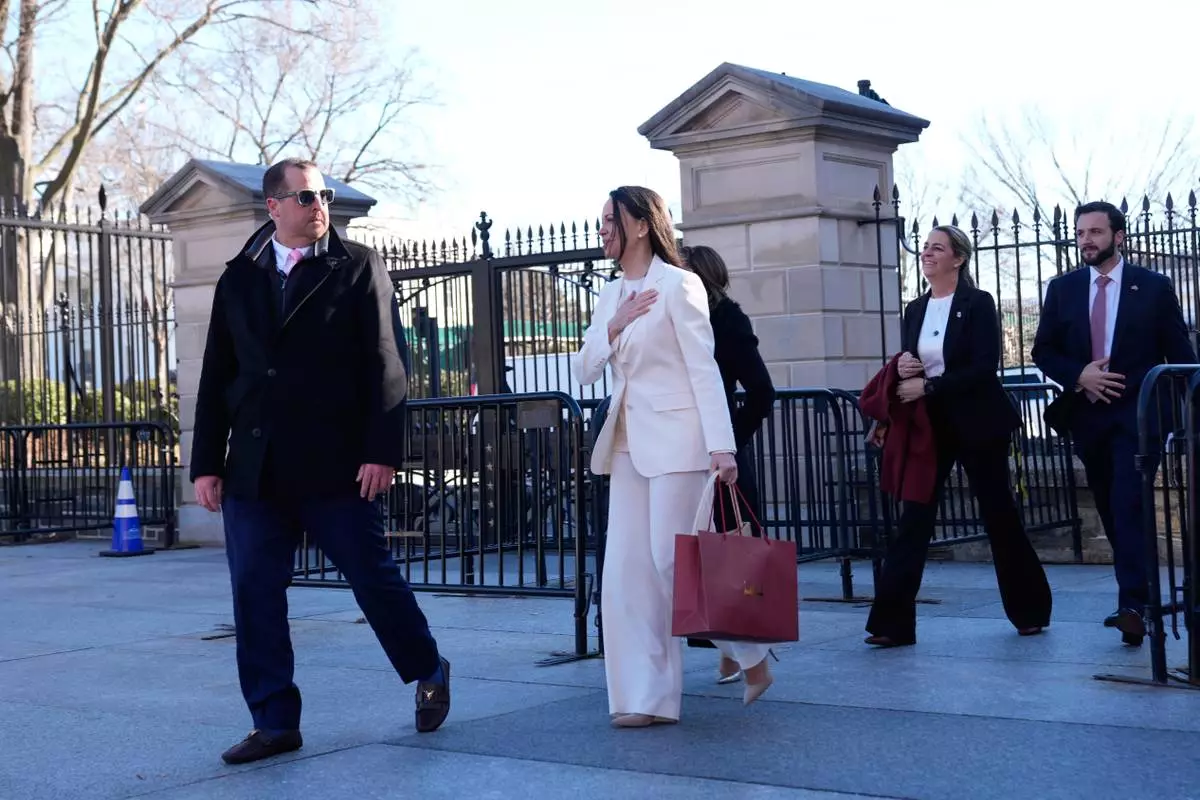
Venezuelan opposition leader María Corina Machado gestures to supporters on Pennsylvania Avenue as she leaves the White House after meeting with President Donald Trump Thursday, Jan. 15, 2026, in Washington. (AP Photo/Pablo Martinez Monsivais)
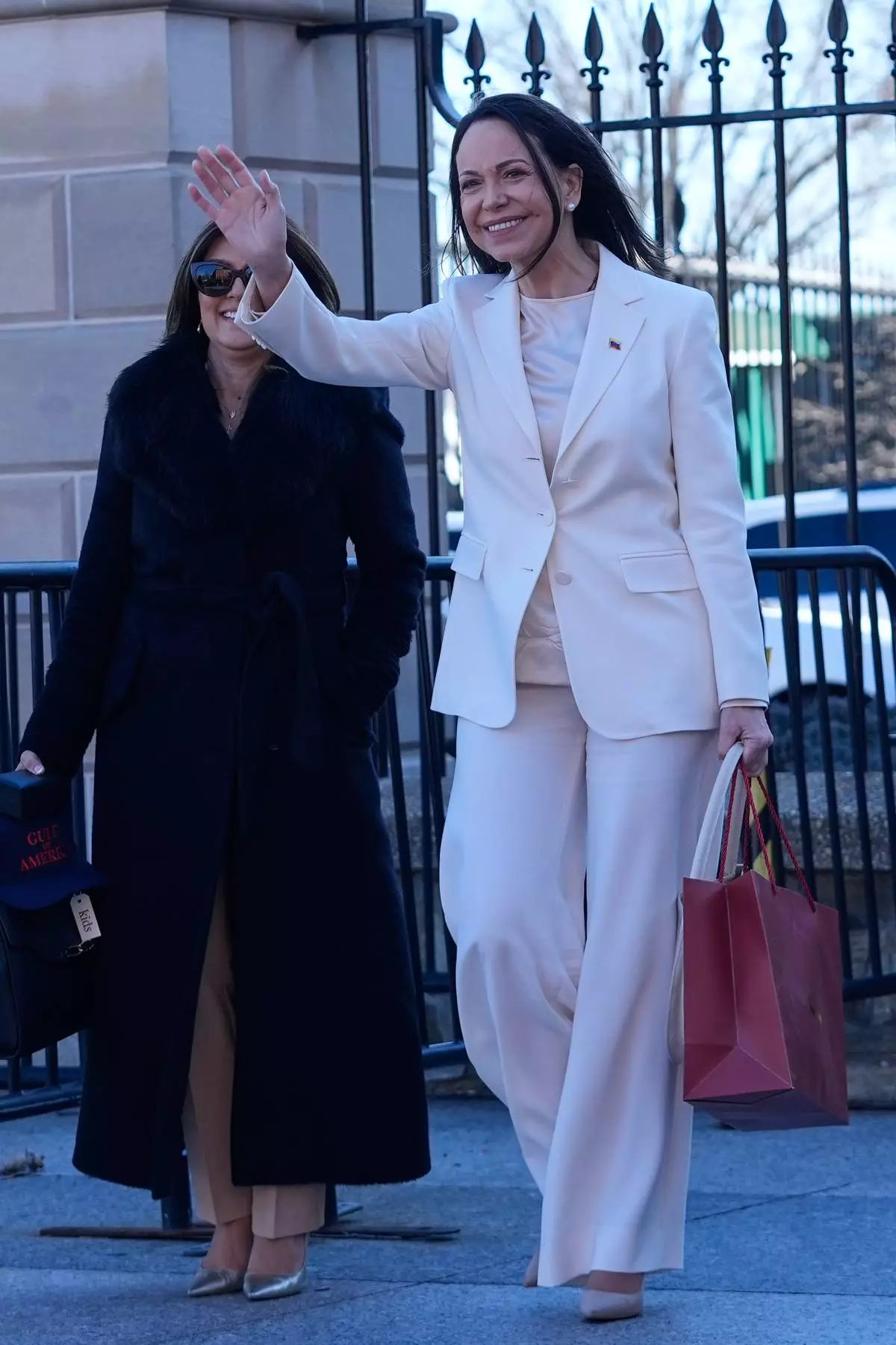
Venezuelan opposition leader María Corina Machado waves to supporters on Pennsylvania Avenue as she leaves the White House after meeting with President Donald Trump Thursday, Jan. 15, 2026, in Washington. (AP Photo/Pablo Martinez Monsivais)
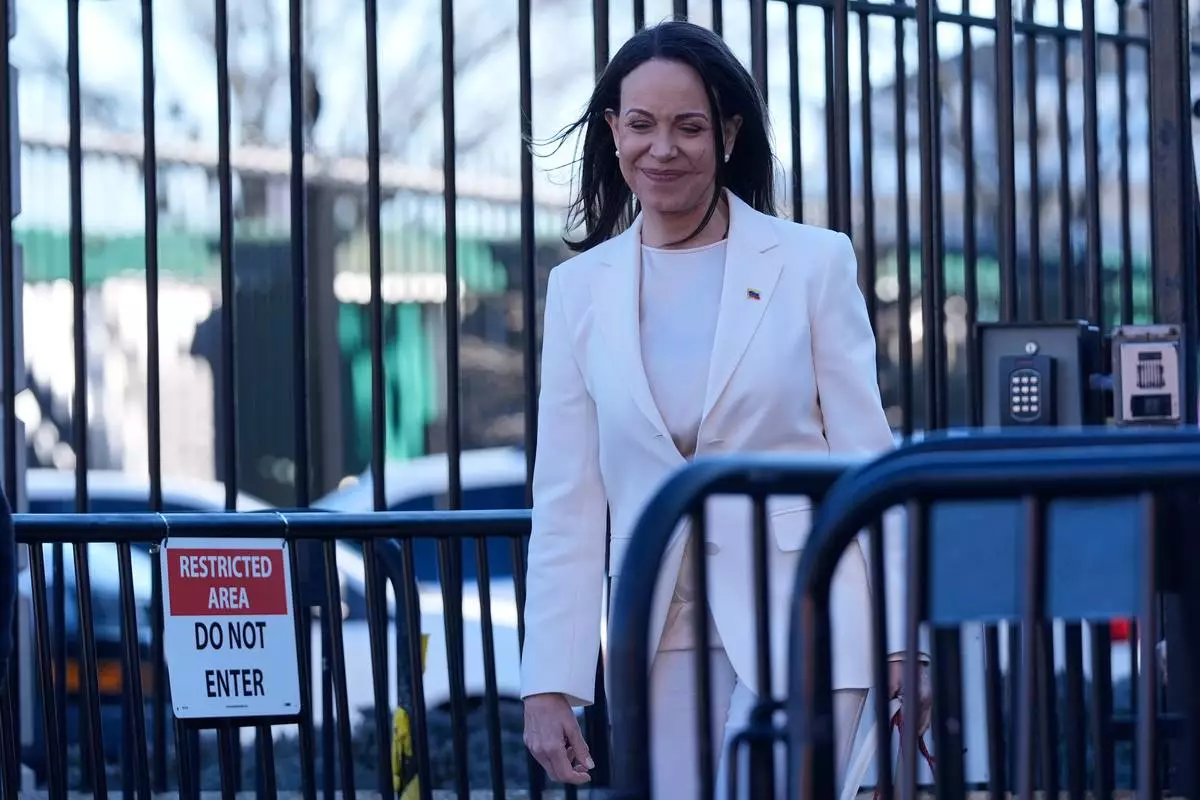
Venezuelan opposition leader María Corina Machado smiles on Pennsylvania Avenue as she leaves the White House after meeting with President Donald Trump Thursday, Jan. 15, 2026, in Washington. (AP Photo/Pablo Martinez Monsivais)
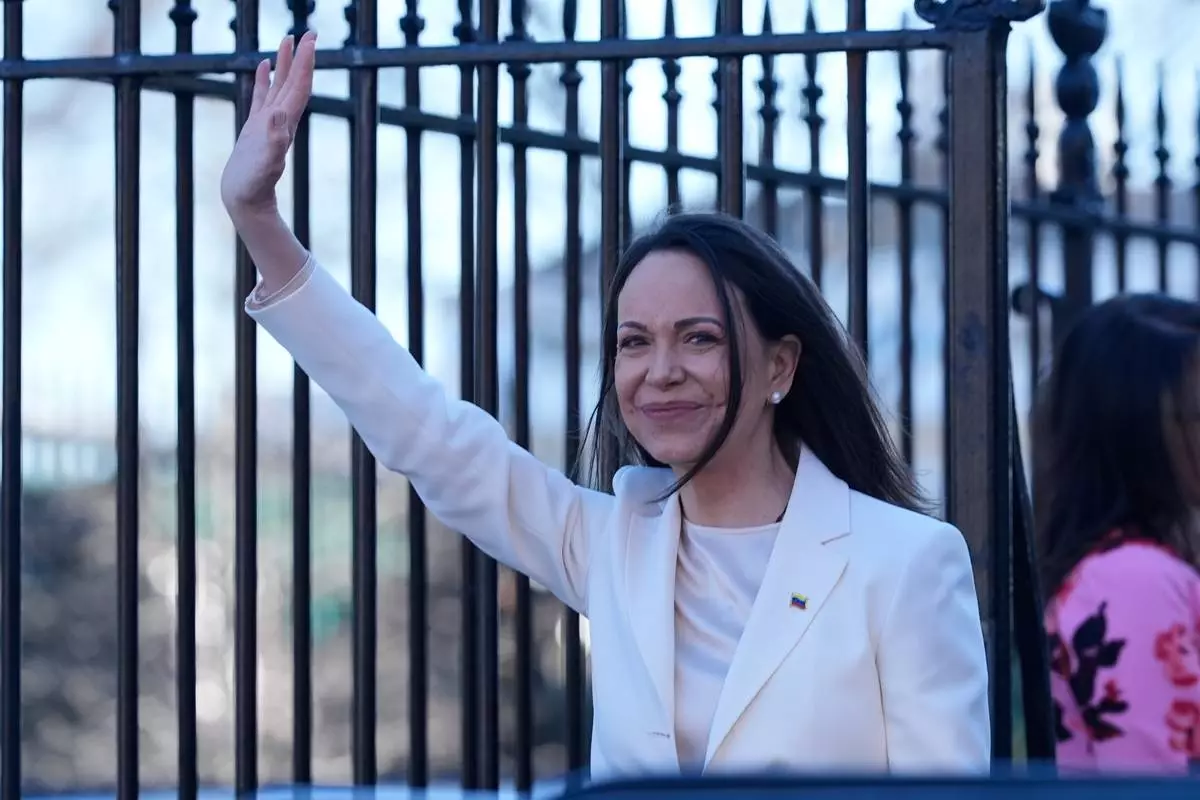
Venezuelan opposition leader María Corina Machado waves to supporters on Pennsylvania Avenue as she leaves the White House after meeting with President Donald Trump Thursday, Jan. 15, 2026, in Washington. (AP Photo/Pablo Martinez Monsivais)
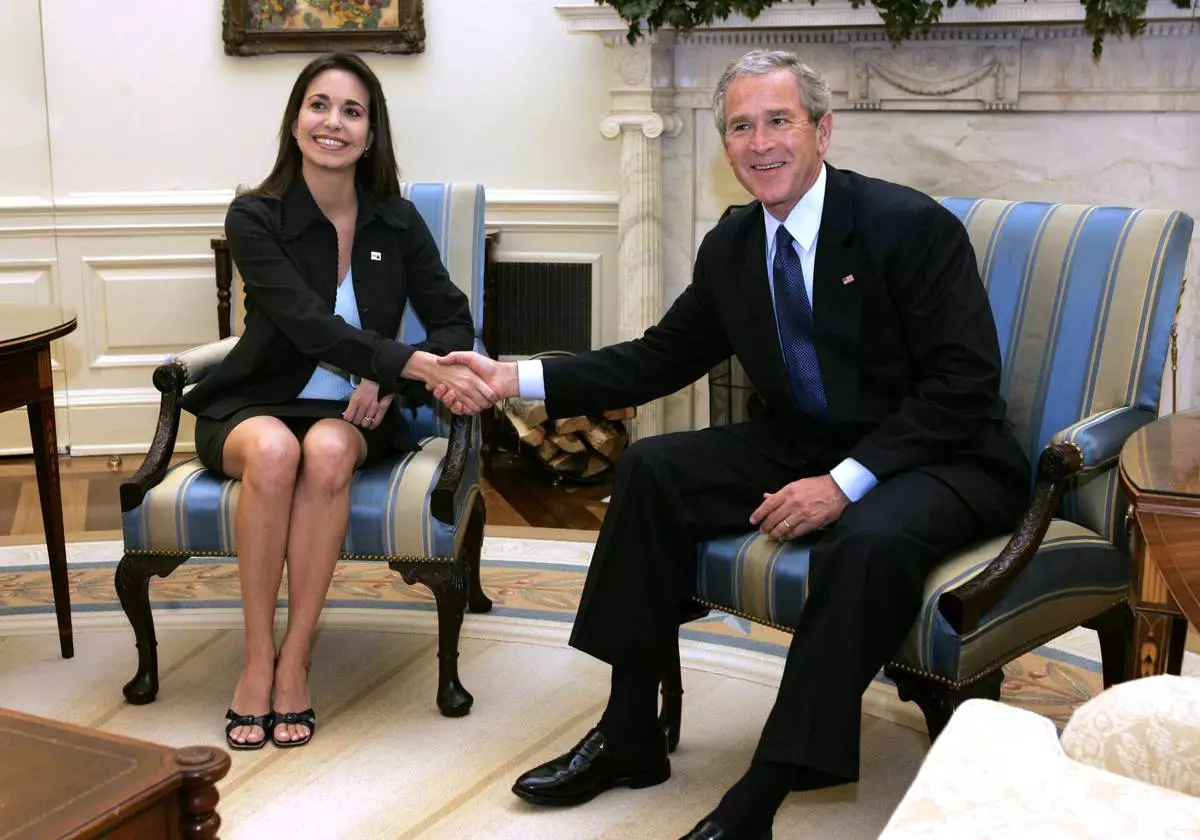
FILE - U.S. President George Bush, right, meets with Maria Corina Machado, executive director of Sumate, a non-governmental organization that defends Venezuelan citizens' political rights, in the Oval Office of the White House, Washington, May 31, 2005. (AP Photo/Charles Dharapak, File)
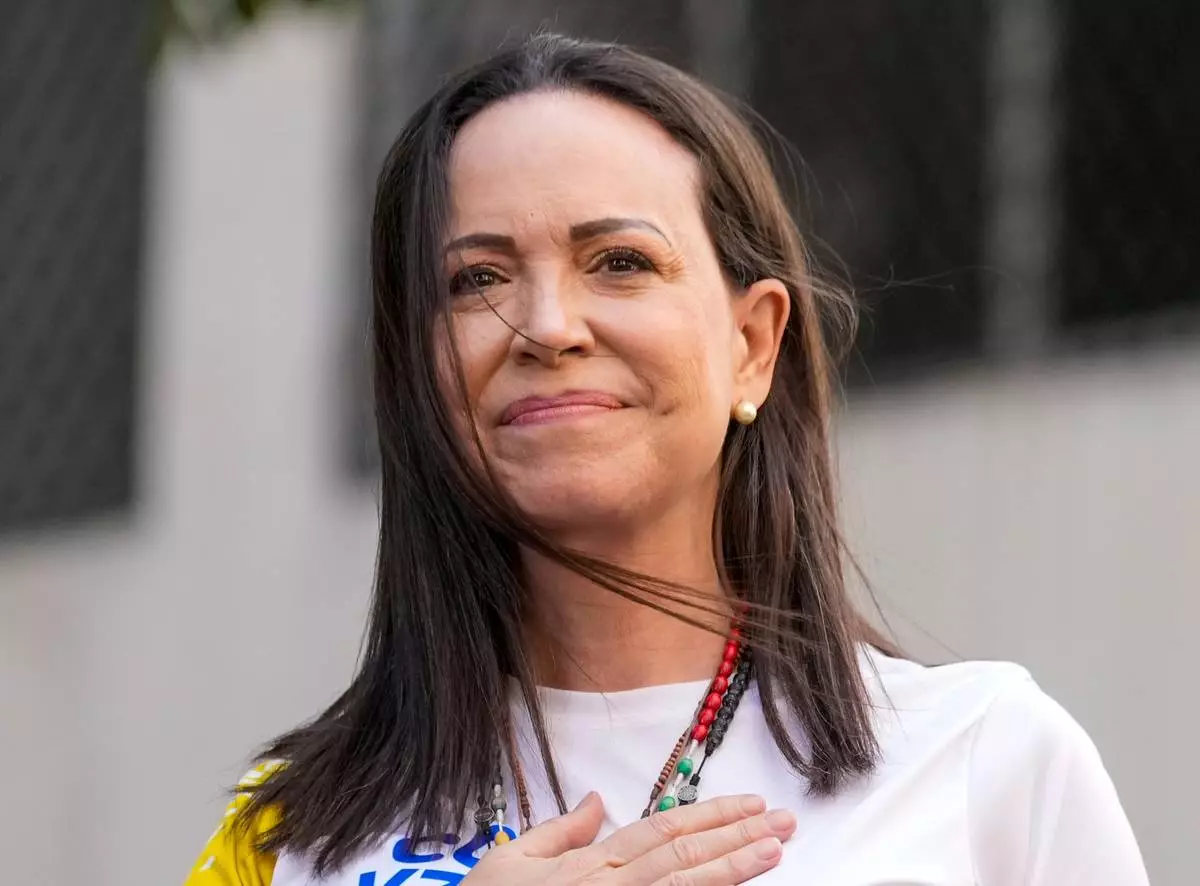
FILE - Opposition leader Maria Corina Machado gestures to supporters during a protest against President Nicolas Maduro the day before his inauguration for a third term, in Caracas, Venezuela, Thursday, Jan. 9, 2025. (AP Photo/Ariana Cubillos, file)