RALEIGH, N.C. (AP) — A North Carolina appeals court ruled Wednesday that a law stripping the governor's authority to appoint State Board of Elections members can take effect for now, even though trial judges struck it down as unconstitutional just last week.
Three judges on the intermediate-level Court of Appeals unanimously granted the request of Republican legislative leaders to suspend enforcement of that ruling. If left intact, the decision means provisions otherwise slated to take effect Thursday would shift the appointment duties from new Democratic Gov. Josh Stein to GOP State Auditor Dave Boliek, at least temporarily.
Barring a contrary ruling by the state Supreme Court, the decision means Boliek could imminently appoint the board's five members from slates of candidates provided by the state Democratic and Republican parties. Stein's lawyers asked the Supreme Court late Wednesday to halt temporarily the Court of Appeals decision.
For over a century, the governor has picked the five board members, three of whom are traditionally members of the governor’s party. Under the new law, the expectation is that Republicans would assume a majority on the board.
Wednesday's order provided neither an explanation for the decision nor the names of the three Court of Appeals judges who ruled — the court releases the names after 90 days. The court has 15 judges — 12 registered Republicans and three Democrats.
Stein and gubernatorial predecessor Roy Cooper sued over the law finalized by the GOP-dominated General Assembly in December, saying the appointment transfer in part unlawfully interfered with the governor's responsibility in the state constitution to take care that laws were “faithfully executed.”
Legislative leaders contend that the constitution allows the General Assembly to disperse executive branch powers to several other statewide elected officials, including the auditor.
Republicans have complained that a governor has too much control over elections, resulting in one-party decision-making and a lack of voter confidence. The board's duties include carrying out campaign finance laws, certifying election results and setting rules on a host of voting administration details.
But Democrats say the laws are a GOP power grab designed to give Republicans an unfair advantage in elections in the battleground state. The board’s importance has been apparent in the still-unresolved election for a state Supreme Court seat. It's unclear how a new board would affect pending litigation in the race between Democratic incumbent Allison Riggs and Republican challenger Jefferson Griffin, himself a Court of Appeals judge.
Stein mentioned that election in criticizing the Court of Appeals decision Wednesday, saying on the social platform X that the order “poses a threat to our democracy and the rule of law. The Supreme Court should not allow it to stand.”
In a 2-1 decision on April 23, a panel of trial judges hearing the lawsuit sided with Stein and permanently blocked the power transfer and other provisions, including one that would have directed Boliek to choose the chairs of election boards in all 100 counties.
The dissenting judge would have upheld the law, saying the General Assembly had the final, constitutional authority to assign new powers to the state auditor.
Attorneys for House Speaker Destin Hall, Senate leader Phil Berger and Boliek quickly asked the Court of Appeals to allow the challenged law to take effect as planned while the court hears further arguments over the trial judges' ruling.
The legislative leaders' lawyers wrote that the two judges making up the majority — one registered Republican and one Democrat — got their legal conclusions wrong.
Bergrer said in a statement Wednesday that the Court of Appeals “rightly affirmed what we all know: the Governor is not the sole elected executive officer in North Carolina’s government.”
But Stein’s attorneys said in a legal brief earlier Wednesday that the lawmakers’ demand to permit the law’s implementation failed to justify “overturning more than a century of historical precedent and practice, numerous binding Supreme Court decisions, and last week’s presumptively correct ruling.” Terms for the current five board members otherwise would have expired in 2027.
Boliek said earlier this week he was prepared to take on the appointments transfer.
Since late 2016, the Republican-dominated legislature has sought to erode or eliminate a governor’s authority to appoint the board that administers elections in the ninth-largest state.
Four previous laws targeting Cooper were blocked by courts. Voters in 2018 also rejected a constitutional amendment that would have forced the governor to pick members recommended by legislative leaders.
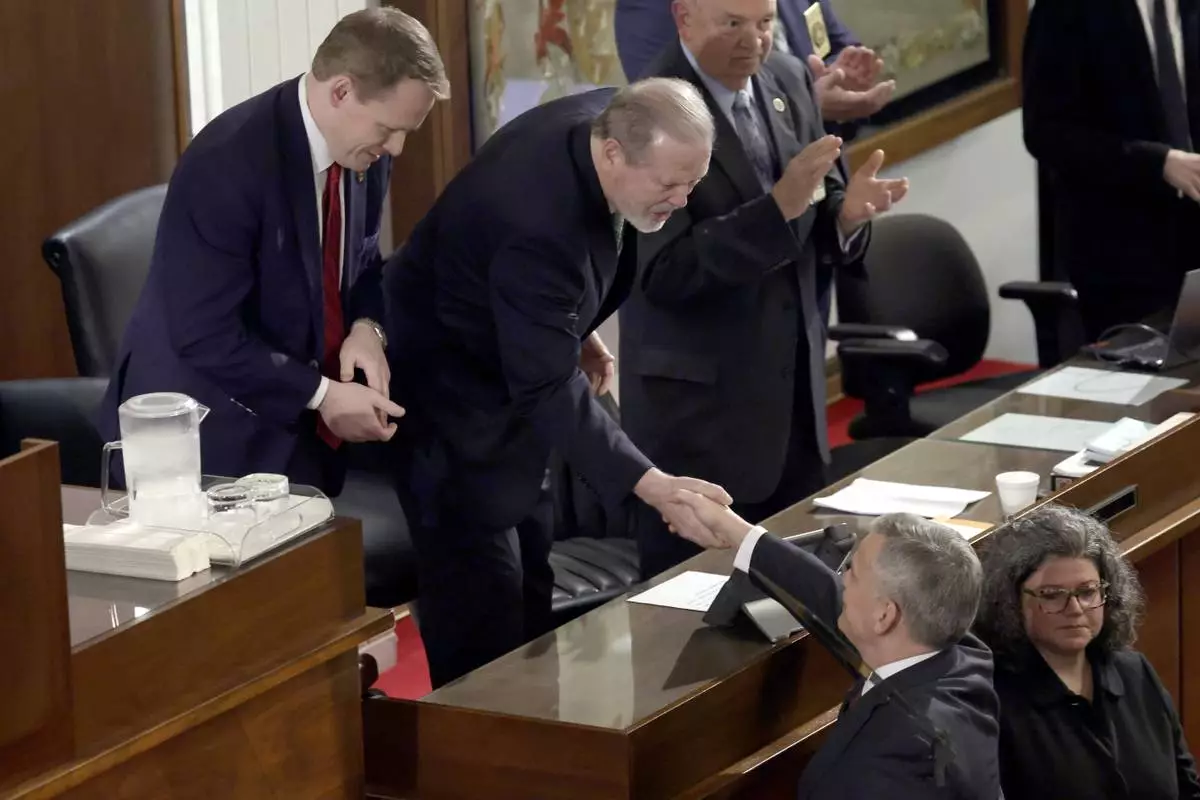
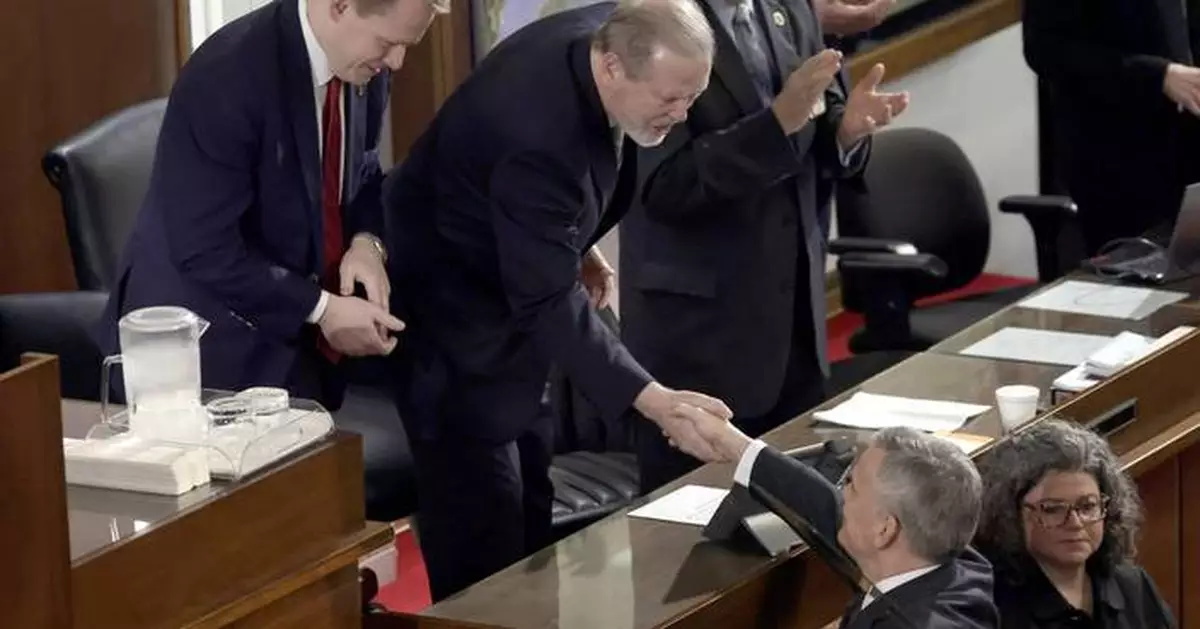
FILE - Speaker of the House Destin Hall, R-Caldwell, top left, and Senate leader Phil Berger, R-Rockingham, top center, greet North Carolina Gov. Josh Stein, bottom right, as he arrives to deliver the State of the State address at the Legislative Building, March 12, 2025, in Raleigh N.C. (AP Photo/Chris Seward, file)