Final Step to Achieving "Dream OLED"
SEOUL, South Korea, May 1, 2025 /PRNewswire/ -- LG Display, the world's leading innovator of display technologies, announced today that it has become the world's first company to successfully verify the commercialization-level performance of blue phosphorescent OLED panels on a mass production line. The achievement comes about eight months after the company partnered with UDC to develop blue phosphorescence, and is considered a significant step closer to realizing a "dream OLED" display.
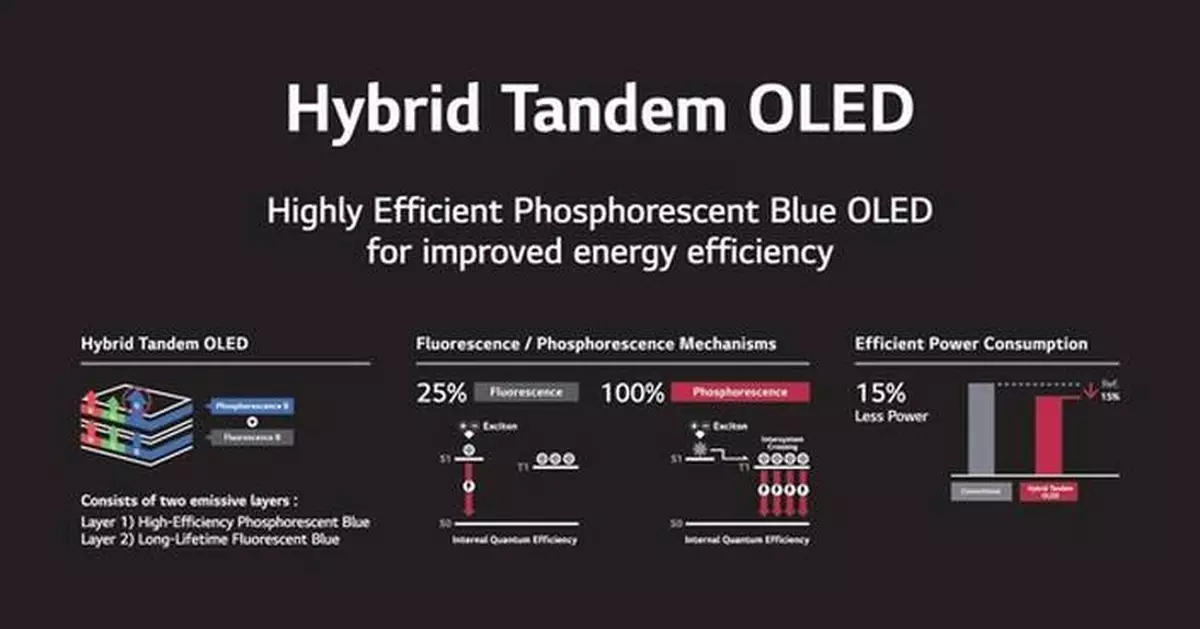
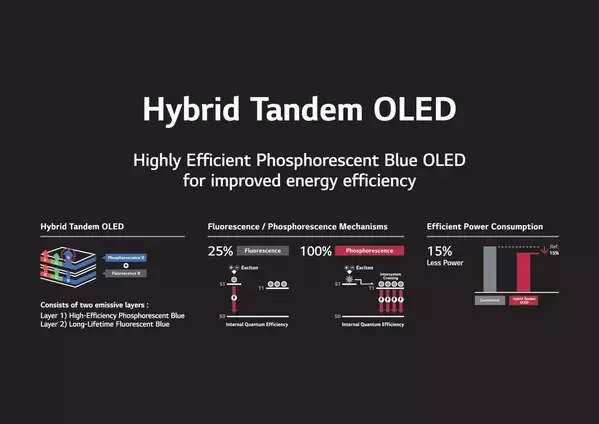
In the display industry, "dream OLED" refers to an OLED panel that achieves phosphorescence for all three primary colors of light (red, green, and blue). OLED panel light emission methods are broadly categorized into fluorescence and phosphorescence. Fluorescence is a simpler process in which materials emit light immediately upon receiving electrical energy, but its luminous efficiency is only 25%. In contrast, phosphorescence briefly stores received electrical energy before emitting light. Although it is technically more complex, this method offers luminous efficiency of 100% and uses a quarter as much power as fluorescence.
However, achieving blue phosphorescence has remained a major challenge even more than 20 years after the commercialization of red and green phosphorescence. This is due to blue, among the three primary colors, having the shortest wavelength and demanding the greatest energy.
LG Display has solved this issue by using a hybrid two-stack Tandem OLED structure, with blue fluorescence in the lower stack and blue phosphorescence in the upper stack. By combining the stability of fluorescence with the lower power consumption of phosphorescence, it consumes about 15% less power while maintaining a similar level of stability to existing OLED panels.
In particular, LG Display is the first to succeed in reaching the commercialization stage of blue phosphorescent OLED panels, where performance evaluation, optical characteristics, and processability on actual mass production lines should all be confirmed. The company has already completed commercialization verification with UDC.
LG Display has independently filed patents for its hybrid blue phosphorescent OLED technology in both South Korea and the United States.
The company will showcase a blue phosphorescent OLED panel featuring two-stack Tandem technology at SID Display Week 2025, the world's largest display event, in San Jose, California from May 11th (local time).
At the show, LG Display will be unveiling a blue phosphorescent OLED panel featuring two-stack Tandem technology applied to a small and medium-sized panel that can be applied to IT devices such as smartphones and tablets. As more and more products require high definition and high efficiency such as AI PCs and AR/VR devices, the application of blue phosphorescence technology is expected to expand rapidly.
"The successful commercialization of blue phosphorescence technology, which has been called the final piece of the 'dream OLED' puzzle, will become an innovative milestone towards the next generation of OLED," said Soo-young Yoon, CTO and Executive Vice President of LG Display. "We expect to secure a leading position in the future display market through blue phosphorescence technology."
About LG Display
LG Display Co., Ltd. [NYSE: LPL, KRX: 034220] is the world's leading innovator of display technologies, including thin-film transistor liquid crystal and OLED displays. The company manufactures display panels in a broad range of sizes and specifications primarily for use in TVs, notebook computers, desktop monitors, automobiles, and various other applications, including tablets and mobile devices. LG Display currently operates manufacturing facilities in Korea and China, and back-end assembly facilities in Korea, China, and Vietnam. The company has approximately 70,707 employees operating worldwide. For more news and information about LG Display, please visit www.lgdisplay.com.
Media Contact:
Joo Yeon Jennifer Ha, Manager, Communication Team
Email: hjy05@lgdisplay.com
** The press release content is from PR Newswire. Bastille Post is not involved in its creation. **
LG Display Becomes World's First to Verify Commercialization of Blue Phosphorescent OLED Panels
Truth Is Everything: 72% of People Say It's More Important than Ever to Prioritize Truth
Research from McCann and Economist Enterprise reveals global growth will be driven by brands' ability to eliminate doubt and connect with the world's fastest-growing audience with ideas that move at the speed and flow of culture
NEW YORK, June 12, 2026 /PRNewswire/ -- McCann today released The Truth About Global Brands, a study of 20,713 people across 20 markets, revealing a fundamental reset in how brands achieve growth and relevance, globally. This year's study draws on independent insights from an analysis of B2B decision-makers conducted by Economist Enterprise, the B2B arm of The Economist Group.
At a time when AI is reshaping decision-making, trust is fragmenting and cultural influence is shifting, the research finds that brands must help consumers navigate an increasingly complex "Truth Maze" by eradicating doubt to drive growth.
"Global brands are experiencing a growth crisis as we've shifted from a trust economy to a doubt economy, putting CMOs under more pressure than ever," said Tyler Turnbull, Global CEO, McCann. "The new playbook for the future of brand building will be grounded in a brand's ability to show up with clarity, credibility and cultural fluency at every decision point."
The "Truth Maze": a New Battleground for Brands' Bottom Line
In a world flooded with information, consumers and business leaders are navigating a "Truth Maze:" a complex web of conflicting information, AI-generated content, and competing claims that has made it harder than ever to determine what is real.
- While 72% of people say it's more important than ever to prioritize truth, 55% believe brands are less truthful than they were 20 years ago
- 76% worry they will soon be unable to distinguish between real people and artificial ones online
While AI adoption is expected -- 72% of consumers and 88% of B2B leaders say brands must use AI to keep up -- accountability is what will set brands apart.
- 53% of people say being transparent about AI use is the most effective way for brands to build trust, and 45% say brands should help them understand what's real and what isn't in AI-generated content
The commercial stakes are high, with the research revealing that trust is not a soft brand value, but a revenue driver.
"In a world where truth matters more than ever, certainty is the new value exchange," said Harjot Singh, Global Chief Strategy Officer, McCann.
- A vast majority of people (80%) say they will actively choose brands they trust, even if they cost more, signaling a growing premium on credibility
- 69% of consumers and 79% of B2B decision-makers have stopped using a brand because they no longer trusted it
"The data tells a compelling story: when business leaders lose faith in a brand, they walk away and they don't come back easily," said Tamara McMillen, Chief Revenue Officer at Economist Enterprise. "What this means for global brands is that the commercial cost of doubt is real and measurable. Brands that invest in being trustworthy guides to B2B decision-makers are the ones best positioned to grow."
"Multi-Modal Globality" Challenges Traditional Brand Building Playbook
In a world inundated with information, the research reveals a major shift in how culture and influence flow globally, as ideas move fluidly across markets, platforms and communities.
- Influence is increasingly multi-directional, not West-to-rest
- Markets like China, India and Saudi Arabia are shaping global norms
- 73% of people say you can be a global citizen without travelling
Culture no longer flows in a straight line from global to local. Instead, it circulates --emerging, evolving and scaling across interconnected networks. Legacy models of global brand building — top-down or bottom-up — are no longer sufficient.
The Next Growth Engine: 1 Billion Strong "Upward Class"
With culture and influence now moving multi-directionally, a new, highly influential and expanding audience is defining the new era of brand growth: the "Upward Class."
- 1.02 billion people globally
- $29.5 trillion in annual spending power
- Highly motivated by progress, self-improvement and upward mobility
Unlike previous generations, these consumers use brands not just to consume, but to signal progress, identity and belonging, reshaping the meaning of status itself.
Critically, the "Upward Class" shows lower brand cynicism and stronger belief in brands as tools for advancement, making them disproportionately influential in defining what growth looks like next.
"Future growth won't come from leaning on existing audiences or legacy markers of scale," continued Turnbull. "It will come from brands that turn truth into a genuine growth engine, building connected systems of meaning, culture and commerce. That's what McCann's Truth Well Told framework is designed to do."
The New Playbook for Global Brand Growth
Across all findings, one principle stands out: the brands that succeed in 2026 and beyond will not be those that say the most, but those that remove the most doubt and connect with segments shaping tomorrow's demand. This requires:
- Acting as a trusted guide in a complex information landscape
- Going back to the basics, delivering products and experiences that are relevant, useful and prove their value
- Identifying and engaging emerging, high-growth audiences that believe in brands
- Designing truth-based ideas that move with culture and scale across networks
Research Methodology
The Truth About Global Brands is based on a survey of 20,713 people across 20 markets [US, UK, Australia, Brazil, Canada, China, France, Germany, Italy, India, Japan, Mexico, Spain, UAE, Saudi Arabia, Philippines, Singapore, South Korea, Thailand, New Zealand], conducted between November 2025 and January 2026, combined with qualitative insights from senior marketing leaders and global CMOs.
*Trended data is reported on a like-for-like basis, with the following markets [US, UK, Brazil, China, France, Germany, India, Japan, Mexico] across 2018, 2023, 2026.
This year's report includes a B2B brand perspective based on independent insights from Economist Enterprise, the B2B division of The Economist Group that helps organizations understand global economic and geopolitical change, make informed strategic decisions and reach influential audiences. Their analysis surfaces the critical nuances that distinguish B2B audiences from the broader consumer sample – and what those nuances mean for brands competing for the trust and confidence of business buyers today.
About McCann
McCann, part of Omnicom (NYSE: OMC), is a leading creative solutions company. The award-winning global brand network is united across 100+ countries by a mission to build iconic brands through the radical creativity of Truth Well Told. Because when the truth is well told, it moves people and markets. Named one of the World's Most Innovative Companies by Fast Company in 2025 and 2024, and ranked in the top 3 most creatively effective networks globally in the Effie Index every year since 2019, McCann is the global brand creative partner of such iconic brands as L'Oreal Paris, Mastercard, Xbox, IKEA and Maggi.
For more information, visit www.mccann.com.
** This press release is distributed by PR Newswire through automated distribution system, for which the client assumes full responsibility. **
The Truth About Global Brands