NEW YORK (AP) — When the enigmatic street artist Banksy spray-painted a heart-shaped balloon covered with a Band-Aid on the wall of a Brooklyn warehouse, the nondescript brick building was instantly transformed into an art destination and the canvas of an unlikely graffiti battle.
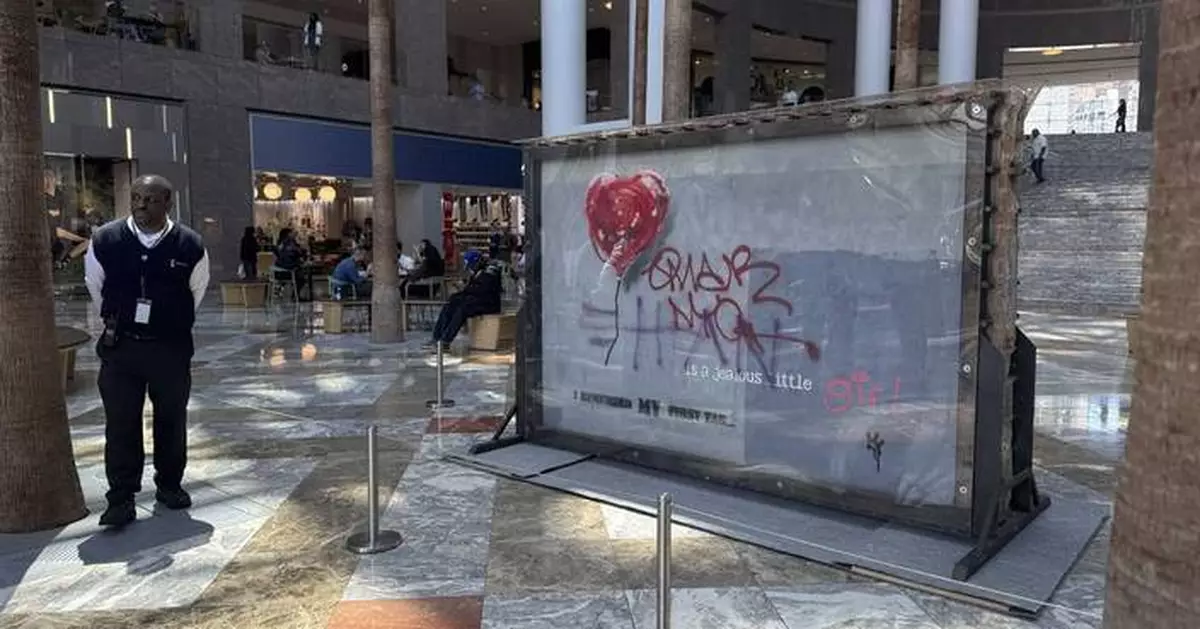
Almost as soon as Banksy revealed the piece back in 2013, an anonymous tagger brazenly walked up and spray painted the words “Omar NYC” in red beside the balloon, to the dismay of onlookers.
Days later, someone stenciled “is a little girl” in white and pink beside Omar’s tag, followed by a seemingly sarcastic phrase in black: “I remember MY first tag.” Some think it was Banksy himself who secretly returned to the scene to add the rejoinder.
The apparent graffiti battle didn’t end there. Another tagger also attempted to leave his mark but was stymied by security guards. Today the phrase “SHAN” is still visible in light purple paint.
Maria Georgiadis, whose family owned the now-demolished warehouse and ultimately removed the section of wall to preserve the artwork, says the graffiti pastiche is quintessentially New York.
“It looks like a war going on,” she said recently. “They’re literally going at it on the wall.”
The preserved wall, dubbed “Battle to Survive a Broken Heart,” will be going up for sale May 21 at Guernsey’s, the New York auction house.
Georgiadis, a Brooklyn schoolteacher, says the sale is bittersweet. Her father, Vassilios Georgiadis, ran his roofing and asbestos abatement company from the warehouse adorned with the balloon.
He died four years ago at age 67 from a heart attack, which is why some of the proceeds from the sale will be donated to the American Heart Association.
“It’s just very significant to us because he loved it and he was just so full of love,” Maria Georgiadis said on a recent visit to the art warehouse where the piece was stored for more than a decade. “It’s like the bandage heart. We all have love, but we’ve all went through things and we just put a little Band-Aid over and just keep on moving, right? That’s how I take it.”
The nearly 4-ton, 6-foot-tall (3.6-metric ton, 1.8-meter-tall) wall section is one of a number of guerrilla works the famously secretive British artist made during a New York residency in 2013.
At the time, Banksy heralded the work by posting on his website photos and an audio track recorded partly in a squeaky, helium-induced voice.
Guernsey auction house President Arlan Ettinger said it is impossible to know for certain because Banksy works clandestinely. But he said the neat stenciling and wording “strongly suggest that this was a gentle way for Banksy to put the other artist in his place.”
Ulrich Blanché, an art history lecturer at Heidelberg University in Germany, called the piece a “very well executed” stencil notable partly because of Banksy's decision to place it in Brooklyn’s port area of Red Hook.
“This part of NYC was not easy to reach at that time,” he said by email. “Banksy wanted people to go to places in NYC they never have seen and love them as well.”
But Blanche questioned whether the additional stenciled text was truly the work of Banksy, saying the word choice and design don’t appear to comport with the artist’s style at the time.
“To call a graffiti guy a ‘girl’ is not something Banksy would do in 2013. This is misogynic and immature in a sexist way,” he wrote. “Three different fonts that do not match and three colors — why should he do that? Too unnecessarily elaborated without reasons. So I think this was added by someone else.”
Blanché also said he is ambivalent about the pending sale, noting Banksy usually doesn't authorize his street pieces for sale. At the same time, he understands the burden placed on property owners to protect and maintain them.
“Banksy’s works should be preserved, but for the community they were made for,” he said. “They should not be turned into goods. They are made and thought for a specific location. Not portable. Not sellable.”
Spokespersons for Banksy declined to comment Friday.
Maria Georgiadis’ brother, Anastasios, said his father had also hoped to keep the piece in Red Hook after having cut it out of the wall and framed in thick steel for safekeeping.
The elder Georgiadis, he said, envisioned the work as the centerpiece of a retail and housing development on the property, a dream he didn't realize. The property has since been sold off by the family.
Ettinger said it is difficult to say what the piece might fetch. There is little precedent for a sale of a Banksy piece of this size, he said.
In 2018, a canvas that was part of Banksy's “Girl With Balloon” series sold in London for 1.04 million pounds ($1.4 million), only to famously self-destruct in front of a stunned auction crowd.
Maria Georgiadis said she hopes whoever buys the “Broken Heart” finds the same beauty and meaning her father drew from the piece.
When Banksy painted it, the family business had been recovering from destructive floods caused by Hurricane Sandy the prior year. Georgiadis recalls her father had no idea who Banksy was but was moved by the simple image.
“My dad had it in his head that Banksy knew what we went through,” she said. “He goes, ‘Can you believe it Maria? It’s a heart.’ ”
Follow Philip Marcelo at twitter.com/philmarcelo.
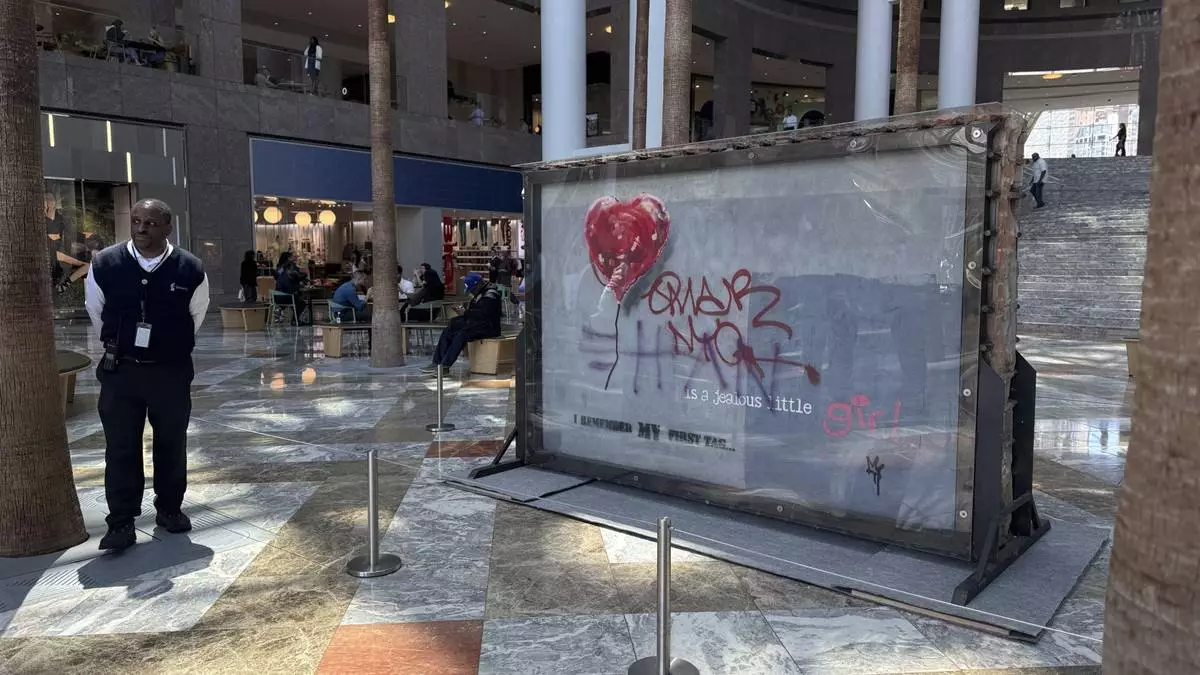
A slab of wall art, The "Battle to Survive a Broken Heart,' created by the artist Banksy, sits on display inside the Brookfield Place atrium, Tuesday, April 29, 2025, in New York. The nearly four-ton piece will be auctioned off on May 21. (AP Photo/Julie Jacobson)
DUBAI, United Arab Emirates (AP) — U.S. President Donald Trump said Iran wants to negotiate with Washington after his threat to strike the Islamic Republic over its bloody crackdown on protesters, a move coming as activists said Monday the death toll in the nationwide demonstrations rose to at least 544.
Iran had no immediate reaction to the news, which came after the foreign minister of Oman — long an interlocutor between Washington and Tehran — traveled to Iran this weekend. It also remains unclear just what Iran could promise, particularly as Trump has set strict demands over its nuclear program and its ballistic missile arsenal, which Tehran insists is crucial for its national defense.
Meanwhile Monday, Iran called for pro-government demonstrators to head to the streets in support of the theocracy, a show of force after days of protests directly challenging the rule of 86-year-old Supreme Leader Ayatollah Ali Khamenei. Iranian state television aired chants from the crowd, who shouted “Death to America!” and “Death to Israel!”
Trump and his national security team have been weighing a range of potential responses against Iran including cyberattacks and direct strikes by the U.S. or Israel, according to two people familiar with internal White House discussions who were not authorized to comment publicly and spoke on condition of anonymity.
“The military is looking at it, and we’re looking at some very strong options,” Trump told reporters on Air Force One on Sunday night. Asked about Iran’s threats of retaliation, he said: “If they do that, we will hit them at levels that they’ve never been hit before.”
Trump said that his administration was in talks to set up a meeting with Tehran, but cautioned that he may have to act first as reports of the death toll in Iran mount and the government continues to arrest protesters.
“I think they’re tired of being beat up by the United States,” Trump said. “Iran wants to negotiate.”
He added: “The meeting is being set up, but we may have to act because of what’s happening before the meeting. But a meeting is being set up. Iran called, they want to negotiate.”
Iran through country's parliamentary speaker warned Sunday that the U.S. military and Israel would be “legitimate targets” if America uses force to protect demonstrators.
More than 10,600 people also have been detained over the two weeks of protests, said the U.S.-based Human Rights Activists News Agency, which has been accurate in previous unrest in recent years and gave the death toll. It relies on supporters in Iran crosschecking information. It said 496 of the dead were protesters and 48 were with security forces.
With the internet down in Iran and phone lines cut off, gauging the demonstrations from abroad has grown more difficult. The Associated Press has been unable to independently assess the toll. Iran’s government has not offered overall casualty figures.
Those abroad fear the information blackout is emboldening hard-liners within Iran’s security services to launch a bloody crackdown. Protesters flooded the streets in the country’s capital and its second-largest city on Saturday night into Sunday morning. Online videos purported to show more demonstrations Sunday night into Monday, with a Tehran official acknowledging them in state media.
In Tehran, a witness told the AP that the streets of the capital empty at the sunset call to prayers each night. By the Isha, or nighttime prayer, the streets are deserted.
Part of that stems from the fear of getting caught in the crackdown. Police sent the public a text message that warned: “Given the presence of terrorist groups and armed individuals in some gatherings last night and their plans to cause death, and the firm decision to not tolerate any appeasement and to deal decisively with the rioters, families are strongly advised to take care of their youth and teenagers.”
Another text, which claimed to come from the intelligence arm of the paramilitary Revolutionary Guard, also directly warned people not to take part in demonstrations.
“Dear parents, in view of the enemy’s plan to increase the level of naked violence and the decision to kill people, ... refrain from being on the streets and gathering in places involved in violence, and inform your children about the consequences of cooperating with terrorist mercenaries, which is an example of treason against the country,” the text warned.
The witness spoke to the AP on condition of anonymity due to the ongoing crackdown.
The demonstrations began Dec. 28 over the collapse of the Iranian rial currency, which trades at over 1.4 million to $1, as the country’s economy is squeezed by international sanctions in part levied over its nuclear program. The protests intensified and grew into calls directly challenging Iran’s theocracy.
Nikhinson reported from aboard Air Force One.
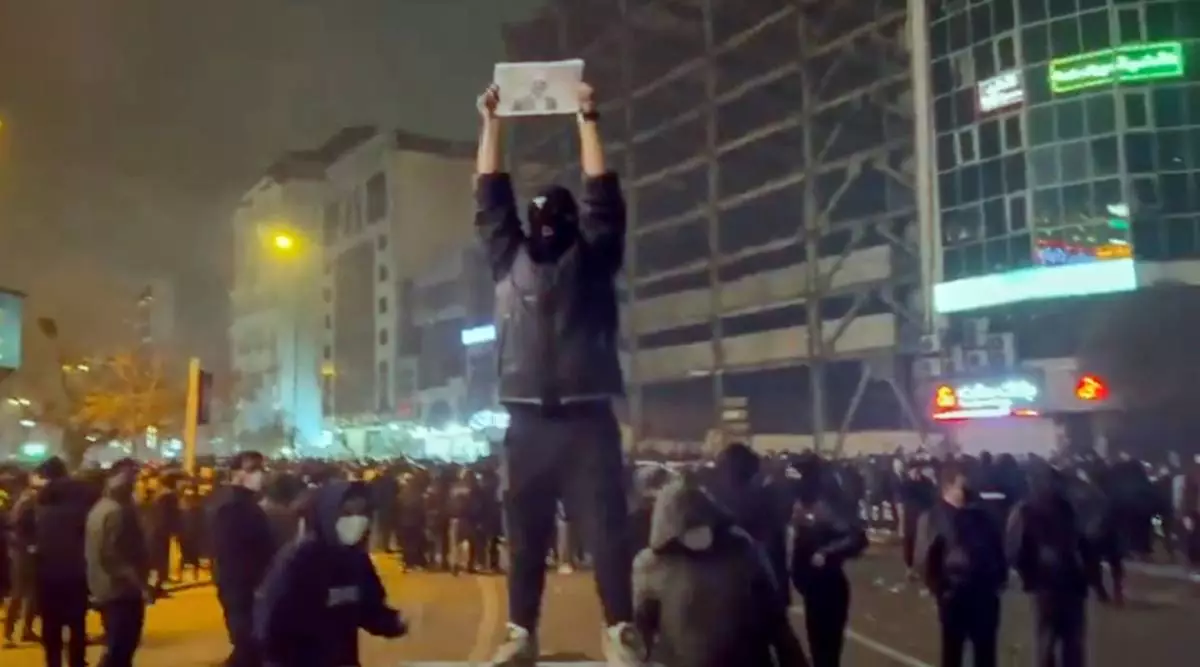
In this frame grab from video obtained by the AP outside Iran, a masked demonstrator holds a picture of Iran's Crown Prince Reza Pahlavi during a protest in Tehran, Iran, Friday, January. 9, 2026. (UGC via AP)
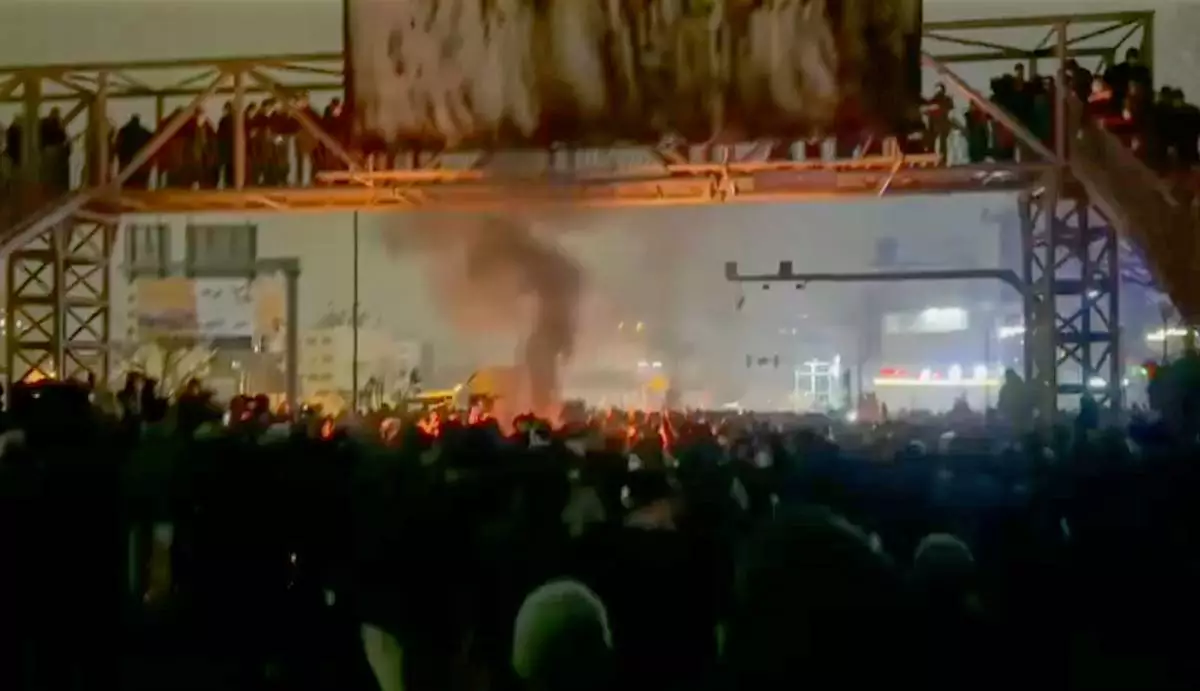
In this frame grab from footage circulating on social media from Iran shows protesters taking to the streets despite an intensifying crackdown as the Islamic Republic remains cut off from the rest of the world in Tehran, Iran, Friday, Jan. 9, 2026.(UGC via AP)
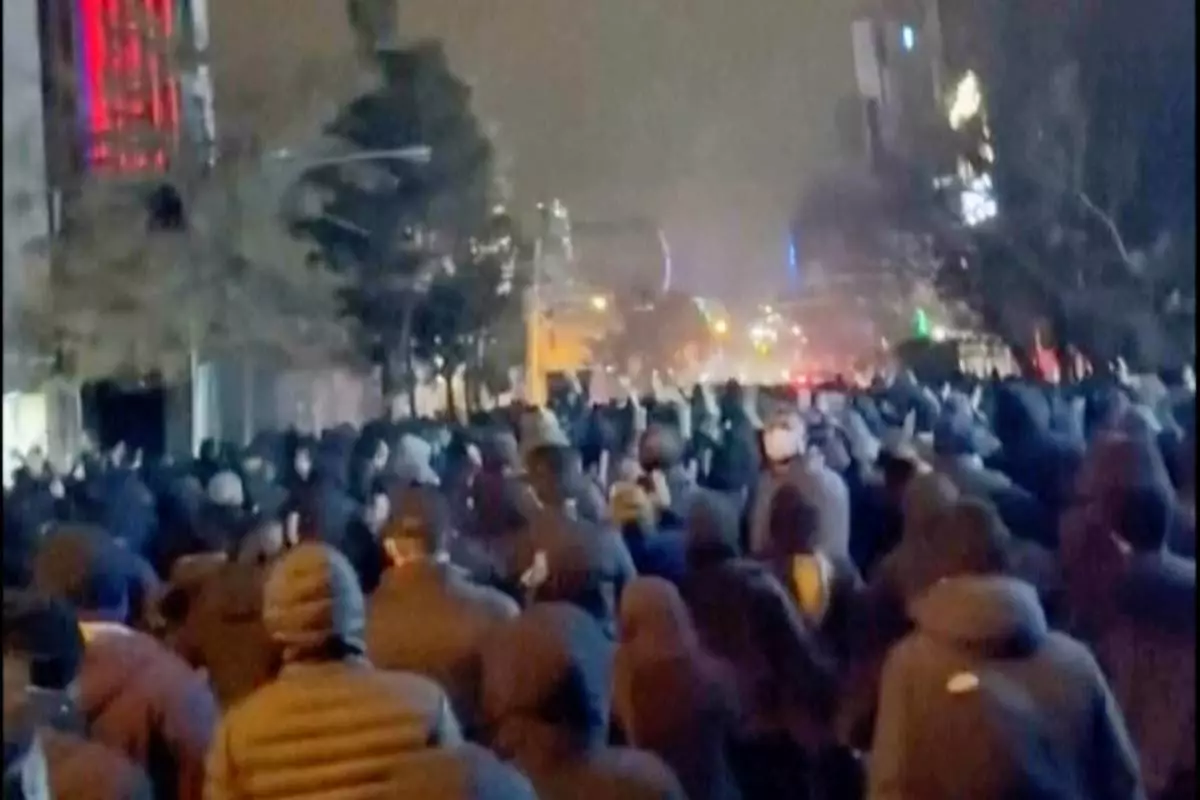
In this frame grab from footage circulating on social media from Iran showed protesters once again taking to the streets of Tehran despite an intensifying crackdown as the Islamic Republic remains cut off from the rest of the world in Tehran, Iran, Saturday Jan. 10, 2026. (UGC via AP)