Multiple leading U.S. corporations delivered disappointing figures in their quarterly financial reports Thursday as uncertainty about President Donald Trump's erratic tariffs and cautious consumer spending clouded their outlook.
Apple estimated that 900 million U.S. dollars could be added to its costs in the quarter ending in June if rates do not change. The Cupertino-based tech giant's shares fell 3.8-percent following the release of its quarterly results.
Amazon issued weaker-than-expected guidance for the second quarter. Analysts at Goldman Sachs warn that levies could reduce Amazon's operating profits by 5 to 10 billion U.S. dollars this year. The Seattle-based e-commerce giant engaged in forward buying of inventory before additional tariffs on Chinese imports were imposed, as roughly 25-percent of its sold items are imported from China.
McDonald's reported its steepest decline in the U.S. sales since the COVID pandemic, with same-store sales dropping 3.6 percent year on year in the first quarter. Analysts note a 10-percent decline in fast food visits by low- and middle-income diners during the quarter, signaling broader economic concerns.

Leading US companies report disappointing quarterly financial figures

Leading US companies report disappointing quarterly financial figures
Russian helicopter manufacturers are looking to take their partnerships with Chinese firms to new heights at the 10th China-Russia Expo, which opened in Harbin of northeast China's Heilongjiang Province on Sunday.
The expo highlights future industries including intelligent equipment, digital security, green building materials, new energy storage and other key fields.
As the largest comprehensive exchange platform between the two countries, Russia's leading helicopter makers are seeing fresh opportunities to team up with Chinese machinery firms, seeking reciprocal partnerships that draw on the strengths of both sides.
Sergei Suchilin, Head of Life Cycle Support at Russian Helicopters, part of the state-owned high-tech conglomerate Rostec, joined the event to present their best products.
"The first one is [Mil] Mi-17, the most common, the most popular model all over the world. It has a lot of different modification and can be used in very many variants of exploitation. First of all, it's for transportation for personnel and cargoes, also it can be used on search and rescue operations," said Suchilin.
Beyond showcasing, Suchilin was particularly keen to connect with Chinese exhibitors and explore potential cooperation, hoping to tap into their manufacturing edge.
"Machines and equipment, I think, it is more interesting -- like a big producing plant for us, and China is famous for its machine and equipment. This field of economics is developing very well nowadays in China," said the Russian exhibitor.
Dozens of meters away from their booth, a variety of aero-engine models for passenger planes, cargo drones and helicopters were on display in the Chinese exhibition zone, covering a comprehensive industrial chain, which is especially appealing for Suchilin.
"It's our first visit and it is really interesting for us, because there are a lot of new developing industries in China and it is very interesting to have a look, and maybe we may have some cooperation in the future, to know the projects of local producers," he said.
The enthusiasm for collaboration is mutual. Zhang Yuliang of Xinghuo Machine Tool in Hebei Province expressed strong confidence in the Russian market, thanks to the high reliability and cost performance of his products.
"We have full confidence in the Russian market. Since 2022, the share of our products exported to Russia has risen from 10 percent to 50 percent. Chinese products boast high-cost performance and stable output. We will keep expanding production capacity to meet the needs of Russian clients," he said.
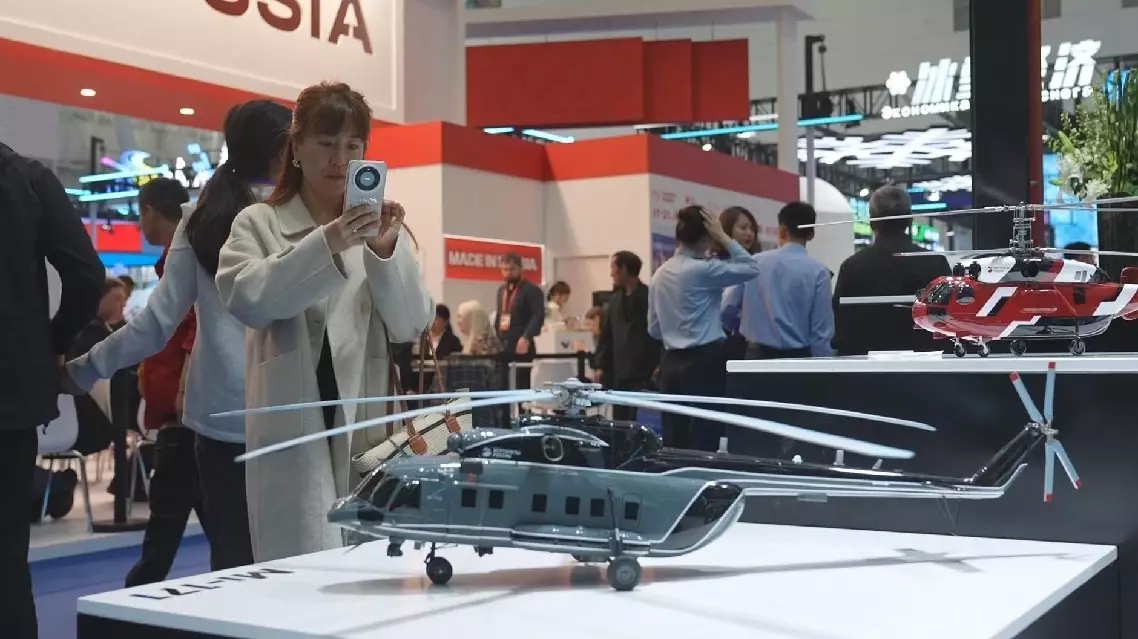
Russian helicopter makers eye collaboration with Chinese firms at China-Russia Expo