NEW YORK (AP) — More U.S. children have died this flu season than at any time since the swine flu pandemic 15 years ago, according to a federal report released Friday.
The 216 pediatric deaths reported by the Centers for Disease Control and Prevention eclipse the 207 reported last year. It's the most since the 2009-2010 H1N1 global flu pandemic.
It's a startlingly high number, given that the flu season is still going on. The final pediatric death tally for the 2023-2024 flu season wasn't counted until autumn.
“This number that we have now is almost certainly an undercount, and one that — when the season is declared over, and they compile all the data — it's almost certain to go up,” said Dr. Sean O’Leary, of the American Academy of Pediatrics.
There are likely several contributors to this season's severity, but a big one is that fewer children are getting flu shots, added O'Leary, a University of Colorado pediatric infectious diseases specialist.
The flu vaccination rate for U.S. children has plummeted from about 64% five years ago to 49% this season.
Flu vaccinations may not prevent people from coming down with symptoms, but research shows they are highly effective at preventing hospitalizations and deaths, O'Leary said.
The season has not only been hard on children. CDC officials have described it as “ highly severe,” and estimate that so far there have been at least 47 million illnesses, 610,000 hospitalizations and 26,000 deaths this season.
CDC officials have information about underlying conditions on nearly 5,200 adults who were hospitalized with flu this season, and 95% had at least one existing health problem. But among 2,000 hospitalized children with more detailed health information, only about 53% had an underlying condition — including asthma and obesity.
The CDC report did not say how many of the children who died were vaccinated. The agency did not make an expert available to talk about the flu season.
The good news is that flu indicators have been waning since February, and last week all 50 states were reporting low or minimal flu activity.
The season has seen more of a mix of flu strain circulating than in many other years, with two different Type A strains — H1N1 and H3N2 — causing a lot of infections. But CDC data released earlier this year suggested flu shots were doing a pretty good job at preventing deaths and hospitalizations.
The CDC continues to recommend that everyone ages 6 months and older get an annual flu vaccine.
Childhood vaccinations in general have been declining, driven by online misinformation and the political schism that emerged around COVID-19 vaccines. Robert F. Kennedy Jr. has also echoed some of the rhetoric of antivaccine activists since taking over as the nation's health secretary.
But there may be other reasons fewer children got flu shots this year, O'Leary said.
Many pediatricians offices are understaffed and are not holding as many after-hours vaccination clinics as in the past. Also, more Americans are getting their vaccinations at pharmacies, but some drugstores don’t vaccinate children, he said.
”My hope is that this season will be a bit of wake up call for folks that we actually do need to vaccinate our kids against influenza,” O’Leary said.
The Associated Press Health and Science Department receives support from the Howard Hughes Medical Institute’s Science and Educational Media Group and the Robert Wood Johnson Foundation. The AP is solely responsible for all content.
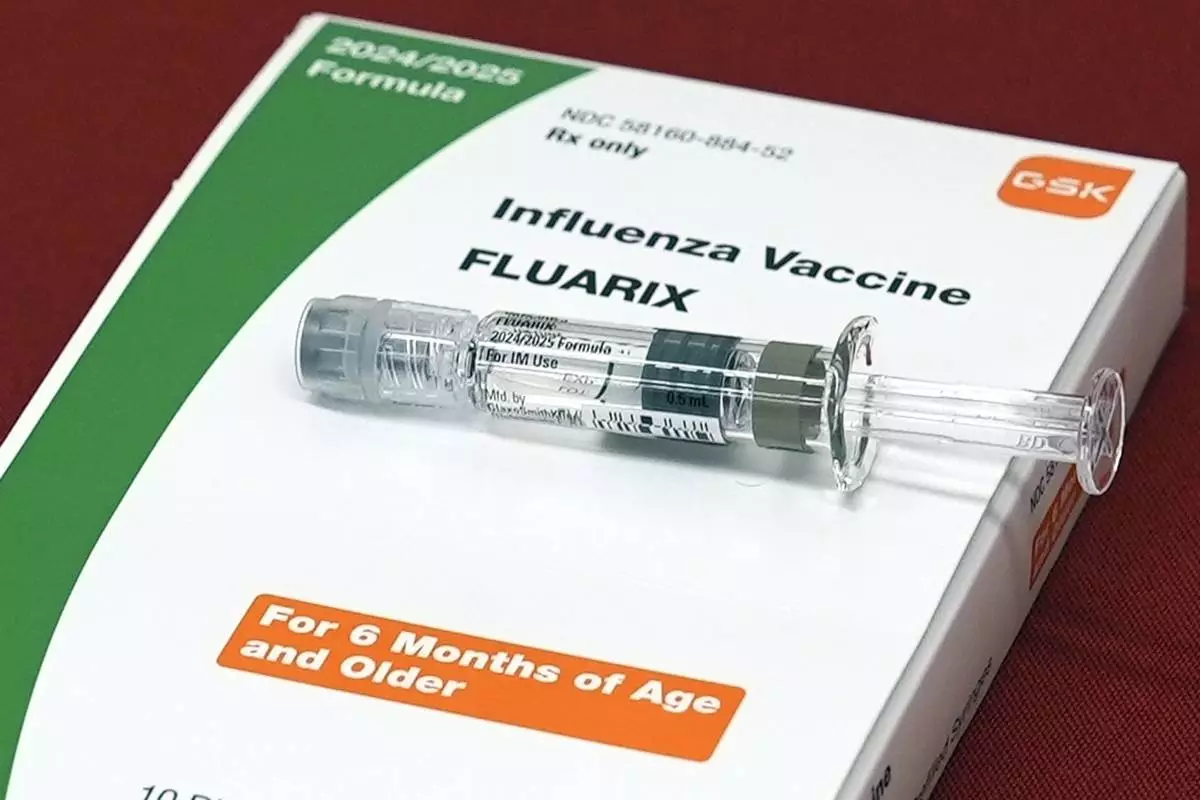
FILE - A flu vaccine is displayed at a pharmacy in New York, on Tuesday, Sept. 24, 2024. (AP Photo/Mary Conlon, File)
YANGON, Myanmar (AP) — Myanmar began a second round of voting Sunday in its first general election since the military takeover five years ago.
Voting expanded to additional townships including some areas affected by the civil war between the military government and its armed opponents.
Critics say the polls organized by the military government are neither free nor fair and are an effort by the military to legitimize its rule after seizing power from the elected government of Aung San Suu Kyi in February 2021.
Tom Andrews, a special rapporteur working with the U.N. human rights office, urged the international community Thursday to reject what he called a “sham election,” saying the first round exposed coercion, violence and political exclusion.
“You cannot have a free, fair or credible election when thousands of political prisoners are behind bars, credible opposition parties have been dissolved, journalists are muzzled, and fundamental freedoms are crushed,” Andrews said.
According to the Assistance Association for Political Prisoners, which keeps detailed tallies of arrests and casualties linked to the conflict, more than 22,000 people are detained for political offenses, and more than 7,600 civilians have been killed by security forces since 2021.
The army’s takeover triggered widespread peaceful protests that soon erupted into armed resistance, and the country slipped into a civil war.
A new Election Protection Law imposes harsh penalties and restrictions for virtually all public criticism of the polls. The authorities have charged more than 330 people under new electoral law for leafleting or online activity over the past few months.
Opposition organizations and ethnic armed groups had previously vowed to disrupt the electoral process.
On Sunday, attacks targeting polling stations and government buildings were reported in at least four of the 100 townships holding polls, with two administrative officials killed, independent online media, including Myanmar Now, reported.
Polling stations opened at 6 a.m. in 100 townships across the country, including parts of Sagaing, Magway, Mandalay, Bago and Tanintharyi regions, as well as Mon, Shan, Kachin, Kayah and Kayin states. Many of those areas have recently seen clashes or remain under heightened security, underscoring the risks surrounding the vote.
The election is being held in three phases due to armed conflicts. The first round took place Dec. 28 in 102 of the country’s total 330 townships. A final round is scheduled for Jan. 25, though 65 townships will not take part because of fighting.
Myanmar has a two-house national legislature, totaling 664 seats. The party with a combined parliamentary majority can select the new president, who can name a Cabinet and form a new government. The military automatically receives 25% of seats in each house under the constitution.
Maj. Gen. Zaw Min Tun, the military government's spokesperson, told journalists on Sunday that the two houses of parliament will be convened in March, and the new government will take up its duties in April.
On Sunday, people in Yangon and Mandalay, the two largest cities, cast their ballots in high schools, government buildings and religious buildings.
At more than 10 polling stations visited by Associated Press journalists, voter numbers ranged from about 150 at the busiest site to just a few at others, appearing lower than during the 2020 election when long lines were common.
The military government said there were more than 24 million eligible voters, about 35% fewer than in 2020. The government called the turnout a success, claiming ballots were cast by more than 6 million people, about 52% of the more than 11 million eligible voters in the election's first phase.
Myo Aung, a chief minister of the Mandalay region, said more people turned out Sunday than in the first phase.
Maung Maung Naing, who voted in Mandalay’s Mahar Aung Myay township, said he wanted a government that will benefit the people.
“I only like a government that can make everything better for livelihoods and social welfare,” he said.
Sandar Min, an independent candidate from Yangon’s Latha township, said she decided to contest the election despite criticism because she wants to work with the government for the good of the country. She hopes the vote will bring change that reduces suffering.
“We want the country to be nonviolent. We do not accept violence as part of the change of the country,” Sandar Min said after casting a vote. “We care deeply about the people of this country.”
While more than 4,800 candidates from 57 parties are competing for seats in national and regional legislatures, only six parties are competing nationwide.
The first phase left the military-backed Union Solidarity and Development Party, or USDP, in a dominant position, winning nearly 90% of the contested seats in the first phase in the lower house. It also won a majority of seats in regional legislatures.
Suu Kyi, Myanmar’s 80-year-old former leader, and her party aren’t participating in the polls. She is serving a 27-year prison term on charges widely viewed as spurious and politically motivated. Her party, the National League for Democracy, was dissolved in 2023, after refusing to register under new military rules.
Other parties also refused to register or declined to run under conditions they deem unfair, while opposition groups have called for a voter boycott.
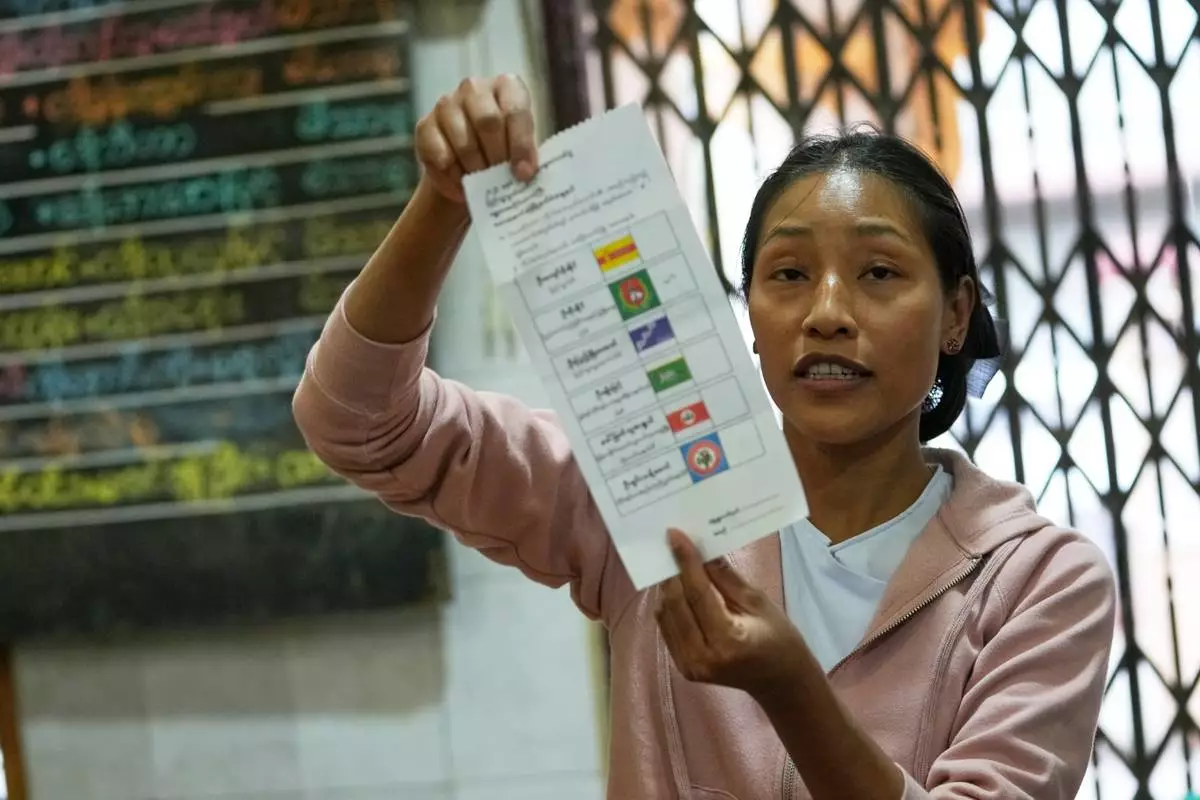
An official of the Union Election Commission counts ballots at a polling station during the second phase of general election in Mandalay, central Myanmar, Sunday, Jan. 11, 2026. (AP Photo/Aung Shine Oo)
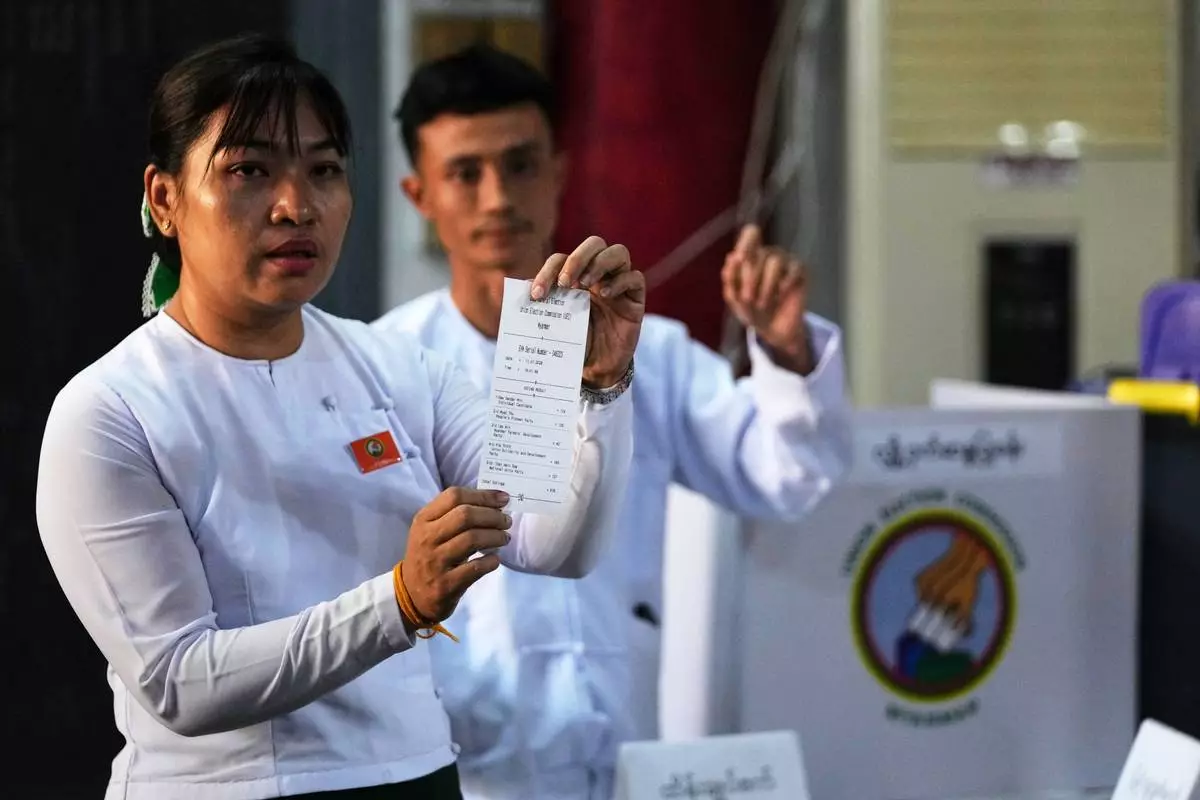
An official of the Union Election Commission shows a slip as they count ballots at a polling station during the second phase of general election in Yangon, Myanmar, Sunday, Jan. 11, 2026. (AP Photo/Thein Zaw)
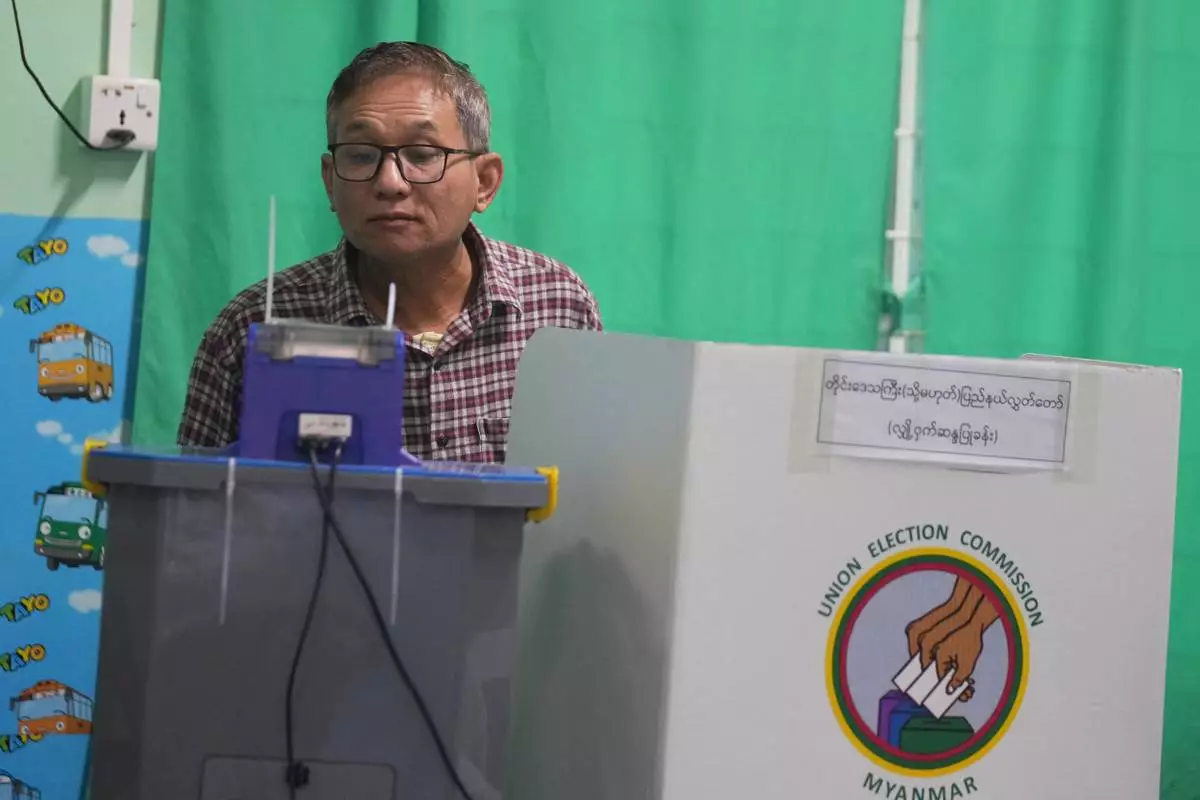
A voter casts ballot at a polling station during the second phase of general election Sunday, Jan. 11, 2026, in Yangon, Myanmar. (AP Photo/Thein Zaw)
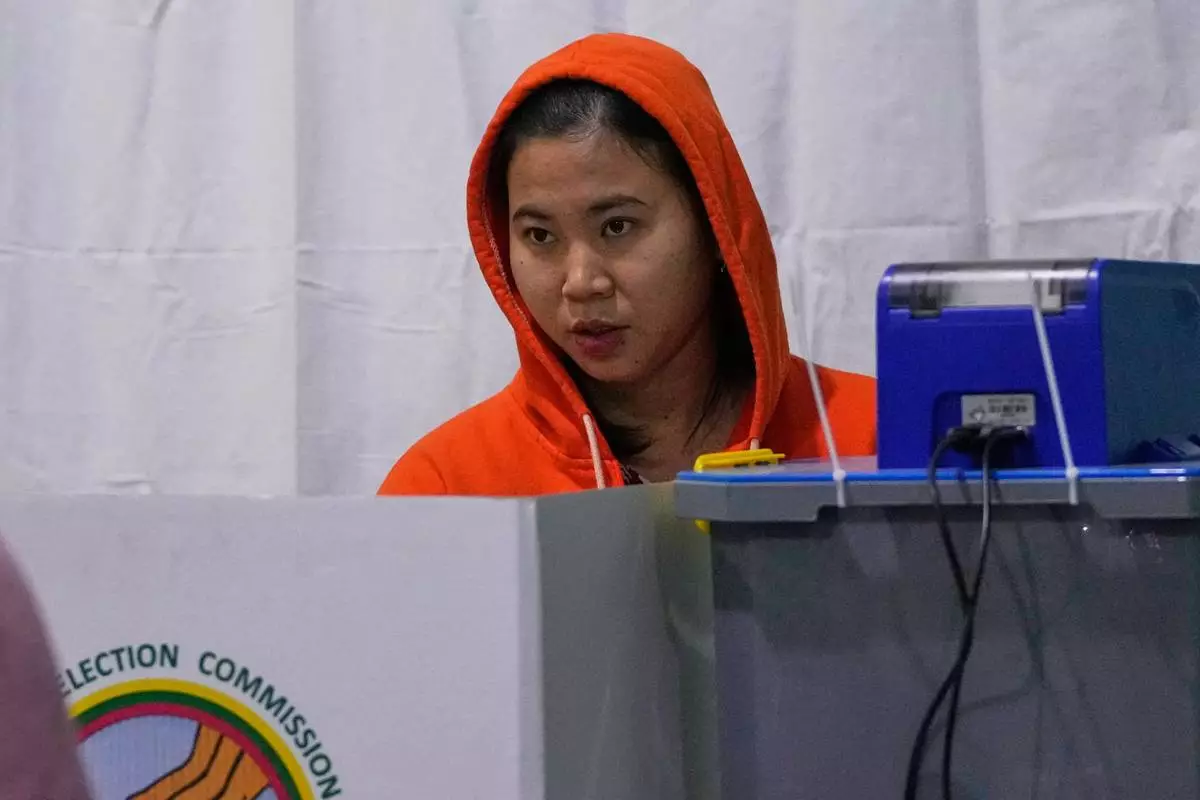
A voter casts ballot at a polling station during the second phase of general election in Mandalay, central Myanmar, Sunday, Jan. 11, 2026. (AP Photo/Aung Shine Oo)
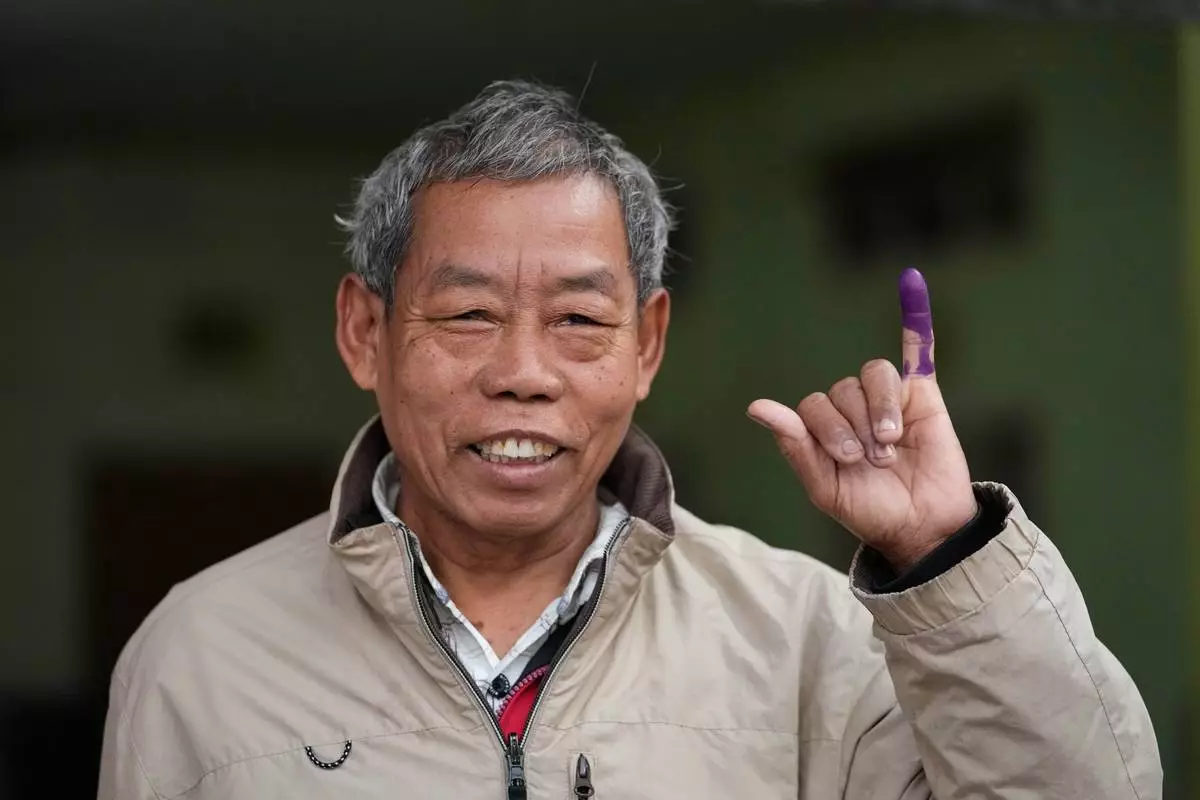
A voter shows his finger, marked with ink to indicate he voted, at a polling station during the second phase of general election in Mandalay, central Myanmar, Sunday, Jan. 11, 2026. (AP Photo/Aung Shine Oo)
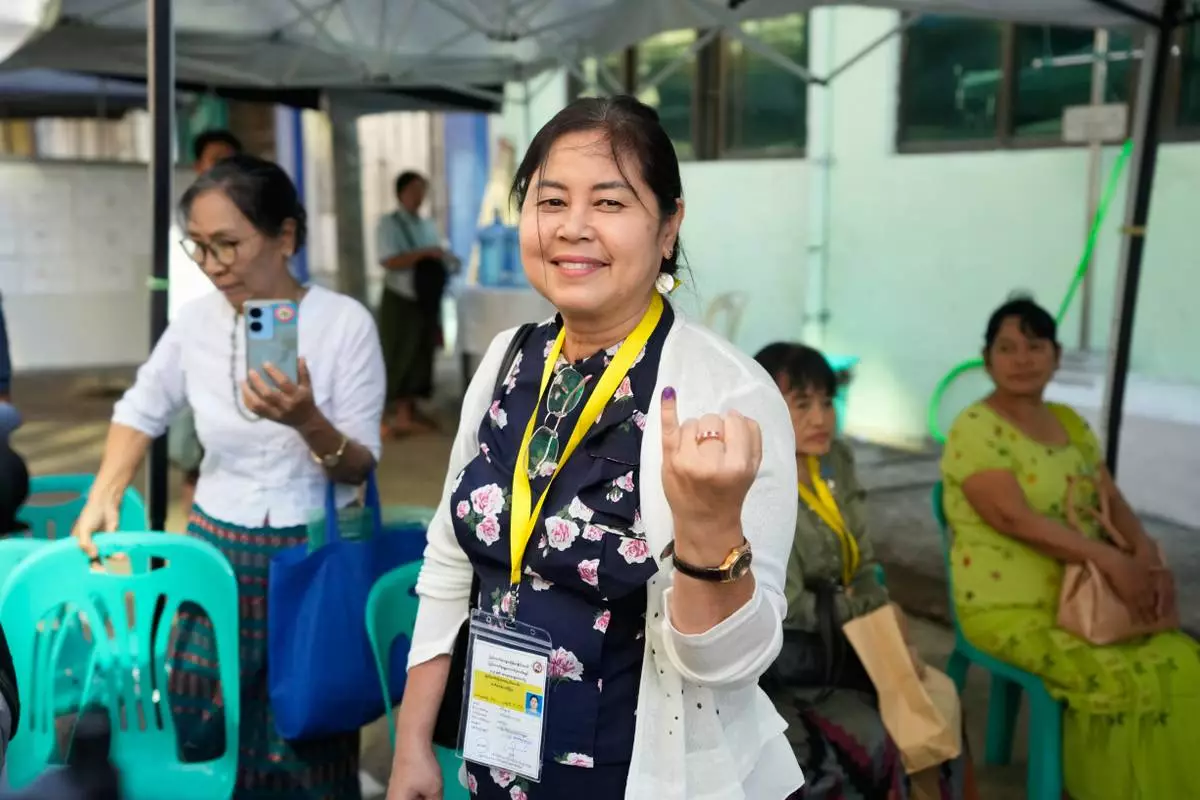
Sandar Min, an individual candidate for an election and former parliament member from ousted leader Aung San Suu Kyi's National League for Democracy (NLD) party, shows off her finger marked with ink indicating she voted at a polling station during the second phase of general election Sunday, Jan. 11, 2026, in Yangon, Myanmar. (AP Photo/Thein Zaw)
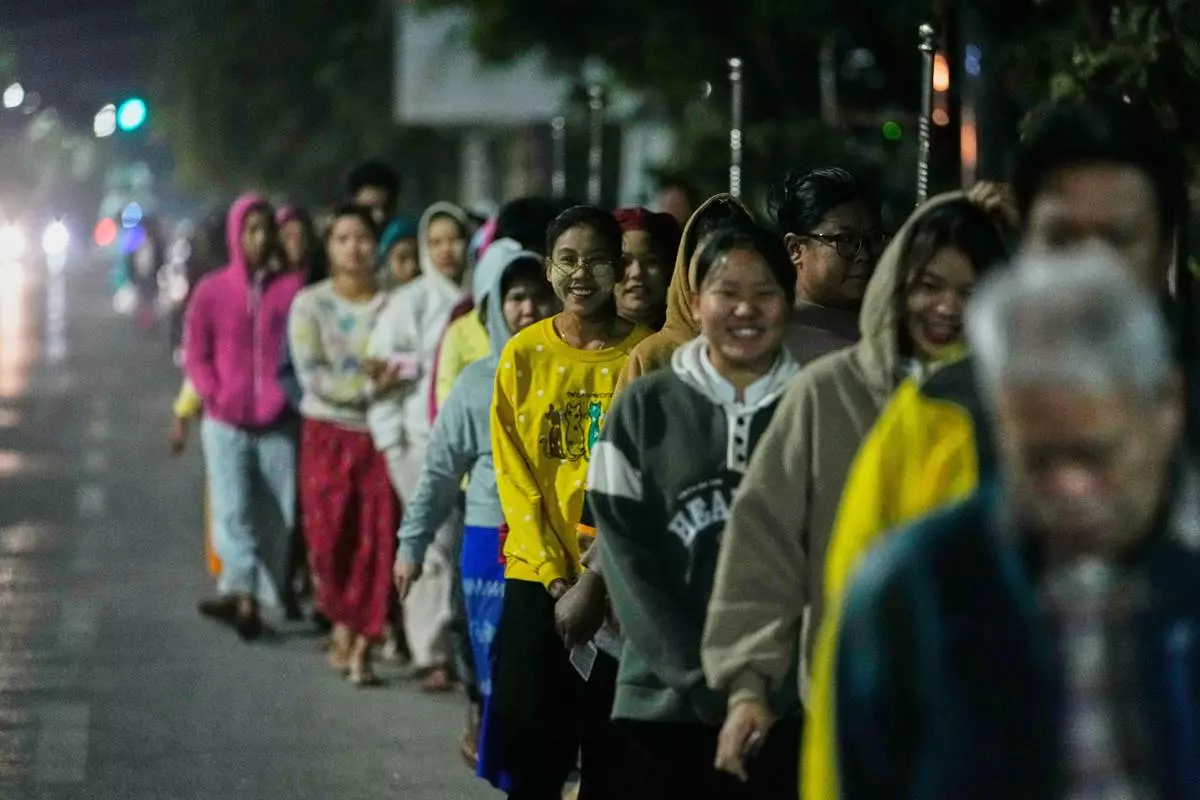
Voters wait for a polling station to open during the second phase of general election in Mandalay, central Myanmar, Sunday, Jan. 11, 2026. (AP Photo/Aung Shine Oo)
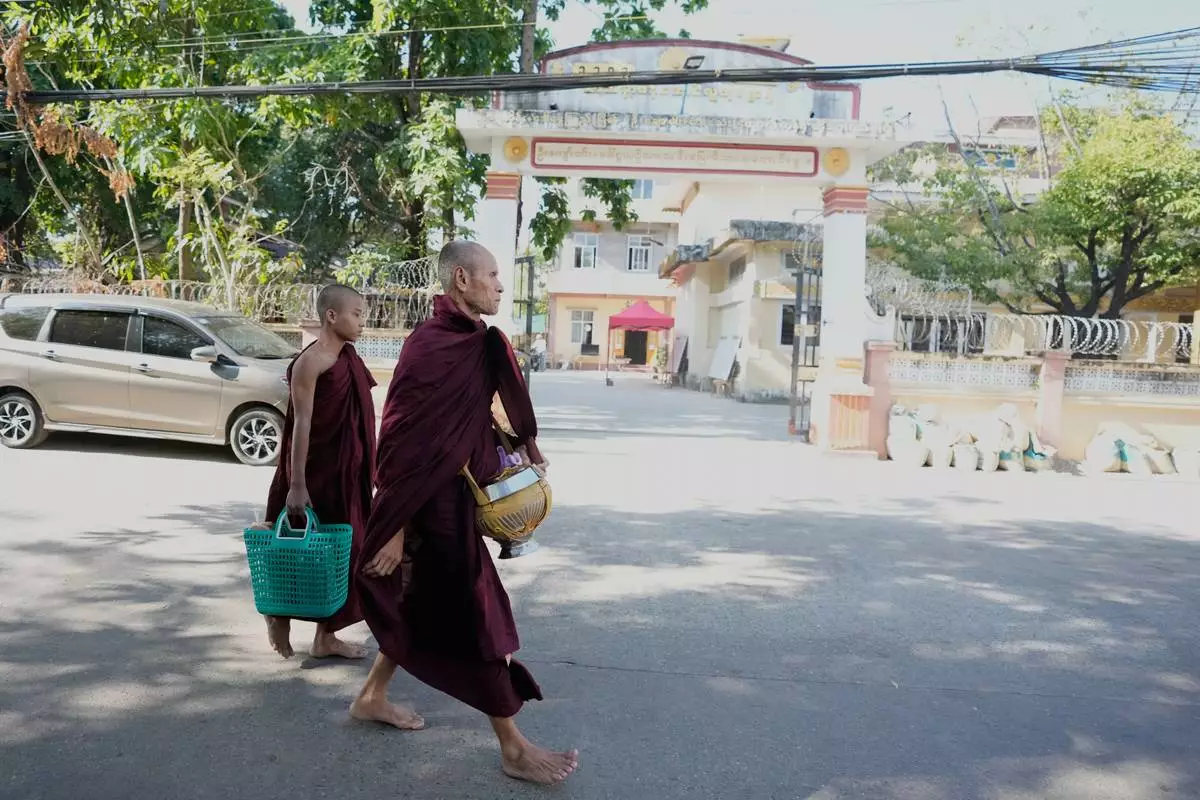
Buddhist monks walk past a polling station opened at a monastery one day before the second phase of the general election in Yangon, Myanmar, Saturday, Jan. 10, 2026. (AP Photo/Thein Zaw)
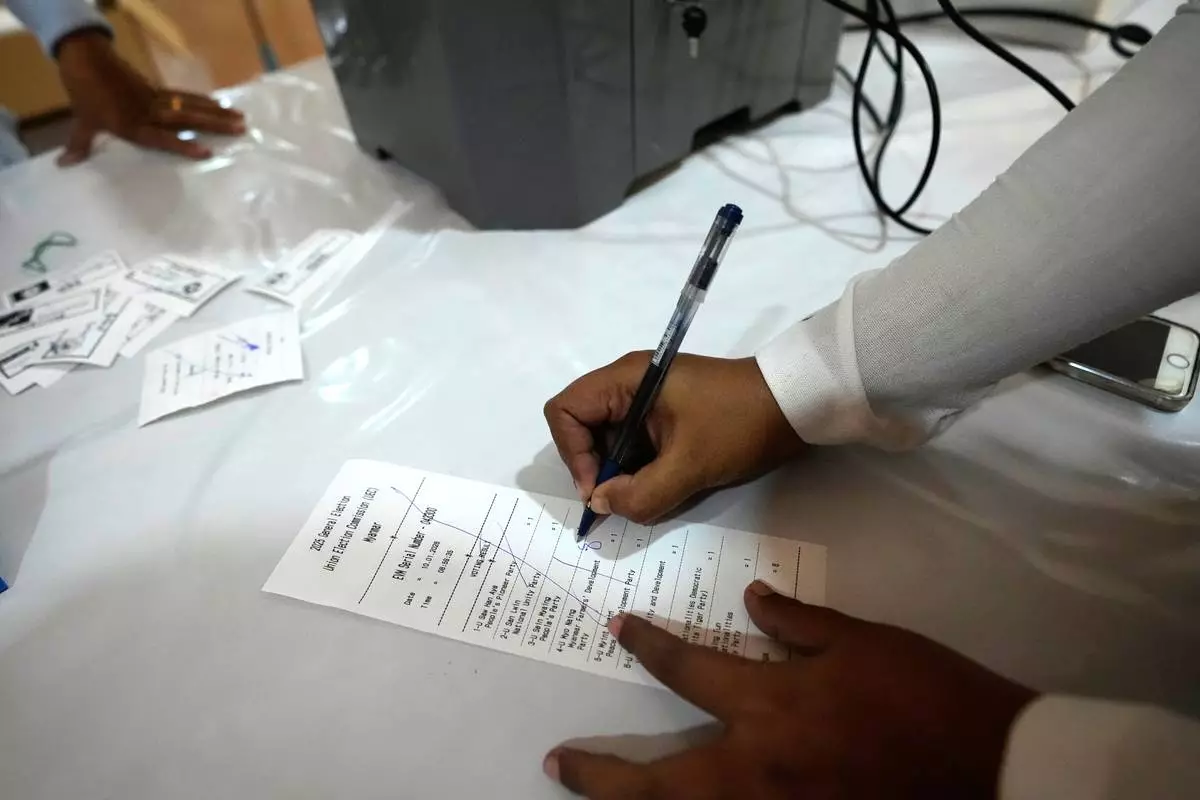
An official of the Union Election Commission checks a sample slip from an electronic voting machine as they prepare to set up a polling station opened at a monastery one day before the second phase of the general election in Yangon, Myanmar, Saturday, Jan. 10, 2026. (AP Photo/Thein Zaw)