BEIRUT (AP) — Four days of clashes between pro-government gunmen and members of a minority sect in Syria have left nearly 100 people dead and raised fears of deadly sectarian violence. The country is deeply divided as it tries to emerge from decades of dictatorship.
The clashes are the worst between forces loyal to the government and Druze fighters since the fall of President Bashar Assad in early December whose family ruled Syria with an iron grip for more than five decades.
The situation between the two sides has been tense for weeks and a smaller clash broke out in March in a suburb of Damascus.
Here are the main reasons the clashes expanded in recent days and background on the two sides:
The Druze religious sec t is a minority group that began as a 10th-century offshoot of Ismailism, a branch of Shiite Islam. More than half the roughly 1 million Druze worldwide live in Syria. Most of the other Druze live in Lebanon and Israel, including in the Golan Heights, which Israel captured from Syria in the 1967 Mideast War and annexed in 1981. In Syria, they largely live in the southern Sweida province and some suburbs of Damascus, mainly in Jaramana and Ashrafiyat Sahnaya to the south.
The transitional government has promised to include the Druze, but has so far kept authority in the hands of the Islamist former insurgents who toppled Assad in December — Hayat Tahrir al-Sham, or HTS.
The new 23-member government in Syria announced in late March only has one Druze member, Minister of Agriculture Amjad Badr.
Under the Assad family's tight rule, religious freedom was guaranteed as the country then boasted about its secular and Arab nationalist system.
The Druze have been slightly divided over how to deal with their issues with the new status quo in the country. Most Druze support a dialogue with the government while others support a more confrontational approach, so the reactions have differed while they are all concerned about the safety of their people.
Syria’s religious and ethnic communities are worried about their place in Syria’s new system that is mostly run by Islamists including some who have links to extremist groups.
The country’s new President Ahmad al-Sharaa himself is a former militant who once was a member of al-Qaida and was held for years in jails in neighboring Iraq for his role in the anti-American insurgency. Although al-Sharaa had said that the right of ethnic and religious minorities will be protected, there have been several rounds of sectarian killings since Assad’s fall.
The Assad family rule that was dominated by members of the Alawite sect had oppressed much of the country’s Sunni majority while giving minorities some powers. Being a member of the Muslim Brotherhood, the largest Islamic group in the country decades ago, was punishable by death as of the 1980s.
The Druze have major concerns about Muslim groups since they came under attack by members of the Islamic State group in 2018 in the southern Sweida province. It left dozens killed or wounded and more than two dozen people were taken hostage for nearly four months. Muslim extremists consider the Druze heretics.
During Syria's 14-year conflict, the Druze had their own militias.
The clashes broke out around midnight Monday in the southern Damascus suburb of Jaramana after an audio clip circulated on social media of a man criticizing Islam’s Prophet Muhammad. The audio was attributed to a Druze cleric. But cleric Marwan Kiwan said in a video posted on social media that he was not responsible for the audio, which angered many Sunni Muslims.
The fighting later spread to the outskirts of the southern town of Sakhnaya triggering the first Israeli airstrike against pro-government gunmen. Israeli officials, whose country has its own Druze community, have vowed to protect the Druze of Syria and warned Islamic groups form entering predominantly Druze areas.
The clashes have pulled Israel further into the conflict with the airstrike two days ago and Friday marked a major increase in tensions with an attack close to the presidential palace in Damascus in what Syria’s presidency called a major escalation.
Israel does not want what it calls Islamic extremists near the country’s northern border. Since Assad’s fall, Israel has carved a buffer zone in southern Syria and has destroyed much of the Syrian army’s assets so they don’t fall into the hands of groups that removed him from power.
Israel had been warning for decades that Iran and its proxies pose a danger along its northern border, and now it is doing the same with the new authorities in Syria who are backed by Turkey.
Other sporadic attacks in different areas as well as an ambush on the Damascus-Sweida highway made the situation worse until a deal was reached early Friday after which Interior Ministry forces and local Druze gunmen deployed in different areas.
The Britain-based war monitor The Syrian Observatory for Human Rights said that 99 people were killed over the past four days, of which 51 were killed in Sakhnaya and the Druze-majority Damascus suburb of Jaramana. Among them were local gunmen and security forces.
The clashes near Damascus and in southern Syria came nearly two months after an ambush by fighters loyal to Assad triggered days of sectarian and revenge attacks. The fighting in the country’s coastal region left more than 1,000 people dead. Many of the dead were civilians who were gunned down because they belonged to the minority Alawite sect that Assad belongs to.
Security forces deployed in the coastal province of Latakia and Tartus but activists say that sectarian killings against Alawites are still taking place albeit at a much slower pace when compared to the early March attacks.
Members of religious minorities in Syria such as Alawites, Christians and Druze fear persecution by the main Sunni Muslim groups. Videos have circulated on social media showing Islamist fighters insulting Druze detainees and humiliating them such as shaving their mustaches.
Associated Press writer Ibrahim Hazboun contributed to this report from Jerusalem.
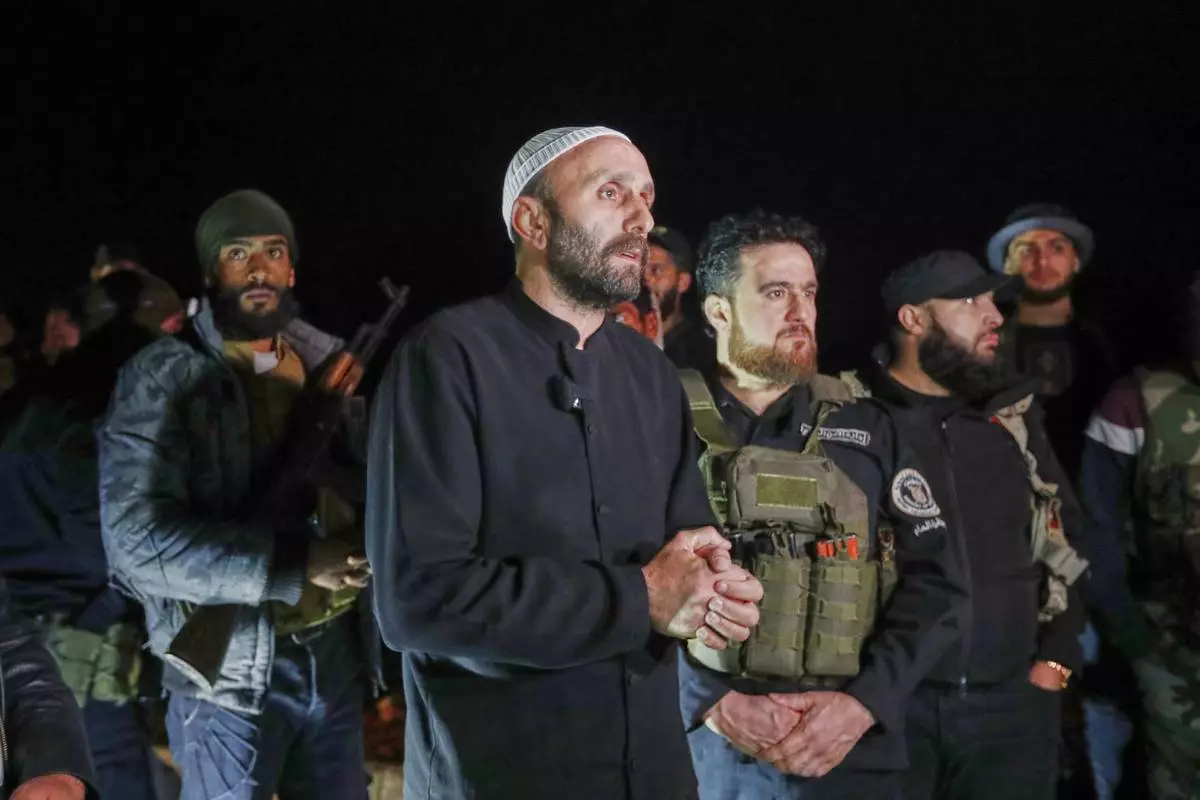
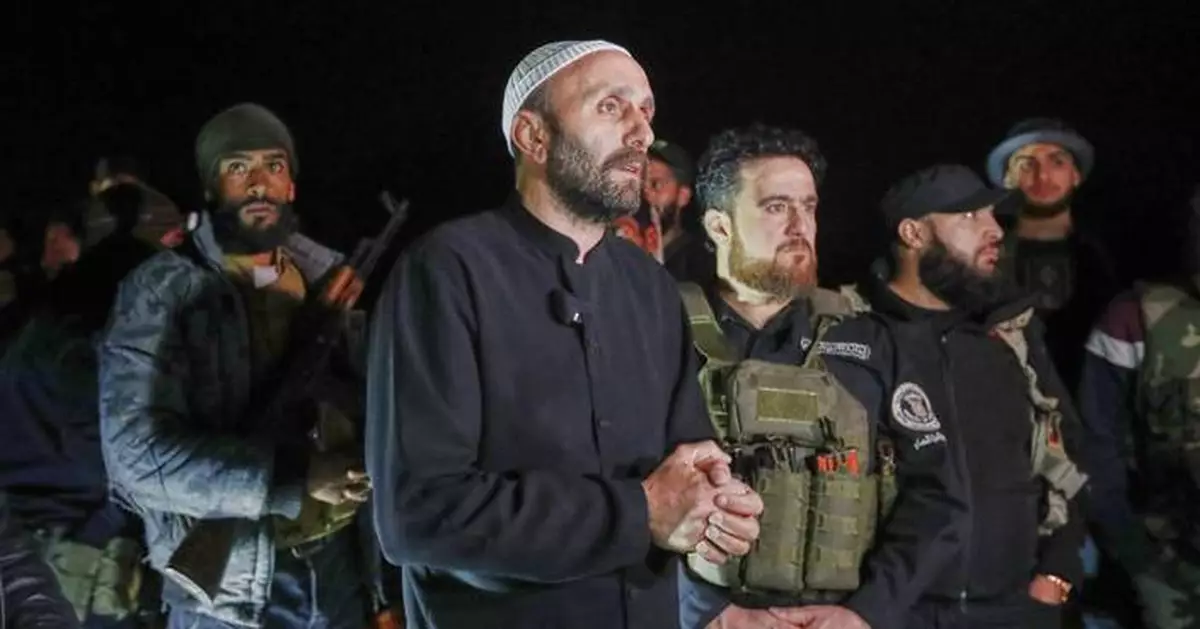
A Druze man, center, stands next to Syrian security forces who reached a deal with Druze gunmen to deploy around the southern Damascus suburb of Jaramana that has witnessed fighting earlier this week in Damascus, Syria, early Friday, May 2, 2025. (AP Photo/Omar Sanadiki)
U.S. President Donald Trump says Iran has proposed negotiations after his threat to strike the Islamic Republic as an ongoing crackdown on demonstrators has led to hundreds of deaths.
Trump said late Sunday that his administration was in talks to set up a meeting with Tehran, but cautioned that he may have to act first as reports mount of increasing deaths and the government continues to arrest protesters.
“The meeting is being set up, but we may have to act because of what’s happening before the meeting. But a meeting is being set up. Iran called, they want to negotiate,” Trump told reporters on Air Force One on Sunday night.
Iran did not acknowledge Trump’s comments immediately. It has previously warned the U.S. military and Israel would be “legitimate targets” if America uses force to protect demonstrators.
The U.S.-based Human Rights Activists News Agency, which has accurately reported on past unrest in Iran, gave the death toll. It relies on supporters in Iran cross checking information. It said at least 544 people have been killed so far, including 496 protesters and 48 people from the security forces. It said more than 10,600 people also have been detained over the two weeks of protests.
With the internet down in Iran and phone lines cut off, gauging the demonstrations from abroad has grown more difficult. Iran’s government has not offered overall casualty figures.
The Latest:
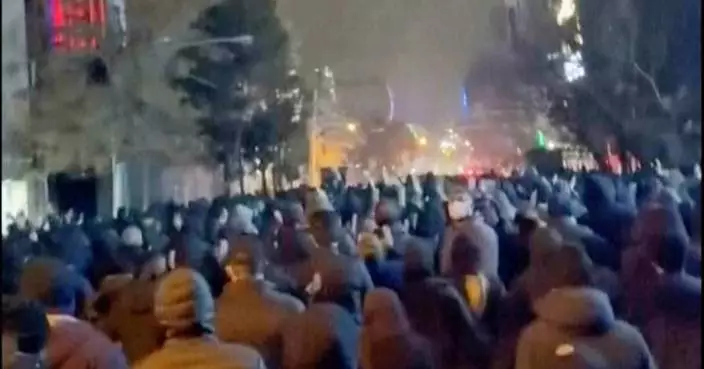
A witness told the AP that the streets of Tehran empty at the sunset call to prayers each night.
Part of that stems from the fear of getting caught in the crackdown. Police sent the public a text message that warned: “Given the presence of terrorist groups and armed individuals in some gatherings last night and their plans to cause death, and the firm decision to not tolerate any appeasement and to deal decisively with the rioters, families are strongly advised to take care of their youth and teenagers.”
Another text, addressed “Dear parents,” which claimed to come from the intelligence arm of the paramilitary Revolutionary Guard, also directly warned people not to take part in demonstrations.
The witness spoke to the AP on condition of anonymity due to the ongoing crackdown.
—- By Jon Gambrell in Dubai, United Arab Emirates
Iran drew tens of thousands of pro-government demonstrators to the streets Monday in a show of power after nationwide protests challenging the country’s theocracy.
Iranian state television showed images of demonstrators thronging Tehran toward Enghelab Square in the capital.
It called the demonstration an “Iranian uprising against American-Zionist terrorism,” without addressing the underlying anger in the country over the nation’s ailing economy. That sparked the protests over two weeks ago.
State television aired images of such demonstrations around the country, trying to signal it had overcome the protests, as claimed by Iranian Foreign Minister Abbas Araghchi earlier in the day.
China says it opposes the use of force in international relations and expressed hope the Iranian government and people are “able to overcome the current difficulties and maintain national stability.”
Chinese Foreign Ministry spokesperson Mao Ning said Monday that Beijing “always opposes interference in other countries’ internal affairs, maintains that the sovereignty and security of all countries should be fully protected under international law, and opposes the use or threat of use of force in international relations.”
German Chancellor Friedrich Merz condemned “in the strongest terms the violence that the leadership in Iran is directing against its own people.”
He said it was a sign of weakness rather than strength, adding that “this violence must end.”
Merz said during a visit to India that the demonstrators deserve “the greatest respect” for the courage with which “they are resisting the disproportional, brutal violence of Iranian security forces.”
He said: “I call on the Iranian leadership to protect its population rather than threatening it.”
Iran’s Foreign Ministry spokesman on Monday suggested that a channel remained open with the United States.
Esmail Baghaei made the comment during a news conference in Tehran.
“It is open and whenever needed, through that channel, the necessary messages are exchanged,” he said.
However, Baghaei said such talks needed to be “based on the acceptance of mutual interests and concerns, not a negotiation that is one-sided, unilateral and based on dictation.”
The semiofficial Fars news agency in Iran, which is close to the paramilitary Revolutionary Guard, on Monday began calling out Iranian celebrities and leaders on social media who have expressed support for the protests over the past two weeks, especially before the internet was shut down.
The threat comes as writers and other cultural leaders were targeted even before protests. The news agency highlighted specific celebrities who posted in solidarity with the protesters and scolded them for not condemning vandalism and destruction to public property or the deaths of security forces killed during clashes. The news agency accused those celebrities and leaders of inciting riots by expressing their support.
Canada said it “stands with the brave people of Iran” in a statement on social media that strongly condemned the killing of protesters during widespread protests that have rocked the country over the past two weeks.
“The Iranian regime must halt its horrific repression and intimidation and respect the human rights of its citizens,” Canada’s government said on Monday.
Iran’s foreign minister claimed Monday that “the situation has come under total control” after a bloody crackdown on nationwide protests in the country.
Abbas Araghchi offered no evidence for his claim.
Araghchi spoke to foreign diplomats in Tehran. The Qatar-funded Al Jazeera satellite news network, which has been allowed to work despite the internet being cut off in the country, carried his remarks.
Iran’s foreign minister alleged Monday that nationwide protests in his nation “turned violent and bloody to give an excuse” for U.S. President Donald Trump to intervene.
Abbas Araghchi offered no evidence for his claim, which comes after over 500 have been reported killed by activists -- the vast majority coming from demonstrators.
Araghchi spoke to foreign diplomats in Tehran. The Qatar-funded Al Jazeera satellite news network, which has been allowed to work despite the internet being cut off in the country, carried his remarks.
Iran has summoned the British ambassador over protesters twice taking down the Iranian flag at their embassy in London.
Iranian state television also said Monday that it complained about “certain terrorist organization that, under the guise of media, spread lies and promote violence and terrorism.” The United Kingdom is home to offices of the BBC’s Persian service and Iran International, both which long have been targeted by Iran.
A huge crowd of demonstrators, some waving the flag of Iran, gathered Sunday afternoon along Veteran Avenue in LA’s Westwood neighborhood to protest against the Iranian government. Police eventually issued a dispersal order, and by early evening only about a hundred protesters were still in the area, ABC7 reported.
Los Angeles is home to the largest Iranian community outside of Iran.
Los Angeles police responded Sunday after somebody drove a U-Haul box truck down a street crowded with the the demonstrators, causing protesters to scramble out of the way and then run after the speeding vehicle to try to attack the driver. A police statement said one person was hit by the truck but nobody was seriously hurt.
The driver, a man who was not identified, was detained “pending further investigation,” police said in a statement Sunday evening.
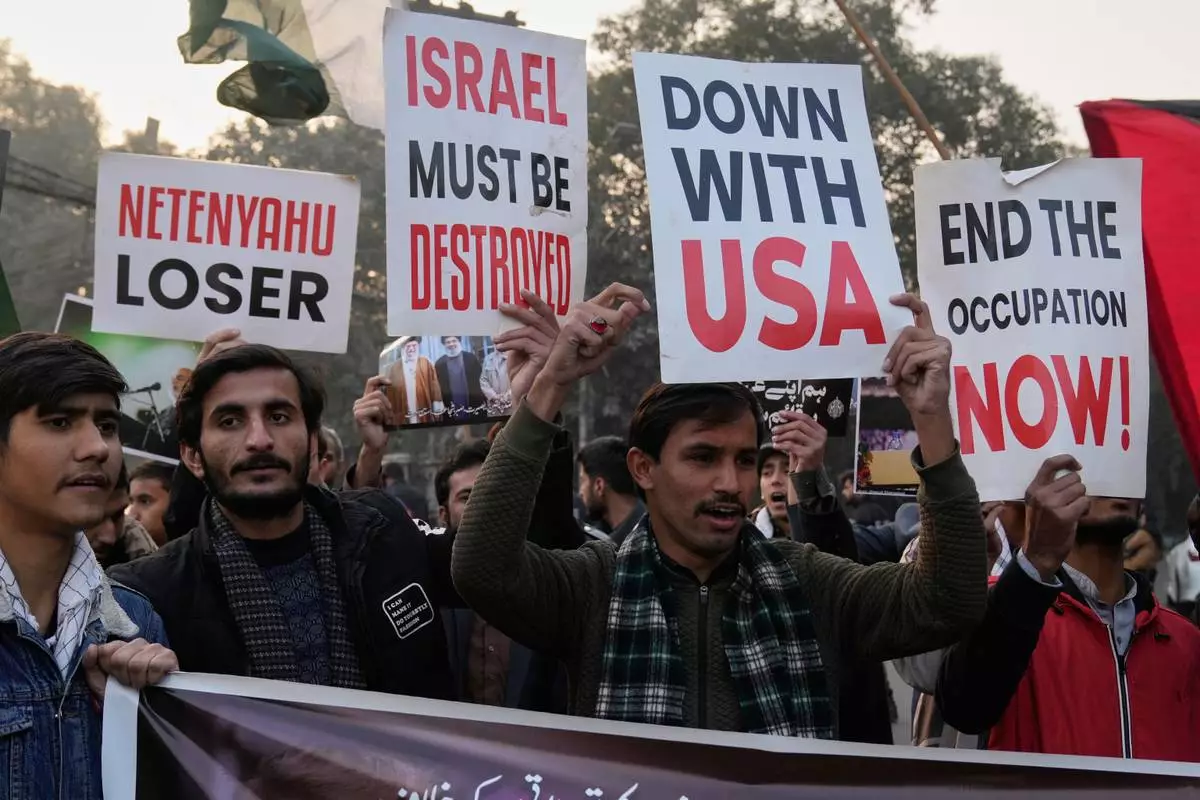
Shiite Muslims hold placards and chant slogans during a protest against the U.S. and show solidarity with Iran in Lahore, Pakistan, Sunday, Jan. 11, 2026. (AP Photo/K.M. Chaudary)
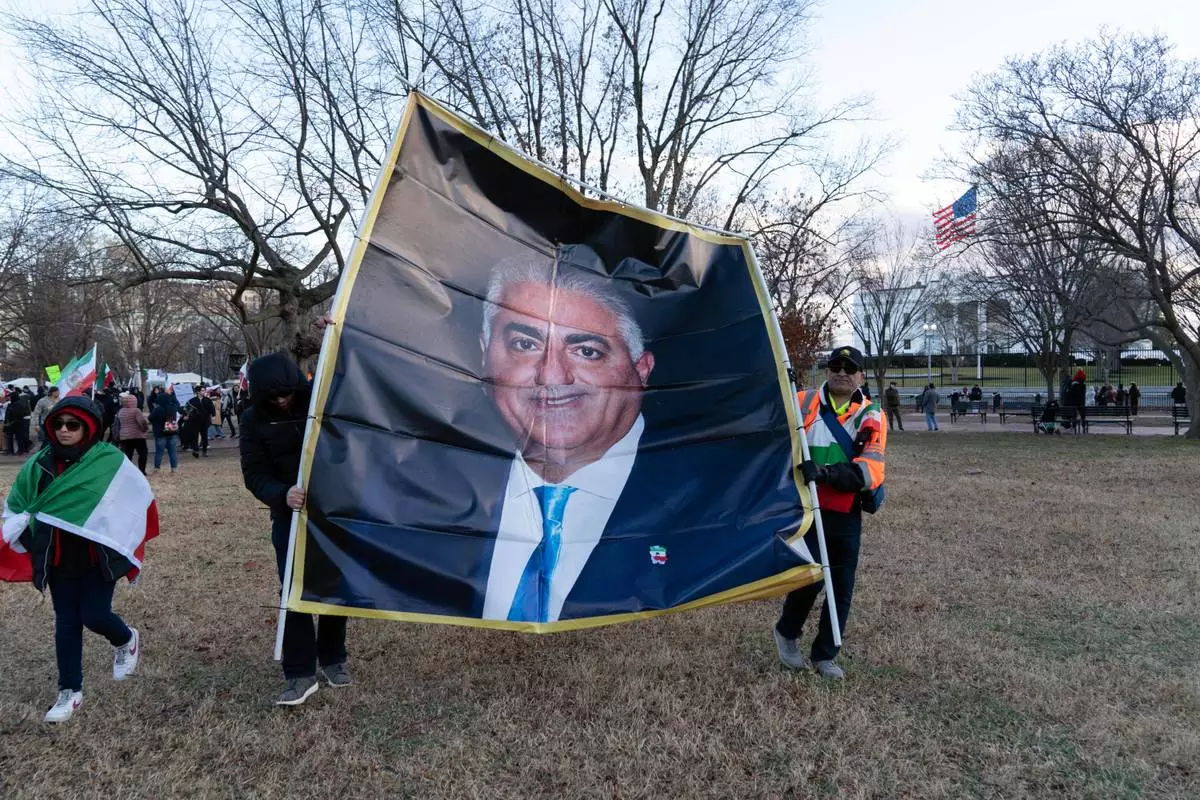
Activists carrying a photograph of Reza Pahlavi take part in a rally supporting protesters in Iran at Lafayette Park, across from the White House, in Washington, Sunday, Jan. 11, 2026. (AP Photo/Jose Luis Magana)
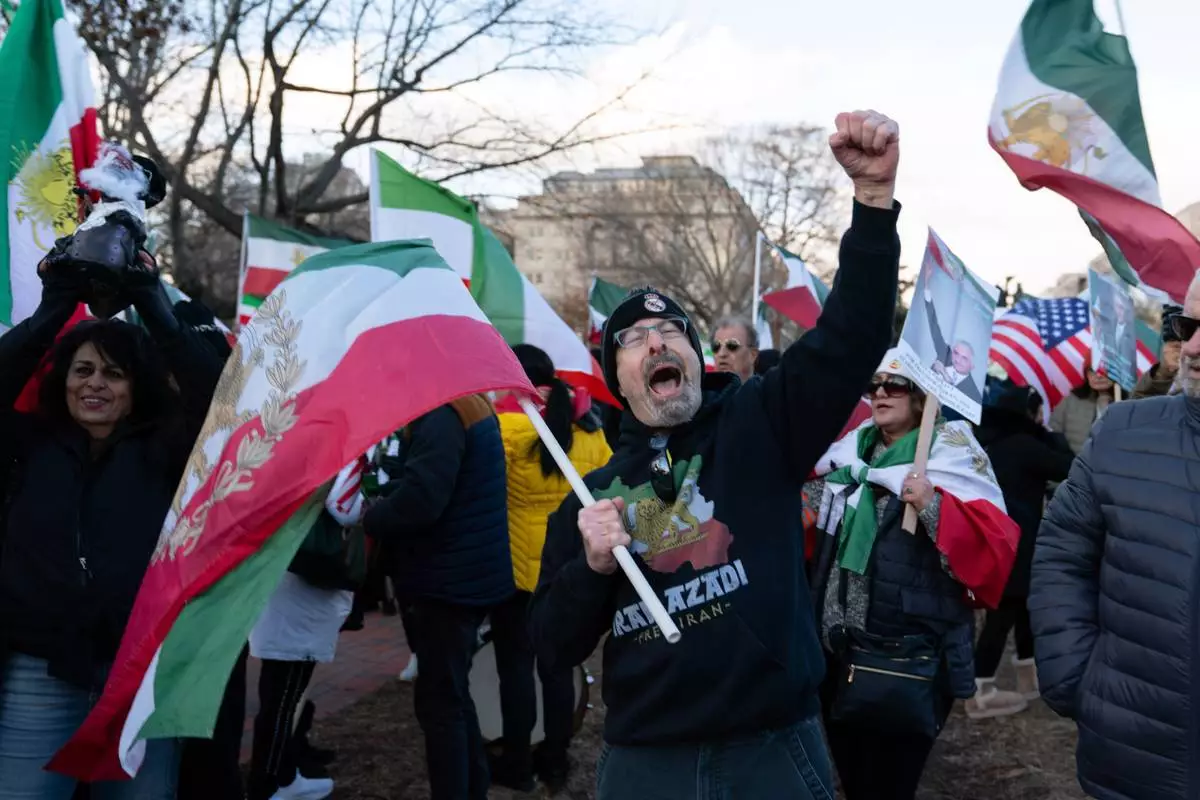
Activists take part in a rally supporting protesters in Iran at Lafayette Park, across from the White House in Washington, Sunday, Jan. 11, 2026. (AP Photo/Jose Luis Magana)
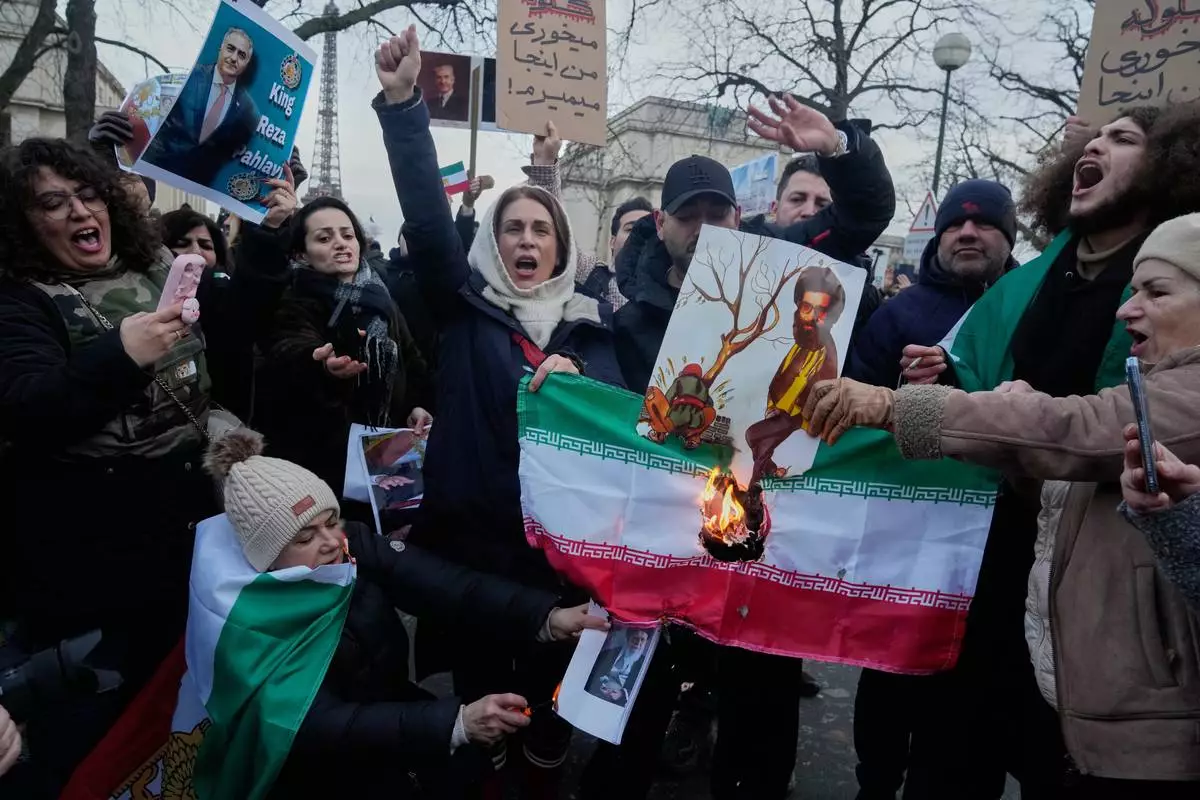
Protesters burn the Iranian national flag during a rally in support of the nationwide mass demonstrations in Iran against the government in Paris, Sunday, Jan. 11, 2026. (AP Photo/Michel Euler)