Skip to Content Facebook Feature Image

Chilean woman with muscular dystrophy becomes face of euthanasia debate as bill stalls in Senate

News

Chilean woman with muscular dystrophy becomes face of euthanasia debate as bill stalls in Senate
News

News

Chilean woman with muscular dystrophy becomes face of euthanasia debate as bill stalls in Senate

2025-05-03 22:18 Last Updated At:22:20

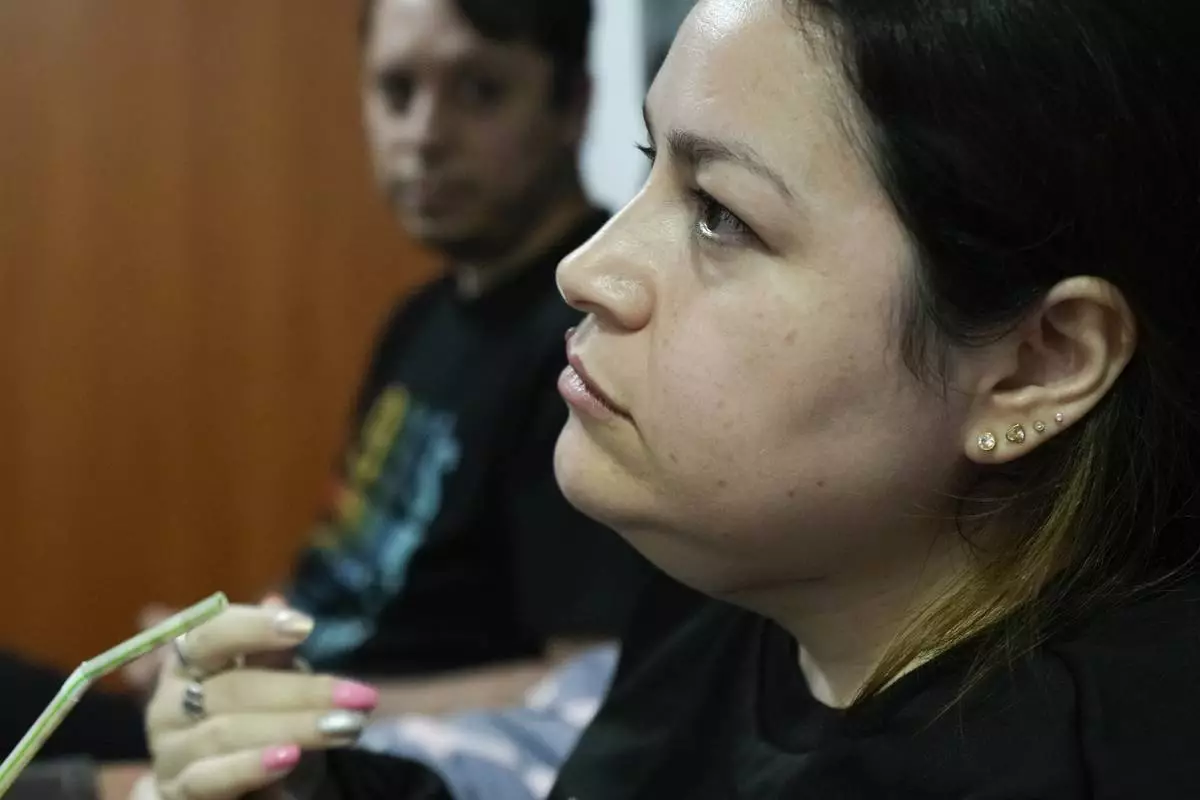
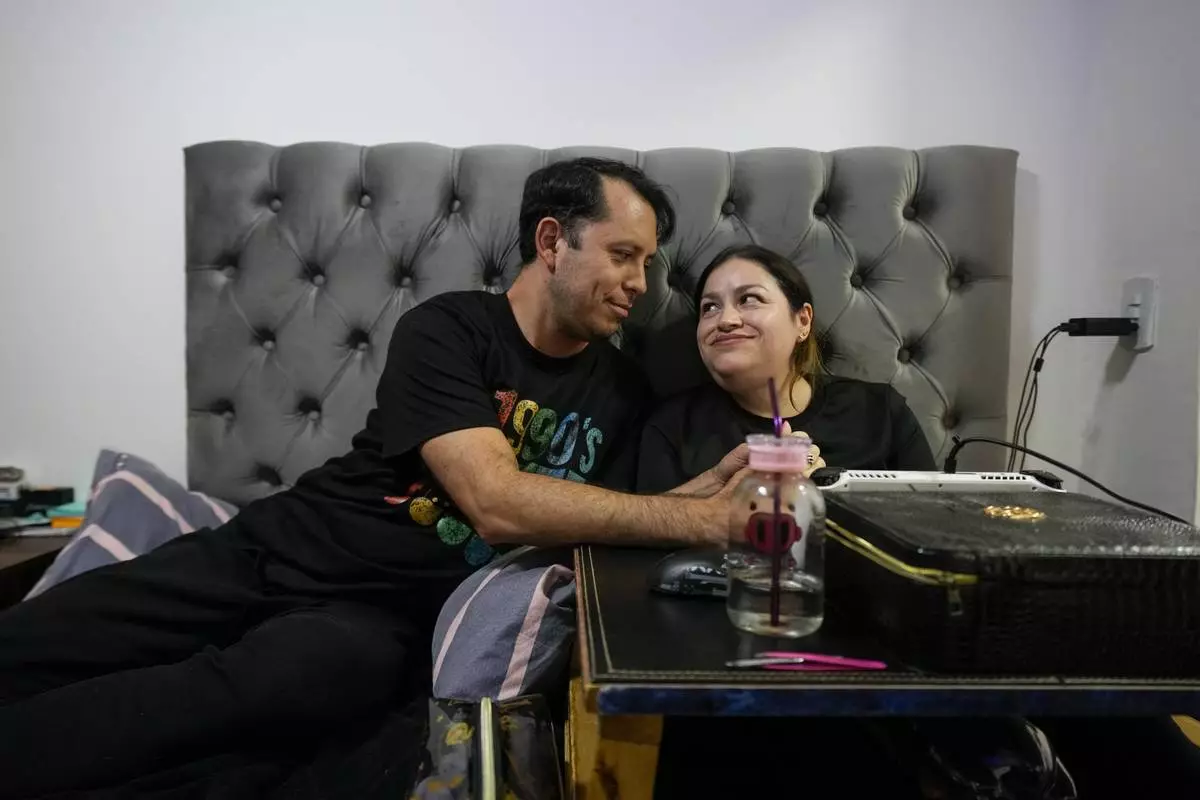
SANTIAGO, Chile (AP) — As a child, Susana Moreira didn’t have the same energy as her siblings. Over time, her legs stopped walking and she lost the ability to bathe and take care of herself. Over the last two decades, the 41-year-old Chilean has spent her days bedridden, suffering from degenerative muscular dystrophy. When she finally loses her ability to speak or her lungs fail, she wants to be able to opt for euthanasia — which is currently prohibited in Chile.

Moreira has become the public face of Chile’s decade-long debate over euthanasia and assisted dying, a bill that the left-wing government of President Gabriel Boric has pledged to address in his last year in power, a critical period for its approval ahead of November’s presidential election.

“This disease will progress, and I will reach a point where I won’t be able to communicate,” Moreira told The Associated Press from the house where she lives with her husband in southern Santiago. “When the time comes, I need the euthanasia bill to be a law.”

In April 2021, Chile’s Chamber of Deputies approved a bill to allow euthanasia and assisted suicide for those over 18 who suffer from a terminal or “serious and incurable” illness. But it has since been stalled in the Senate.

The initiative seeks to regulate euthanasia, in which a doctor administers a drug that causes death, and assisted suicide, in which a doctor provides a lethal substance that the patients take themselves.

If the bill passes, Chile will join a select group of countries that allow both euthanasia and assisted suicide, including the Netherlands, Belgium, Canada, Spain and Australia.

It would also make Chile the third Latin American country to rule on the matter, following Colombia’s established regulations and Ecuador’s recent decriminalization, which remains unimplemented due to a lack of regulation.

When she was 8 years old, Moreira was diagnosed with shoulder-girdle muscular dystrophy, a progressive genetic disease that affects all her muscles and causes difficulty breathing, swallowing and extreme weakness.

Confined to bed, she spends her days playing video games, reading and watching Harry Potter movies. Outings are rare and require preparation, as the intense pain only allows her three or four hours in the wheelchair. As the disease progressed, she said she felt the “urgency” to speak out in order to advance the discussion in Congress.

“I don’t want to live plugged into machines, I don’t want a tracheostomy, I don’t want a feeding tube, I don’t want a ventilator to breathe. I want to live as long as my body allows me,” she said.

In a letter to President Boric last year, Moreira revealed her condition, detailed her daily struggles and asked him to authorize her euthanasia.

Boric made Moreira’s letter public to Congress in June and announced that passing the euthanasia bill would be a priority in his final year in office. “Passing this law is an act of empathy, responsibility and respect,” he said.

But hope soon gave way to uncertainty.

Almost a year after that announcement, multiple political upheavals have relegated Boric’s promised social agenda to the background.

Chile, a country of roughly 19 million inhabitants at the southern tip of the southern hemisphere, began to debate euthanasia more than ten years ago. Despite a predominantly Catholic population and the strong influence of the Church at the time, Representative Vlado Mirosevic, from Chile's Liberal Party, first presented a bill for euthanasia and assisted dying in 2014.

The proposal was met with skepticism and strong resistance. Over the years, the bill underwent numerous modifications with little significant progress until 2021. “Chile was then one of the most conservative countries in Latin America,” Mirosevic told the AP.

More recently, however, public opinion has shifted, showing greater openness to debating thorny issues. “There was a change in the mood," Mirosevic said, citing the rising support for the euthanasia bill among Chileans.

Indeed, recent surveys show strong public support for euthanasia and assisted dying in Chile.

According to a 2024 survey by Chilean public opinion pollster Cadem, 75% of those interviewed said they supported euthanasia, while a study by the Center for Public Studies from October found that 89% of Chileans believe euthanasia should “always be allowed” or “allowed in special cases,” compared to 11% who believed the procedure "should never be allowed.”

Boric’s commitment to the euthanasia bill has been welcomed by patients and families of those lost to terminal illnesses, including Fredy Maureira, a decade-long advocate for the right of choosing when to die.

His 14-year-old daughter Valentina went viral in 2015, after posting a video appealing to then-President Michelle Bachelet for euthanasia. Her request was denied, and she died less than two months later from complications of cystic fibrosis.

The commotion generated both inside and outside Chile by her story allowed the debate on assisted death to penetrate also into the social sphere.

“I addressed Congress several times, asking lawmakers to put themselves in the shoes of someone whose child or sibling is pleading to die, and there’s no law to allow it," said Maureira.

Despite growing public support, euthanasia and assisted death remains a contentious issue in Chile, including among health professionals.

“Only when all palliative care coverage is available and accessible, will it be time to sit down and discuss the euthanasia law,” Irene Muñoz Pino, a nurse, academic and advisor to the Chilean Scientific Society of Palliative Nursing, said. She was referring to a recent law, enacted in 2022, that ensures palliative care and protects the rights of terminally ill individuals.

Others argue that the absence of a legal medical option for assisted dying could lead patients to seek other riskier, unsupervised alternatives.

“Unfortunately, I keep hearing about suicides that could have been instances of medically assisted death or euthanasia,” said Colombian psychologist Monica Giraldo.

With only a few months remaining, Chile’s leftist government faces a narrow window to pass the euthanasia bill before the November presidential elections dominate the political agenda.

“A sick person isn’t certain of anything; the only certainty they have is that they will suffer,” Moreira said. “Knowing that I have the opportunity to choose, gives me peace of mind."

Follow AP’s coverage of Latin America and the Caribbean at https://apnews.com/hub/latin-america
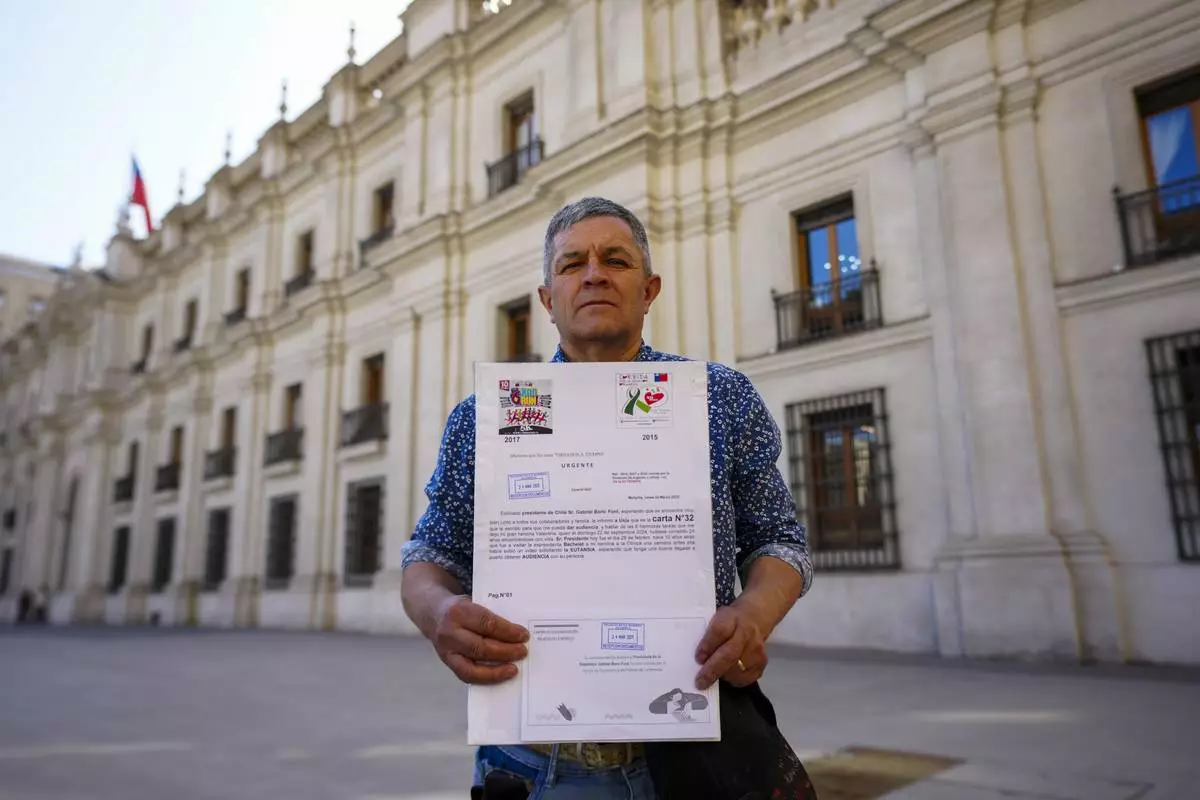
Fredy Maureira, the father of Valentina, who suffered from cystic fibrosis and died at the age of 14, holds a copy of a letter he left at the presidential palace requesting a meeting with President Gabriel Boric, in Santiago, Chile, Monday, March 24, 2025. (AP Photo/Esteban Felix)
Fredy Maureira, the father of Valentina, who suffered from cystic fibrosis and died at the age of 14, holds a copy of a letter he left at the presidential palace requesting a meeting with President Gabriel Boric, in Santiago, Chile, Monday, March 24, 2025. (AP Photo/Esteban Felix)

Susana Moreira, 41, a degenerative muscular dystrophy patient, gives an interview in her bedroom in Santiago, Chile, Monday, April 7, 2025. (AP Photo/Esteban Felix)
Susana Moreira, 41, a degenerative muscular dystrophy patient, gives an interview in her bedroom in Santiago, Chile, Monday, April 7, 2025. (AP Photo/Esteban Felix)

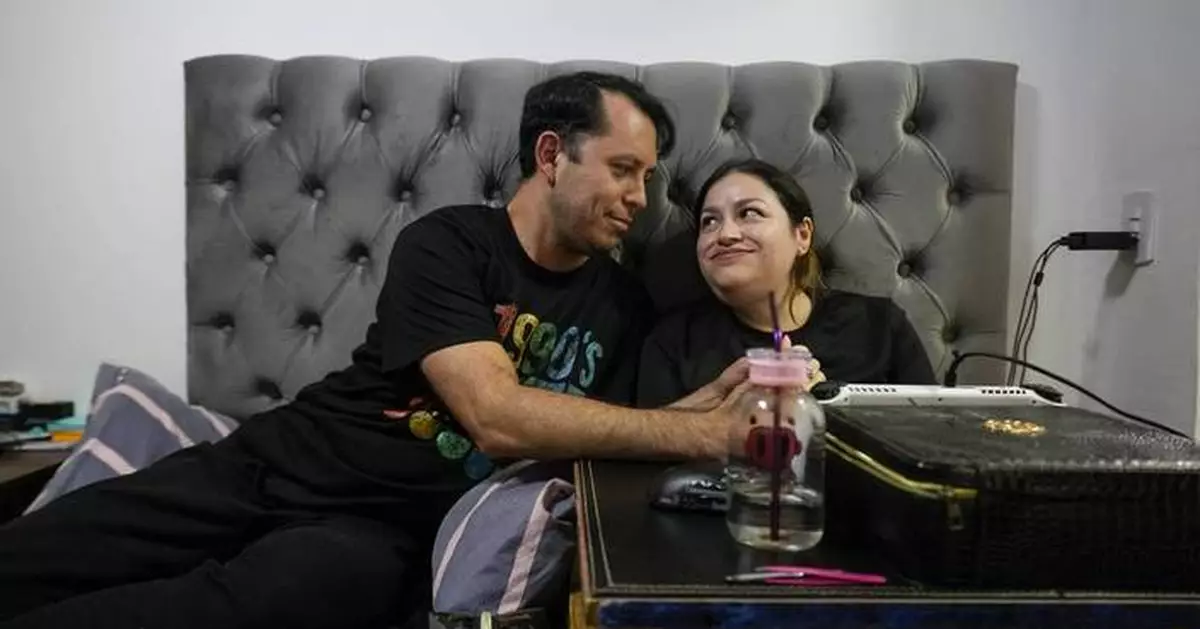
Susana Moreira, 41, a degenerative muscular dystrophy patient, looks at her husband in her bedroom in Santiago, Chile, Thursday, April 10, 2025. (AP Photo/Esteban Felix)
Susana Moreira, 41, a degenerative muscular dystrophy patient, looks at her husband in her bedroom in Santiago, Chile, Thursday, April 10, 2025. (AP Photo/Esteban Felix)
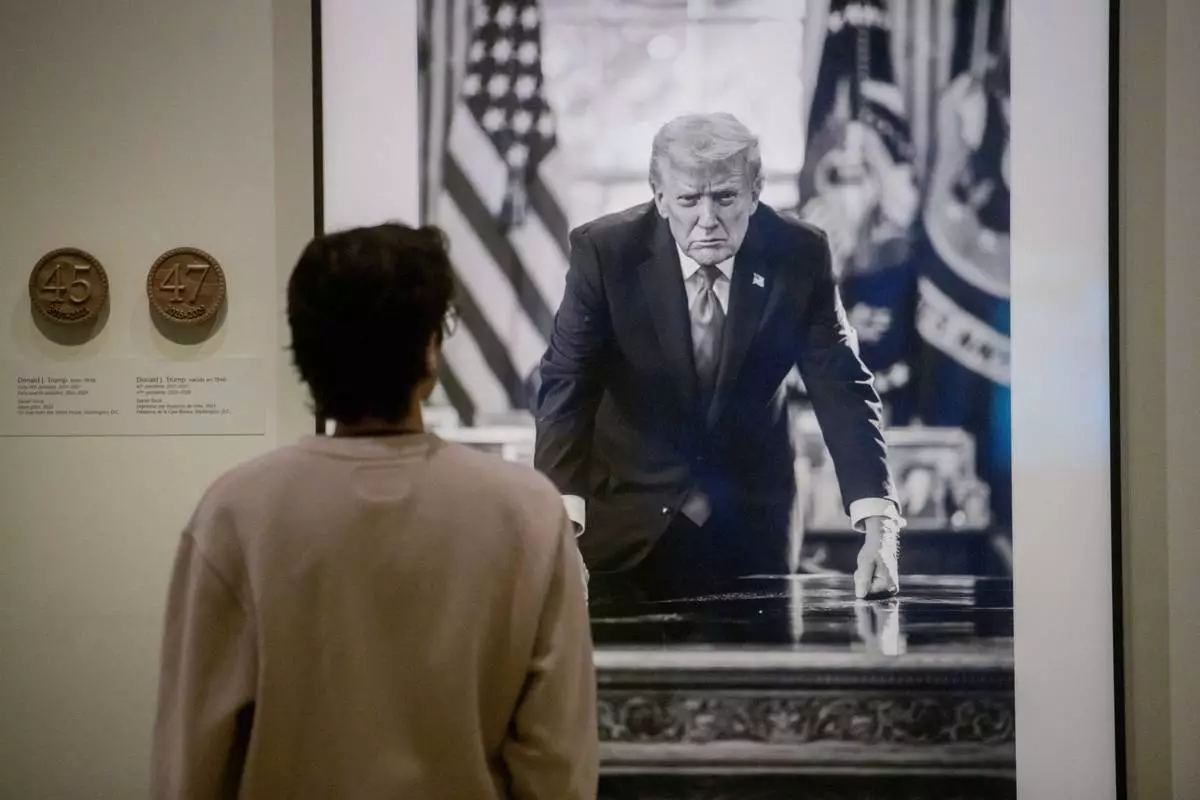
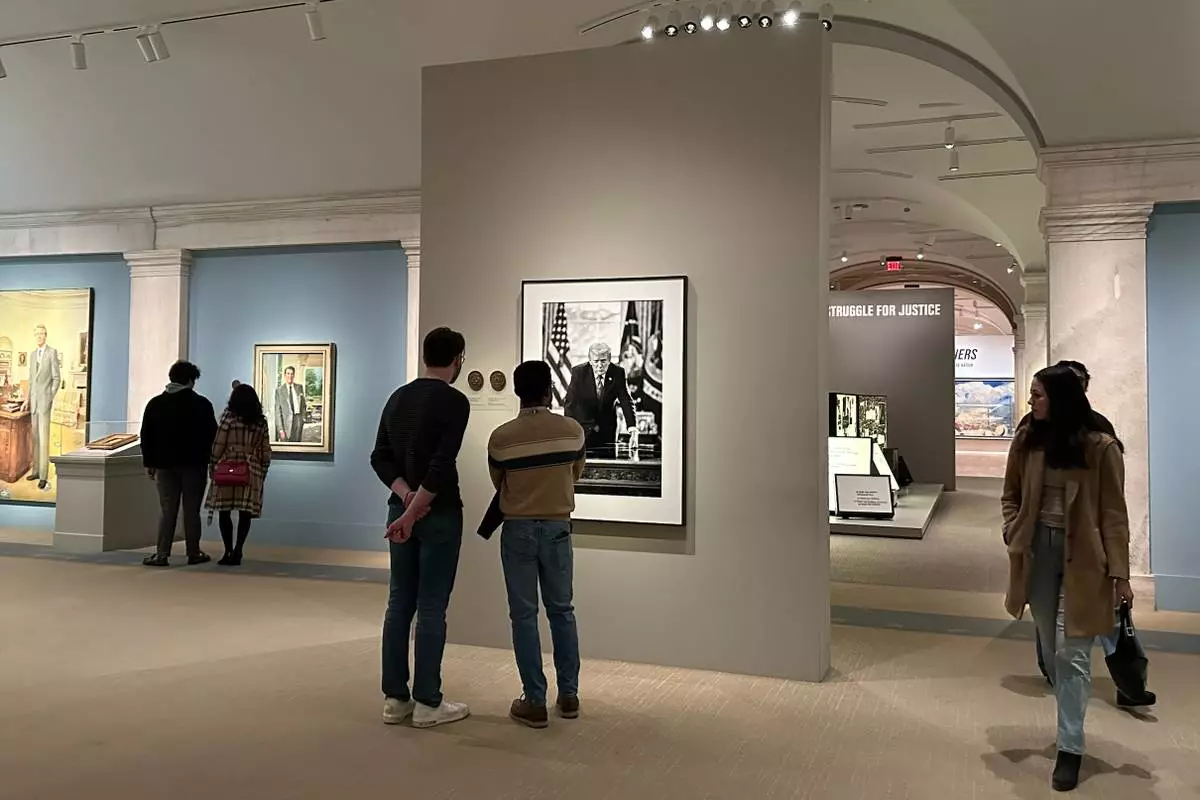
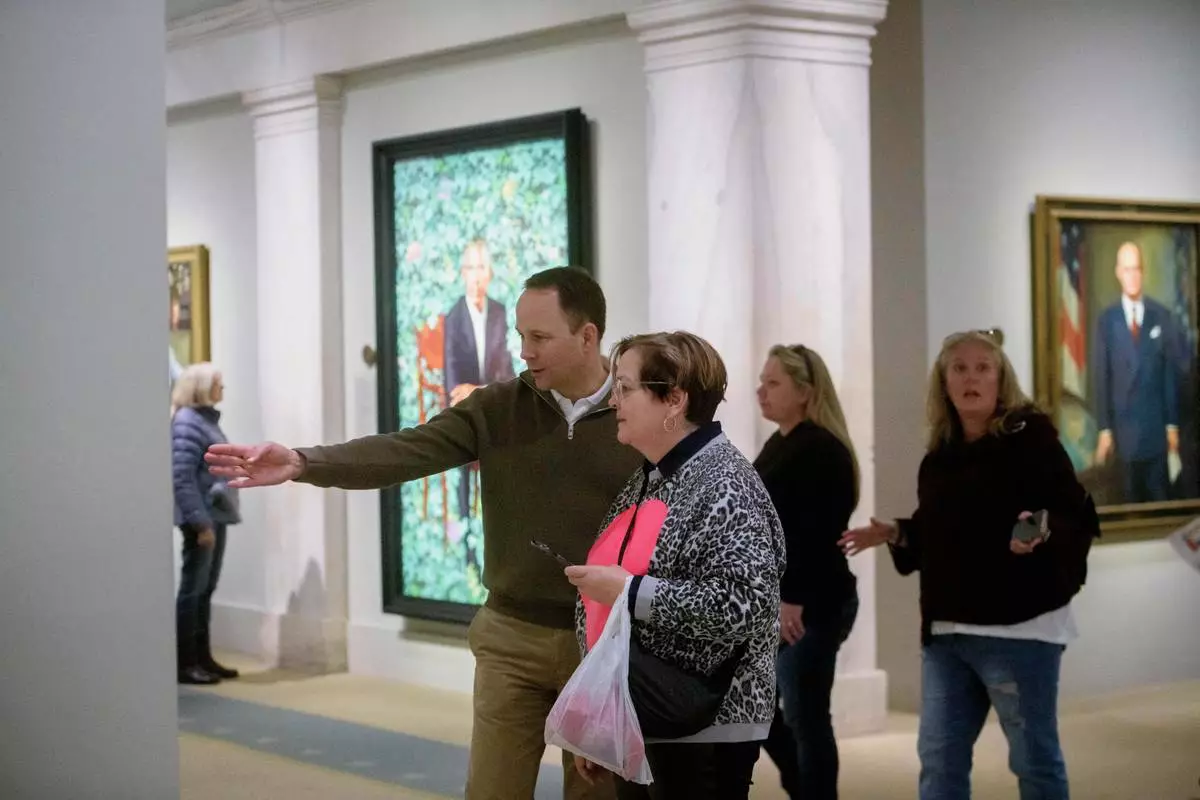
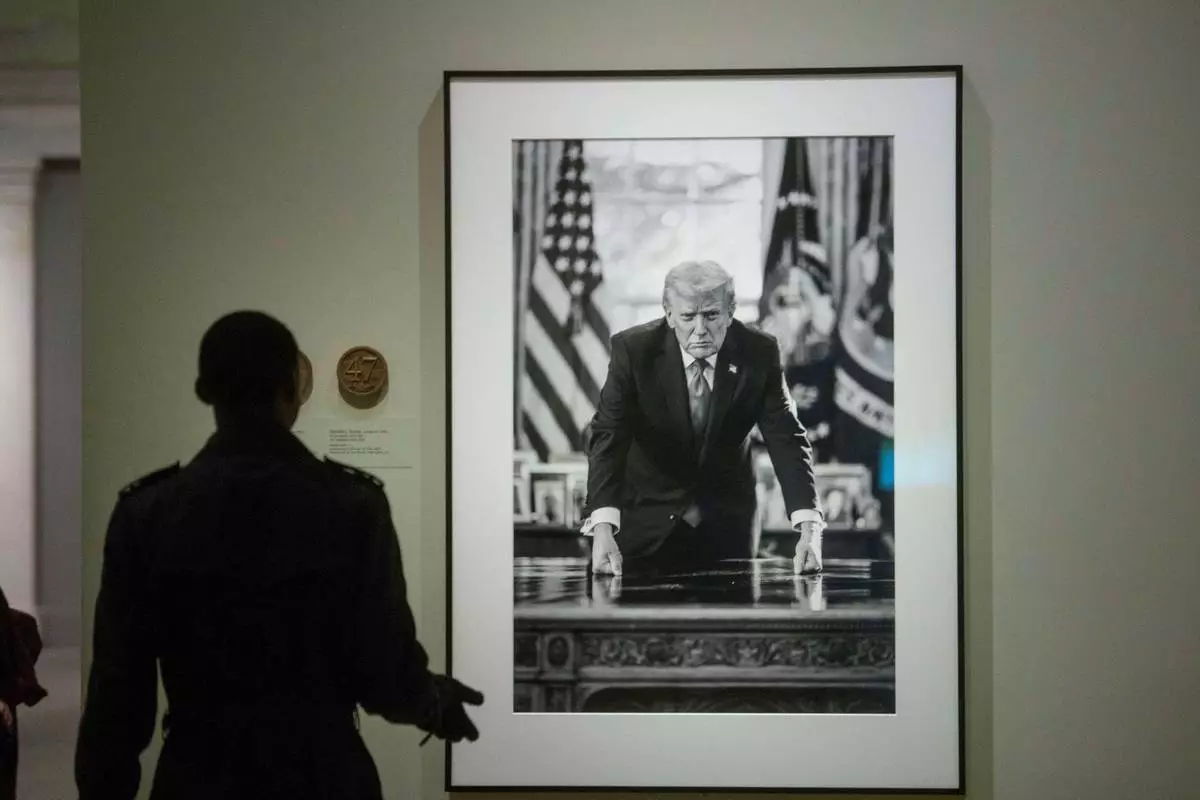
WASHINGTON (AP) — President Donald Trump's photo portrait display at the Smithsonian's National Portrait Gallery has had references to his two impeachments removed, the latest apparent change at the collection of museums he has accused of bias as he asserts his influence over how official presentations document U.S. history.

The wall text, which summarized Trump's first presidency and noted his 2024 comeback victory, was part of the museum's “American Presidents” exhibition. The description had been placed alongside a photograph of Trump taken during his first term. Now, a different photo appears without any accompanying text block, though the text was available online. Trump was the only president whose display in the gallery, as seen Sunday, did not include any extended text.

The White House did not say whether it sought any changes. Nor did a Smithsonian statement in response to Associated Press questions. But Trump ordered in August that Smithsonian officials review all exhibits before the nation celebrates the 250th anniversary of the Declaration of Independence on July 4. The Republican administration said the effort would “ensure alignment with the president’s directive to celebrate American exceptionalism, remove divisive or partisan narratives, and restore confidence in our shared cultural institutions.”

Trump's original “portrait label," as the Smithsonian calls it, notes Trump's Supreme Court nominations and his administration's development of COVID-19 vaccines. That section concludes: “Impeached twice, on charges of abuse of power and incitement of insurrection after supporters attacked the U.S. Capitol on January 6, 2021, he was acquitted by the Senate in both trials.”

Then the text continues: “After losing to Joe Biden in 2020, Trump mounted a historic comeback in the 2024 election. He is the only president aside from Grover Cleveland (1837– 1908) to have won a nonconsecutive second term.”

Asked about the display, White House spokesman Davis Ingle celebrated the new photograph, which shows Trump, brow furrowed, leaning over his Oval Office desk. Ingle said it ensures Trump's “unmatched aura ... will be felt throughout the halls of the National Portrait Gallery.”

The portrait was taken by White House photographer Daniel Torok, who is credited in the display that includes medallions noting Trump is the 45th and 47th president. Similar numerical medallions appear alongside other presidents' painted portraits that also include the more extended biographical summaries such as what had been part of Trump's display.

Sitting presidents are represented by photographs until their official paintings are commissioned and completed.

Ingle did not answer questions about whether Trump or a White House aide, on his behalf, asked for anything related to the portrait label.

The gallery said in a statement that it had previously rotated two photographs of Trump from its collection before putting up Torok's work.

“The museum is beginning its planned update of the America’s Presidents gallery which will undergo a larger refresh this Spring,” the gallery statement said. “For some new exhibitions and displays, the museum has been exploring quotes or tombstone labels, which provide only general information, such as the artist’s name.”

For now, references to Presidents Andrew Johnson and Bill Clinton being impeached in 1868 and 1998, respectively, remain as part of their portrait labels, as does President Richard Nixon's 1974 resignation as a result of the Watergate scandal.

And, the gallery statement noted, “The history of Presidential impeachments continues to be represented in our museums, including the National Museum of American History.”

Trump has made clear his intentions to shape how the federal government documents U.S. history and culture. He has offered an especially harsh assessment of how the Smithsonian and other museums have featured chattel slavery as a seminal variable in the nation's development but also taken steps to reshape how he and his contemporary rivals are depicted.

In the months before his order for a Smithsonian review, he fired the head archivist of the National Archives and said he was firing the National Portrait Gallery's director, Kim Sajet, as part of his overhaul. Sajet maintained the backing of the Smithsonian's governing board, but she ultimately resigned.

At the White House, Trump has designed a notably partisan and subjective “Presidential Walk of Fame” featuring gilded photographs of himself and his predecessors — with the exception of Biden, who is represented by an autopen — along with plaques describing their presidencies.

The White House said at the time that Trump himself was a primary author of the plaques. Notably, Trump's two plaques praise the 45th and 47th president as a historically successful figure while those under Biden's autopen stand-in describe the 46th executive as “by far, the worst President in American History” who “brought our Nation to the brink of destruction.”

Barrow reported from Atlanta.

People react to a photograph of President Donald Trump on display at the Smithsonian's National Portrait Gallery's "American Presidents" exhibit on Sunday, Jan. 11, 2026 in Washington. (AP Photo/Rod Lamkey, Jr.)

People react to a photograph of President Donald Trump on display at the Smithsonian's National Portrait Gallery's "American Presidents" exhibit on Sunday, Jan. 11, 2026 in Washington. (AP Photo/Rod Lamkey, Jr.)

Visitors to the National Portrait Gallery walk past the portrait of President Donald Trump, Sunday, Jan. 11, 2026, in Washington. (AP Photo/Rod Lamkey, Jr.)

Visitors to the National Portrait Gallery walk past the portrait of President Donald Trump, Sunday, Jan. 11, 2026, in Washington. (AP Photo/Rod Lamkey, Jr.)

Visitors stop to look at a photograph of President Donald Trump and a short plaque next to it are on display at the Smithsonian's National Portrait Gallery's "American Presidents" exhibit on Sunday, Jan. 11, 2026 in Washington. (AP Photo/Rod Lamkey, Jr.)

Visitors stop to look at a photograph of President Donald Trump and a short plaque next to it are on display at the Smithsonian's National Portrait Gallery's "American Presidents" exhibit on Sunday, Jan. 11, 2026 in Washington. (AP Photo/Rod Lamkey, Jr.)

A photograph of President Donald Trump and a short plaque next to it are on display at the Smithsonian's National Portrait Gallery's "American Presidents" exhibit on Sunday, Jan. 11, 2026 in Washington. (AP Photo/Anna Johnson)

A photograph of President Donald Trump and a short plaque next to it are on display at the Smithsonian's National Portrait Gallery's "American Presidents" exhibit on Sunday, Jan. 11, 2026 in Washington. (AP Photo/Anna Johnson)

President Donald Trump speaks during a meeting with oil executives in the East Room of the White House, Friday, Jan. 9, 2026, in Washington. (AP Photo/Evan Vucci)

President Donald Trump speaks during a meeting with oil executives in the East Room of the White House, Friday, Jan. 9, 2026, in Washington. (AP Photo/Evan Vucci)

Recommended Articles