On summer break from a Ph.D. program, an international student at University of California, San Diego, was planning a trip with a few friends to Hawaii. But after seeing international students across the United States stripped of their legal status, the student decided against it.
Any travel, even inside the U.S., just didn't seem worth the risk.
“I probably am going to skip that to ... have as few interactions with governments as possible," said the student, who spoke on condition of anonymity out of fear of being targeted.
International students weighing travel to see family, take a vacation or conduct research are thinking twice because of the Trump administration's crackdown, which has added to a sense of vulnerability.
Even before students suddenly began losing permission to study in the U.S., some colleges were encouraging international students and faculty to postpone travel, citing government efforts to deport students involved in pro-Palestinian activism. As the scale of the status terminations emerged in recent weeks, more schools have cautioned against non-essential travel abroad for international students.
University of California, Berkeley, for one, issued an advisory last week saying upcoming international travel was risky due to “strict vetting and enforcement.”
At least 1,220 students at 187 colleges, universities and university systems have had their visas revoked or legal status terminated since late March, according to an Associated Press review of university statements, correspondence with school officials and court records.
The number of affected students appears far higher, though. At least 4,736 international students’ visa records were terminated in a government database that maintains their legal status, according to an April 10 Immigration and Customs Enforcement response to inquiries from Congress.
Suddenly at risk for deportation, some students went into hiding while others left the country on their own. Many of the students said they had only minor infractions on their records or didn't know why their records were removed.
After federal judges raised due process concerns in several students' cases, the U.S. government reversed the terminations but then issued new guidance expanding the reasons international students can lose their legal status in the future.
Under the new policy, valid reasons for status termination include the revocation of the visas students used to enter the U.S. In the past, if a student’s visa was revoked, they generally could stay in the U.S. to finish school. They simply would not be able to reenter if they left the country.
The fast-evolving situation has left colleges struggling to advise students.
A Michigan college employee who helps international students navigate the visa process said they are inquiring more than ever about summer travel. The employee, who spoke on condition of anonymity because he was not authorized to speak to the media, said he often has been unable to give sufficient answers.
Last year, the U.S. hosted around 1.1 million international students, a source of essential tuition revenue at many schools. Advocates say that number is likely to shrink as the crackdown hurts America's appeal.
Over the past few weeks, Rishi Oza's immigration law firm in North Carolina has received calls about travel risks almost daily from people of varied immigration status, including international students.
“You kind of shake your head and say, ‘Is this the character of the country we want?'” Oza said. “It just seems that it’s a bit out of whack that people are fearful of leaving and whether they'll be able to come back.”
Students in the U.S. with a visa need to decide if their travels are critical, Oza said.
When attempting reentry after leaving the country, they should bring immigration documents, school transcripts and even court documents if they were charged with a crime and the court dismissed the case. Ultimately, lawyers can't foretell what will happen at the airport, he said.
The unpredictability has put one international student at the University of Illinois in distress. The student, who requested anonymity to avoid being targeted, has laid low since one of his classmates left the country after their legal status was terminated.
The student's plan to travel to his home country in Asia this summer causes feelings of panic, but he has nowhere else to stay. He bought his plane ticket and is committed to the trip. His anxiety over what could happen when he returns, however, is still there.
Associated Press reporter Christopher L. Keller contributed from Albuquerque, New Mexico.
The Associated Press’ education coverage receives financial support from multiple private foundations. AP is solely responsible for all content. Find AP’s standards for working with philanthropies, a list of supporters and funded coverage areas at AP.org.

FILE - A group of Florida International University students protest against cuts in federal funding and an agreement by campus police to partner with Immigration and Customs Enforcement, on the FIU campus on a day of protests around the country in support of higher education, Thursday, April 17, 2025, in Miami. (AP Photo/Rebecca Blackwell, File)
RHO, Italy (AP) — No ice is colder and harder than speedskating ice. The precision it takes has meant that Olympic speedskaters have never competed for gold on a temporary indoor rink – until the 2026 Milan Cortina Winter Games.
In the pursuit of maximum glide and minimum friction, Olympic officials brought on ice master Mark Messer, a veteran of six previous Olympic speedskating tracks and the ice technician in charge of the Olympic Oval in Calgary, Canada — one of the fastest tracks in the world with over 300 records.
Messer has been putting that experience to work one thin layer of ice at a time since the end of October at the new Speed Skating Stadium, built inside adjacent trade fair halls in the city of Rho just north of Milan.
“It’s one of the biggest challenges I’ve had in icemaking,’’ Messer said during an interview less than two weeks into the process.
If Goldilocks were a speedskater, hockey ice would be medium hard, for fast puck movement and sharp turns. Figure skating ice would be softer, allowing push off for jumps and so the ice doesn’t shatter on landing. Curling ice is the softest and warmest of all, for controlled sliding.
For speedskating ice to be just right, it must be hard, cold and clean. And very, very smooth.
“The blades are so sharp, that if there is some dirt, the blade will lose the edge,’’ Messer said, and the skater will lose speed.
Speedskater Enrico Fabris, who won two Olympic golds in Turin in 2006, has traded in his skates to be deputy sports manager at the speedskating venue in Rho. For him, perfect ice means the conditions are the same for all skaters — and then if it's fast ice, so much the better.
"It's more of a pleasure to skate on this ice,'' he said.
Messer’s first Olympics were in Calgary in 1988 — the first time speedskating was held indoors. “That gave us some advantages because we didn’t have to worry about the weather, wind blowing or rain,’’ he said. Now he is upping the challenge by becoming the first ice master to build a temporary rink for the Olympics.
Before Messer arrived in Italy, workers spent weeks setting up insulation to level the floor and then a network of pipes and rubber tubes that carry glycol — an antifreeze — that is brought down to minus 7 or minus 8 degrees Celsius (17.6 to 19.4 degrees Fahrenheit) to make the ice.
Water is run through a purification system — but it can’t be too pure, or the ice that forms will be too brittle. Just the right amount of impurities “holds the ice together,’’ Messer said.
The first layers of water are applied slowly, with a spray nozzle; after the ice reaches a few centimeters it is painted white — a full day’s work — and the stripes are added to make lanes.
“The first one takes about 45 minutes. And then as soon as it freezes, we go back and do it again, and again and again. So we do it hundreds of times,’’ Messer said.
As the ice gets thicker, and is more stable, workers apply subsequent layers of water with hoses. Messer attaches his hose to hockey sticks for easier spreading.
What must absolutely be avoided is dirt, dust or frost — all of which can cause friction for the skaters, slowing them down. The goal is that when the skaters push “they can go as far as possible with the least amount of effort,’’ Messer said.
The Zamboni ice resurfacing machine plays a key role in keeping the track clean, cutting off a layer and spraying water to make a new surface.
One challenge is gauging how quickly the water from the resurfacing machine freezes in the temporary rink.
Another is getting the ice to the right thickness so that the Zamboni, weighing in at six tons, doesn’t shift the insulation, rubber tubing or ice itself.
“When you drive that out, if there’s anything moving it will move. We don’t want that,’’ Messer said.
The rink got its first big test on Nov. 29-30 during a Junior World Cup event. In a permanent rink, test events are usually held a year before the Olympics, leaving more time for adjustments. “We have a very small window to learn,’’ Messer acknowledged.
Dutch speedskater Kayo Vos, who won the men’s neo-senior 1,000 meters, said the ice was a little soft — but Messer didn’t seem too concerned.
“We went very modest to start, now we can start to change the temperatures and try to make it faster and still maintain it as a safe ice,’’ he said.
Fine-tuning the air temperature and humidity and ice temperature must be done methodically — taking into account that there will be 6,000 spectators in the venue for each event. The next real test will be on Jan. 31, when the Olympians take to the ice for their first training session.
“Eighty percent of the work is done but the hardest part is the last 20 percent, where we have to try to find the values and the way of running the equipment so all the skaters get the same conditions and all the skaters get the best conditions,’’ Messer said.
AP Winter Olympics: https://apnews.com/hub/milan-cortina-2026-winter-olympics

Serpentines are set on the ice of the stadium where speed skating discipline of the Milan Cortina 2026 Winter Olympics will take place, in Rho, outskirt of Milan, Tuesday, Nov. 11, 2025. (AP Photo/Luca Bruno)

Ice Master Mark Messer poses in the stadium where speed skating discipline of the Milan Cortina 2026 Winter Olympics will take place, in Rho, outskirt of Milan, Tuesday, Nov. 11, 2025. (AP Photo/Luca Bruno)
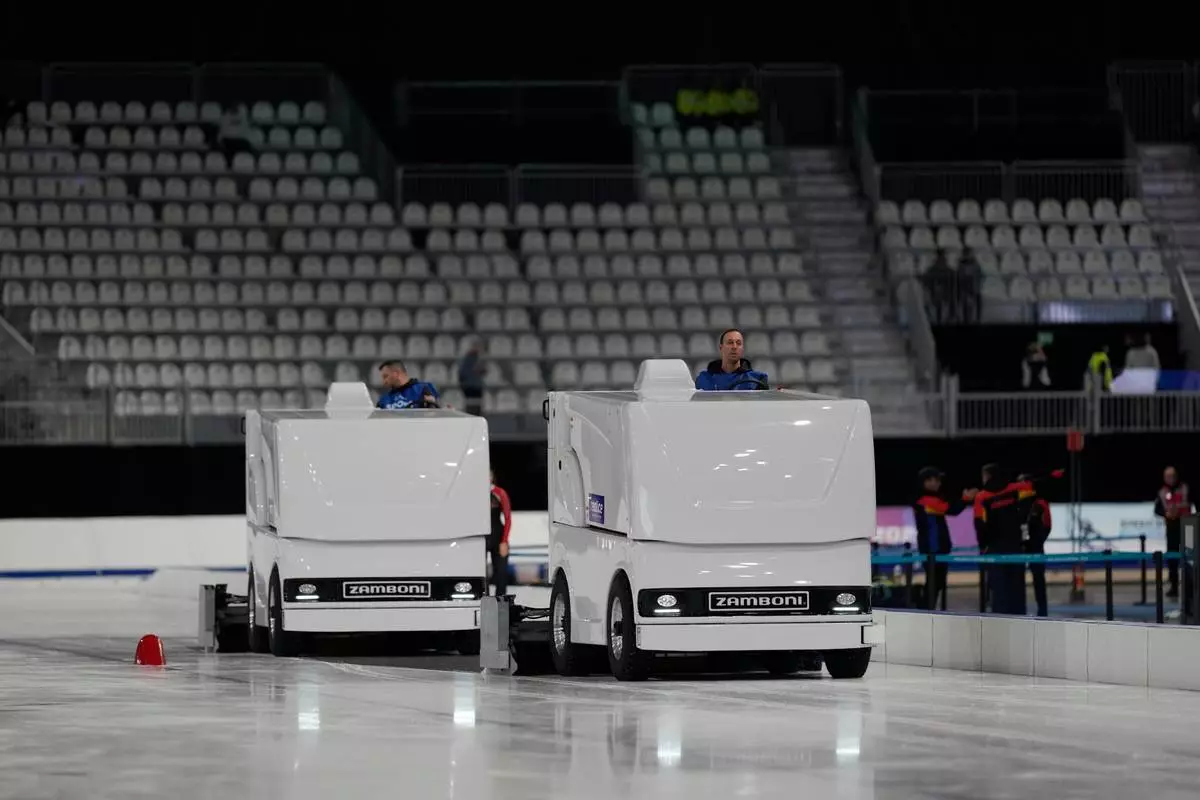
Workers clean the ice surface during a peed skating Junior World Cup and Olympic test event, in Rho, near Milan, Italy, Saturday, Nov. 29, 2025. (AP Photo/Luca Bruno)

Ice Master Mark Messer poses in the stadium where speed skating discipline of the Milan Cortina 2026 Winter Olympics will take place, in Rho, outskirt of Milan, Tuesday, Nov. 11, 2025. (AP Photo/Luca Bruno)

Ice Master Mark Messer poses in the stadium where speed skating discipline of the Milan Cortina 2026 Winter Olympics will take place, in Rho, outskirt of Milan, Tuesday, Nov. 11, 2025. (AP Photo/Luca Bruno)