BATON ROUGE, La. (AP) — An ambitious project to restore a rapidly vanishing stretch of Louisiana coast that was devastated by the 2010 Gulf oil spill has been thrown deeper into disarray amid claims by Gov. Jeff Landry that his predecessor concealed an unfavorable study that it was feared could imperil the $3 billion effort.
It's a controversy that was even predicted by the previous administration as it grappled with how to handle conflicting environmental analyses for the project, according to a confidential memo obtained by The Associated Press.
The nine-page document, prepared by five attorneys working for then-Gov. John Bel Edwards' administration, sheds new light on a study Landry says was improperly withheld from the public and the U.S. Army Corps of Engineers as it was approving a permit for the Mid-Barataria Sediment Diversion.
The stakes were so high the attorneys even weighed whether state officials could face federal charges for withholding from the Corps a report that the diversion would generate significantly less land than another modeling projection used in a federal review.
Prosecution seemed “extremely unlikely,” the lawyers wrote to the heads of the Coastal Protection and Restoration Authority, which oversees the diversion project, but they added that “the severe consequences and criminalization of the action warranted mention.”
The attorneys also warned that the Corps might suspend or revoke the permit if it discovered the study after the fact, the 2022 memo shows, foreshadowing actions taken last month when the Corps cited “deliberately withheld” information among its reasons for suspending its permit for the project. The move halts construction despite more than half a billion dollars already spent.
“They hid the bad stuff and only showed the (Corps) the version they liked,” Landry wrote in a post on X. “Science is easy when you just delete the inconvenient parts!”
Edwards denied his administration withheld information from the Corps and said “Gov. Landry’s accusations are demonstrably false.”
“When all the facts are presented, the public will see that his administration has played political games and botched this important project,” Edwards said in a statement to AP.
Landry countered in his own statement that “the facts speak for themselves.”
Amid the finger-pointing, conservation proponents have called the report in question a red herring that Landry is using to tank the project. The diversion, funded mostly from a settlement arising from BP’s 2010 Deepwater Horizon oil spill, is the largest of its kind in Louisiana’s history.
The Mid-Barataria Sediment Diversion would puncture levees in southeast Louisiana, diverting some of the river’s sediment-rich flow to restore wetlands. The long-delayed project was intended to mitigate a disappearing coastline caused by a range of factors such as climate change-induced sea-level rise and the river’s vast levee system. Ground was broken in 2023, but state and federal litigation has stalled it.
Opponents have blasted its ballooning cost and crippling effects on the local fishing and oyster industries. Landry has said the project would “break” Louisiana’s culture of shrimp and oyster harvesting, likening it to government efforts a century ago to punish schoolchildren for speaking Cajun French.
Earlier this year, Landry's administration approached the Corps with a list of concerns about the project, including a 2022 study it said “does not appear to have been disclosed to the public nor considered by all necessary persons within the Corps.”
Officials working for the state at the time defended their handling of the report in question, saying it had been focused on analyzing maintenance and operational costs related to the diversion and was not intended to be part of the federal environmental impact statement process.
The report, prepared by AECOM Technical Services and a subcontractor, produced “inconsistent” results such as a significantly lower projected land creation — as few as 7 square miles (18 square kilometers) compared to the 21 square miles (54 square kilometers) estimated under the primary model, according to the confidential memo.
Officials familiar with the study said its lower projection resulted from not properly accounting for sea level rise and underestimating the river's flow. The memo also pointed to the need for “significant dredging” to maintain the diversion channel, which Landry's administration now says will cost tens of millions of dollars.
In the memo, the attorneys outlined a series of “reputational concerns” about withholding the study and warned it would be more difficult to keep “controlling the narrative” if the Louisiana Coastal Protection and Restoration Authority “is on the defensive.”
The memo noted the Corps and other federal agencies could delay the project for years if they attempted to integrate the modeling results into their environmental impact analysis. Failing to formally disclose the modeling results to federal agencies like the Corps, the attorneys warned, also would leave the project vulnerable to litigation.
They suggested the Edwards administration “informally discuss” the issue with federal agencies and then strategize the best way to “formally” enter it into the public record for the agencies to review.
The report's findings eventually were verbally communicated to at least one Corps official, who indicated it was insignificant, according to multiple former Coastal Protection and Restoration Authority officials familiar with the exchange. But the complete analysis itself was not submitted into the public record, nor was the official's response at the time, they said.
The former state officials weren't authorized to discuss internal deliberations and spoke to the AP on the condition of anonymity.
Col. Cullen Jones, head of the Corps’ New Orleans District, told Landry’s administration last month that the Corps recently conducted a “technical review” of the modeling analysis in question and concluded it “would not affect” the permit.
But Jones said the Corps suspended the project’s permit in part because “the State deliberately withheld information … that the State knew it should provide.”
The Corps also pointed to actions taken by Landry’s administration, including a 90-day work stoppage announced last month amid plans to study an alternative “smaller diversion” and claims the state can't afford the project.
It’s unclear how Landry intends to respond to the permit’s suspension. The state has until Monday to take action to dispute the permit suspension. At that point, the Corps could revoke or modify the permit as it sees fit.
Louisiana’s coastal agency earmarked about $573 million in its 2025 budget for the project, an amount now being reviewed by the legislature. Last fall, federal agencies tasked with managing Deepwater Horizon settlement money warned that if Louisiana backs out of or alters the Mid-Barataria diversion, money allocated for it would need to be returned.
Lauren Bourg, director of the National Audubon Society’s Mississippi River Delta program, told lawmakers that ending or altering the project “sends the message that any infrastructure project in this state may be undone by a few stakeholders who engage in politics with the right people, distorting the scientific and engineering principles upon which all of these projects are grounded.”
But many in southeast Louisiana’s fishing industry applauded the move to halt the project.
“If all this water comes down, it’s going to kill everything,” said Mitch Jurisich, chairman of the Louisiana Oyster Task Force.
__ Brook reported from New Orleans. He is a corps member for The Associated Press/Report for America Statehouse News Initiative. Report for America is a nonprofit national service program that places journalists in local newsrooms to report on undercovered issues. Follow Brook on X at @jack_brook96
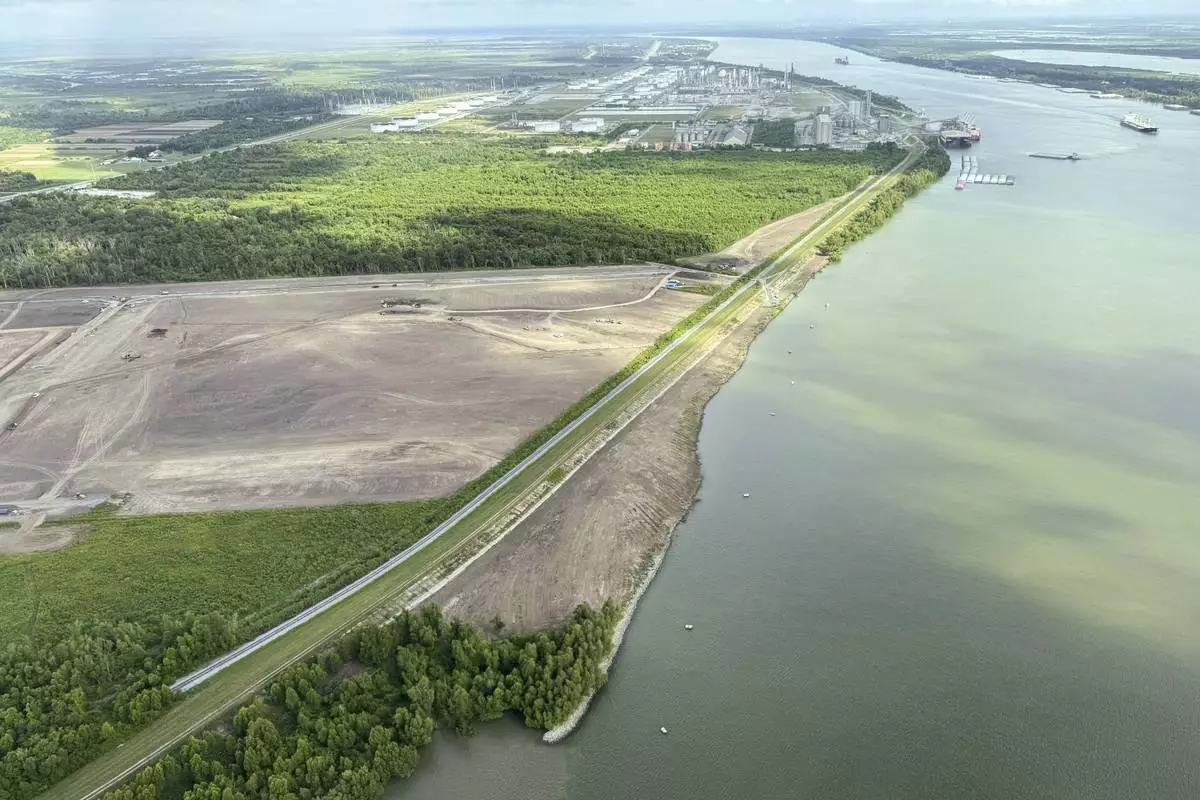
FILE - The nearly $3 billion Mid-Barataria Sediment Diversion project along the Mississippi River, intended to stave off coastal land loss in southeastern Louisiana, is seen during a flyover with the environmental coalition group Restore the Mississippi River Delta, Aug. 29, 2024. (AP Photo/Jack Brook)