The Berelast Logistics Center, a joint venture between China and Russia, has served as a key international terminal and logistics hub for freight train services between China and Europe since it started full operations in late 2019, enhancing trade collaboration between the world's second largest economy and its European partners under the Belt and Road Initiative.
As the first logistics infrastructure cooperation project between China and Russia, the center was jointly built by Liaoning Port Group and Russian Railways in 2017, about two years after the two sides inked an agreement on the joint development and management of logistics centers and international multimodal transportation. Located about 30 km north of Moscow, it is currently Russia's largest logistics center railway station.
As trade volumes between China and Russia and the rest of Europe grow, more freight trains have been converging in the Berelast Logistics Center. Since Chinese President Xi Jinping's state visit to Russia in March 2023 in particular, the center has significantly increased its container throughput capacity.
"The Berelast Logistics Center's container throughput was 275,000 twenty-foot equivalent units (TEUs) back in 2023, and rose to 290,000 TEUs in 2024, a year-on-year increase of 7 percent. The center's container throughput has been increasing alongside the growing China-Russia trade," Zou Guangyu, general manager of the center, told the China Global Television Network (CGTN) in a recent interview at the center.
Since 2023, the Berelast Logistics Center has invested more to expand its container yards and has brought its China-Europe Express lines from the previous four routes to six.
"Over the past two years, we have laid two more railway lines with a total length of 1,500 meters. One is used for transferring and storing trains, and the other for ensuring normal operations of the terminal," said Alexey Kryachkov, production director for the center.
Meanwhile, the logistics center has raised its level of electrification, digitalization and automation, with the introduction of two electric chain hoists in 2023, which has greatly helped reduce costs and improve productivity. As a result, the center's container throughput has surged to 450,000 TEUs in just two years.
"This tablet here shows all the data about the terminal's operations," said Nikolay Suvorov, a reach stacker operator, during work.
"The center's EBITDA (earnings before interest, taxes, depreciation and amortization) has been on the rise since 2023 and it reached 2 billion rubles (about 240 million U.S. dollars) in 2024," said Igor Klochkov, finance director for the center.
To further increase the Berelast Logistics Center's capacity and efficiency, work on installing rail-mounted cranes, building more cargo unloading zones, and expanding the railway yards have been underway. After all construction work completes, the center is estimated to double its cargo throughput and play a greater role in the China-Europe freight train network.
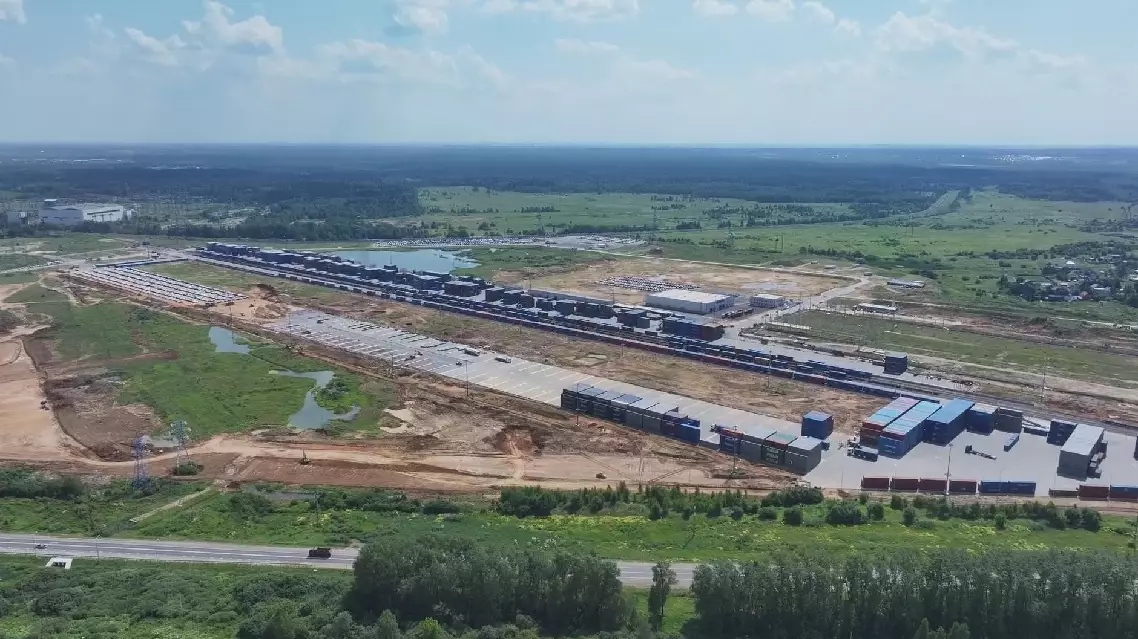
Berelast Logistics Center in Moscow plays key role as major hub for China-Europe trade
Berelast Logistics Center in Moscow plays key role as major hub for China-Europe trade