NEW YORK (AP) — President Donald Trump is eyeing Hollywood for his next round of tariffs, threatening to levy all films produced outside the U.S. at a steep rate of 100%.
Over the weekend, Trump accused other countries of “stealing the movie-making capabilities” of the U.S. and said that he had authorized the Commerce Department and the U.S. Trade Representative to immediately begin the process of implementing this new import tax on all foreign-made films. But further specifics or dates weren't provided. And the White House confirmed that no final decisions had been made as of Monday.
Trump later said that he would meet with industry executives about the proposal but a lot remains unclear about how an import tax on complex, international productions could even be implemented.
If imposed, experts warn that such a tariff would dramatically hike the costs of making movies today. That uncertainty could put filmmakers in limbo, much like other industries that have recently been caught in the crosshairs of today’s ongoing trade wars.
Unlike other sectors that have recently been targeted by tariffs, however, movies go beyond physical goods, bringing larger intellectual property ramifications into question. Here's what we know.
Trump is citing national security concerns, a justification he's similarly used to impose import taxes on certain countries and a range of sector-specific goods.
In a Sunday night post on his social media platform Truth Social, Trump claimed that the American movie industry is “DYING to a very fast death" as other countries offer “all sorts of incentives” to draw filmmaking away from the U.S.
Trump has previously voiced concern about movie production moving overseas. And in recent years, U.S. film and television production has been hampered between setbacks from the COVID-19 pandemic, the Hollywood guild strikes of 2023 and the recent wildfires in the Los Angeles area. Incentive programs have also long-influenced where movies are shot both abroad and within the U.S., with more production leaving California to states like Georgia and New Mexico -- as well as countries like Canada.
But unlike other sectors targeted by Trump's recently-imposed tariffs, the American film industry currently holds a trade deficit that's in the U.S.'s favor.
In movie theaters, American-produced movies overwhelmingly dominate the domestic marketplace. Data from the Motion Picture Association also shows that American films made $22.6 billion in exports and $15.3 billion in trade surplus in 2023 — with a recent report noting that these films “generated a positive balance of trade in every major market in the world” for the U.S.
Last year, international markets accounted for over 70% of Hollywood’s total box office revenue, notes Heeyon Kim, an assistant professor of strategy at Cornell University. She warns that tariffs and potential retaliation from other countries impacting this industry could result in billions of dollars in lost earnings and thousands of jobs.
“To me, (this) makes just no sense," she said, adding that such tariffs could "undermine otherwise a thriving part of the U.S. economy.”
The International Alliance of Theatrical Stage Employees, which represents behind-the-scenes entertainment workers across the U.S. and Canada, said in a statement Monday that Trump had “correctly recognized” the “urgent threat from international competition” that the American film and television industry faces today. But the union said it instead recommended the administration implement a federal production tax incentive and other provisions to “level the playing field” while not harming the industry overall.
That's anyone's guess.
“Traditional tariffs apply to physical imports crossing borders, but film production primarily involves digital services — shooting, editing and post-production work that happens electronically," notes Ann Koppuzha, a lawyer and business law lecturer at Santa Clara University's Leavey School of Business.
Koppuzha said that film production is more like an applied service that can be taxed, not tariffed. But taxes require Congressional approval, which could be a challenge even with a Republican majority.
Making a movie is also an incredibly complex — and international — process. It’s common for both large and small films to include production in the U.S. and in other countries. Big-budget movies like the upcoming “Mission: Impossible — The Final Reckoning,” for instance, are shot around the world.
U.S. studios frequently shoot abroad because tax incentives can aid production costs. But a blanket tariff across the board could discourage that or limit options, Kim said — hurting both Hollywood films and the global industry that helps create them.
“When you make these sort of blanket rules, you’re missing some of the nuance of how production works,” added Steven Schiffman, a longtime industry veteran and adjunct professor at Georgetown University. “Sometimes you just need to go to the location, because frankly it’s way too expensive just to try to create in a soundstage”
Schiffman points to popular titles filmed outside the U.S. — such as Warner Bros' “Harry Potter” series, which was almost entirely shot in the U.K. “The cost to have done that would have like literally double to produce those movies under this proposed tariff," he said.
Overall, experts warn that the prospect of tariffing foreign-made movies ventures into uncharted waters.
“There’s simply no precedent or sense for applying tariffs to these types of creative services,” Koppuzha said. And while the Trump administration could extend similar threats to other forms of intellectual property, like music, “they’d encounter the same practical hurdles."
But if successful, some also warn of potential retaliation. Kim points to “quotas" that some countries have had to help boost their domestic films by ensuring they get a portion of theater screens, for example. Many have reduced or suspended such quotas over the years in the name of open trade — but if the U.S. places a sweeping tariff on all foreign-made films, these kinds of quotas could come back, “which would hurt Hollywood film or any of the U.S.-made intellectual property,” Kim said.
And while U.S. dominance in film means “there are fewer substitutes” for retaliation, Schiffman notes that other forms of entertainment — like game development — could see related impacts down the road.
Others stress the potential consequences of hampering international collaboration overall.
“Creative content distribution requires thoughtful economic approaches that recognize how modern storytelling flows across borders," notes Frank Albarella, U.S. media and telecommunications sector leader at KPMG. "The question hanging over every screen: Might we better nurture American storytelling through smart, targeted incentives, or could we inadvertently force audiences to pay more for what could become a narrower creative landscape?”
AP Writers Jake Coyle and Jill Colvin in New York, Aamer Madhani in Palm Beach, Florida and Darlene Superville in Washington contributed to this report.
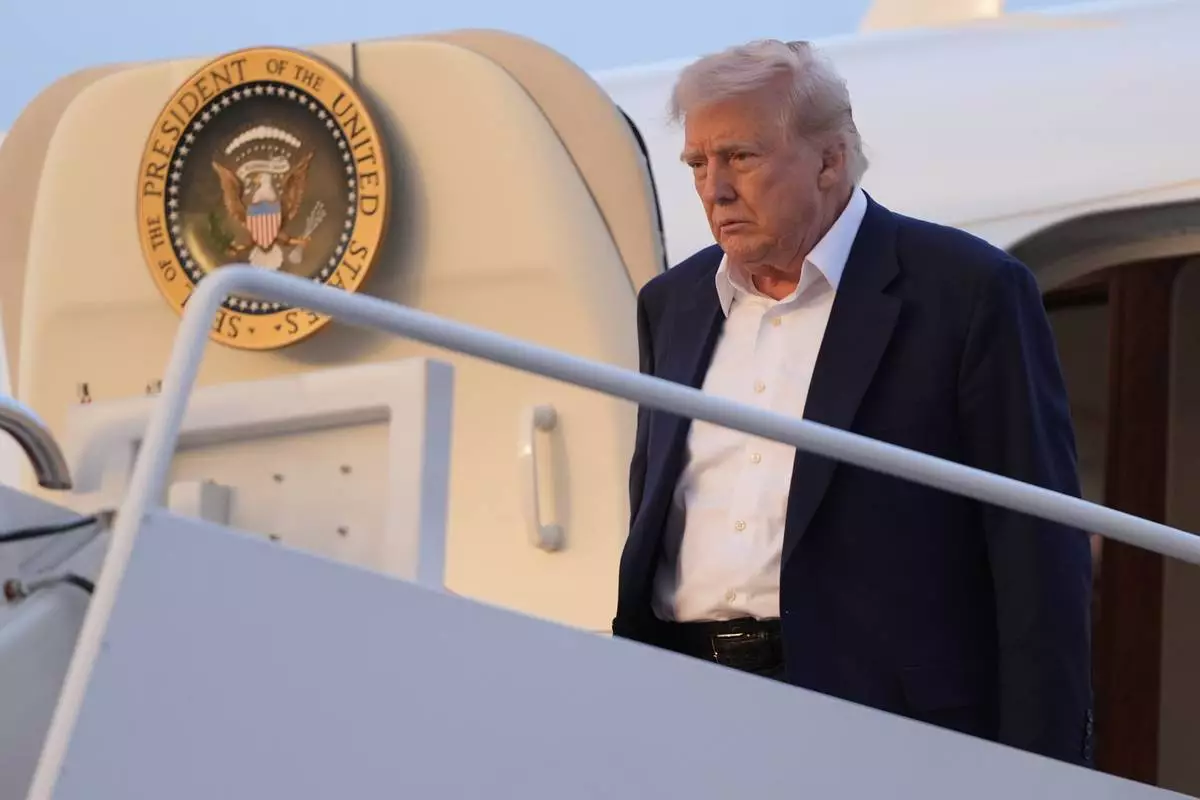
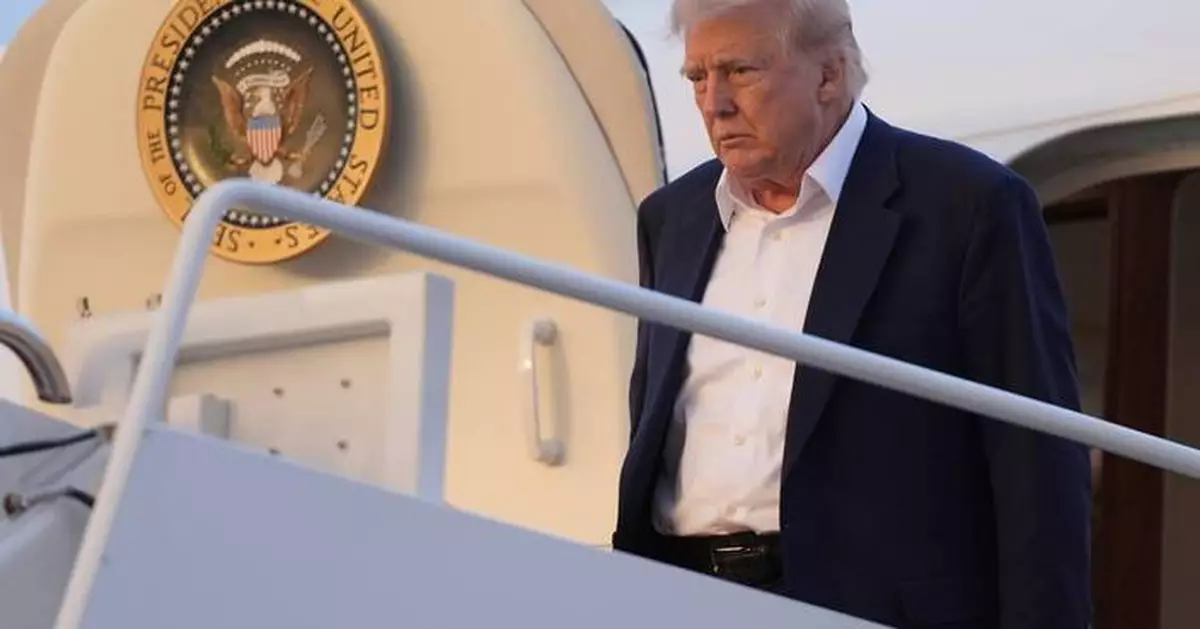
President Donald Trump arrives on Air Force One at Joint Base Andrews, Md., Sunday, May 4, 2025. (AP Photo/Manuel Balce Ceneta)