LOS ANGELES--(BUSINESS WIRE)--May 5, 2025--
Resecurity®, a leading U.S.-based cybersecurity company, proudly announces its official membership in the U.S.-U.A.E. Business Council, a premier organization dedicated to advancing commercial ties between the United States and the United Arab Emirates.
This press release features multimedia. View the full release here: https://www.businesswire.com/news/home/20250505438269/en/
The U.S.-U.A.E. Business Council plays a pivotal role in enhancing the bilateral relationship between the United States and the U.A.E. through high-level engagement with business and government leaders. It provides its members with unique access to exclusive networking opportunities, market intelligence, and strategic insights that foster mutual investment and innovation across sectors including energy, healthcare, defense, technology, and cybersecurity.
“We are delighted to welcome Resecurity to the U.S.-U.A.E. Business Council,” said Danny Sebright, President of the U.S.-U.A.E. Business Council. “Resecurity brings deep expertise in cybersecurity and threat intelligence, and their participation will add tremendous value to our growing technology and cybersecurity-focused initiatives. We look forward to supporting their efforts to build strong partnerships and enhance digital resilience in the U.A.E. and across the region.”
“Our membership in the U.S.-U.A.E. Business Council reflects our long-term commitment to building trusted relationships in the Middle East,” said Gene Yoo, CEO of Resecurity. “As the U.A.E. continues to lead regional digital transformation, we are excited to contribute our expertise in threat intelligence and cybersecurity innovation to support its vision for a secure and resilient digital future.”
Resecurity has been actively expanding its footprint in the Middle East and GCC regions, working with governments and enterprises to tackle emerging cyber threats, enhance digital resilience, and secure critical infrastructure. This collaboration with the U.S.-U.A.E. Business Council will further support efforts to bridge the cybersecurity gap and enable knowledge-sharing between international partners.
About Resecurity
Resecurity® is a cybersecurity company that delivers a unified endpoint protection, risk management, and cyber threat intelligence platform. Known for providing best-of-breed data-driven intelligence solutions, Resecurity services and platforms focus on early-warning identification of data breaches and comprehensive protection against cybersecurity risks. Founded in 2016, it has been globally recognized as one of the world's most innovative cybersecurity companies with the sole mission of enabling organizations to combat cyber threats regardless of how sophisticated they are. Most recently, Resecurity was named one of the Top 10 fastest-growing private cybersecurity companies in Los Angeles, California, by Inc. Magazine. An Official Partner of the Cybercrime Atlas by the World Economic Forum (WEF), Member of InfraGard National Members Alliance (INMA), AFCEA, NDIA, SIA, FS-ISAC and the American Chamber of Commerce in Saudi Arabia (AmChamKSA), Singapore (AmChamSG), Korea (AmChamKorea), Mexico (AmChamMX), Thailand (AmChamThailand), and UAE (AmChamDubai). To learn more about Resecurity, visit https://resecurity.com.
About the U.S.-U.A.E. Business Council
The U.S.-U.A.E. Business Council is the premier business organization dedicated to advancing bilateral commercial relations between the United States and the United Arab Emirates. Through its programs, events, and policy work, the U.S.-U.A.E. Business Council provides its members with unparalleled access to senior decision-makers in both countries and facilitates strategic partnerships across various sectors. To learn more about the U.S.-U.A.E. Business Council, visit https://usuaebusiness.org.
Resecurity Joins U.S. U.A.E. Business Council to Strengthen Cybersecurity Collaboration in the Middle East
WASHINGTON (AP) — President Donald Trump is meeting with oil executives at the White House on Friday in hopes of securing $100 billion in investments to revive Venezuela’s ability to fully tap into its expansive reserves of petroleum — a plan that rides on their comfort in making commitments in a country plagued by instability, inflation and uncertainty.
Since the U.S. military raid to capture former Venezuelan leader Nicolás Maduro on Saturday, Trump has quickly pivoted to portraying the move as a newfound economic opportunity for the U.S., seizing tankers carrying Venezuelan oil, saying the U.S. is taking over the sales of 30 million to 50 million barrels of previously sanctioned Venezuelan oil and will be controlling sales worldwide indefinitely.
On Friday, U.S. forces seized their fifth tanker over the past month that has been linked to Venezuelan oil. The action reflected the determination of the U.S. to fully control the exporting, refining and production of Venezuelan petroleum, a sign of the Trump administration's plans for ongoing involvement in the sector as it seeks commitments from private companies.
It's all part of a broader push by Trump to keep gasoline prices low. At a time when many Americans are concerned about affordability, the incursion in Venezuela melds Trump’s assertive use of presidential powers with an optical spectacle meant to convince Americans that he can bring down energy prices.
The meeting, set for 2:30 p.m. EST, will be open to the news media, according to an update to the president's daily schedule. “At least 100 Billion Dollars will be invested by BIG OIL, all of whom I will be meeting with today at The White House,” Trump said Friday in a pre-dawn social media post.
Trump is set to meet with executives from 17 oil companies, according to the White House. Among the companies attending are Chevron, which still operates in Venezuela, and ExxonMobil and ConocoPhillips, which both had oil projects in the country that were lost as part of a 2007 nationalization of private businesses under Maduro’s predecessor, Hugo Chávez.
The president is meeting with a wide swath of domestic and international companies with interests ranging from construction to the commodity markets. Other companies slated to be at the meeting include Halliburton, Valero, Marathon, Shell, Singapore-based Trafigura, Italy-based Eni and Spain-based Repsol.
Large U.S. oil companies have so far largely refrained from affirming investments in Venezuela as contracts and guarantees need to be in place. Trump has suggested on social media that America would help to backstop any investments.
Venezuela’s oil production has slumped below one million barrels a day. Part of Trump's challenge to turn that around will be to convince oil companies that his administration has a stable relationship with Venezuela’s interim President Delcy Rodríguez, as well as protections for companies entering the market.
Secretary of State Marco Rubio, Energy Secretary Chris Wright and Interior Secretary Doug Burgum are slated to attend the oil executives meeting, according to the White House.
Meanwhile, the United States and Venezuelan governments said Friday they were exploring the possibility of r estoring diplomatic relations between the two countries, and that a delegation from the Trump administration arrived to the South American nation on Friday.
The small team of U.S. diplomats and diplomatic security officials traveled to Venezuela to make a preliminary assessment about the potential re-opening of the U.S. Embassy in Caracas, the State Department said in a statement.
Trump also announced on Friday he’d meet with President Gustavo Petro in early February, but called on the Colombian leader to make quick progress on stemming flow of cocaine into the U.S.
Trump, following the ouster of Maduro, had made vague threats to take similar action against Petro. Trump abruptly changed his tone Wednesday about his Colombian counterpart after a friendly phone call in which he invited Petro to visit the White House.
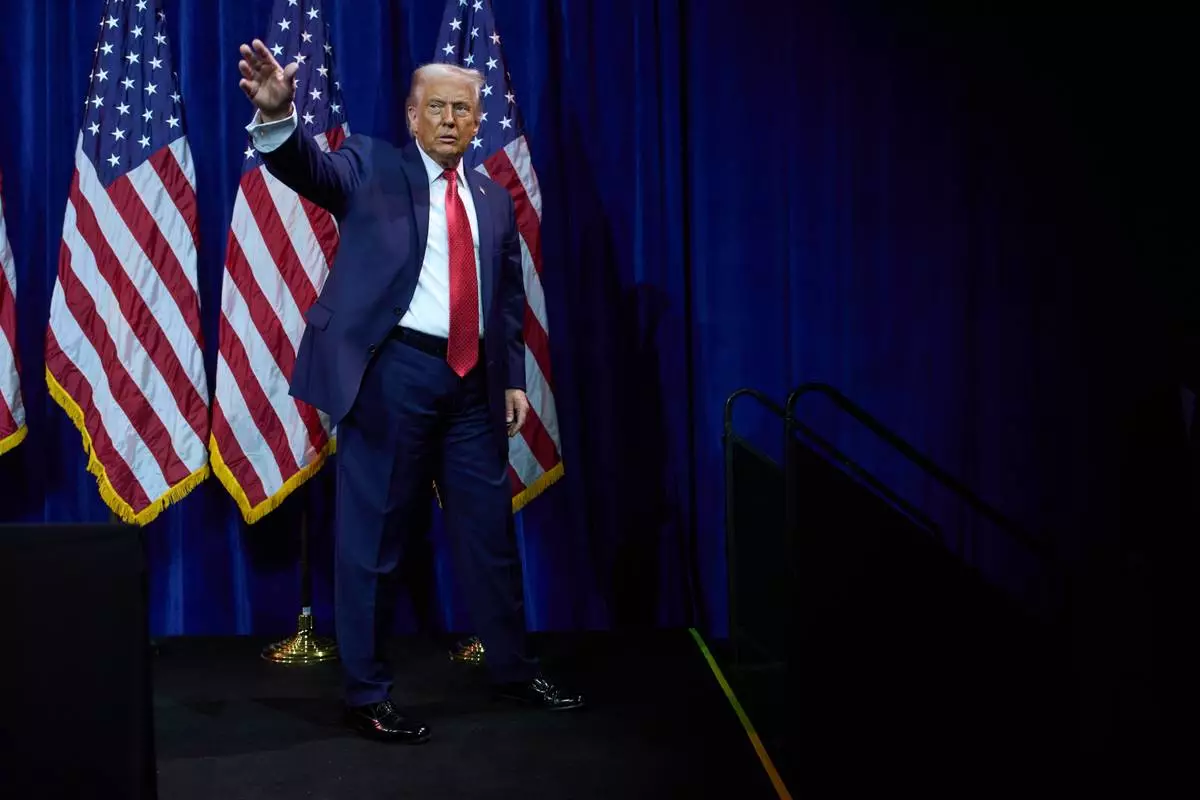
President Donald Trump waves as he walks off stage after speaking to House Republican lawmakers during their annual policy retreat, Tuesday, Jan. 6, 2026, in Washington. (AP Photo/Evan Vucci)