WASHINGTON (AP) — The Trump administration has asked a judge to toss out a lawsuit from three Republican-led states seeking to cut off telehealth access to the abortion medication mifepristone.
Justice Department attorneys on Monday stayed the legal course charted by the Biden administration, though they didn't directly weigh in on the underlying issue of access to the drug, which is part of the nation's most common method of abortion.
Rather, the government argued the states don't have the legal right, or standing, to sue.
“The states are free to pursue their claims in a district where venue is proper, but the states’ claims before this court must be dismissed or transferred pursuant to the venue statute’s mandatory command,” federal government attorneys wrote.
The lawsuit from Idaho, Kansas and Missouri argues that the Food and Drug Administration should roll back access to mifepristone. They filed their complaint after the Supreme Court preserved access to mifepristone last year. They want the FDA to prohibit telehealth prescriptions for mifepristone, require three in-office visits and restrict the point in a pregnancy when it can be used.
The case is being considered in Texas by U.S. District Judge Matthew Kacsmaryk, a Trump nominee who once ruled in favor of halting approval for the drug.
Kacsmaryk’s original ruling came in a lawsuit filed by anti-abortion groups. It was narrowed by an appeals court before being tossed out by the Supreme Court, which found the plaintiffs lacked the legal right to sue.
The three states later moved to revive the case, arguing they did have legal standing because access to the drug undermined their abortion laws.
But the Department of Justice attorneys said the states can't just piggyback on the earlier lawsuit as a way to keep the case in Texas.
Nothing is stopping the states from filing the lawsuit someplace else, attorney Daniel Schwei wrote, but the venue has to have some connection to the claims being made.
Besides, Schwei wrote, the states are challenging actions the FDA took in 2016, when it first loosened restrictions on mifeprostone. That's well past the six-year time limit to sue, he said.
Abortion is banned at all stages of pregnancy in Idaho. Missouri had a strict ban, but clinics recently began offering abortions again after voters approved a new constitutional amendment for reproductive rights. Abortion is generally legal up to 22 weeks in Kansas, where voters rejected an anti-abortion ballot measure in 2022, though the state does have age restrictions.
Trump told Time magazine in December he would not restrict access to abortion medication. On the campaign trail, the Republican said abortion is an issue for the states and stressed that he appointed justices to the Supreme Court who were in the majority when striking down the national right to abortion in 2022.
Health Secretary Robert F. Kennedy Jr.'s stance on abortion seems to have shifted at times, drawing criticism from both abortion rights advocates and anti-abortion forces. During his first confirmation hearing in January, he repeatedly said, “I have always believed abortion is a tragedy,” when pressed about his views.
Mifepristone is usually used in combination with a second drug for medication abortion, which has accounted for more than three-fifths of all abortions in the U.S. since the Supreme Court’s ruling overturning Roe v. Wade.

FILE - Anti-abortion protesters Jean Bullock, left, and Sue Dunn, demonstrate outside Planned Parenthood Great Rivers, Dec. 5, 2024, at in St. Louis, Mo. (Laurie Skrivan/St. Louis Post-Dispatch via AP, File)

FILE - The Department of Justice seal is seen during a news conference Thursday, Dec. 5, 2024, in Memphis, Tenn. (AP Photo/George Walker IV, File)
The Lumbee Tribe of North Carolina achieved a goal more than a century in the making on Wednesday when it secured federal recognition as a tribal nation through the passage of a defense bill in Congress.
The state-recognized tribe, whose historic and genealogical claims have been called into question by several tribal leaders, has been seeking federal acknowledgement for generations. Congress has considered the issue for more than 30 years, but the effort gained momentum after President Donald Trump endorsed the state-recognized tribe on the campaign trail last year.
Legislation to recognize the Lumbee Tribe had struggled to pass through Congress in recent years, but it was attached to the 2026 National Defense Authorization Act, which was passed by the Senate on Wednesday afternoon. It was unclear when the president would sign it.
“It means a lot because we have been figuring out how to get here for so long,” said Lumbee Tribal Chairman John Lowery moments after celebrating the victory in the office of North Carolina Sen. Thom Tillis. “We have been second-class Natives and we will never be that again, and no one can take it away from us.”
With federal recognition comes a bevy of federal resources, including access to new streams of federal dollars and grants and resources like the Indian Health Service. It also allows the tribe to put land into trust, which gives it more control over things like taxation and economic development, such as a casino.
In the 1980s, the Lumbee Tribe sought recognition through the Office of Federal Acknowledgement within the Interior Department, which evaluates the historical and genealogical claims of tribal applicants. The office declined to accept the application, citing a 1956 act of Congress that acknowledged the Lumbee Tribe but withheld the benefits of federal recognition.
That decision was reversed in 2016, allowing the Lumbee to pursue recognition through the federal administrative process. The tribe instead continued to seek recognition through an act of Congress.
There are 574 federally recognized tribal nations. Since the Office of Federal Acknowledgement was established in 1978, 18 have been approved by the agency, while about two dozen have gained recognition through congressional legislation. Nineteen applications ranging from Maine to Montana are now pending before the agency, with at least one under consideration by Congress.
Once federally recognized, the Lumbee Tribe would become one of the largest tribal nations in the country, with about 60,000 members. Congressional Budget Office estimates have found that providing the tribe with the necessary federal resources would cost hundreds of millions of dollars in the first few years alone.
“Hopefully, Congress will expand the pie in appropriations so that the other tribes, many of which are poor, don’t suffer because there’s suddenly such a larger number of Native Americans in that region," said Kevin Washburn, former assistant secretary of Indian affairs at the Interior Department and a professor at the University of California, Berkeley School of Law.
Over 200 Lumbee members gathered in a gymnasium in Pembroke, North Carolina, to watch the final Senate vote on television. They celebrated with shouts, raised hands and applause as the unofficial tally indicated the bill would receive final congressional approval.
Victor Dial held his 8-month daughter Collins at the celebration. Dial’s grandfather is a late former tribal chairman.
“He told us the importance of this, and he told us this day would happen, but we didn’t know when,” Dial said. “I’m so glad my kids were here to see it.”
Not everyone in Indian Country is celebrating. The move has drawn opposition from some tribal leaders, historians and genealogists who argue that the Lumbee’s claims are unverifiable and that Congress should require the tribe to complete the formal recognition process.
“Federal recognition does not create us — it acknowledges us,” Shawnee Tribe Chief Ben Barnes, an opponent of Lumbee recognition, testified before the Senate last month. He warned against replacing historical documentation with political considerations.
Critics have noted that the Lumbee have a history of shifting claims and previously used different names, including Cherokee Indians of Robeson County, and say the tribe lacks a documented historical language.
“If identity becomes a matter of assertion rather than continuity, then this body will not be recognizing tribes, it will be manufacturing them,” Barnes told lawmakers.
The Lumbee Tribe counters that it descends from a mixture of ancestors “from the Algonquian, Iroquoian and Siouan language families,” according to its website, and notes it has been recognized by North Carolina since 1885.
While the Lumbee Tribe has received bipartisan support over the years, federal recognition became a campaign promise in 2024 for both Trump and Democratic nominee Kamala Harris.
“He kept that promise and showed extraordinary leadership," said Tillis, the Republican senator who introduced a bill to recognize the Lumbee Tribe.
Robeson County, where most Lumbee members live, has shifted politically in recent years. Once dominated by Democrats, the socially conservative area has trended Republican. The Lumbee Tribe's members in North Carolina are an important voting block in the swing state, which Trump won by more than three points.
In January, Trump issued an executive order directing the Interior Department to develop a plan for Lumbee recognition. That plan was submitted to the White House in April, and a department spokesperson said the tribe was advised to pursue recognition through Congress.
Since then, Lowery, the tribal chairman, has worked closely with members of Congress, particularly Tillis, and appealed directly to Trump. In September, Lowery wrote to Trump announcing ancestral ties between the Lumbee Tribe and the president's daughter Tiffany Trump, according to Bloomberg, which first reported on the letter.
Associated Press writers Gary D. Robertson in Raleigh, North Carolina, Allen G. Breed in Pembroke, North Carolina, and Jacquelyn Martin in Washington, D.C., contributed.

John Lowery, N.C. State Rep. and Chairman of the Lumbee Tribe of N.C., center, leads a toast to Sen. Thom Tillis, R-N.C., center, front right, as members of the Lumbee Tribe of North Carolina, celebrate the passage of a bill granting their people federal recognition, on Capitol Hill, in Washington, Wednesday, Dec. 17, 2025. (AP Photo/Jacquelyn Martin)
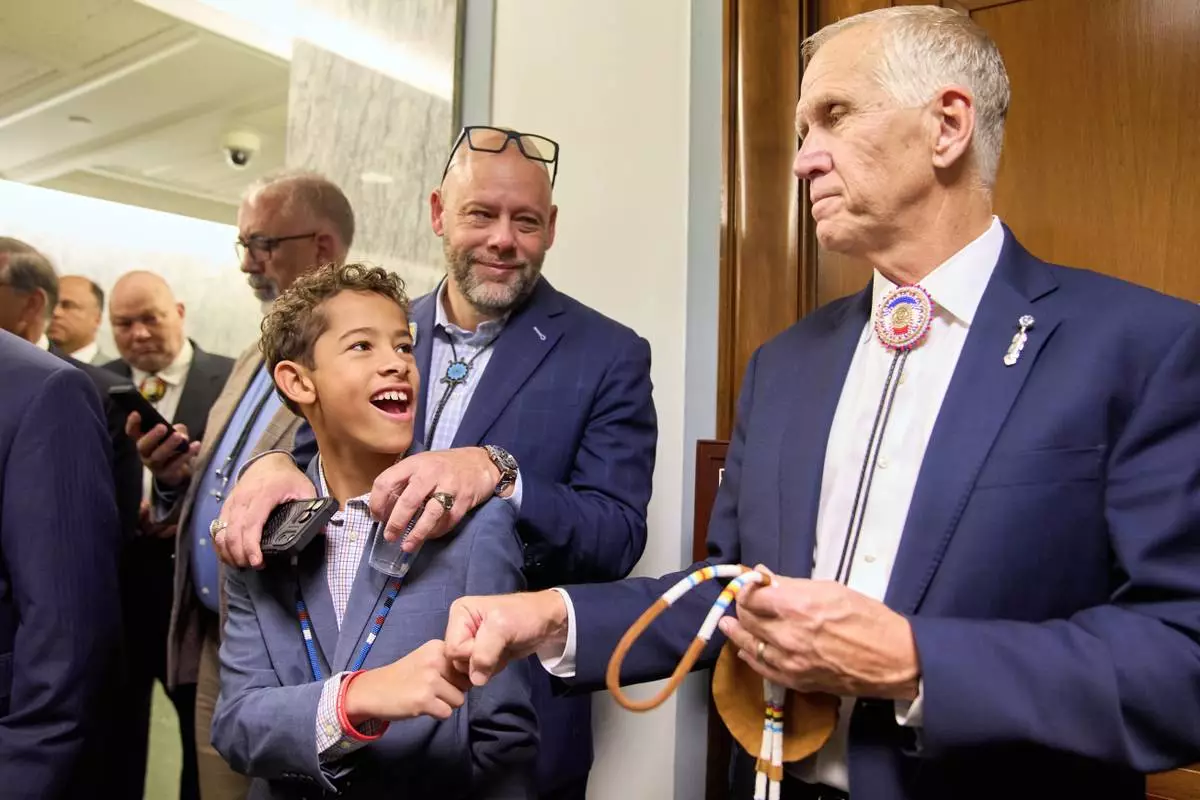
Austin Curt Thomas, 11, gets a celebratory fist bump from Sen. Thom Tillis, R-N.C., as he and his father Aaron Thomas, of Pembroke, N.C., join fellow members of the Lumbee Tribe of North Carolina, to celebrate after the passage of a bill granting their people federal recognition, on Capitol Hill, in Washington, Wednesday, Dec. 17, 2025. (AP Photo/Jacquelyn Martin)
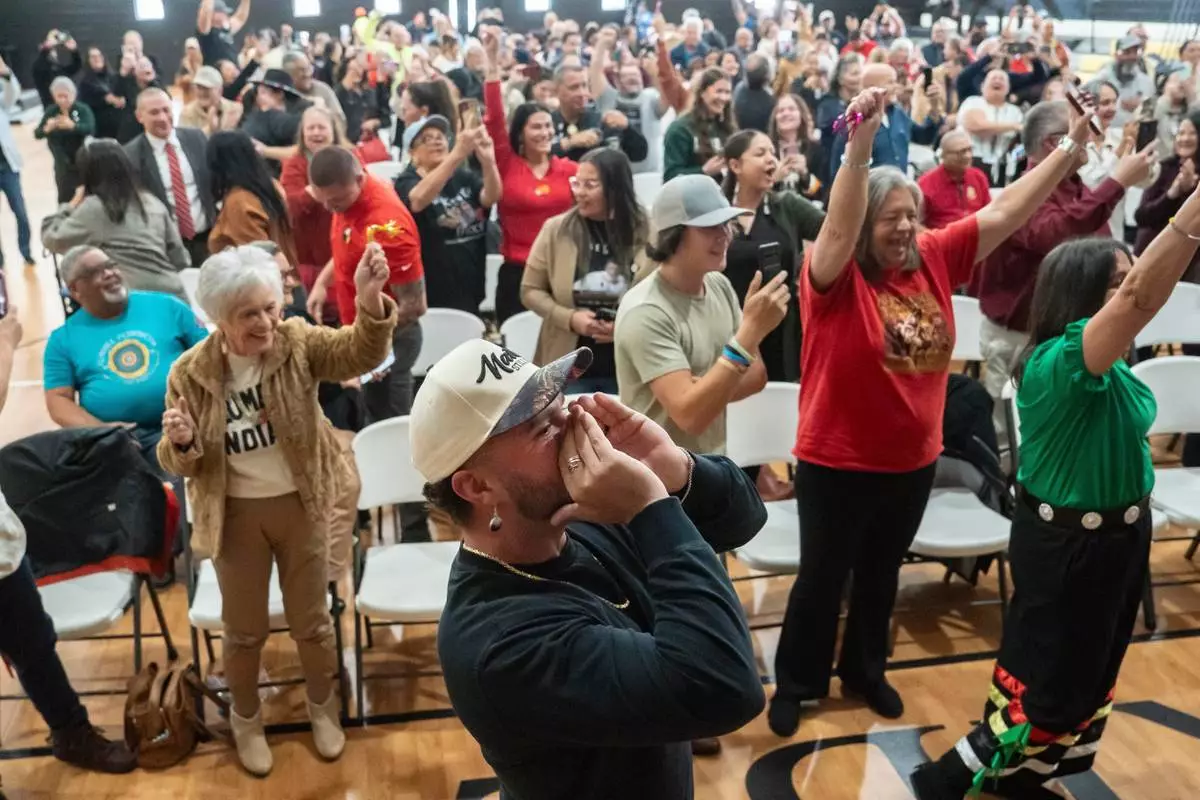
People celebrate after passage of the National Defense Authorization Act by the U.S. Senate during a watch party hosted by the Lumbee Tribe of North Carolina, Wednesday, Dec. 17, 2025, in Pembroke, N.C. (AP Photo/Allison Joyce)

People celebrate after passage of the National Defense Authorization Act by the U.S. Senate, during a watch party hosted by the Lumbee Tribe of North Carolina, Wednesday, Dec. 17, 2025, in Pembroke, N.C. (AP Photo/Allison Joyce)
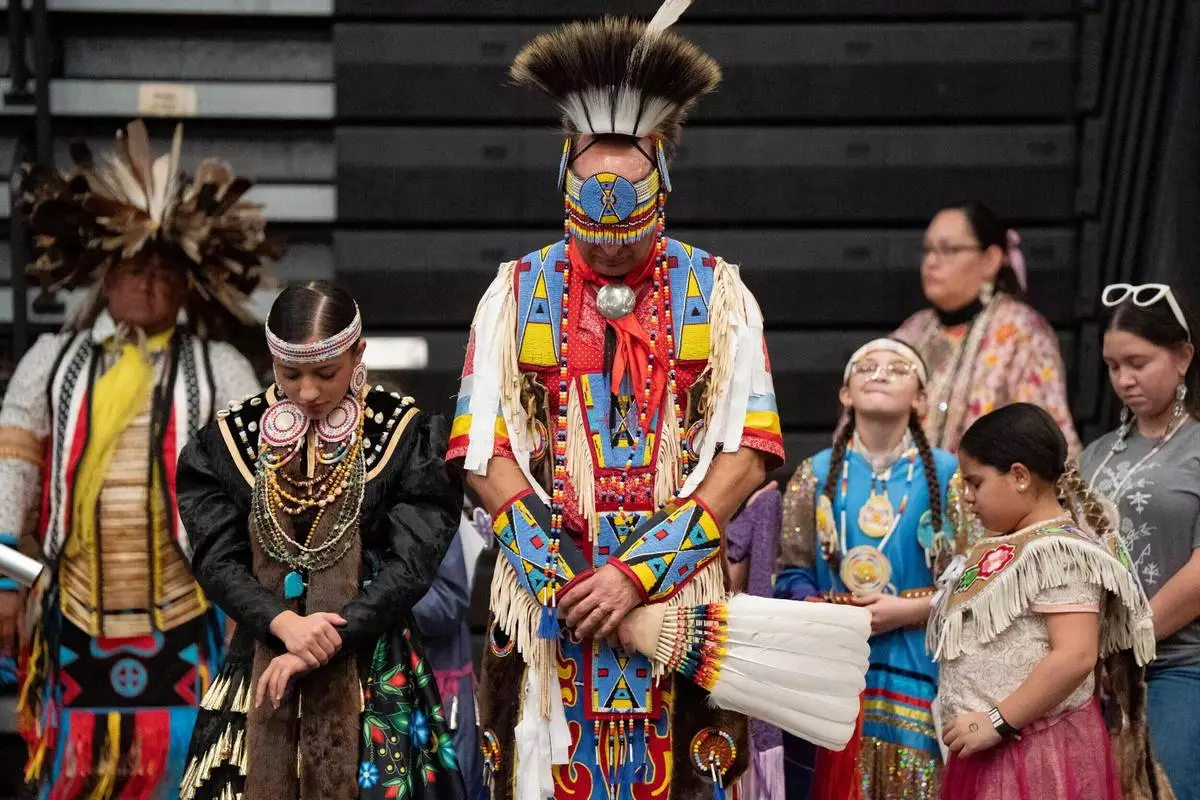
FILE - Members of the Lumbee Tribe bow their heads in prayer during the BraveNation Powwow and Gather at UNC Pembroke, March 22, 2025, in Pembroke, N.C. (AP Photo/Allison Joyce, file)
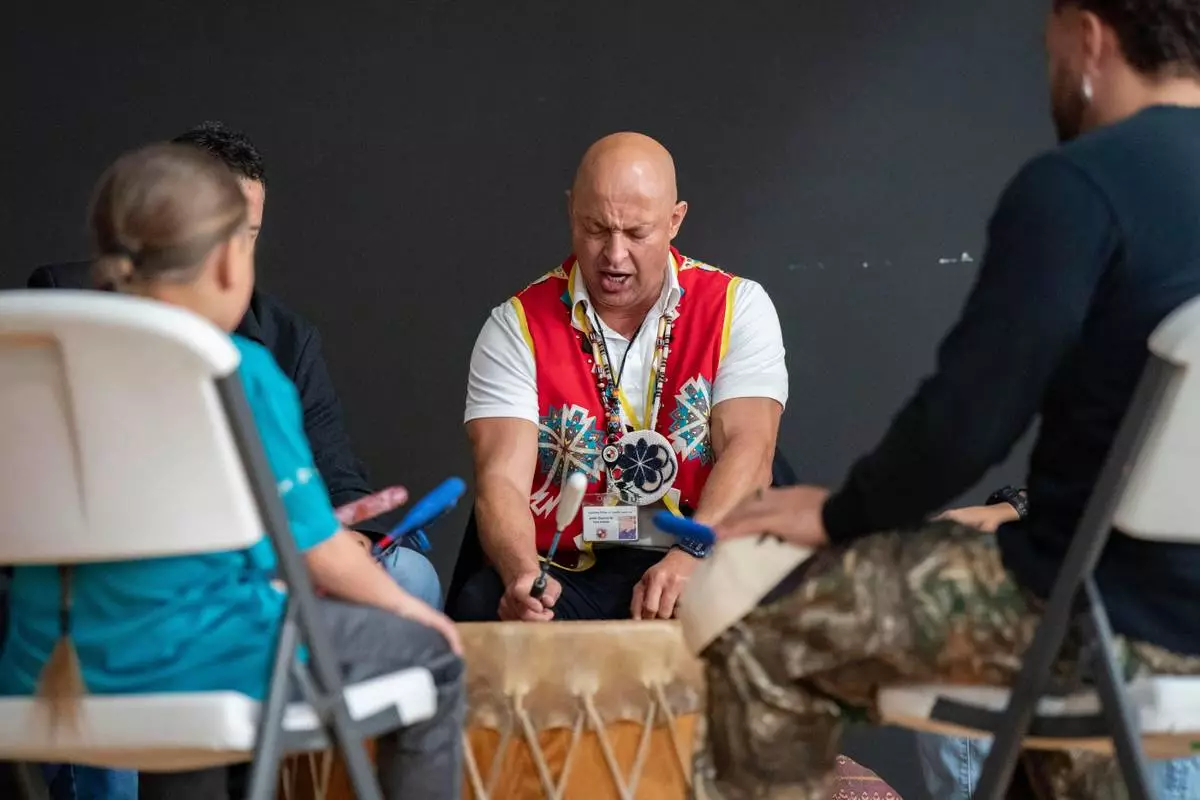
People sing while playing drums during a watch party hosted by the Lumbee Tribe of North Carolina, Wednesday, Dec. 17, 2025, in Pembroke, N.C. (AP Photo/Allison Joyce)

People celebrate after passage of the National Defense Authorization Act by the U.S. Senate during a watch party hosted by the Lumbee Tribe of North Carolina, Wednesday, Dec. 17, 2025, in Pembroke, N.C. (AP Photo/Allison Joyce)

People celebrate after passage of the National Defense Authorization Act by the U.S. Senate during a watch party hosted by the Lumbee Tribe of North Carolina, Wednesday, Dec. 17, 2025, in Pembroke, N.C. (AP Photo/Allison Joyce)

People celebrate after passage of the National Defense Authorization Act by the U.S. Senate, during a watch party hosted by the Lumbee Tribe of North Carolina, Wednesday, Dec. 17, 2025, in Pembroke, N.C. (AP Photo/Allison Joyce)