DURHAM, N.C.--(BUSINESS WIRE)--May 6, 2025--
restor3d, a leader in 3D printed, personalized orthopedic implant care, proudly announces the successful limited market release of the Aeros™ Modular Stem Total Ankle System, with five cases performed on launch day, May 5, 2025, at OrthoCarolina by renowned foot and ankle specialists Dr. Kent Ellington and Aeros design team member, Dr. Samuel Ford.
This press release features multimedia. View the full release here: https://www.businesswire.com/news/home/20250506591407/en/
The Aeros Modular Stem, the latest addition to the Kinos Total Ankle family, represents the first and only anteriorly inserted modular stem tibial implant available for Total Ankle Replacement (TAR). Cleared by the FDA for both primary and revision indications, the system enters a limited market release throughout 2025, with full commercial launch anticipated in 2026.
“We are exhilarated to see this system come to life in the OR with such a strong start,” said Dr. Samuel Ford. “The streamlined instrumentation and thoughtful design of the Aeros Modular Stem made for an efficient intraoperative experience, and it opens new doors for both primary and complex revision ankle arthroplasty cases.”
Designed for efficiency, versatility, and ease of use, the Aeros Modular Stem requires just three trays of procedure-specific instruments, compared to up to seven trays for competitive systems. The implant is inserted through a standard anterior TAR incision, avoiding violation of the heel, calcaneus, or subtalar joint—a key differentiator from other intramedullary systems. The refined instrumentation provides a hands-free working area for streamlined tibial canal preparation, with coupled and standalone Patient Specific Resection (PSR ™ ) Cut Guides providing greater intraoperative flexibility, particularly in complex deformity cases. Restor3D’s proprietary TIDAL Technology on all tibial and talar implants provides scientifically proven, research backed osseointegration potential, further emphasizing the role of the Kinos Total Ankle System in advancing total ankle arthroplasty.
The system is fully compatible with all existing Kinos Flat Cut Talus and bearing components, including its interchangeable Anatomic and Range articulations. In simulator testing, both articulating bearings demonstrated substantially improved polyethylene wear performance, with 200% less wear than Competitor A and 400% less than Competitor B¹. Competitors A and B were selected for comparison due to their length of time in the market and considerable clinical follow-up data presented in the literature. This advancement reflects the biomechanically accurate design of Kinos and directly addresses the growing demand for longer-lasting implants as survivorship rates improve.
Early retrospective studies are underway to validate an anticipated 30% reduction in operative time versus traditional stemmed systems—a meaningful objective given published data by Gross et al.², which links every 15-minute increase in TAR operative time with a 10% increase in complications, 33% increase in wound dehiscence, and 16% increase in reoperations.
“The Kinos Modular Stem system combines modularity, versatility, and simplicity in a way the TAR market has long needed,” added Dr. Ford. “This is a platform I’m confident will appeal to both experienced and new users alike.”
¹ Data on File
² As presented at AOFAS 2024 Annual Meeting “A Prospective Evaluation of a 4th Generation Total Ankle Prosthesis with Flat Cut vs Chamfer Cut Talar Component" 9/13/2024 Vancouver, British Columbia, Canada
About restor3d, Inc.
restor3d is a world leader in 3D printed patient specific musculoskeletal implants and driven by the belief that every patient deserves personalized care. The company holds proprietary expertise and intellectual property in 3D printing of osseointegrative materials, AI-based planning and design automation tools, and digital health solutions to provide seamless data-backed care to optimize individual patient outcomes. Alongside its customers, restor3d is reimagining the musculoskeletal reconstruction landscape. More information is available at www.restor3d.com.
Forward Looking Statements
Certain statements made in this release that are not statements of historical or current facts are forward-looking statements which involve known and unknown risks, uncertainties and other factors that may cause the actual results, performance or achievements of the company to be materially different from historical results or from any future results or projections expressed or implied by such forward-looking statements. In many cases, forward-looking statements can be identified by terms such as “future,” “believes,” “expects,” “may,” “will,” “should,” “potential,” “estimates,” “intends,” “anticipates” or “plans” or the negative of these terms or other comparable terminology. Forward-looking statements are based upon management’s beliefs, assumptions and current expectations but are subject to known and unknown risks and uncertainties including, without limitation, distribution challenges, market trends and demand, product efficacy and safety concerns, product or raw material availability and other supply constraints. Although management believes that the expectations reflected in the forward-looking statements are reasonable, forward-looking statements are not, and should not be relied upon as a guarantee of future performance or results. The forward-looking statements included are made only as the date of this release. The company assumes no obligation to update any information or forward-looking statement contained herein, save for any information required to be disclosed by law.
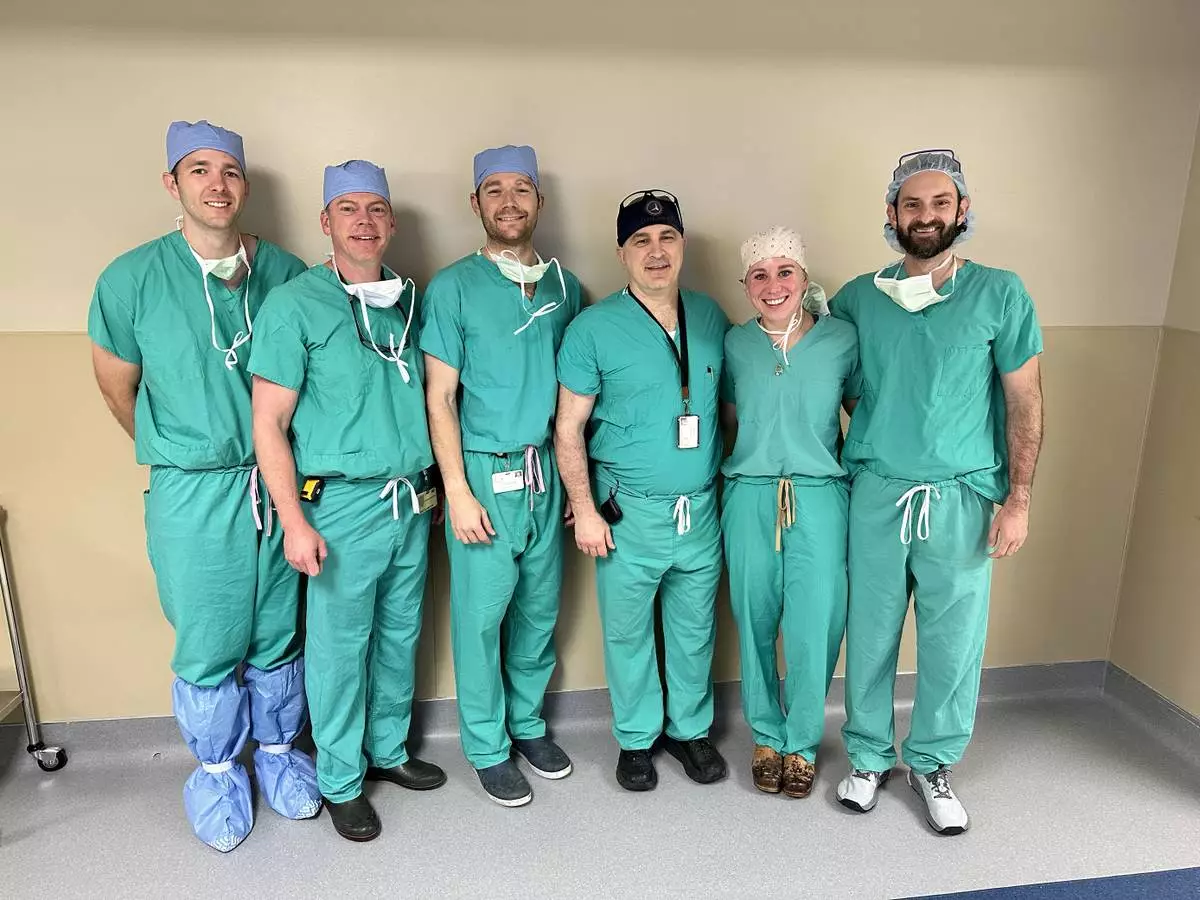
Drs. Kent Ellington, Sam Ford, and Scott Shawen, of OrthoCarolina Foot & Ankle Institute in Charlotte, NC were the first surgeons in the country to utilize the new Aeros™ Modular Stem Total Ankle System from restor3d (Raleigh, NC) during its limited market release.

NEW YORK (AP) — Reviving a campaign pledge, President Donald Trump wants a one-year, 10% cap on credit card interest rates, a move that could save Americans tens of billions of dollars but drew immediate opposition from an industry that has been in his corner.
Trump was not clear in his social media post Friday night whether a cap might take effect through executive action or legislation, though one Republican senator said he had spoken with the president and would work on a bill with his “full support.” Trump said he hoped it would be in place Jan. 20, one year after he took office.
Strong opposition is certain from Wall Street in addition to the credit card companies, which donated heavily to his 2024 campaign and have supported Trump's second-term agenda. Banks are making the argument that such a plan would most hurt poor people, at a time of economic concern, by curtailing or eliminating credit lines, driving them to high-cost alternatives like payday loans or pawnshops.
“We will no longer let the American Public be ripped off by Credit Card Companies that are charging Interest Rates of 20 to 30%,” Trump wrote on his Truth Social platform.
Researchers who studied Trump’s campaign pledge after it was first announced found that Americans would save roughly $100 billion in interest a year if credit card rates were capped at 10%. The same researchers found that while the credit card industry would take a major hit, it would still be profitable, although credit card rewards and other perks might be scaled back.
About 195 million people in the United States had credit cards in 2024 and were assessed $160 billion in interest charges, the Consumer Financial Protection Bureau says. Americans are now carrying more credit card debt than ever, to the tune of about $1.23 trillion, according to figures from the New York Federal Reserve for the third quarter last year.
Further, Americans are paying, on average, between 19.65% and 21.5% in interest on credit cards according to the Federal Reserve and other industry tracking sources. That has come down in the past year as the central bank lowered benchmark rates, but is near the highs since federal regulators started tracking credit card rates in the mid-1990s. That’s significantly higher than a decade ago, when the average credit card interest rate was roughly 12%.
The Republican administration has proved particularly friendly until now to the credit card industry.
Capital One got little resistance from the White House when it finalized its purchase and merger with Discover Financial in early 2025, a deal that created the nation’s largest credit card company. The Consumer Financial Protection Bureau, which is largely tasked with going after credit card companies for alleged wrongdoing, has been largely nonfunctional since Trump took office.
In a joint statement, the banking industry was opposed to Trump's proposal.
“If enacted, this cap would only drive consumers toward less regulated, more costly alternatives," the American Bankers Association and allied groups said.
Bank lobbyists have long argued that lowering interest rates on their credit card products would require the banks to lend less to high-risk borrowers. When Congress enacted a cap on the fee that stores pay large banks when customers use a debit card, banks responded by removing all rewards and perks from those cards. Debit card rewards only recently have trickled back into consumers' hands. For example, United Airlines now has a debit card that gives miles with purchases.
The U.S. already places interest rate caps on some financial products and for some demographics. The Military Lending Act makes it illegal to charge active-duty service members more than 36% for any financial product. The national regulator for credit unions has capped interest rates on credit union credit cards at 18%.
Credit card companies earn three streams of revenue from their products: fees charged to merchants, fees charged to customers and the interest charged on balances. The argument from some researchers and left-leaning policymakers is that the banks earn enough revenue from merchants to keep them profitable if interest rates were capped.
"A 10% credit card interest cap would save Americans $100 billion a year without causing massive account closures, as banks claim. That’s because the few large banks that dominate the credit card market are making absolutely massive profits on customers at all income levels," said Brian Shearer, director of competition and regulatory policy at the Vanderbilt Policy Accelerator, who wrote the research on the industry's impact of Trump's proposal last year.
There are some historic examples that interest rate caps do cut off the less creditworthy to financial products because banks are not able to price risk correctly. Arkansas has a strictly enforced interest rate cap of 17% and evidence points to the poor and less creditworthy being cut out of consumer credit markets in the state. Shearer's research showed that an interest rate cap of 10% would likely result in banks lending less to those with credit scores below 600.
The White House did not respond to questions about how the president seeks to cap the rate or whether he has spoken with credit card companies about the idea.
Sen. Roger Marshall, R-Kan., who said he talked with Trump on Friday night, said the effort is meant to “lower costs for American families and to reign in greedy credit card companies who have been ripping off hardworking Americans for too long."
Legislation in both the House and the Senate would do what Trump is seeking.
Sens. Bernie Sanders, I-Vt., and Josh Hawley, R-Mo., released a plan in February that would immediately cap interest rates at 10% for five years, hoping to use Trump’s campaign promise to build momentum for their measure.
Hours before Trump's post, Sanders said that the president, rather than working to cap interest rates, had taken steps to deregulate big banks that allowed them to charge much higher credit card fees.
Reps. Alexandria Ocasio-Cortez, D-N.Y., and Anna Paulina Luna, R-Fla., have proposed similar legislation. Ocasio-Cortez is a frequent political target of Trump, while Luna is a close ally of the president.
Seung Min Kim reported from West Palm Beach, Fla.
President Donald Trump arrives on Air Force One at Palm Beach International Airport, Friday, Jan. 9, 2025, in West Palm Beach, Fla. (AP Photo/Julia Demaree Nikhinson)
FILE - Visa and Mastercard credit cards are shown in Buffalo Grove, Ill., Feb. 8, 2024. (AP Photo/Nam Y. Huh, File)