NEW YORK--(BUSINESS WIRE)--May 6, 2025--
Capitolis, the financial technology company, today announced the appointment of Amol Naik as Chief Operating Officer (COO), effective May 5. Reporting to Gil Mandelzis, Founder and Chief Executive Officer of Capitolis, Naik will be responsible for managing the company’s day-to-day operations, driving company-wide execution against the firm’s business strategy.
This press release features multimedia. View the full release here: https://www.businesswire.com/news/home/20250506062637/en/
Naik is a seasoned financial services leader and a builder of world-class teams, bringing over 25 years of experience in strategic, operational, financial, and risk management roles across private and public fintech and global financial services firms.
Most recently, Naik served as COO at Pagaya (NASDAQ: PGY), where he helped build and scale the company through a successful public company transaction. Prior to that, Naik served a 23-year career at Goldman Sachs where he was a Partner. Over the years, he held various global roles in the US, Europe, and APAC, redesigning the firm’s financial resource management process, leading operational strategy efforts, and driving the implementation of major technology initiatives.
“Capitolis has been growing rapidly, and we have been looking for the right operational leader to help us scale and support further growth in our business,” said Gil Mandelzis. “Amol has a proven track record of delivering impact and innovation in the financial industry, and his extensive experience in financial resource optimization and in building and scaling a fintech company will be invaluable as we continue our rapid growth. We are excited to have Amol join our team, and I look forward to his contributions to Capitolis.”
Recently, Capitolis has experienced strong business momentum and expansion. The fintech launched a variety of new solutions over the past year, has significantly grown the network of clients leveraging its platform, received additional strategic bank investments, and acquired Capitalab, BGC Group’s Rates Compression and Margin Optimization business, to enter into the Interest Rate space.
“I am thrilled to join Capitolis as we accelerate towards our next phase of growth, building a scalable, sustainable, and robust business,” said Amol Naik. “This is an extremely innovative, agile, and client-driven company. I have been impressed by the people, the investors, and the market opportunity. As COO, I look forward to fostering collaboration, driving results, and delivering solutions to clients in a cohesive way that helps address their challenges.”
Naik received a Bachelor of Engineering from the University of Mumbai as well as a Master of Science in Economics and Master of Business Administration from Iowa State University.
To learn more about Capitolis, visit https://capitolis.com.
About Capitolis
We believe the financial markets can and should work for everyone. Capitolis is the technology company helping to create safer and more vibrant financial markets by unlocking capital constraints and enabling greater access to more diversified capital and investment opportunities. Rooted in advanced technology and deep financial expertise, Capitolis powers groundbreaking financial solutions that drive growth for global and regional banks – and institutional investors alike. Capitolis is backed by world class venture capital firms, including Canapi Ventures, 9Yards Capital, SVB Capital, Andreessen Horowitz (a16z), Index Ventures, Sequoia Capital, Spark Capital, and S Capital, as well as leading global banks such as Citi, J.P. Morgan, Morgan Stanley, Standard Chartered, State Street and UBS.
Founded in 2017, our team brings decades of experience in launching successful startups, technology, and financial services. Capitolis was recognized on the Inc. 2024 Best in Business list in the Financial Services and Innovation & Technology categories, and named World’s Best FX Software Provider for the second straight year in the 2024 Euromoney Foreign Exchange Awards. The company has been included on each of CNBC’s World's Top Fintech Companies 2024 list and Deloitte’s 2024 Technology Fast 500 list in consecutive years and was named to Fast Company’s prestigious annual list of The World’s Most Innovative Companies for 2023. American Banker recognized Capitolis among the Best Places to Work in Fintech, and the company was named by Crain’s New York Business as one of New York’s Best Places to Work in 2024 for the third consecutive year. For more information, please visit our website at www.capitolis.com or follow us on LinkedIn.

Capitolis Appoints Amol Naik as Chief Operating Officer
RHO, Italy (AP) — No ice is colder and harder than speedskating ice. The precision it takes has meant that Olympic speedskaters have never competed for gold on a temporary indoor rink – until the 2026 Milan Cortina Winter Games.
In the pursuit of maximum glide and minimum friction, Olympic officials brought on ice master Mark Messer, a veteran of six previous Olympic speedskating tracks and the ice technician in charge of the Olympic Oval in Calgary, Canada — one of the fastest tracks in the world with over 300 records.
Messer has been putting that experience to work one thin layer of ice at a time since the end of October at the new Speed Skating Stadium, built inside adjacent trade fair halls in the city of Rho just north of Milan.
“It’s one of the biggest challenges I’ve had in icemaking,’’ Messer said during an interview less than two weeks into the process.
If Goldilocks were a speedskater, hockey ice would be medium hard, for fast puck movement and sharp turns. Figure skating ice would be softer, allowing push off for jumps and so the ice doesn’t shatter on landing. Curling ice is the softest and warmest of all, for controlled sliding.
For speedskating ice to be just right, it must be hard, cold and clean. And very, very smooth.
“The blades are so sharp, that if there is some dirt, the blade will lose the edge,’’ Messer said, and the skater will lose speed.
Speedskater Enrico Fabris, who won two Olympic golds in Turin in 2006, has traded in his skates to be deputy sports manager at the speedskating venue in Rho. For him, perfect ice means the conditions are the same for all skaters — and then if it's fast ice, so much the better.
"It's more of a pleasure to skate on this ice,'' he said.
Messer’s first Olympics were in Calgary in 1988 — the first time speedskating was held indoors. “That gave us some advantages because we didn’t have to worry about the weather, wind blowing or rain,’’ he said. Now he is upping the challenge by becoming the first ice master to build a temporary rink for the Olympics.
Before Messer arrived in Italy, workers spent weeks setting up insulation to level the floor and then a network of pipes and rubber tubes that carry glycol — an antifreeze — that is brought down to minus 7 or minus 8 degrees Celsius (17.6 to 19.4 degrees Fahrenheit) to make the ice.
Water is run through a purification system — but it can’t be too pure, or the ice that forms will be too brittle. Just the right amount of impurities “holds the ice together,’’ Messer said.
The first layers of water are applied slowly, with a spray nozzle; after the ice reaches a few centimeters it is painted white — a full day’s work — and the stripes are added to make lanes.
“The first one takes about 45 minutes. And then as soon as it freezes, we go back and do it again, and again and again. So we do it hundreds of times,’’ Messer said.
As the ice gets thicker, and is more stable, workers apply subsequent layers of water with hoses. Messer attaches his hose to hockey sticks for easier spreading.
What must absolutely be avoided is dirt, dust or frost — all of which can cause friction for the skaters, slowing them down. The goal is that when the skaters push “they can go as far as possible with the least amount of effort,’’ Messer said.
The Zamboni ice resurfacing machine plays a key role in keeping the track clean, cutting off a layer and spraying water to make a new surface.
One challenge is gauging how quickly the water from the resurfacing machine freezes in the temporary rink.
Another is getting the ice to the right thickness so that the Zamboni, weighing in at six tons, doesn’t shift the insulation, rubber tubing or ice itself.
“When you drive that out, if there’s anything moving it will move. We don’t want that,’’ Messer said.
The rink got its first big test on Nov. 29-30 during a Junior World Cup event. In a permanent rink, test events are usually held a year before the Olympics, leaving more time for adjustments. “We have a very small window to learn,’’ Messer acknowledged.
Dutch speedskater Kayo Vos, who won the men’s neo-senior 1,000 meters, said the ice was a little soft — but Messer didn’t seem too concerned.
“We went very modest to start, now we can start to change the temperatures and try to make it faster and still maintain it as a safe ice,’’ he said.
Fine-tuning the air temperature and humidity and ice temperature must be done methodically — taking into account that there will be 6,000 spectators in the venue for each event. The next real test will be on Jan. 31, when the Olympians take to the ice for their first training session.
“Eighty percent of the work is done but the hardest part is the last 20 percent, where we have to try to find the values and the way of running the equipment so all the skaters get the same conditions and all the skaters get the best conditions,’’ Messer said.
AP Winter Olympics: https://apnews.com/hub/milan-cortina-2026-winter-olympics

Serpentines are set on the ice of the stadium where speed skating discipline of the Milan Cortina 2026 Winter Olympics will take place, in Rho, outskirt of Milan, Tuesday, Nov. 11, 2025. (AP Photo/Luca Bruno)

Ice Master Mark Messer poses in the stadium where speed skating discipline of the Milan Cortina 2026 Winter Olympics will take place, in Rho, outskirt of Milan, Tuesday, Nov. 11, 2025. (AP Photo/Luca Bruno)
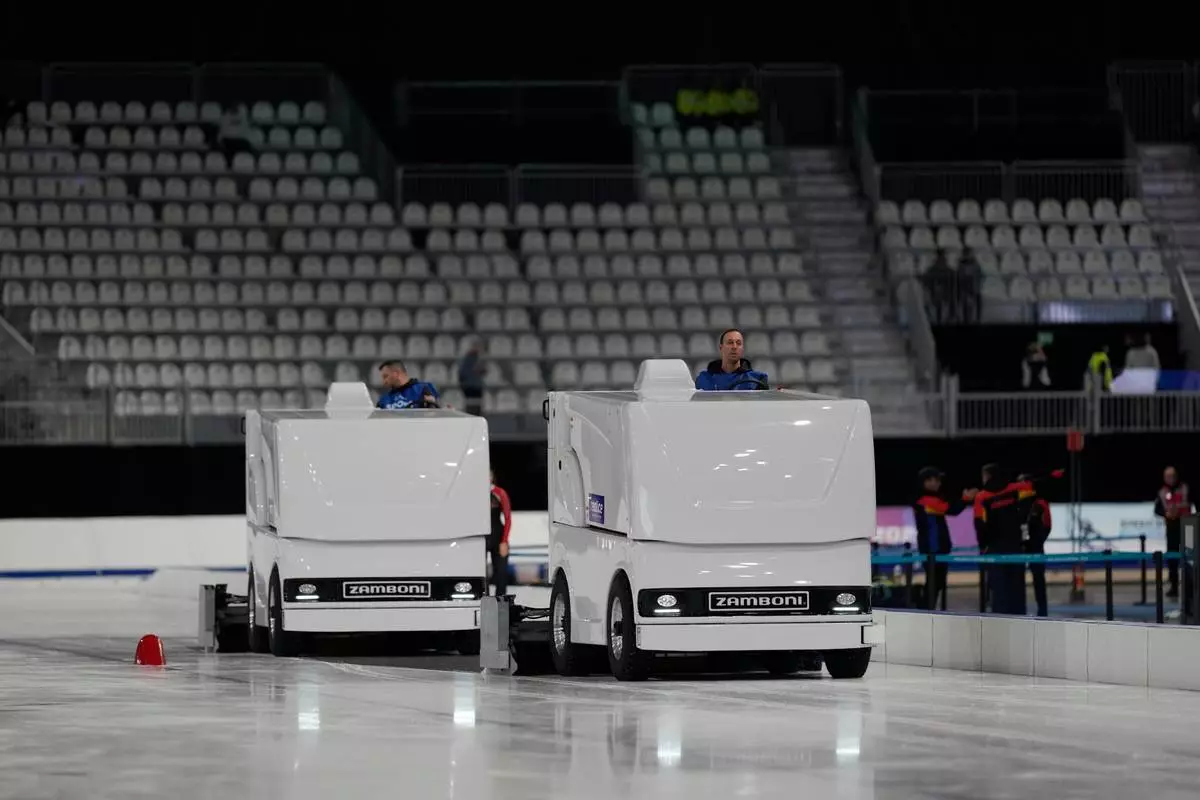
Workers clean the ice surface during a peed skating Junior World Cup and Olympic test event, in Rho, near Milan, Italy, Saturday, Nov. 29, 2025. (AP Photo/Luca Bruno)

Ice Master Mark Messer poses in the stadium where speed skating discipline of the Milan Cortina 2026 Winter Olympics will take place, in Rho, outskirt of Milan, Tuesday, Nov. 11, 2025. (AP Photo/Luca Bruno)

Ice Master Mark Messer poses in the stadium where speed skating discipline of the Milan Cortina 2026 Winter Olympics will take place, in Rho, outskirt of Milan, Tuesday, Nov. 11, 2025. (AP Photo/Luca Bruno)