FRANKFURT, Germany (AP) — Friedrich Merz's unprecedented failure to win election as German chancellor in the first round of voting in parliament — though he won in the second — raised doubts about his new government's ability to carry through on plans to push Europe's largest economy out of stagnation.
Tuesday's stumble at the start of his new coalition government between his Union bloc and the Social Democrats added uncertainty around the future of an economy that hasn't seen significant growth since before the COVID-19 pandemic.
Above all, Merz had been expected to end the squabbling over spending and budgets that plagued predecessor Olaf Scholz's unruly three-party coalition that collapsed in November. His Feb. 23 election win and coalition deal seemed to provide assurance that his government could end policy paralysis and confront challenges including lagging investment in pro-growth projects, choking bureaucracy and a lack of skilled labor.
But the first-round flop in parliament raised questions about how solid Merz's majority would be and whether it can pass reforms to raise growth after two years of shrinking output. The outgoing government predicted zero growth for this year.
“The failed vote, and fact that it came out of the blue, have already weakened Merz significantly," said Franziska Palmas, senior Europe economist at Capital Economics.
“His promise to run a much more efficient and conflict-free government ... looks much less credible now. And delivering on his economic proposals, including a big increase in defense and infrastructure spending, corporate tax cuts, bureaucracy cuts and digitalization, will be more difficult than expected,” Palmas added.
Merz’s coalition has 328 members in the new parliament. The fact that he received only 310 votes on the first secret ballot — when he needed a majority of 316 out of 630 votes — led to speculation that some fiscally conservative legislators are resisting his post-election decision to loosen Germany's constitutional limit on deficit spending and set up a 500 billion euro fund to spend on infrastructure such as bridges, schools and rail lines.
Those measures were passed in the outgoing parliament.
Merz won election with 325 votes on the second try, but significant damage has been done. He is taking office “with two black eyes and shaky knees,” said Andrea Roemmele, professor of communications in politics and civil society at Berlin's Hertie School.
Hope that the government will quickly push ahead with new investments and reforms “has been shattered,” said Carsten Brzeski, global chief of macro at ING bank: “Today’s events show that not everyone seems to have understood the sense of urgency and the need to have a functioning government.”
For years, the debt limits constrained spending on infrastructure and was ultimately blamed for slowing growth. On top of that, China has gone from a lucrative export market for German companies to a competitor in German specialties such as autos and industrial machinery. Extensive permissions processes are blamed for slowing new business projects, while the loss of cheap Russian natural gas due to the invasion of Ukraine has raised energy costs for businesses.
While the vote was “a bad surprise," some of the tough decisions on spending and the debt limit were already taken care of in the outgoing parliament, said Holger Schmieding, chief economist at Berenberg bank. “The extra fiscal space exists ... today's upset will probably not affect the way the additional money for defense and infrastructure is allocated in a major way.”
Schmieding noted that most votes in parliament are not by secret ballot, which could prevent some of the coalition members who spurned Merz from voting against bills in parliament.
The decision to set up the infrastructure fund outside the debt limit had raised hope for more government spending and an exit from stagnation. Those hopes were dampened April 2 when U.S. President Donald Trump announced a slew of new tariffs on almost all U.S. trading partners, including a 20% tariff on goods from the European Union.
That immediately added to the headwinds for Germany's export-dominated economy, amid uncertainty over whether EU officials can negotiate a lower tariff rate during the 90-day pause institute by Trump before the tariffs take effect.

Leader of the Christian Democrats Friedrich Merz is applauded after being elected new chancellor at the German federal parliament, Bundestag, at the Reichstag building in Berlin, Germany, Tuesday, May 6, 2025. (AP Photo/Ebrahim Noroozi)
RHO, Italy (AP) — No ice is colder and harder than speedskating ice. The precision it takes has meant that Olympic speedskaters have never competed for gold on a temporary indoor rink – until the 2026 Milan Cortina Winter Games.
In the pursuit of maximum glide and minimum friction, Olympic officials brought on ice master Mark Messer, a veteran of six previous Olympic speedskating tracks and the ice technician in charge of the Olympic Oval in Calgary, Canada — one of the fastest tracks in the world with over 300 records.
Messer has been putting that experience to work one thin layer of ice at a time since the end of October at the new Speed Skating Stadium, built inside adjacent trade fair halls in the city of Rho just north of Milan.
“It’s one of the biggest challenges I’ve had in icemaking,’’ Messer said during an interview less than two weeks into the process.
If Goldilocks were a speedskater, hockey ice would be medium hard, for fast puck movement and sharp turns. Figure skating ice would be softer, allowing push off for jumps and so the ice doesn’t shatter on landing. Curling ice is the softest and warmest of all, for controlled sliding.
For speedskating ice to be just right, it must be hard, cold and clean. And very, very smooth.
“The blades are so sharp, that if there is some dirt, the blade will lose the edge,’’ Messer said, and the skater will lose speed.
Speedskater Enrico Fabris, who won two Olympic golds in Turin in 2006, has traded in his skates to be deputy sports manager at the speedskating venue in Rho. For him, perfect ice means the conditions are the same for all skaters — and then if it's fast ice, so much the better.
"It's more of a pleasure to skate on this ice,'' he said.
Messer’s first Olympics were in Calgary in 1988 — the first time speedskating was held indoors. “That gave us some advantages because we didn’t have to worry about the weather, wind blowing or rain,’’ he said. Now he is upping the challenge by becoming the first ice master to build a temporary rink for the Olympics.
Before Messer arrived in Italy, workers spent weeks setting up insulation to level the floor and then a network of pipes and rubber tubes that carry glycol — an antifreeze — that is brought down to minus 7 or minus 8 degrees Celsius (17.6 to 19.4 degrees Fahrenheit) to make the ice.
Water is run through a purification system — but it can’t be too pure, or the ice that forms will be too brittle. Just the right amount of impurities “holds the ice together,’’ Messer said.
The first layers of water are applied slowly, with a spray nozzle; after the ice reaches a few centimeters it is painted white — a full day’s work — and the stripes are added to make lanes.
“The first one takes about 45 minutes. And then as soon as it freezes, we go back and do it again, and again and again. So we do it hundreds of times,’’ Messer said.
As the ice gets thicker, and is more stable, workers apply subsequent layers of water with hoses. Messer attaches his hose to hockey sticks for easier spreading.
What must absolutely be avoided is dirt, dust or frost — all of which can cause friction for the skaters, slowing them down. The goal is that when the skaters push “they can go as far as possible with the least amount of effort,’’ Messer said.
The Zamboni ice resurfacing machine plays a key role in keeping the track clean, cutting off a layer and spraying water to make a new surface.
One challenge is gauging how quickly the water from the resurfacing machine freezes in the temporary rink.
Another is getting the ice to the right thickness so that the Zamboni, weighing in at six tons, doesn’t shift the insulation, rubber tubing or ice itself.
“When you drive that out, if there’s anything moving it will move. We don’t want that,’’ Messer said.
The rink got its first big test on Nov. 29-30 during a Junior World Cup event. In a permanent rink, test events are usually held a year before the Olympics, leaving more time for adjustments. “We have a very small window to learn,’’ Messer acknowledged.
Dutch speedskater Kayo Vos, who won the men’s neo-senior 1,000 meters, said the ice was a little soft — but Messer didn’t seem too concerned.
“We went very modest to start, now we can start to change the temperatures and try to make it faster and still maintain it as a safe ice,’’ he said.
Fine-tuning the air temperature and humidity and ice temperature must be done methodically — taking into account that there will be 6,000 spectators in the venue for each event. The next real test will be on Jan. 31, when the Olympians take to the ice for their first training session.
“Eighty percent of the work is done but the hardest part is the last 20 percent, where we have to try to find the values and the way of running the equipment so all the skaters get the same conditions and all the skaters get the best conditions,’’ Messer said.
AP Winter Olympics: https://apnews.com/hub/milan-cortina-2026-winter-olympics

Serpentines are set on the ice of the stadium where speed skating discipline of the Milan Cortina 2026 Winter Olympics will take place, in Rho, outskirt of Milan, Tuesday, Nov. 11, 2025. (AP Photo/Luca Bruno)

Ice Master Mark Messer poses in the stadium where speed skating discipline of the Milan Cortina 2026 Winter Olympics will take place, in Rho, outskirt of Milan, Tuesday, Nov. 11, 2025. (AP Photo/Luca Bruno)
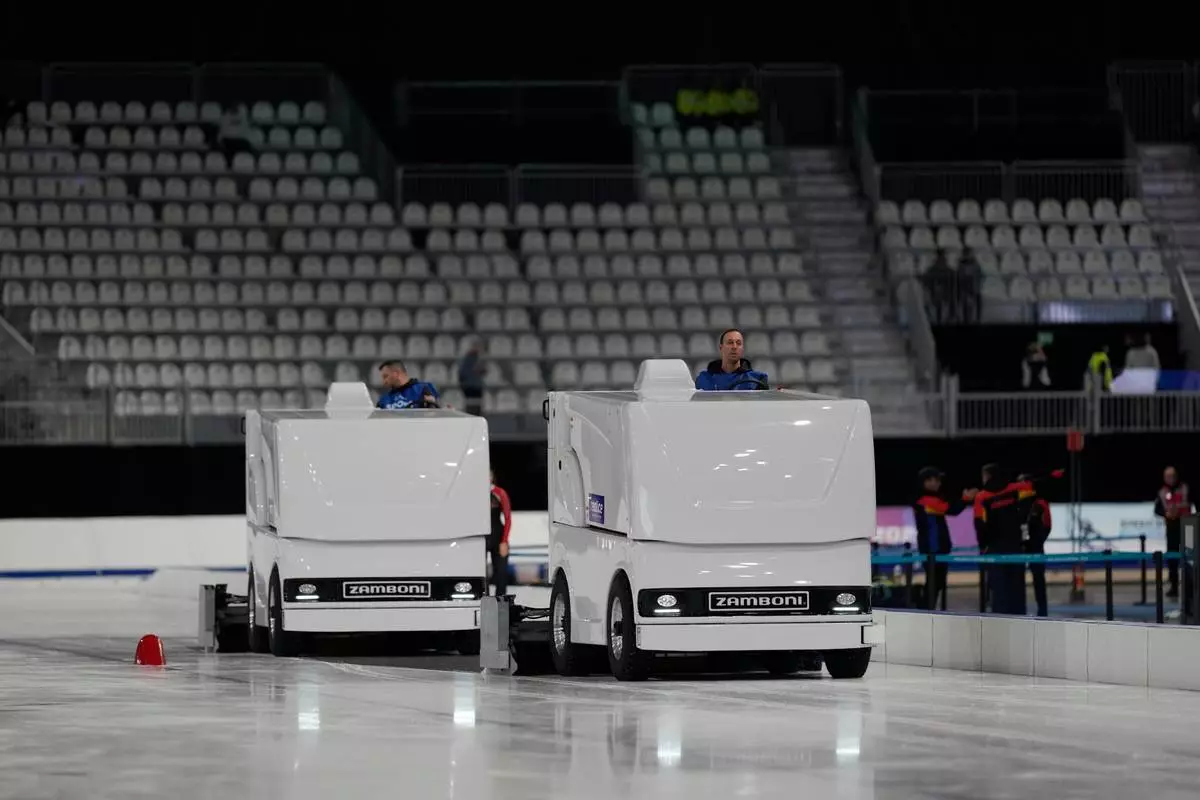
Workers clean the ice surface during a peed skating Junior World Cup and Olympic test event, in Rho, near Milan, Italy, Saturday, Nov. 29, 2025. (AP Photo/Luca Bruno)

Ice Master Mark Messer poses in the stadium where speed skating discipline of the Milan Cortina 2026 Winter Olympics will take place, in Rho, outskirt of Milan, Tuesday, Nov. 11, 2025. (AP Photo/Luca Bruno)

Ice Master Mark Messer poses in the stadium where speed skating discipline of the Milan Cortina 2026 Winter Olympics will take place, in Rho, outskirt of Milan, Tuesday, Nov. 11, 2025. (AP Photo/Luca Bruno)