WASHINGTON (AP) — President Donald Trump plans to announce while on his trip to Saudi Arabia next week that the United States will now refer to the Persian Gulf as the Arabian Gulf or the Gulf of Arabia, according to two U.S. officials.
Arab nations have pushed for a change to the geographic name of the body of water off the southern coast of Iran, while Iran has maintained its historic ties to the gulf.
The two U.S. officials spoke with The Associated Press on Tuesday on condition of anonymity to discuss the matter. The White House and National Security Council did not immediately respond to messages seeking comment.
The Persian Gulf has been widely known by that name since the 16th century, although usage of “Gulf of Arabia” and “Arabian Gulf” is dominant in many countries in the Middle East. The government of Iran — formerly Persia — threatened to sue Google in 2012 over the company’s decision not to label the body of water at all on its maps.
On Google Maps in the U.S., the body of water appears as Persian Gulf (Arabian Gulf). Apple Maps only says the Persian Gulf.
The U.S. military for years has unilaterally referred to the Persian Gulf as the Arabian Gulf in statements and images it releases.
The name of the body of water has become an emotive issue for Iranians who embrace their country’s long history as the Persian Empire. A spat developed in 2017 during Trump’s first term when he used the name Arabian Gulf for the waterway. Iran’s president at the time, Hassan Rouhani, suggested Trump needed to “study geography.”
“Everyone knew Trump’s friendship was for sale to the highest bidder. We now know that his geography is, too,” Iranian Foreign Minister Mohammad Javad Zarif wrote online at the time.
On Wednesday, Iran's current foreign minister also weighed in, saying that names of Mideast waterways do “not imply ownership by any particular nation, but rather reflects a shared respect for the collective heritage of humanity.”
“Politically motivated attempts to alter the historically established name of the Persian Gulf are indicative of hostile intent toward Iran and its people, and are firmly condemned,” Abbas Araghchi wrote on the social platform X.
"Any short-sighted step in this connection will have no validity or legal or geographical effect, it will only bring the wrath of all Iranians from all walks of life and political persuasion in Iran, the U.S. and across the world."
Trump can change the name for official U.S. purposes, but he can’t dictate what the rest of the world calls it.
The International Hydrographic Organization — of which the United States is a member — works to ensure all the world’s seas, oceans and navigable waters are surveyed and charted uniformly, and also names some of them. There are instances where countries refer to the same body of water or landmark by different names in their own documentation.
In addition to Saudi Arabia, Trump is also set to visit Doha, Qatar, and Abu Dhabi, the capital of the United Arab Emirates, which also lie on the body of water. Originally planned as Trump’s first trip overseas since he took office on Jan. 20, it comes as Trump has tried to draw closer to the Gulf countries as he seeks their financial investment in the U.S. and support in regional conflicts, including resolving the Israel-Hamas war in Gaza and limiting Iran’s advancing nuclear program.
The U.S. president also has significant financial ties to the countries through his personal businesses, over which he has retained ownership from the Oval Office.
The move comes several months after Trump said the U.S. would refer to the Gulf of Mexico as the Gulf of America.
The Associated Press sued the Trump administration earlier this year after the White House barred its journalists from covering most events because of the organization’s decision not to follow the president’s executive order to rename the Gulf of Mexico as the “Gulf of America” within the United States.
U.S. District Judge Trevor N. McFadden, an appointee of President Donald Trump, ruled last month that the First Amendment protects the AP from government retaliation over its word choice and ordered the outlet’s access to be reinstated.
Associated Press writers Zeke Miller in Washington, Jon Gambrell in Dubai, United Arab Emirates, and Meg Kinnard in Chapin, South Carolina, contributed to this report.
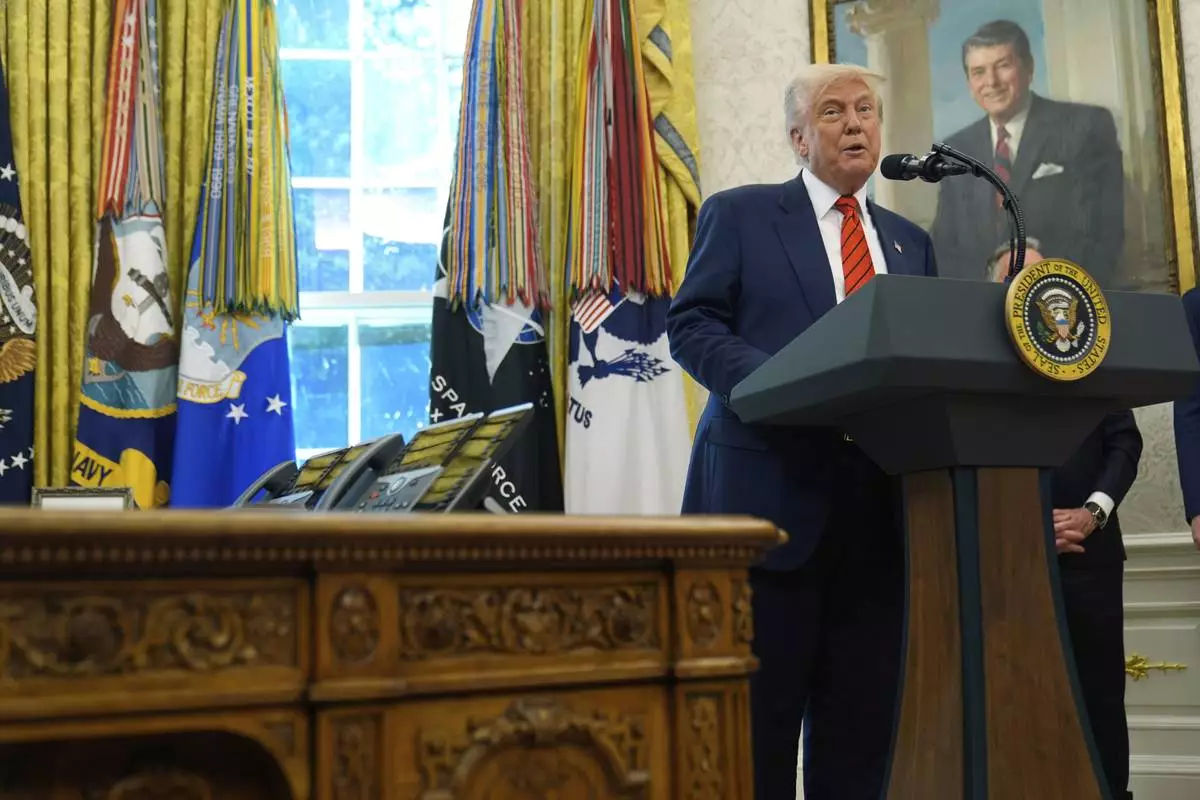
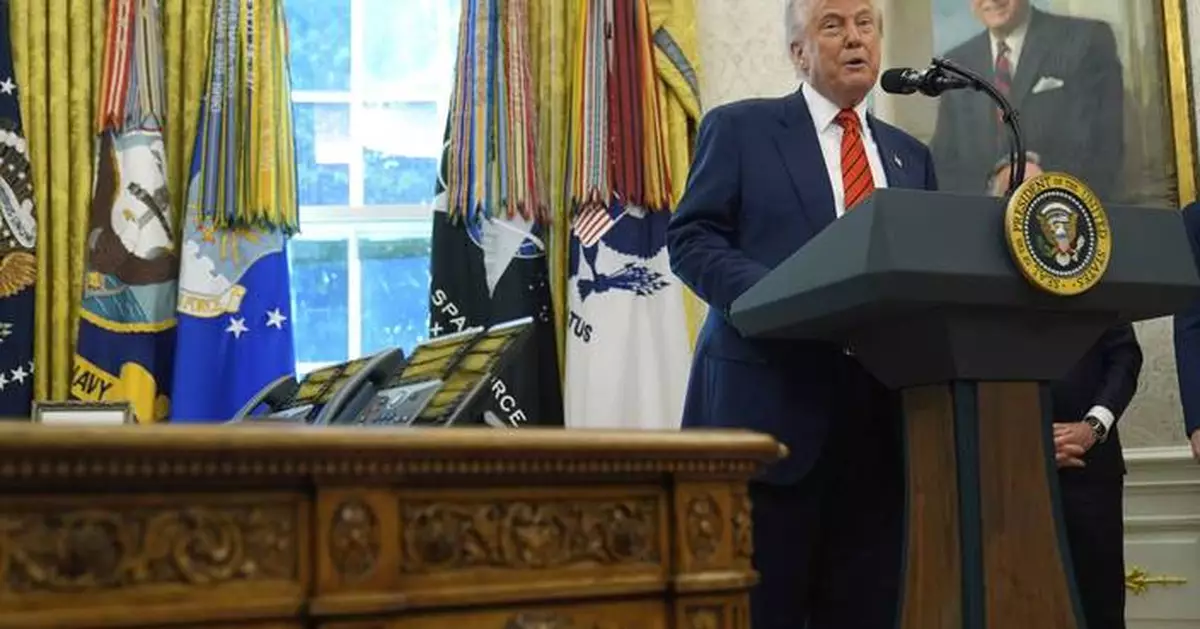
President Donald Trump speaks before Steve Witkoff is sworn as special envoy during a ceremony in the Oval Office of the White House, Tuesday, May 6, 2025, in Washington. (AP Photo/Mark Schiefelbein)
ROME (AP) — The Italian government closed ranks on Friday to slam U.S. President Donald Trump over his claim that Premier Giorgia Meloni had “begged” for a photo with him during the recent G7 summit, a pushback that suggested the longtime U.S. ally had had enough of Trump’s boasting.
Italian Foreign Minister Antonio Tajani abruptly cancelled a planned trip to the United States this weekend, calling Trump’s claims “serious and offensive” toward Meloni and all of Italy.
Meloni for her part posted a video calling Trump’s claims “completely fabricated" and expressing astonishment that he would invent such things about an ally. She concluded: “Italy and I do not beg.”
Trump had made the comments in an interview broadcast Friday morning on the La7 network. The La7 correspondent had asked Trump about Ukraine, but Trump raised Meloni and the conversation turned to their meeting during the just-concluded G7 meeting in Evian-les-Bains, France. Meloni and Trump were filmed speaking at several moments, including alone on a small sofa.
According to La7, Trump said Meloni had “begged” him for a photo-op. Trump said he wasn’t obliged to do it but that he felt sorry for her and agreed, La7 said. The broadcaster has a dubbed version of the conversation online, not the original English audio.
In her video, Meloni said she was responding to Trump’s claims because “certain things deserve an immediate response."
“Donald Trump’s statements are completely fabricated. I am frankly stunned,” she said. “I don’t know why the president of the United States behaves this way toward his own allies. After all, this isn’t the first time this has happened.”
It was an apparent reference to an interview Trump gave to Italian daily Corriere della Sera in April in which he criticized Meloni's refusal to back the U.S.-Israel war in Iran. Meloni didn't respond publicly at the time.
By Friday, it appeared she had had enough of his boasts and broadsides.
“I can only say that it’s a shame he doesn’t show the same resolve toward the enemies of the West, toward the enemies of the United States — toward leaders with whom he, on the other hand, is much more accommodating," Meloni said Friday. "But there’s one thing he must remember: Italy and I do not beg.”
The White House did not return an immediate request for comment on Meloni’s remarks.
Meloni had initially sought to build on longstanding strong U.S.-Italian ties when Trump began his second mandate, and had positioned herself as a “bridge” between Washington and the European Union. She was the lone EU head of state to attend his inauguration.
But relations have frayed over the U.S. war in Iran, which Meloni has said was illegal, and Trump’s position on Ukraine, which Italy strongly supports. Trump's tariffs and strong U.S. support of Israel over its war in Gaza have been other points of contention.
By Friday afternoon, solidarity with Meloni had poured in from across the government and political spectrum, and included a call from President Sergio Mattarella, Italy’s widely respected head of state.
“Whoever attacks @GiorgiaMeloni attacks all of us,” posted Transport Minister Matteo Salvini.
Justice Minister Carlo Nordio referenced the sacrifice of American troops in World War II in underlining the harm to U.S.-Italy relations caused by Trump.
“The thousands of crosses marking the graves of American soldiers who died to free us from Nazi-Fascist dictatorship did not deserve such a painful blow to our fraternal ties,” Nordio said on X.
Defense Minister Guido Crosetto said he didn't believe Meloni would ever beg someone for a photo, “not even under threat.”
“I can, however, imagine how much it cost her to set aside what Trump had said weeks ago, to serve the interests of Italy, of Europe, and of the West,” Crosetto posted on X. “Jokes of this kind do no good to anyone: neither to the USA, nor to Italy, nor to the alliance.”
Tajani had been due to travel to the U.S. on Sunday to take part in an Italy-U.S. business forum in Miami during which he was to have meet with U.S. Secretary of State Marco Rubio, according to a U.S. State Department announcement of the meeting.
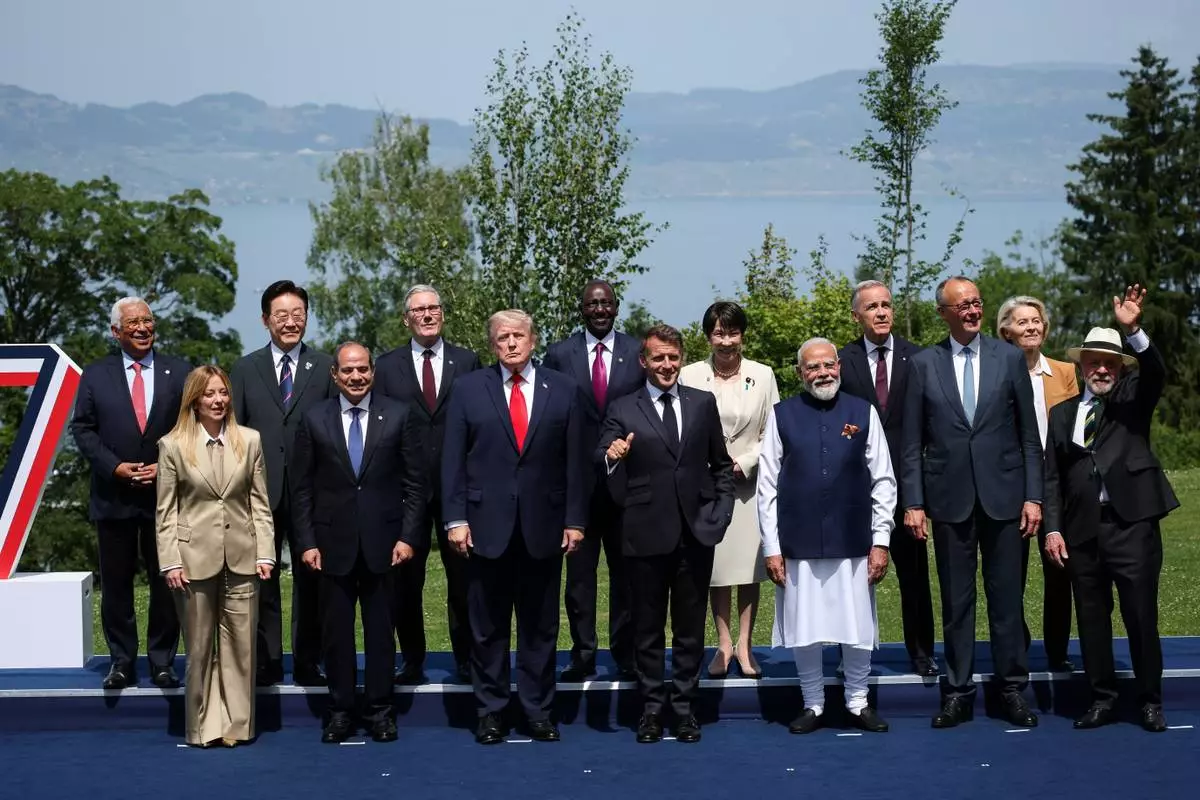
From left, European Council President Antonio Costa, Italian Prime Minister Giorgia Meloni, South Korea's President Lee Jae Myung, Egyptian President Abdel Fattah al-Sisi, British Prime Minister Keir Starmer, U.S. President Donald Trump, Kenya's President William Ruto, French President Emmanuel Macron, Japanese Prime Minister Sanae Takaichi, India's Prime Minister Narendra Modi, Canadian Prime Minister Mark Carney, German Chancellor Friedrich Merz, European Commission President Ursula von der Leyen, Brazilian President Luiz Inacio Lula da Silva gather for a group photo at the G7 summit in Evian-les-Bains, France, Tuesday June 16, 2026. (Isabel Infantes/Pool Photo via AP)
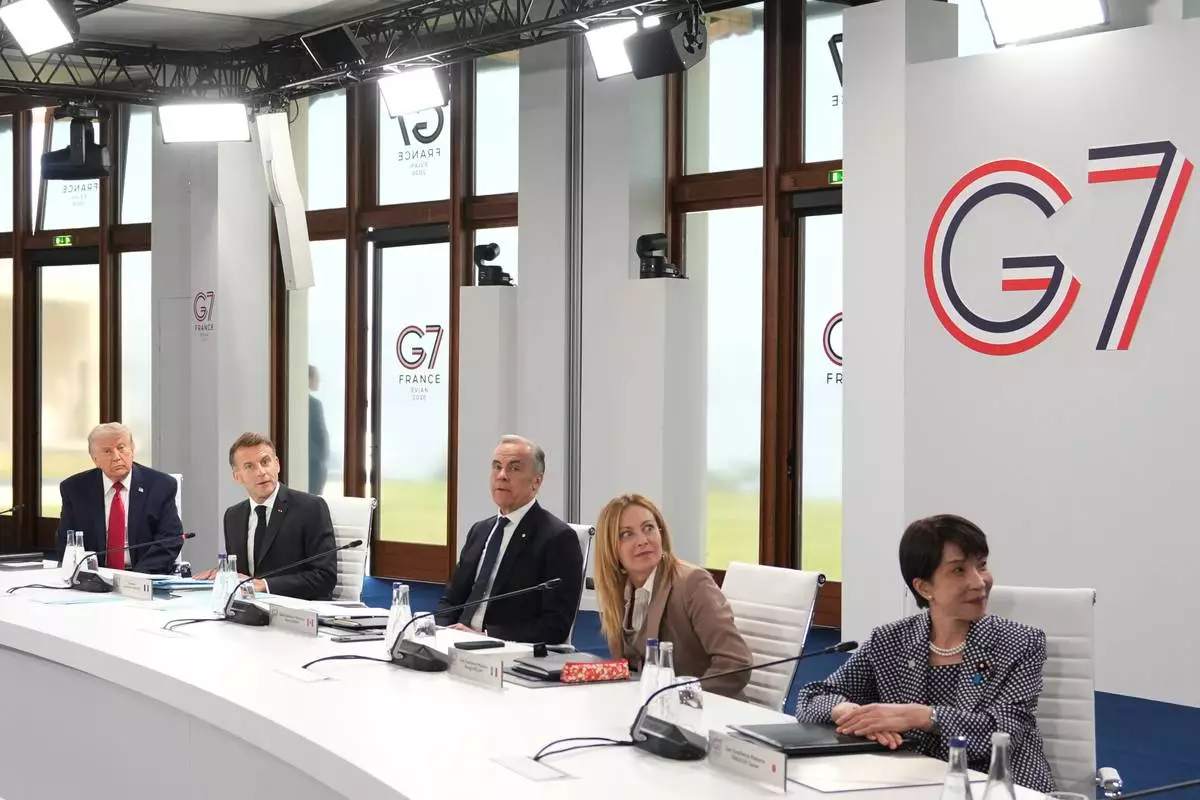
From right, U.S. President Donald Trump, French President Emmanuel Macron, Canadian Prime Minister Mark Carney, Italian Prime Minister Giorgia Meloni and Japan's Prime Minister Sanae Takaichi during a working session at the G7 summit in Evian-les-Bains, France, Wednesday, June 17, 2026. (AP Photo/Thibault Camus)
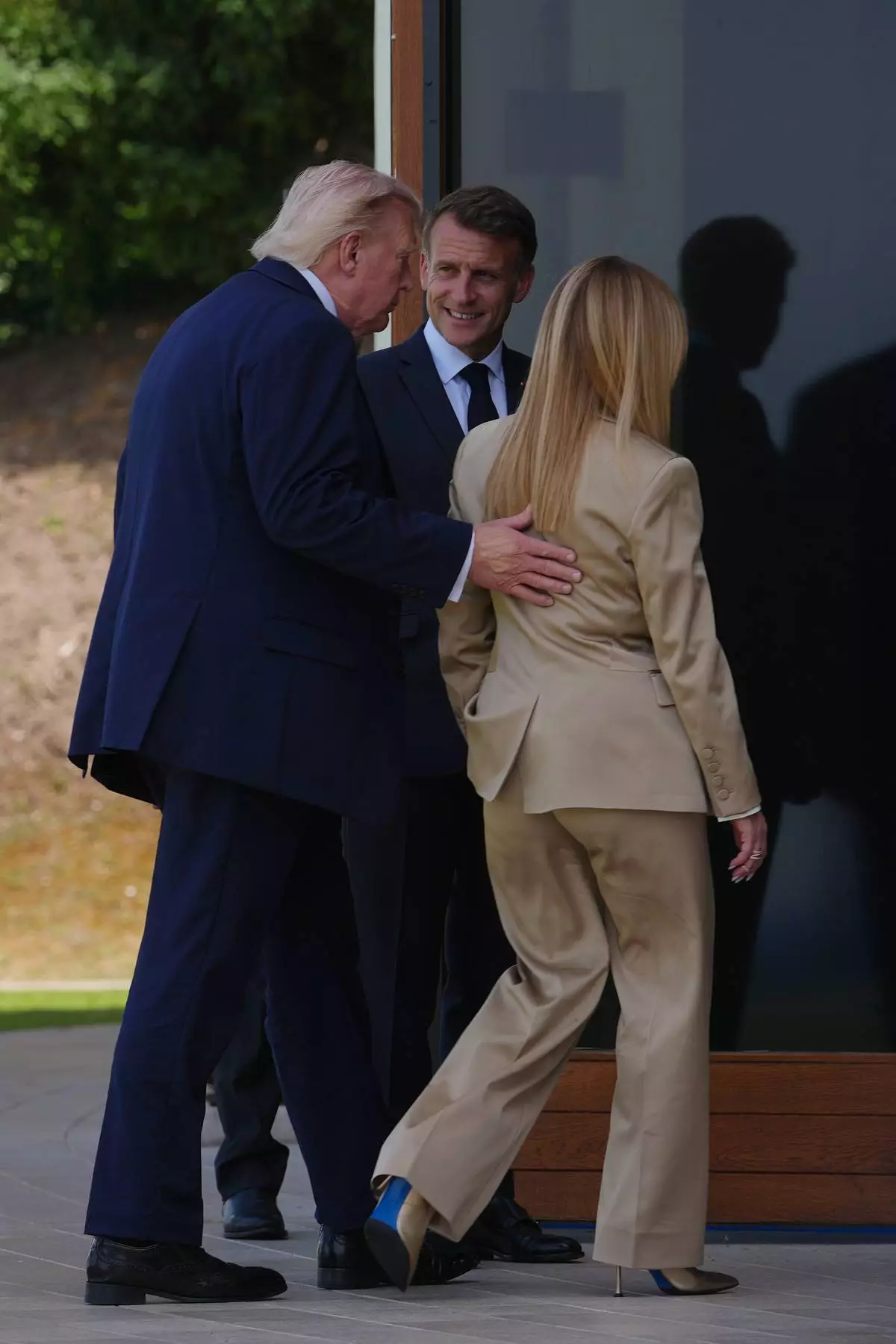
U.S. President Donald Trump, left, speaks with French President Emmanuel Macron, center, and Italian Prime Minister Giorgia Meloni after a group photo of G7 leaders and invited nations during the G7 summit in Evian-les-Bains, France, Tuesday, June 16, 2026. (AP Photo/Thibault Camus)
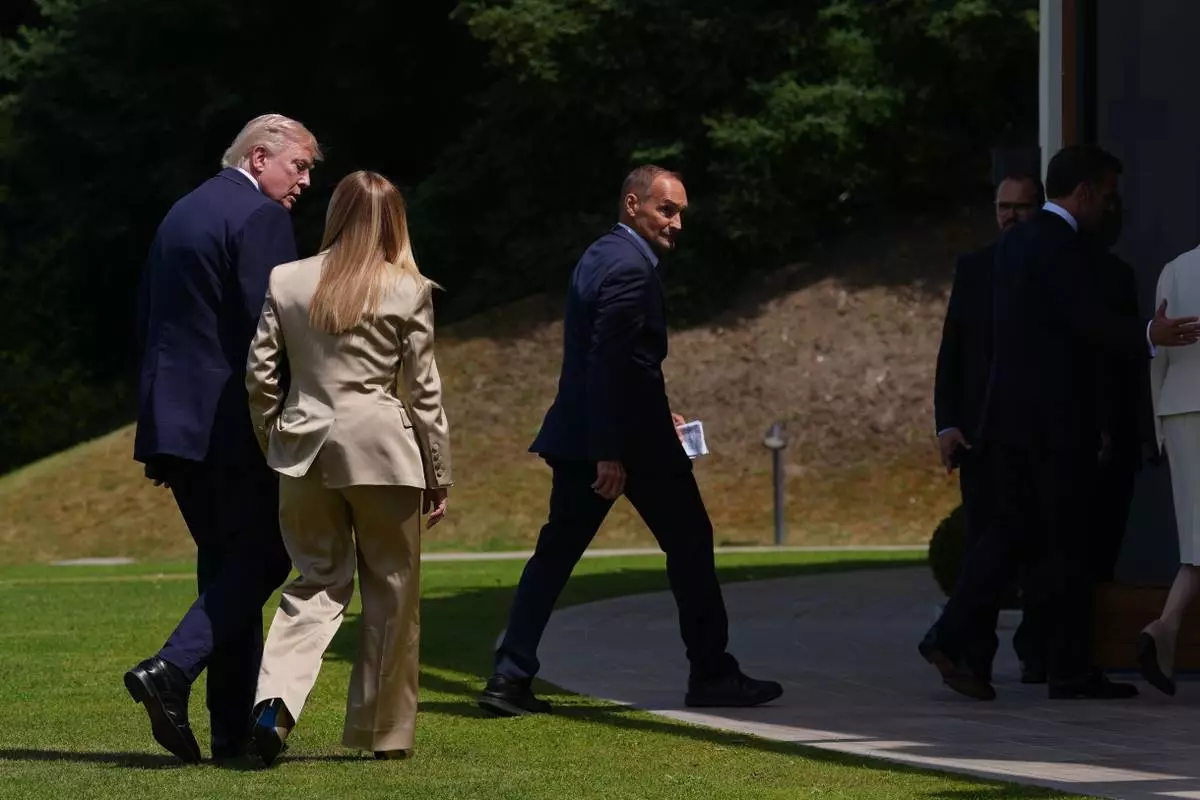
U.S. President Donald Trump, left, speaks with Italian Prime Minister Giorgia Meloni, second left, after a group photo of G7 leaders and invited nations during the G7 summit in Evian-les-Bains, France, Tuesday, June 16, 2026. (AP Photo/Thibault Camus)
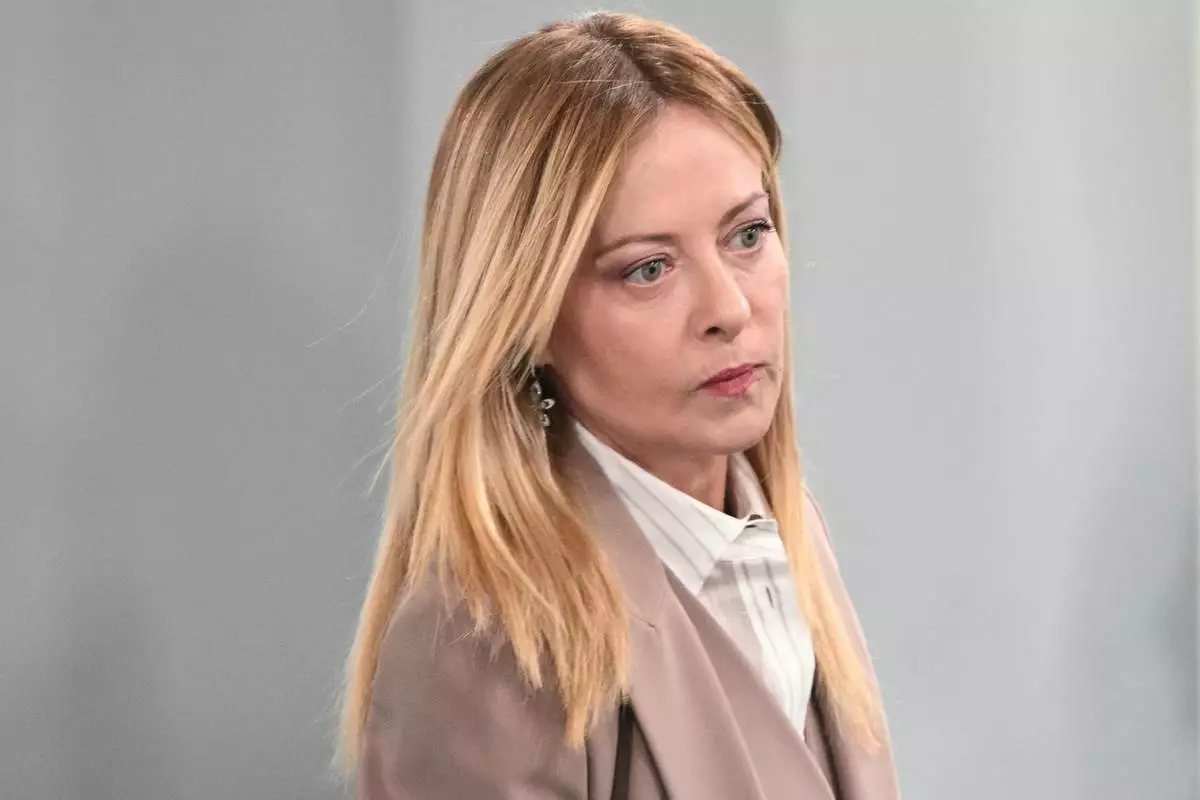
Italy's Prime Minister Giorgia Meloni looks on ahead of a working session at the G7 summit, in Evian-les-Bains, France, Wednesday, June 17, 2026. (Mandel Ngan/Pool Photo via AP)