SALT LAKE CITY (AP) — Attorneys for a Utah man who has been on death row for 37 years sought to convince a state judge Wednesday that the convicted murderer should be spared execution because he has dementia.
Ralph Leroy Menzies was sentenced to die in 1988 for the killing of Maurine Hunsaker, a mother of three. His attorneys said the 67-year-old inmate's dementia is so severe that he cannot understand why he is facing execution.
If he is deemed competent, Menzies could be the next U.S. prisoner executed by firing squad after the method was used on two South Carolina men in recent weeks: a man convicted of killing his ex-girlfriend’s parents in 2001 and a man who killed an off duty police officer in 2004.
Medical experts brought in by prosecutors have said Menzies still has the mental capacity to understand his situation, while those brought in by the defense said he does not. Prosecutor Daniel Boyer urged the judge Wednesday to move forward with the execution.
The hearing was the last in Menzies’ competency case. Judge Matthew Bates said he would have a decision within the next 60 days.
Lindsey Layer, a lawyer for Menzies, described how the inmate often forgets to renew his medications and can no longer do laundry because she said he has forgotten how washing machines work. She compared his aptitude at using a tablet to that of her 3-year-old child.
“I imagine your 3-year-old also understands that if he sneaks a cookie out of the cookie jar, he's going to go on time out,” Bates responded. “So it seems like what you're arguing is that Mr. Menzies' understanding of his impending execution needs to be more than that of a 3-year-old.”
Layer agreed.
Menzies is not the first person to receive a dementia diagnosis while awaiting execution.
The U.S. Supreme Court in 2019 blocked the execution of a man with dementia in Alabama, ruling Vernon Madison was protected against execution under a constitutional prohibition against cruel and unusual punishment. Madison, who killed a police officer in 1985, died in prison in 2020.
That case followed earlier Supreme Court rulings barring executions of people with severe mental illness. If a defendant cannot understand why they are dying, the Supreme Court said, then an execution is not carrying out the retribution that society is seeking.
“It's not just about mental illness. It can be also the consequence of brain damage or stroke or dementia — the fundamental question being whether he has a rational understanding of the reasons he is being executed,” said Robin Maher, executive director of the Death Penalty Information Center.
More than half of all prisoners sentenced to death in the U.S. spend more than 18 years on death row, according to the organization.
Menzies earlier chose a firing squad as his method of execution. Utah death row inmates sentenced before May 2004 were given a choice between that and lethal injection. For inmates sentenced in the state after that date, lethal injection is the default method of execution unless the drugs are unavailable.
Since 1977 only five prisoners in the U.S. have been executed by firing squad. Three were in Utah, most recently in 2010, and the others in South Carolina. Only three other states — Idaho, Mississippi and Oklahoma — allow the execution method.
Hunsaker, a 26-year-old married mother of three, was abducted by Menzies from the gas station where she worked. She was later found strangled and her throat cut at a picnic area in the Wasatch Mountains of northern Utah. Menzies had Hunsaker’s wallet and several other belongings when he was jailed on unrelated matters. He was convicted of first-degree murder and other crimes.
Over nearly four decades, attorneys for Menzies filed multiple appeals that delayed his death sentence, which had been scheduled at least twice before it was pushed back.
Matt Hunsaker, who was 10 years old when his mother was killed, testified Wednesday that the ongoing case has caused his family emotional turmoil. He expressed gratitude that it might finally be over soon.
“This has gone on for decades,” he said. “Thirty-nine years, two months and nine days ago, my mom was murdered. We miss her. We love her.”
Brown reported from Billings, Montana.

Ralph Leroy Menzies appears in Third District Court for a competency hearing in West Jordan, Utah, Monday, Nov 18, 2024. (Rick Egan/The Salt Lake Tribune via AP, Pool)
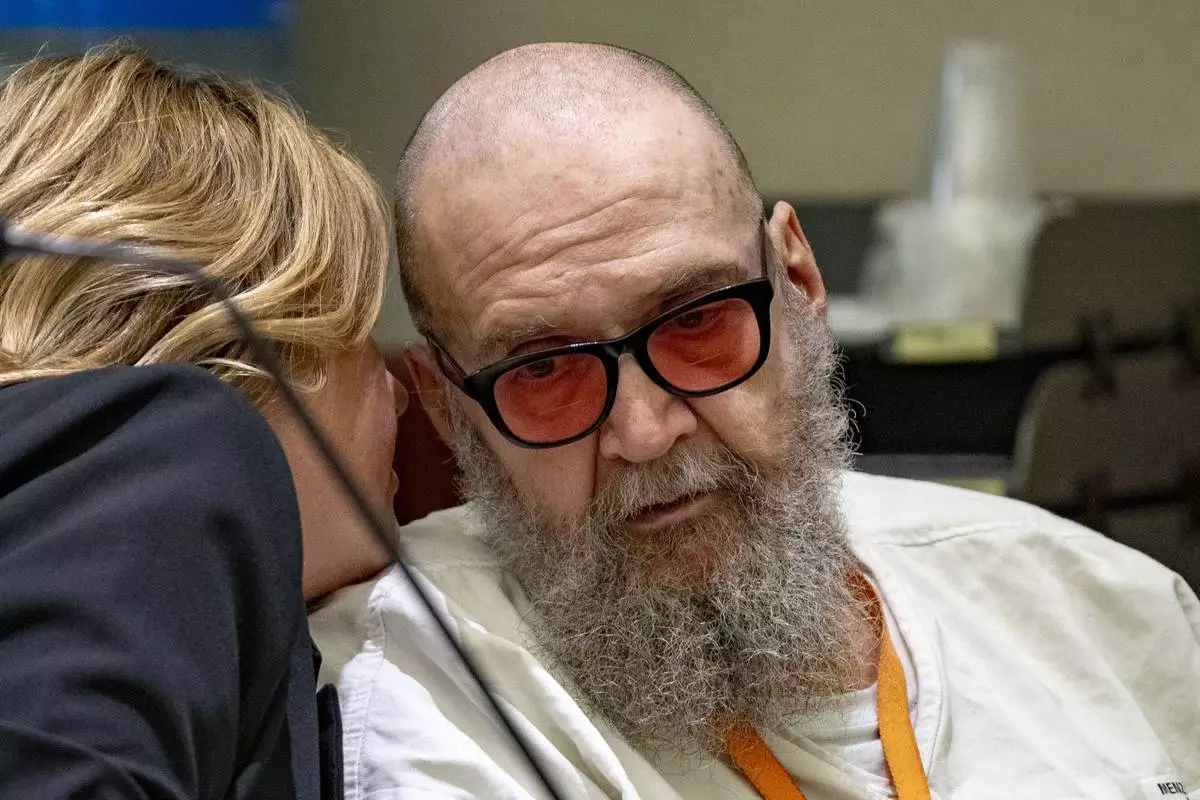
Jasmine North, Federal Public Defender Mitigation Investigator, speaks with Ralph Leroy Menzies, during his competency hearing in Third District Court in West Jordan, on Monday, Nov 18, 2024. (Rick Egan//The Salt Lake Tribune via AP, Pool)